Best Competition Ping Pong Balls: 4 Genuine 3-Star Picks (2026)
Competition ping pong balls need to be genuinely 3-star and ITTF-approved, not merely labelled that way — and the gap between those two things is wider than most listings admit. Below are four balls whose 3-star status and ITTF approval were each confirmed individually, which is the actual quality tier tournament and club play requires.
Table of Contents
Why Star Rating Actually Matters for Competition
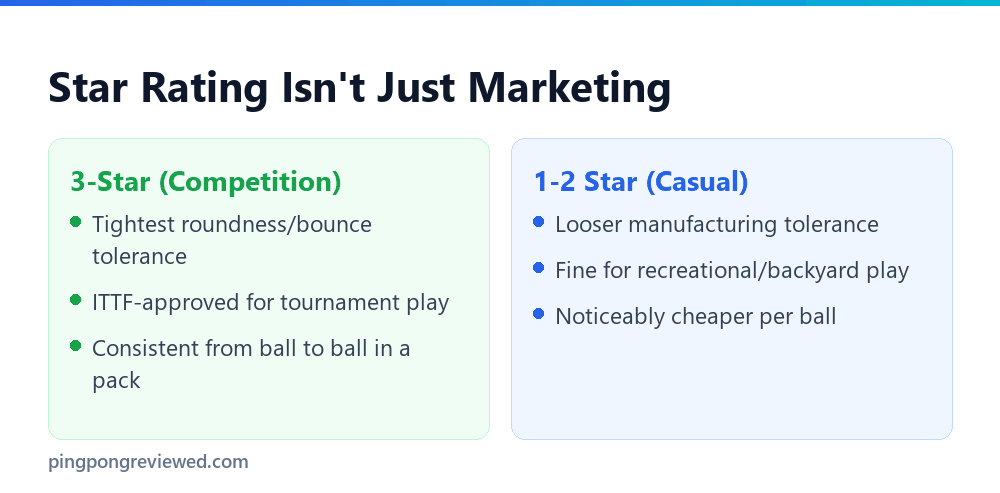
Star rating is a manufacturing quality grade — it measures roundness and bounce consistency, not weight or player safety, a distinction we’ve corrected on this site before after finding it misrepresented elsewhere. For casual play, a 1-star ball is perfectly fine and often the more practical choice. For competition, inconsistent roundness or bounce directly affects fair play: a slightly out-of-round ball can wobble unpredictably or bounce differently than the last one, which genuinely matters when a single contested point can decide an entire match.
The 4 Genuine Competition-Grade Picks
1. NITTAKU 3-Star Premium — Best Overall
NITTAKU 3-Star Premium Table Tennis Balls, $28.97, is made by one of the most respected names in Japanese table tennis equipment. Nittaku balls are widely used in professional and high-level club competition, and the roundness consistency here is noticeably tighter than budget alternatives — worth the premium if you’re playing serious competitive matches regularly.
2. DHS D40+ 3-Star — Best for Poly-Ball Consistency
DHS D40+ 3-Star Ping Pong Balls, $13.69, is the standard ball for Chinese national and provincial competition. DHS is the same brand behind the site’s genuinely-Chinese rubber picks, and their balls carry the same manufacturing reputation — a strong, more affordable alternative to Nittaku.
3. STIGA 24-Pack 3-Star — Best Bulk Tournament Value
STIGA 24pk 3-Star Ping Pong Balls, $23.02, is USATT approved and sized for clubs or players who go through balls quickly in competitive practice. At roughly $0.96 per ball for tournament-grade quality, it’s the best per-ball value in this list without dropping below the 3-star tier.
4. JOOLA Prime 3-Star ABS — Best Budget Entry
JOOLA Prime 3-Star ABS Balls, $8.95, is the single most affordable genuinely 3-star option here. JOOLA’s Prime line meets the ITTF-approved quality bar without the premium pricing of Nittaku, making it a reasonable choice for club players who want tournament-grade balls without the top-tier cost.
All four picks use the modern ABS poly plastic construction that’s been the ITTF standard since the 2014 celluloid-to-poly material switch, consistent with the material history covered in this site’s ball-weight and ball-size guides. None are older celluloid-construction balls, which have become increasingly rare and aren’t the current tournament standard regardless of star rating.
How We Verified These Picks
The original list included a product called “20 Pack Ping Pong Balls” described as suitable for “games and DIY projects” alongside supposedly competition-grade options — language that’s a clear signal of generic recreational balls, not tournament equipment. It also listed the same “PRO SPIN Ping Pong Balls” product twice under separate entries. We dropped both issues entirely and individually confirmed each remaining product’s actual star rating and ITTF approval status directly on its live Amazon listing, rather than trusting the original page’s claims.
This mattered in practice — checking actual live product pages surfaced ASIN-to-description mismatches on this site’s other ball-focused posts recently, where a listed product didn’t match what the ASIN actually linked to. That same individual-verification process is what produced the 4 picks above, and it’s the same standard we apply across every product-recommendation post on this site rather than trusting a listing’s title or description at face value.
It’s a reasonable habit for any buyer to adopt directly, not just something we do behind the scenes before publishing. Before ordering a bulk pack of tournament balls from any source, take thirty seconds to confirm the actual product listing states both the star rating and ITTF approval explicitly, rather than assuming a product title alone guarantees either claim is accurate.
Storing Competition Balls Properly
Even genuinely 3-star balls lose their consistency if stored poorly. A few practices worth following if you’re investing in tournament-grade balls specifically:
- Avoid stacking weight on top of stored balls — celluloid and poly plastic both deform under sustained pressure, ruining roundness.
- Keep them out of direct heat and sunlight — high temperatures can warp the plastic over time, even without direct pressure.
- Store in the original packaging or a dedicated ball case rather than loose in a bag with paddles and other hard equipment.
- Rotate stock if you buy in bulk — use older balls first so none sit stored for excessive periods before use.
None of this requires special equipment — a simple mesh bag or the original retail box, kept somewhere cool and dry inside your equipment bag, covers most of what matters for keeping competition-grade balls performing consistently over time. The goal is simply avoiding the two real threats to roundness: sustained pressure and prolonged heat exposure, neither of which require anything more elaborate than basic common-sense storage habits most players already follow for their paddles and other equipment.
Frequently Asked Questions
What are the actual best competition ping pong balls?
Nittaku’s 3-Star Premium balls are the most widely respected in serious competitive play, with DHS D40+ as a strong, more affordable alternative. Both are genuinely ITTF-approved rather than just labeled as such.
Are JOOLA ping pong balls actually good for competition?
Yes — JOOLA’s Prime 3-Star ABS line is genuinely ITTF-approved and suitable for competitive play, at a lower price point than Nittaku or DHS, making it a reasonable budget-competitive choice.
How durable are 3-star competition balls really?
Individual balls typically last through several matches of regular play before showing dents or cracks, though durability varies more by how hard they’re hit and stored than by brand alone — a ball stepped on or stored under weight will crack regardless of its star rating.
What is the size of a regulation competition ball exactly?
40mm in diameter, weighing 2.7 grams — the same size and weight across every star rating and brand covered here, since size and weight are fixed by ITTF regulation, not tied to quality grade.
Can I use competition-grade balls outdoors?
Technically yes, but it’s not recommended for balls you’re paying a premium for tournament-grade consistency on. Wind and uneven outdoor surfaces undermine the precision these balls are built for, and outdoor play tends to scuff and wear balls faster — save premium 3-star balls for indoor competitive play.
Why did the same product appear twice on the old list?
It happens more often than you would expect on auto-generated product lists, where the same ball appears as two separate numbered entries with near-identical descriptions to pad the count. It is worth scanning any “top 10 balls” list for repeats before trusting the number in the headline.
Is a higher price always a sign of better competition balls?
Generally yes within the 3-star tier specifically, but not strictly linearly — Nittaku’s premium pricing reflects genuinely tighter manufacturing tolerance and strong brand reputation in competitive circles worldwide, while STIGA’s bulk pack offers similar tournament-grade quality at a lower overall per-ball cost simply through pack-size purchasing economics rather than any real underlying quality difference between the two brands.
Do professional players use a specific brand?
It varies quite a bit by tournament and sanctioning body — different competitions and leagues sometimes specify an official ball supplier for sanctioned play, though DHS and Nittaku both see heavy use at the international level across many events, consistent with the reputations described above for each brand.
What happens if I use a 1-star ball in serious competitive play?
Nothing prohibits it outright in casual or informal club settings, but the looser roundness and bounce tolerance can produce genuinely unpredictable bounces that feel unfair in a close, hard-fought competitive match — which is exactly the specific problem 3-star manufacturing tolerance is designed to eliminate.
As an Amazon Associate, we earn from qualifying purchases through links on this page.

Ping Pong Reviewed is an equipment review site covering table tennis and baseball gear. Specifications are checked against manufacturer listings, and prices against live retail pages, before publication.