How to Fix a Dented Ping Pong Ball (When It Actually Works)
How to fix a dented ping pong ball: submerge it in hot (not boiling) water for 1-2 minutes. The trapped air inside expands with heat and can push a shallow dent back out. This works more reliably on older celluloid balls than on modern poly balls, which have been standard since 2014 and don’t always respond the same way. Cracked or badly deformed balls usually aren’t worth fixing — they cost under a dollar to replace.

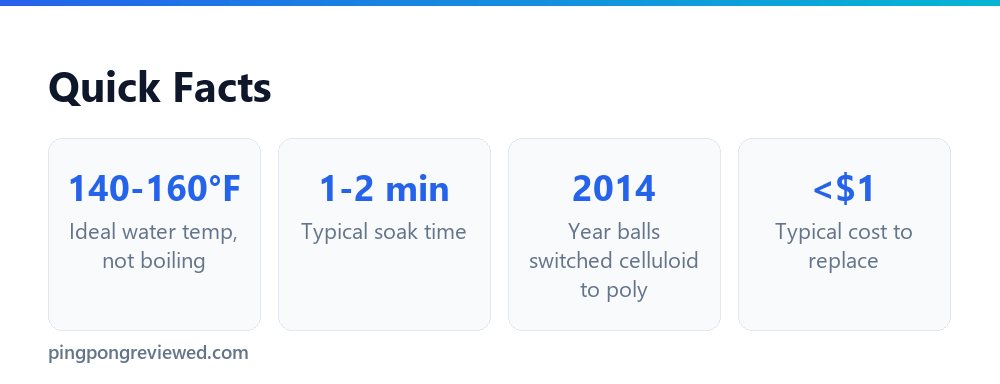
- →Hot water, not boiling water, is the real fix — trapped air expansion pushes a shallow dent back into shape without risking warping the plastic.
- →Modern poly balls (standard since the ITTF’s 2014 material change) don’t respond as reliably to this trick as older celluloid balls did.
- →A cracked seam or a ball that’s still visibly warped after one attempt isn’t worth fixing further — replace it, since a fresh ball costs less than a dollar.
- →This only works on genuine dents from impact, not on a ball that’s out of round from manufacturing or general wear.
A dented ping pong ball throws off bounce and spin in ways that are obvious mid-rally. The good news: a shallow dent is often fixable in under two minutes with nothing but hot water. The bad news: it doesn’t always work, especially on modern balls, and knowing when to stop trying and just grab a new ball saves more time than repeated attempts on a lost cause. Here’s the accurate version of this fix, without the outdated advice that assumes every ball is still made of celluloid.
Table of Contents
How to Fix a Dented Ping Pong Ball: Why Hot Water Works
A ping pong ball is a sealed, hollow sphere with air trapped inside. Heat that air, and it expands, pushing outward on the ball’s shell from the inside. On a shallow dent, that internal pressure is often enough to pop the plastic back into its round shape. This isn’t a myth — it’s basic physics, and it’s been a known trick for decades. What’s changed is the ball material itself, and that change is exactly what most old advice on this topic completely ignores.
Celluloid vs. Poly Balls: Why It Matters
Until 2014, regulation ping pong balls were made of celluloid, a material that responds well to heat and pops back into shape fairly reliably. The ITTF switched to poly (plastic) balls after that, mainly over celluloid’s flammability risk during manufacturing and shipping. Poly balls are what you’ll almost certainly own today if you bought balls recently, and they don’t respond to the hot water trick as consistently. It can still work, especially on a fresh, shallow dent, but don’t expect the same success rate older players remember from celluloid balls decades ago, back when this trick was closer to a guarantee than a maybe.
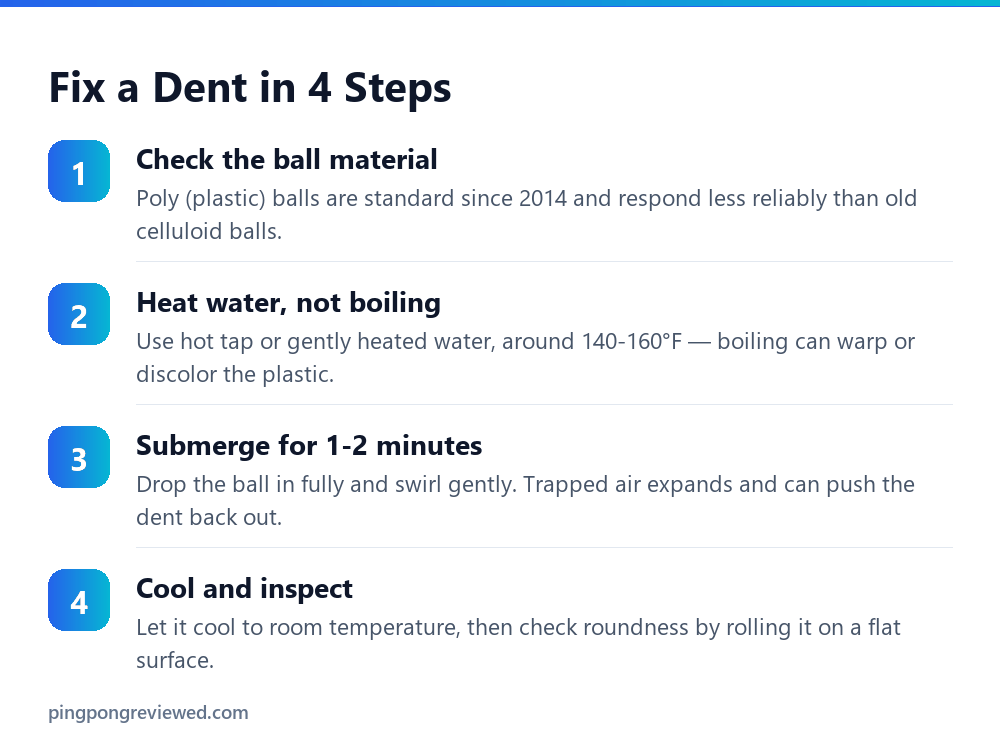
⚠️ Watch out: Never use boiling water. It can warp the plastic permanently or cause visible discoloration, making a dented ball worse instead of better. Hot tap water or water heated to around 140-160°F is enough — you don’t need it at a rolling boil.
Step-by-Step: The Hot Water Method
Heat water to hot but not boiling. Submerge the ball fully, swirling it gently for about a minute so heat reaches all sides evenly. Check it after a minute or two — if the dent has popped out, remove it and let it cool to room temperature before playing. If nothing’s changed after two minutes, one more short attempt is reasonable, but repeated cycles rarely help beyond that point and mostly just waste time you could spend actually playing instead of babysitting a stubborn ball.
💡 Pro tip: Roll the ball on a flat table after it cools. A truly round ball rolls in a straight line without wobbling — that’s a better test of success than eyeballing the dent alone.
When It’s Not Worth Fixing
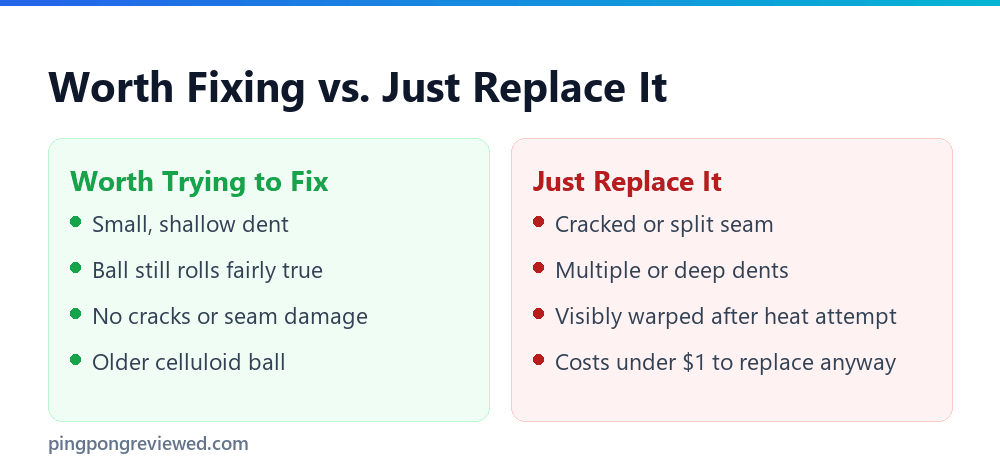
Skip the repair attempt entirely if the ball has a cracked or split seam, multiple dents, or already looks warped rather than simply dented. None of those come back with hot water, and pushing harder — more heat, more time, more attempts — just risks damaging the ball further without success. Ping pong balls are genuinely cheap to replace, often costing well under a dollar each in bulk packs, so there’s little reason to spend real effort saving one that’s clearly beyond a simple dent worth fixing.
What About Practice Balls vs. Competition Balls
Cheaper practice balls, often unrated or 1-star, tend to use slightly thinner plastic than 3-star competition balls, which makes them both easier to dent and, in some cases, slightly more responsive to the hot water fix since the thinner material moves more readily under heat and pressure. That’s a small silver lining for practice balls specifically, but it doesn’t change the core advice: a shallow dent is worth a try, anything more serious isn’t worth the effort on either ball tier.
Does Ball Brand Affect Repairability
Not dramatically. The celluloid-versus-poly distinction matters far more than brand for predicting whether the hot water trick will work. Within the poly category, most major brands use broadly similar plastic formulations, so you shouldn’t expect one 3-star brand to reliably out-perform another at bouncing back from a dent. If a specific ball consistently won’t un-dent no matter what you try, that’s more likely about the dent’s severity than the brand stamped on it.
Preventing Dents in the First Place
Most dents happen from a ball rolling off the table and getting stepped on, or from storage in a bag where something crushes it. Keep spare balls in a rigid case rather than loose in a bag with other gear, and sweep dropped balls off the floor promptly during a session rather than letting them sit where they might get stepped on between points. A simple habit of pausing play briefly to retrieve a rolled-away ball prevents far more damage over a season than any repair trick fixes after the fact.
Buying Extras Instead of Repeated Repairs
Given how cheap balls are in bulk, many regular players simply keep a stock of 10-20 on hand rather than nursing individual balls back into shape repeatedly. That approach makes more sense the more often you play, since the time spent heating water and testing roundness adds up across a season in a way that buying a fresh bulk pack usually beats on pure time value, even before factoring in the low material cost itself.
What Happens Inside the Ball During the Fix
It’s worth understanding the mechanism a little more precisely, since it explains why this trick has real limits. The air sealed inside the ball follows the same physics as any gas: heat it, and its pressure rises inside a fixed volume. That rising pressure pushes outward evenly across the entire inner surface of the shell, not just at the dent. A shallow dent yields to that pressure because the surrounding plastic is still flexible enough to move back into its original curve. A deep dent or a weakened, cracked area has already lost some of that flexibility, which is exactly why the same physics that fixes a minor dent does nothing for serious damage.
Alternative Heat Sources Worth Knowing About
Hot water is the most reliable and safest method, but it’s not the only one people try. Some players use a hair dryer aimed directly at the dent, which can work on very minor imperfections but heats unevenly compared to full submersion and takes longer to show results. Direct contact with a stove, lighter, or any open flame should be avoided entirely — beyond the obvious burn risk, uneven direct heat is far more likely to melt or discolor the plastic than gently warm it through. Water stays the safer, more predictable choice for a reason.
A Quick Way to Test If It’s Worth Attempting
Before heating anything, press gently on the dent with a thumb. If it flexes slightly and shows any give, the plastic still has enough flexibility for the hot water method to have a real chance. If the area feels stiff, cracked, or doesn’t move at all under light pressure, that’s a sign the ball has taken more serious damage than a simple dent, and heat treatment is unlikely to help. This quick check takes seconds and saves you from a pointless soak on a ball that was never going to bounce back.
How do you get dents out of a ping pong ball?
Submerge it in hot (not boiling) water for 1-2 minutes. The trapped air expands and can push a shallow dent back into shape, though this works more reliably on older celluloid balls than modern poly balls.
Why doesn’t the hot water trick always work on newer balls?
Regulation balls switched from celluloid to poly plastic in 2014, mainly over flammability concerns with celluloid. Poly doesn’t respond to heat expansion as consistently as celluloid did.
Can you fix a cracked ping pong ball?
Not practically — a cracked seam doesn’t respond to the hot water method, and attempting to cut, fill, or reseal the ball changes its weight and bounce more than it’s worth for a repair. Replace it instead.
Is it safe to use boiling water on a ping pong ball?
No — boiling water can warp or discolor the plastic. Hot tap water or water heated to around 140-160°F is enough to expand the trapped air without that risk.
Can a hair dryer fix a dented ping pong ball?
It can work on very minor dents, but heats less evenly than full water submersion and usually takes longer to show any real result.

Ping Pong Reviewed is an equipment review site covering table tennis and baseball gear. Specifications are checked against manufacturer listings, and prices against live retail pages, before publication.