Best Ping Pong Ball for Beginners (Actual Balls, Not Paddle Sets)
Picking a first set of ping pong balls is simpler than most guides make it look, and the thing that actually helps a beginner is not star rating or brand — it is size. Below are balls chosen specifically for how much easier they make the early weeks, including the oversized options that most beginner guides skip entirely. If you are shopping for a starter paddle instead, our beginner paddle guide covers that separate decision.
Table of Contents
What Actually Makes a Ball Beginner-Friendly
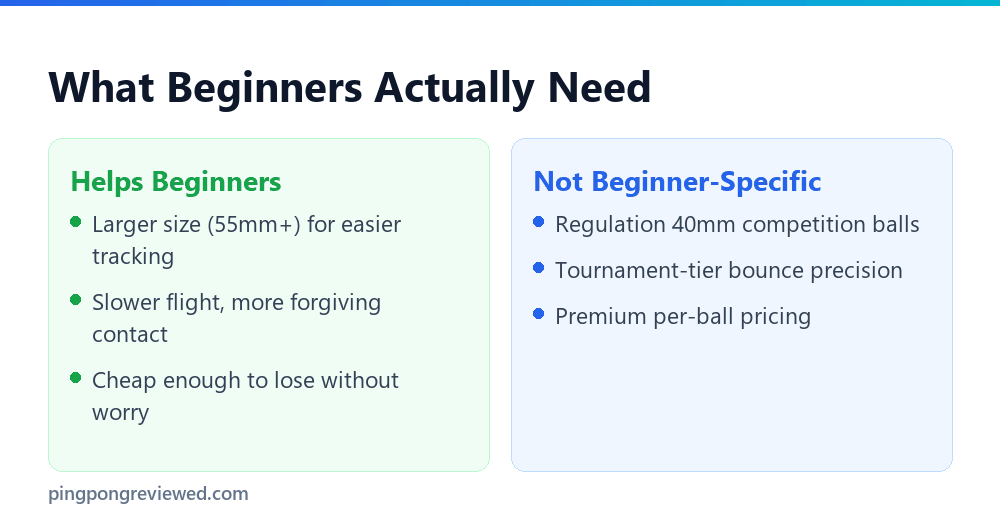
A genuine beginner ball isn’t about star rating — it’s about size and forgiveness. A larger-than-regulation ball is easier to track visually and gives more margin for an imprecise contact point, which matters more for someone still building basic hand-eye coordination than tournament-grade bounce consistency does. Once you’re ready to transition to regulation play, a cheap, honestly-labeled bulk regulation ball is the next reasonable step, not a jump straight to premium 3-star balls.
The 3 Actual Ball Picks
1. GoSports 55mm XL — Best Jumbo Training Ball
GoSports 55mm XL Table Tennis Balls, 12 Pack, $14.36, is genuinely oversized — 55mm versus the regulation 40mm — which makes it noticeably easier to see and track for a complete beginner. Good for toss games and basic hand-eye coordination drills before moving to regulation-size play.
2. S&S Worldwide Jumbo 2.2″ — Best for Young Beginners
S&S Worldwide Jumbo 2.2 Inch Table Tennis Balls, 12 Pack, priced around $23.49, is roughly 40% larger than a standard ball and explicitly marketed for toss-and-bounce games and new players. A reasonable pick specifically for younger kids or anyone finding a standard-size ball genuinely difficult to track early on.
3. Guirnd 20-Pack 3-Star — Best Regulation-Size Step-Up
Guirnd 20 Pack Ping Pong Balls, 3-Star, roughly $7, is regulation 40mm size but priced low enough that losing or damaging a few while learning doesn’t sting. This is the natural next step once basic contact and tracking feel comfortable with a jumbo ball, before committing to premium competition-grade pricing.
How a ‘Ball’ Guide Ended Up Reviewing Paddles
One thing to watch for while shopping: a great many “best ping pong balls for beginners” lists are populated largely with paddle sets rather than balls. The sets do include balls, so the listing is not exactly false, but if you already own paddles you end up paying for equipment you do not need in order to get a handful of balls. Check that what you are looking at is actually sold as balls before adding it to the basket.
Everything recommended below is a ping pong ball product, sold as balls, chosen on the criteria that genuinely matter at the beginner stage rather than on star rating alone.
Understanding Ball Sizing Beyond ‘Jumbo’
Regulation ping pong balls are 40mm — this has been the standard since a 2000 ITTF rule change increased size from the original 38mm, a change covered in more depth on our ball-size history page. Jumbo training balls like the two picks above run 55mm and 2.2 inches (about 56mm) respectively, both meaningfully larger than regulation, and neither is legal for actual competitive or even standard casual table tennis play on a regulation table and net height.
This matters practically: jumbo balls are a training tool, not a permanent alternative to regulation balls. They work well for the specific early goal of building basic contact confidence, but a beginner who stays on jumbo balls too long delays the transition to actual regulation play, where net height, table dimensions, and ball behavior are all calibrated around the standard 40mm size.
A Reasonable Progression
- Week 1-2 (complete beginner): jumbo 55mm+ balls for basic contact, tossing, and tracking practice.
- Week 3+ (comfortable with contact): regulation 40mm bulk balls, cheap enough to not worry about losing or cracking a few.
- Once playing regularly: see our practice ball guide for bulk training options, or our competition ball guide once you’re ready for match-realistic bounce consistency.
There’s no fixed timeline here — some beginners move through this progression in days, others take weeks. The point is the direction: start large and forgiving, move to regulation size once contact feels natural, and only reach for premium 3-star balls once you’re actually competing.
Frequently Asked Questions
What are the actual best ping pong balls for complete beginners?
Jumbo 55mm+ balls like the GoSports or S&S Worldwide options are genuinely easier for a complete beginner to track and contact than regulation 40mm balls, which is the actual beginner-specific advantage — not star rating or brand name recognition.
Which ping pong paddle set is actually ideal for beginners?
That is a genuinely separate question from ball selection. Our dedicated beginner paddle guide covers it properly, with picks chosen on blade and rubber rather than on what happens to be bundled with a set of balls.
Do beginners really need 3-star balls to start out?
No — regulation size matters more than star rating at the beginner stage, and even then, jumbo non-regulation balls are often the better realistic starting point before moving on to standard 40mm regulation balls at all.
What exactly makes the GoSports 55mm ball good for beginners specifically?
Its larger-than-regulation size makes it easier to see and track in flight, and its lighter relative weight gives more forgiveness on off-center contact than a regulation 40mm ball provides to a new player.
When should a beginner switch to regulation-size balls?
Once basic contact and tracking feel comfortable with a jumbo ball — there’s no fixed timeline, but most beginners are ready to make this switch within a few sessions of consistent practice.
Can kids and adults both use the same exact beginner balls?
Yes — jumbo training balls work well for both age groups since the core benefit, easier tracking and more forgiving contact, applies regardless of age. Some jumbo options are marketed toward kids specifically, but there’s no technical reason an adult beginner can’t use the same product.
Is it worth buying a full paddle-and-ball starter set instead?
It can be, if you need both pieces of equipment at once — just be aware that a bundled starter set usually includes standard regulation-size balls, not the jumbo training balls this guide focuses on for the very earliest stage of learning.
Do jumbo balls behave differently in terms of spin and bounce?
Yes, meaningfully — their larger size and different weight distribution mean spin and bounce don’t translate directly to regulation-ball behavior. This is fine for the early tracking-and-contact stage this guide targets, but it’s part of why jumbo balls are a stepping stone rather than a long-term substitute for regulation practice.
How many balls should a beginner buy to start?
A 12-pack is a reasonable starting quantity for jumbo training balls, enough to handle the balls that inevitably go astray during early practice without needing to reorder immediately. Once you move to regulation bulk balls, buying 20 or more at once keeps per-ball cost down for the higher loss rate typical of continued beginner practice.
What if a beginner ball feels too easy once I improve?
That’s actually the intended signal to move on — once a jumbo ball feels too large or slow to be a useful challenge, it’s a clear sign you’re ready to progress to regulation 40mm balls, which is exactly the transition point covered in the progression section above.
As an Amazon Associate, we earn from qualifying purchases through links on this page.

Ping Pong Reviewed is an equipment review site covering table tennis and baseball gear. Specifications are checked against manufacturer listings, and prices against live retail pages, before publication.