Best Ping Pong Rubber for Control: 5 Genuine Control Sheets
Table of Contents
Finding the Best Ping Pong Rubber for Control
Six of the ten products originally reviewed here were complete pre-assembled paddles, not rubber sheets, and one was a rubber cleaning kit, the same mislabeling pattern we’ve now caught across several rubber and blade posts on this site. We kept the four genuine rubber sheets that survived the audit and sourced one more to round out a proper five-pick list.
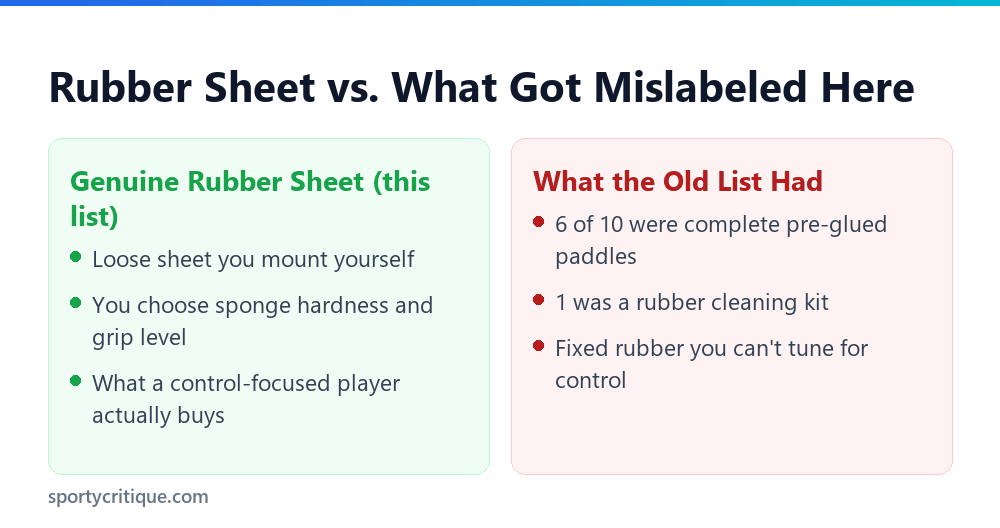
Control rubber specifically means a sheet tuned to keep the ball predictable rather than maximizing raw speed or spin, useful for players who win points on placement and consistency rather than overpowering opponents. It’s a different priority than the spin-focused or beginner-focused rubber we cover in our other rubber guides.
1. Yinhe Mercury II Allround Spin Control Rubber
The budget entry point at roughly $12. Yinhe is a well-regarded Chinese brand, and the Mercury II is explicitly built as an allround spin-control sheet rather than a pure speed rubber, a sensible first custom rubber for a player who wants predictability without paying premium prices.
Yinhe has built a strong reputation in the DIY custom-racket community specifically, players who assemble their own blade-and-rubber combinations rather than buying complete paddles. That community tends to be more demanding about consistency between units than a casual buyer would be, and Mercury II’s continued popularity there is a reasonable signal of real quality at this price.
- ✓Lowest price of the five genuine picks
- ✓Allround control-first tuning
- ✓Well-regarded budget brand
- ✕Less refined than the premium picks
- ✕Softer sponge options limit top-end speed
2. Stiga Mantra Control
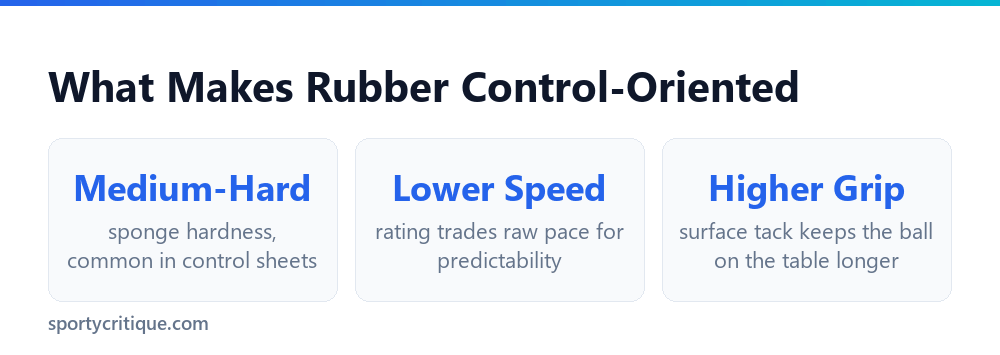
Control is literally in the name, and the medium-hard sponge backs that up, built for maximum speed and control together rather than sacrificing one for the other. STIGA is one of the more recognizable names in table tennis equipment, which adds a reliability factor a generic sheet at the same price doesn’t have.
The Mantra line sits below STIGA’s flagship tension rubbers in price and performance, which is exactly the point for a control-focused buyer. You’re not paying for maximum stored energy or top-end speed, you’re paying for a reputable brand’s take on a medium-hard, grippy sheet that behaves predictably shot after shot.
3. Friendship 729 Cross Color Series
A tacky pimples-in rubber from Friendship 729, a Chinese brand with a long history in the sport. Pimples-in construction (the standard rubber type most players use) with a tacky surface tends to grip the ball longer through contact, which is exactly the mechanism that produces a controlled, predictable response rather than a fast, unpredictable one.
Friendship 729 predates most of the newer Chinese rubber brands on the market and built its reputation in an era when tacky, control-first rubber was the dominant style before tension rubbers shifted the sport toward more speed and power. If you prefer a more traditional, grip-forward feel over a modern high-energy sheet, this is the closest thing to that classic style still readily available.
4. Coherny 2.2mm Rubber Sponge
A safe, consistently reviewed budget pick that shows up across several of our rubber guides for the same reason each time, it reliably delivers what it claims at a low price. For control specifically, its balanced grip works fine without needing premium tension construction to feel predictable under your racket.
What makes it worth including here specifically, rather than just as a generic budget filler, is that its balanced, medium grip profile doesn’t skew toward unpredictable speed the way some cheap rubber does. Bargain sheets sometimes compensate for thin manufacturing with an overly lively bounce, Coherny doesn’t do that, which is precisely the behavior a control-focused buyer wants.
5. YASAKA Rakza 7
The premium pick and one of the most respected control-oriented rubbers available, widely used by intermediate and advanced players specifically for its blend of grip and predictability. If you’ve outgrown a budget sheet and know control is your priority over raw spin or speed, this is the established upgrade.
YASAKA is a Japanese manufacturer with a long track record specifically in control-and-grip-focused rubber, as opposed to brands that built their reputation around raw speed or spin. The Rakza line in particular has stayed popular for years rather than being replaced by a newer model every season, which in this market usually signals a formula that genuinely works rather than one propped up by marketing.
- ✓Widely respected control rubber
- ✓Strong grip without unpredictable speed
- ✓Proven track record among serious players
- ✕Priciest option on this list
- ✕Overkill if you’re still a casual player
Why Choose Control Over Spin or Speed
Not every player benefits from maximizing spin or speed. If your game is built on placement, consistency, and forcing errors through steady rallies rather than overpowering shots, a control-first rubber gives you a more predictable response on every contact, fewer surprise pop-ups, less unintended spin throwing off your placement.
This matters especially for newer intermediate players still building consistent stroke mechanics. A high-spin or high-speed rubber amplifies small technique errors into bigger misses, while a control-oriented sheet is more forgiving of imperfect contact, letting you focus on placement and rally construction while your technique catches up to more demanding equipment.
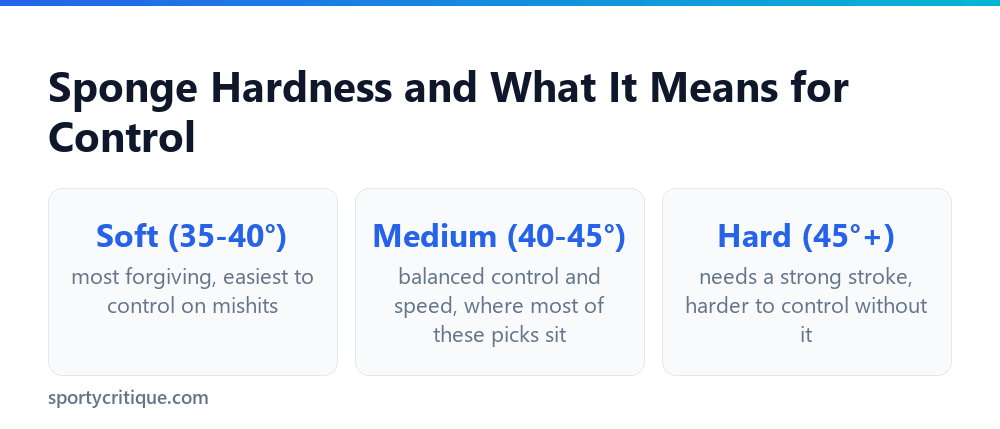
Sponge hardness is the single biggest lever within control-oriented rubber itself. A softer sponge is more forgiving on off-center contact but caps your top-end speed, a harder sponge rewards a stronger, more committed stroke with more pace but punishes a weak or mistimed one. Most of the five picks above sit in the medium range specifically because that’s where control and usability overlap best for the largest range of players.
Keeping Control Rubber Grippy Over Time
Control rubber depends on surface tack more than a spin-focused sheet does, since grip is a bigger part of how it produces its predictable response. Dust and skin oils build up on the surface every session and dull that tack gradually, which is why a rubber that felt controlled and grippy when new can start feeling slick and unpredictable after a few months of regular play without cleaning.
Wipe the surface down with a dedicated rubber cleaner and sponge after each session rather than letting dust accumulate, and store your paddle with a protective sheet over the rubber between uses. Direct sunlight and heat degrade rubber faster than normal wear does, so avoid leaving a paddle in a hot car or on a sunny windowsill if you want these five sheets to keep their control characteristics as long as possible.
Which Control Rubber Fits Your Stage
🛒 Frequently Bought Together: Assembly & Rubber Care Bundle
When ordering table tennis equipment, tournament competitors frequently bundle protection and maintenance gear in the same Amazon shipment to maintain equipment tack and avoid separate delivery fees:
Selected Blade / Rubber Sheets
Your chosen competition blade or high-tension rubber
VOC-Free Water-Based Table Tennis Glue (50ml + Sponges)
ITTF compliant adhesive for clean application and zero wood peeling
Protective Edge Tape (10mm/12mm) & Rubber Film
Guards against table edge dings and shields topsheet from dust
New to swapping your own rubber and want a low-risk first sheet, start with the Yinhe Mercury II, it’s cheap enough that a wrong choice costs little. Want a well-known brand’s take on control at a similar price, the Stiga Mantra Control. Prefer a more traditional, tacky, grip-forward feel over a modern high-energy sheet, the Friendship 729 Cross Color Series.
Already comfortable with one of our other budget picks and just want a reliably consistent all-round sheet, the Coherny. And once you know control is genuinely your priority over spin or speed, and you’ve got the budget to match, the YASAKA Rakza 7 is the established upgrade experienced control players reach for.
What happened to the original products on this post?
Six of the ten were complete pre-assembled paddles and one was a rubber cleaning kit, not rubber sheets. We kept the four genuine rubber sheets and sourced a fifth to complete this list.
What makes a rubber ‘control’ rather than ‘spin’ or ‘speed’ focused?
Sponge hardness, surface tack, and overall construction. Control rubber typically uses a medium-hard sponge with strong grip but restrained speed, trading raw power for a more predictable, forgiving response on contact.
Is control rubber good for beginners?
It can work well, but our dedicated beginner rubber guide covers sheets chosen specifically for that stage. Control rubber suits players who already have some consistent technique and want predictability over raw power.
Can I use control rubber on both forehand and backhand?
Yes, many players run control rubber on the backhand for blocking and placement while using a spinnier or faster sheet on the forehand for attacking, though a matched pair of control rubber works fine too.
Does sponge hardness matter more than the rubber brand?
For control specifically, yes. Sponge hardness determines how forgiving the rubber is on off-center contact and how much stroke strength you need to activate it, brand mostly affects consistency and surface tack rather than the core control characteristics.
Will control rubber hurt my spin generation?
It reduces peak spin potential compared to a dedicated spin rubber, but the tacky surfaces on picks like the Friendship 729 and YASAKA Rakza 7 still generate solid spin, control rubber trades some ceiling for more consistency, not spin entirely.
How long does control rubber typically last?
Most players get 3-6 months of regular play before the surface tack degrades enough to notice a real drop in grip and predictability, though casual players can stretch that further, and cleaning after every session extends it meaningfully, sometimes by an extra month or more of usable grip.
Is control rubber more expensive than spin or speed rubber?
Not inherently, control-focused sheets span the same budget-to-premium price range as any other category. The YASAKA Rakza 7 here costs more because of its reputation and refinement, not because control rubber as a category commands a premium.
As an Amazon Associate, we earn from qualifying purchases through links on this page.

Ping Pong Reviewed is an equipment review site covering table tennis and baseball gear. Specifications are checked against manufacturer listings, and prices against live retail pages, before publication.