Butterfly Sriver Review: The 1967 Rubber Still Sold Today
Sriver’s speed rating on Butterfly’s own scale is 38. Tenergy 05’s is 83. Before concluding Sriver is a bad rubber, it’s worth knowing why those numbers look nothing alike, and why Sriver is still sold, still bought, and still winning matches nearly six decades after it launched.
What follows is Butterfly’s own published specifications, current retail pricing, and the real historical context behind a rubber old enough that most players comparing it to modern tensor rubber are comparing across a technology gap, not a quality gap. Not a claimed hands-on verdict.
📊 Note: What this review is. We have not logged hours on this sheet, and we’re not going to describe a feel we haven’t felt. What follows is verified pricing, Butterfly’s own specification numbers, and the documented history behind a historic product.
Table of Contents
What Sriver Costs Right Now
Butterfly’s own US shop prices Sriver at $32.99 a sheet, the least expensive rubber covered across this site’s Butterfly reviews so far. It’s available in four thicknesses, 1.5mm, 1.7mm, 1.9mm, and 2.1mm, a wider range than several of Butterfly’s newer premium rubbers offer.
Sriver is listed on Amazon across its full thickness range in both colors, alongside Butterfly’s own shop and other long-established retailers.
Why the Numbers Look So Low, Explained Honestly
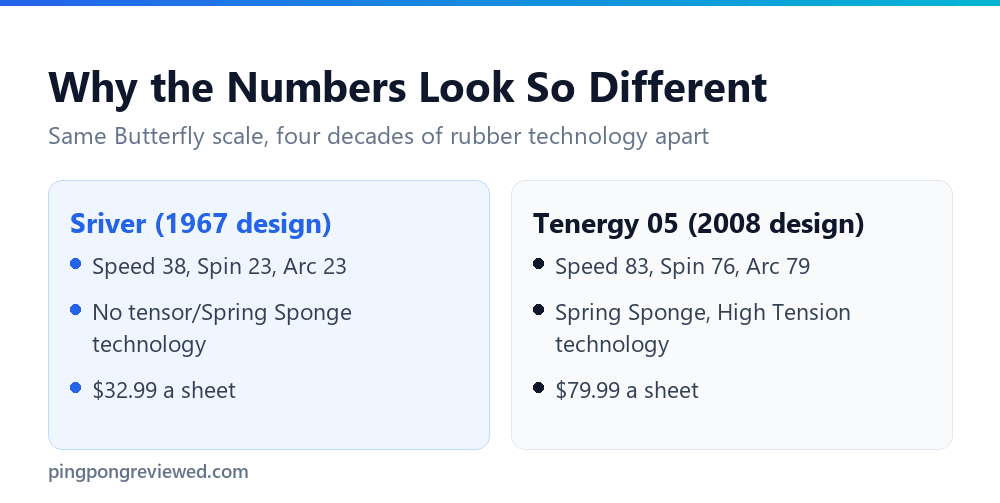
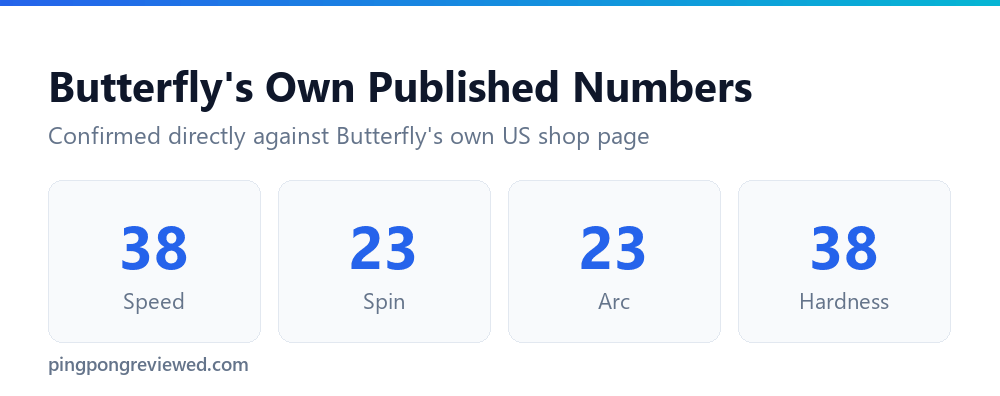
Sriver’s Speed 38, Spin 23, Arc 23 figures sit dramatically below Tenergy 05’s Speed 83, Spin 76, Arc 79, on the exact same Butterfly scoring scale. That gap is real, and it deserves an honest explanation rather than a dismissal in either direction.
This is worth internalizing before comparing any older, classic-design rubber against a modern tensor sheet using raw numbers alone. The scale itself has effectively expanded over time as manufacturers introduced faster technology, which compresses where older, still-legitimate rubbers land by comparison.
A Documented, Multi-Decade Competitive Record
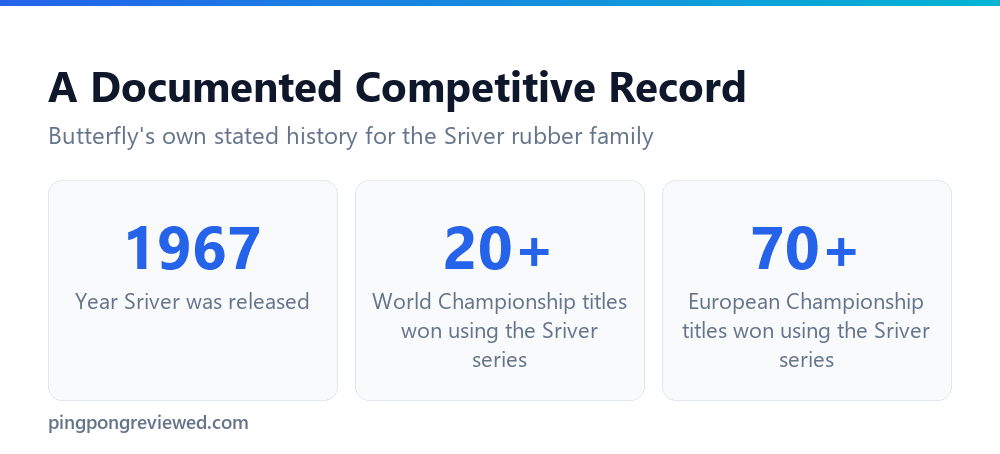
Sriver launched in 1967, and Butterfly’s own materials describe it as bringing a significant change to the sport at the time, built around a combination of friction and elasticity that was new for its era. That’s not a vague nostalgia claim, Butterfly’s own stated figures put more than 20 World Championship titles and more than 70 European Championship titles won by players using the Sriver rubber series (including its FX and EL variants) across its multi-decade history.
Few pieces of sporting equipment stay in continuous production and competitive relevance for nearly six decades. Sriver’s longevity isn’t marketing nostalgia, it’s a rare track record for a piece of equipment in a sport where technology has changed dramatically over the same period.
The Official Specifications
Who Sriver Is Actually For
- ✓You want a controllable, classic all-round rubber
- ✓You’re a hardbat, classic-style, or control-first player
- ✓You want the lowest price point in Butterfly’s current lineup
- ✓You value predictability and control over maximum spin or speed
- ✕You’re chasing maximum modern tensor spin or speed output
- ✕You’re an attacking player building around heavy topspin loops
- ✕You want to directly compare Sriver’s raw numbers against Tenergy 05
- ✕You’ve never played a classic, non-tensor rubber and expect tensor-level output
Sriver’s own official classification is “all-round” rather than an attacking or offensive-first rubber. That’s a direct, honest description from Butterfly itself, not a euphemism, Sriver is built for balance and control rather than maximizing any single output figure.
The FX and EL Variants Worth Knowing About
Butterfly also sells Sriver FX and Sriver EL, both built around the same Sriver topsheet paired with different sponge formulations. Sriver FX uses a medium-soft sponge suited to controlled attacks and blocks; Sriver EL uses a medium-soft elastic sponge Butterfly describes as balancing the power of original Sriver with the touch of Sriver FX. Both remain distinct, currently sold products, not discontinued variants, worth knowing so a Sriver-family purchase doesn’t accidentally become the wrong variant for what you’re actually after.
📊 Note: This review covers standard Sriver specifically. FX and EL carry their own separate specifications and pricing, distinct enough from the original that they deserve their own dedicated comparison rather than being assumed identical.
Thickness Options
Sriver’s four available thicknesses, 1.5mm, 1.7mm, 1.9mm, and 2.1mm, give a wide range for a control-first rubber. Thinner options push further toward pure control and touch; thicker options add more of whatever speed and spin the classic sponge formulation provides.
💡 Pro tip: If you’re trying Sriver specifically to feel what pre-tensor rubber plays like, a middle thickness like 1.9mm gives a representative feel without pushing to either extreme of the available range.
Why a 1967 Rubber Is Still on the Market at All
Most equipment categories don’t keep a nearly 60-year-old design in active, current production alongside their newest technology. Sriver’s continued presence in Butterfly’s lineup reflects genuine, sustained demand rather than a legacy product being kept around out of sentiment, a manufacturer doesn’t maintain manufacturing lines, quality control, and retail distribution for a product decades past its prime purely for nostalgia when that shelf space and production capacity could go to a newer, higher-margin product instead.
That sustained demand comes from a distinct player base: coaches and club players who value predictable, controllable equipment for teaching and recreational play, players competing in classic or hardbat-adjacent formats where extreme modern spin isn’t the format’s focus, and players who simply prefer a rubber that doesn’t punish an imperfect stroke the way a high-tension attacking sheet can. None of those use cases have disappeared just because tensor technology exists.
How Sriver Fits Into a Beginner’s Journey
It’s worth directly addressing whether Sriver makes sense as a genuine starting rubber, since its low price and control-first profile might suggest it as a beginner option. The honest answer is mixed: Sriver’s forgiving, controllable character does suit a beginner’s developing stroke reasonably well, but a player planning to progress toward modern attacking play will eventually outgrow what Sriver’s classic sponge formulation can provide, in a way that a modern budget tensor rubber like Rozena wouldn’t require as dramatic a subsequent upgrade.
That’s not a reason to avoid Sriver as a first rubber, it’s context for what happens next. A beginner starting on Sriver who develops toward an attacking style should expect a bigger jump in feel when eventually moving to a tensor rubber than a beginner who started on a modern budget option would experience.
Gluing and Care
Sriver uses the same modern, water-based gluing process as any current inverted rubber, spread thin on both blade and rubber, let both go touch-dry, then lay the sheet down from one edge. Sriver’s classic sponge formulation doesn’t require any different process than gluing a modern tensor sheet.
Storage and care follow the same general principles as any inverted rubber: keep it covered when not in use, avoid heat and direct sunlight, and expect gradual performance decline over extended use as the sponge and topsheet naturally age, the same as any rubber eventually experiences regardless of its design era.
A Note on Comparing Rubbers Across Eras
This review is worth keeping as a reference point for any future comparison between an older, established rubber and a newer one carrying flashier numbers. Speed, spin, and arc figures only mean what they claim to mean within the era and technology generation they were scored in. A rubber released decades apart from another will almost always show a stark gap on paper, and that gap alone says nothing about whether either rubber is well made or worth buying.
The only way to know whether an older design’s lower numbers actually matter for your own game is to ask what you’re trying to accomplish with the rubber, not to compare its raw figures against whatever the newest release happens to score.
Where to Buy It
Sriver’s long production history means it’s carried widely across established table tennis retailers and Butterfly’s own shop, alongside Amazon listings spanning its full thickness range. Given its lower price point relative to premium modern rubbers, the financial incentive for counterfeiting is somewhat lower than for rubbers like Tenergy 05 or Dignics, though buying from an established retailer remains the safer default for any branded rubber purchase.
None of this needs to feel like settling for less. A rubber that has stayed relevant, in continuous production, across nearly six decades of the sport’s technological evolution earns its place on a shopping list on its own terms, not as a consolation option for players who can’t afford something newer.
Judge it against what it’s actually trying to be, a controllable, all-round classic, and Sriver holds up completely. Judge it against a rubber built to solve a different problem entirely, and of course it comes up short. That comparison was never the fair one to make.
Common Questions
How much does Butterfly Sriver cost?
Butterfly’s own US shop prices it at $32.99 per sheet, the lowest price among the Butterfly rubbers covered on this site.
Why does Sriver score so much lower than Tenergy 05?
Sriver is a 1967 design that predates Spring Sponge and High Tension tensor technology by decades. It’s scored honestly on the same scale, which later tensor rubbers stretched upward.
Is Sriver a bad rubber because of its low numbers?
No. It’s a documented, still-competitive classic design with more than 20 World and 70 European Championship titles won using the Sriver series across its history.
What’s the difference between Sriver, Sriver FX, and Sriver EL?
All three share the same topsheet with different sponge formulations. FX and EL are separate, currently sold products with their own specifications, not old variants of the original.
Who is Sriver actually built for?
Butterfly classifies it as an all-round rubber, suited to control-first and classic-style players rather than modern maximum-spin attacking play.
The Verdict
The short version: Sriver’s low numbers next to Tenergy 05 reflect a four-decade technology gap, not a quality gap, this is a historic, still-competitive all-round rubber with a documented championship record, priced at $32.99 and built for control and balance rather than maximum modern output. Verified directly against Butterfly’s own shop page on 6 September 2026.
- →Butterfly’s own numbers: Speed 38, Spin 23, Arc 23, Hardness 38.
- →Priced at $32.99, the lowest among this site’s Butterfly reviews.
- →A 1967 design, predating tensor/Spring Sponge technology entirely.
- →More than 20 World and 70 European Championship titles won with the Sriver series.
- →Classified by Butterfly as all-round, built for control over maximum output.
So the closing question isn’t whether Sriver beats Tenergy 05 on paper, it doesn’t, and was never trying to. It’s whether a controllable, historically proven all-round rubber fits the kind of game you’re actually trying to play.
Nearly six decades of continuous production is its own kind of verdict, delivered by generations of players and coaches rather than by any single review.
As an Amazon Associate, we earn from qualifying purchases through links on this page.

Ping Pong Reviewed is an equipment review site covering table tennis and baseball gear. Specifications are checked against manufacturer listings, and prices against live retail pages, before publication.