Donic Baracuda Review: Verified Specs, Prices and Ratings
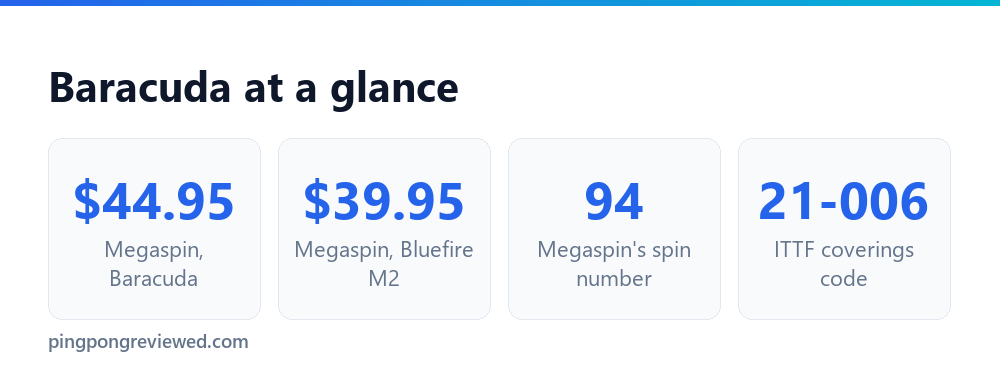
This Donic Baracuda review sticks to what Donic and the retailers publish. Donic lists the Baracuda as hard, with high spin, fast speed and medium control, in red, black and blue, 1.8 mm, 2.0 mm and max, for attacking players who use lots of topspin. On October 2, 2026 Megaspin sold it at $44.95 and showed the red and black 1.8 mm sheets out of stock. We haven’t played with it, so this is a verification of specs and prices, not a verdict on feel.
The Baracuda is sold on a phrase that sounds like a rules problem: a built-in speed glue effect. Reviews often turn that phrase into claims about how the rubber plays. This one reports what Donic’s own pages say, what Megaspin’s pages say, what the ITTF’s list of authorized coverings shows, and where they disagree.
We checked all of them on October 2, 2026. Prices and stock change, so read every price here as a snapshot with a date. If you’re comparing it with its Donic sibling, see our Donic Bluefire M2 review.
- →Price on October 2, 2026: $44.95 at Megaspin, no markdown. Red and black 1.8 mm were out of stock there.
- →Donic lists it as hard, spin high, speed fast and control medium, for attacking players who use lots of topspin.
- →Megaspin’s numbers (90, 94 and 70) are Megaspin’s own, with no stated scale.
- →The ITTF list of authorized coverings includes the Baracuda (code 21-006) in five colors.
- →Donic’s Baracuda page gives no degree figure and no glue or booster guidance.
Table of Contents
Donic Baracuda specifications
Donic says the Baracuda is designed based on Formula Donic, but with one decisive addition: the ball leaves the rubber in a considerably higher arc, providing much more spin for topspin strokes. Donic’s glossary doesn’t place the Baracuda in a rubber generation. Megaspin’s page calls the effect inbuilt speed glue. Those are the maker’s and the retailer’s descriptions, and we have no test to confirm either.
Donic’s words and Megaspin’s numbers
The Baracuda has two sets of ratings, and they are easy to blend by accident. Donic uses words. Megaspin uses numbers. Neither states how the other maps onto it.
Read the two together and you get a consistent picture of a high-spin rubber, but not an identical one. Donic’s word for control is medium, and Megaspin’s number is 70. We can’t convert one into the other, and we haven’t tested the rubber, so we don’t try.
Baracuda versus Bluefire M2
The two are easy to confuse because Megaspin’s numbers are almost identical. Donic’s own descriptions are not. Our Bluefire M2 review covers that rubber in the same way.
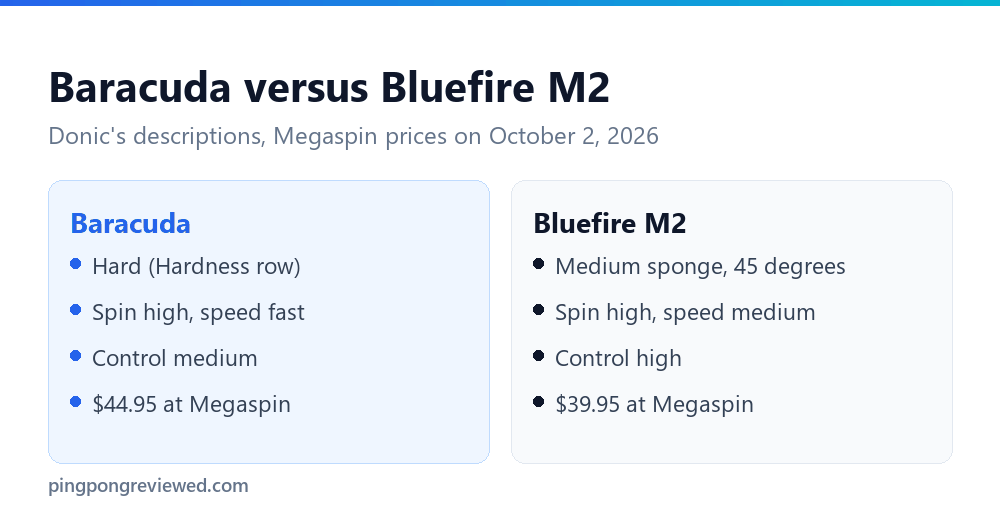
On Megaspin’s numbers the two are one point apart on speed and level on spin and control. On Donic’s pages the Baracuda is hard and fast with medium control and the M2 is a medium sponge with medium speed and high control. We don’t know why the two sets of ratings don’t match, so we can’t tell you which description fits your hands.
Where Donic, Megaspin and the ITTF list differ
The same rubber gets described differently across the pages we read. None of the differences is an error on its own, but they matter if you compare reviews, so here they are in one place.
When the retailer shows numbers and the maker shows words, we show both and don’t convert one into the other. When two lines on one Donic page differ, as the hardness and technology lines do, we quote both.
The Baracuda in Megaspin’s Donic compare table
Megaspin’s compare table puts Donic’s rubbers side by side with prices. We show the figures it gave on October 2, 2026, with the caveat that Megaspin says there is no universal standard for rubber ratings and advises comparing sheets of the same manufacturer.
Of the five rubbers in this table, the Baracuda is second-lowest priced, above the M2 and below the other three. Megaspin’s full Donic table lists other Donic rubbers at lower prices. We haven’t tested any of them, so the table describes a price list and Megaspin’s numbers, not an ordering by how they play.
Price, stock and where to buy
On October 2, 2026 Megaspin listed the Baracuda at $44.95. The red and black 1.8 mm sheets were out of stock. Red 2.0 mm, red max, black 2.0 mm and black max were in stock, and pink was sold in 2.0 mm and max. Megaspin listed the Bluefire M2 at $39.95, $5.00 below the Baracuda, though that M2 price was a markdown from $49.95 and a markdown can end.
On Amazon, one Baracuda listing is titled DONIC Baracuda Table Tennis Rubber. Amazon’s data showed no price or availability for it when we checked, and the listing says it is available in red and black, so we can’t tell you what is in stock. Check the listing for the sheet size and thickness you want before you order. Donic’s European Baracuda page lists 48.90 euros including VAT, which isn’t a US price.
ITTF approval and colors
The January 3, 2026 list of authorized coverings, as hosted by the French federation, includes the Baracuda with the code 21-006, pimples in, in black, blue, pink, red and violet, and no expiry shown. See the list. It covers rubbers, not complete rackets.
The racket rule itself is in the ITTF Statutes 2026: the covering must be matt, black on one side, and a bright color clearly distinguishable from black and from the color of the ball on the other. The list includes the Baracuda in pink. Whether a particular organizer accepts a particular racket is up to that event, so check the event’s own rules.
The speed glue effect, in the sources’ words
The phrase deserves its own section because it’s the part most readers worry about. Here is what each source actually says.
Put together, the sources say that Megaspin describes the Baracuda as having an inbuilt speed glue effect, that Donic describes it as based on Formula Donic with a higher arc added, and that the rubber appears on the list of authorized coverings. We haven’t tested it, so we don’t claim to know what it does in play.
Who the Baracuda is for, according to Donic
Donic says the Baracuda is for attacking players who use lots of topspin. That is positioning, not a finding, and we haven’t tested the rubber. If you’re deciding between rubbers, ask whether that description matches how you play, and treat our tables as a list of what the sources say.
If you’re also weighing a Butterfly rubber, our Tenergy 05 review and Rozena review cover those on the same terms. Their scales differ, so don’t compare their numbers with Megaspin’s or Donic’s.
What this review cannot tell you
A verification review has limits, and it’s fairer to list them. We can’t tell you how the Baracuda feels, how long it lasts, how it behaves with a particular blade or how it compares in your hands with another rubber. Donic’s page gives no degree figure for the sponge, and no glue or booster guidance. We also can’t tell you whether the 1.8 mm sheets will return to stock at Megaspin, or whether Amazon’s listing includes one sheet or a pair, because Amazon’s data doesn’t say.
What we can tell you is where the numbers and the wording come from, so you can judge how much weight each deserves. If the choice between two rubbers comes down to feel, a review like this can narrow the list but not make the call, and a short trial of each in person will tell you more.
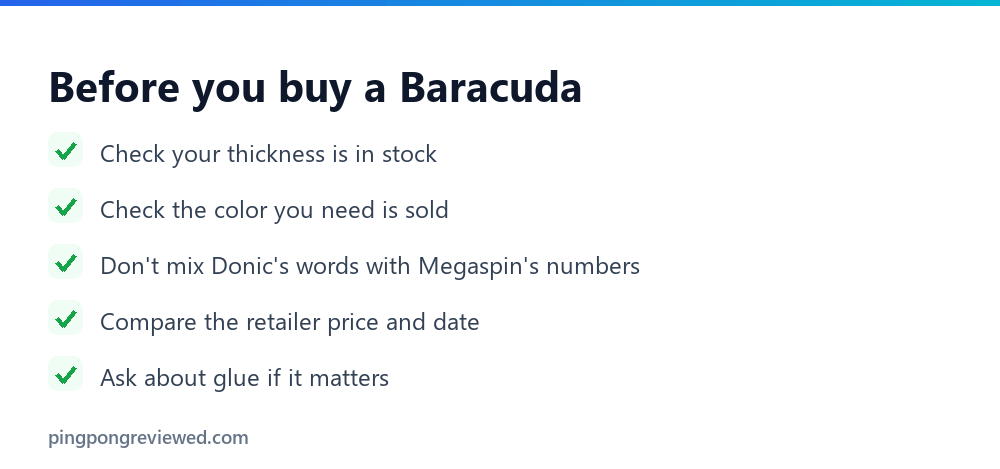
Questions to settle before you order
How we checked this review
We read Donic’s pages for the Baracuda, the Bluefire M2 and the Bluefire series, Donic’s rubber technology glossary, Megaspin’s product pages and compare table, the January 3, 2026 list of authorized coverings, the ITTF Statutes 2026 and Amazon’s product data, all on October 2, 2026. We did not play with the rubber, so we don’t say how it feels. We don’t quote star ratings or review counts, including the retailers’ own. Prices and stock change, so treat the numbers as a snapshot.
Frequently asked questions
How much does the Donic Baracuda cost?
On October 2, 2026 Megaspin listed the Baracuda at $44.95 with no markdown, and Donic’s European page listed 48.90 euros including VAT. Amazon had a Baracuda listing, but its data showed no price or availability when we checked.
How hard is the Baracuda sponge?
Donic’s Baracuda page says hard in its Hardness row, while its Technology text says medium sponge. Donic gives no degree figure for the Baracuda, so we can’t place it on the degree scale Donic uses for the Bluefire series.
What are the Baracuda’s ratings?
Donic describes spin as high, speed as fast and control as medium. Megaspin shows its own numbers of Speed 90, Spin 94 and Control 70. Megaspin’s compare page says there is no universal standard for rubber ratings, so don’t mix the two sets.
What colors and thicknesses does the Baracuda come in?
Donic lists red, black and blue in 1.8 mm, 2.0 mm and max. Megaspin sells red and black, plus pink in 2.0 mm and max, and showed the red and black 1.8 mm sheets as out of stock on October 2, 2026. The ITTF list of authorized coverings includes black, blue, pink, red and violet.
Is the Baracuda ITTF approved?
The January 3, 2026 list of authorized coverings, as hosted by the French federation, includes the Baracuda with the code 21-006, pimples in, with no expiry shown. That list covers rubbers, and rackets are a separate matter.
What does the built-in speed glue effect mean?
Megaspin’s page uses the phrase inbuilt speed glue effect. Donic says the Baracuda is based on Formula Donic with one decisive addition, a considerably higher arc for the ball and much more spin on topspin strokes, and its glossary says the speed glue effect has been integrated into its rubbers for more than 20 years. We have no test to confirm what that means in play.
What is the difference between the Baracuda and the Bluefire M2?
On Donic’s pages the Baracuda is listed as hard with fast speed and medium control, and the M2 as a medium 45 degree sponge with medium speed and high control. Megaspin’s numbers are nearly identical for the two, at 90, 94 and 70 for the Baracuda and 91, 94 and 70 for the M2.
Who is the Baracuda for?
Donic says it is for attacking players who use lots of topspin. That is Donic’s positioning, and we haven’t tested the rubber.
Does the Baracuda need glue or a booster?
Donic’s Baracuda page gives no glue or booster guidance, so we can’t say.
Sources
Specs come from Donic’s pages for the Baracuda and the Bluefire M2, and its glossary. Prices and stock come from Megaspin’s Baracuda page, M2 page and compare table, and from Amazon’s product data. The covering list is the January 3, 2026 list of authorized racket coverings, and the racket rule is in the ITTF Statutes 2026.
As an Amazon Associate, we earn from qualifying purchases through links on this page.

Ping Pong Reviewed is an equipment review site covering table tennis and baseball gear. Specifications are checked against manufacturer listings, and prices against live retail pages, before publication.