Best Looping Ping Pong Blade: 5 Genuine Offensive Blades
Table of Contents
This List Used to Be Mostly Paddles, Not Blades
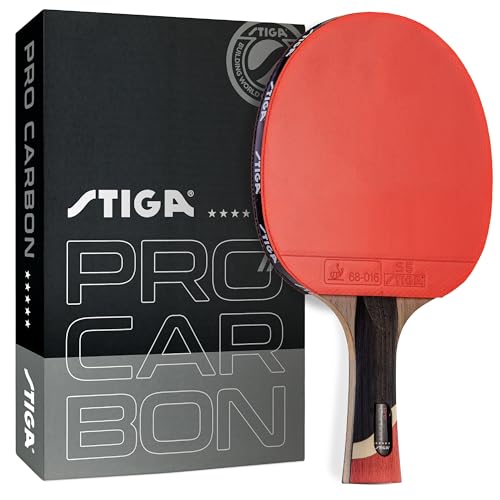
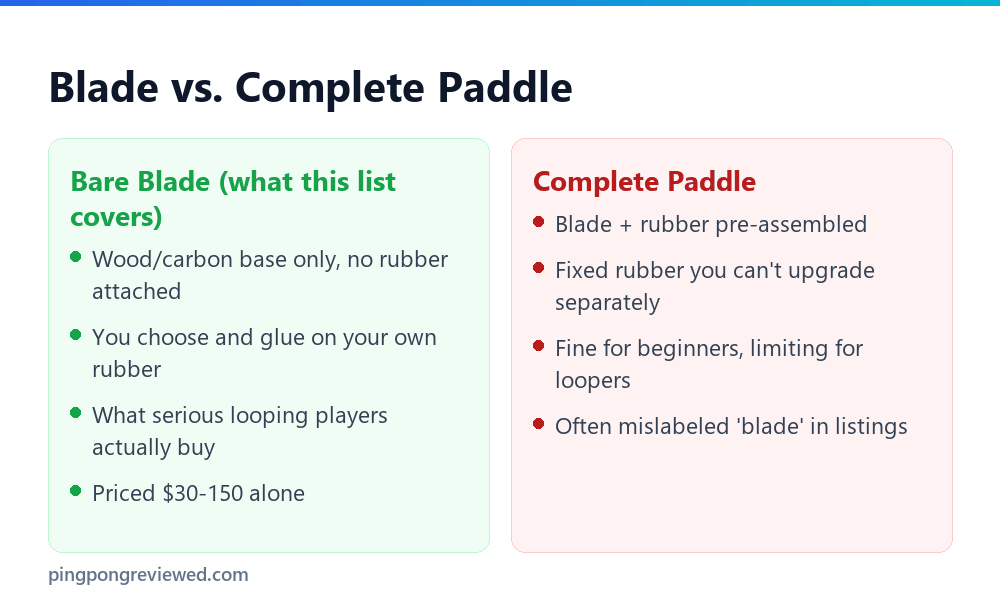
We audited the original picks on this post and found the same mislabeling pattern we’ve now caught on three other blade posts on this site: six of the seven products reviewed here were complete pre-assembled paddles, blade and rubber already glued together, not bare blades. One (a STIGA Carbon+ Bundle) even came with balls and a wristband. The one genuine bare blade in the original lineup, a JOOLA Rossi, has since been discontinued.
A looping blade specifically is a bare wood-or-carbon base built to support heavy topspin play, you pair it with your own choice of spin-friendly rubber rather than buying it pre-matched to a generic all-round sheet. If you’re a beginner who just wants to start playing, a complete paddle is the right call, our beginner paddle guide covers that. This list is specifically for players ready to choose their own rubber.
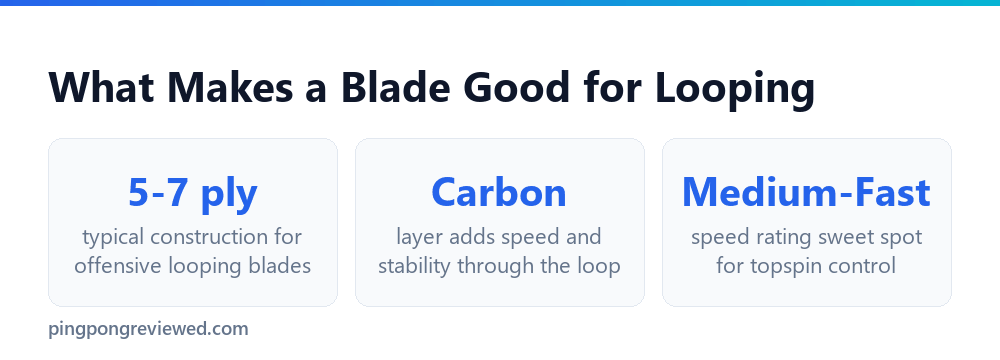
The looping stroke itself is a fast, brushing topspin shot, low to high contact with a whip-like acceleration through the ball, and it’s the technique that separates intermediate players from advanced ones more than almost any other single skill. A blade tuned for it needs enough stiffness to return that racket speed as pace, but not so much that it overwhelms your control of where the ball actually lands. That balance is what the five picks below are built around, and it’s exactly what a repurposed all-round or defensive blade won’t give you.
1. HAMAL HSB-03 Elite Professional Blade
The budget entry point at under $35, and still a genuine offensive blade, outer carbon ZL fiber over a Koto outer ply, explicitly sold as blade-only with no rubber attached. For a player upgrading from a complete beginner paddle into their first custom rubber setup, this is a low-risk way to try the looping-blade path without a big investment.
The Koto outer ply is worth understanding specifically. It’s a harder, denser wood than the softer plies used in control-first blades, and it’s part of why this blade can compete with options three times its price on raw looping performance. What you’re not getting at this price is the refined feel and consistency of manufacturing that comes with a longer-established brand, the blade performs well, but expect more variance between individual units than you’d see from GEWO or VICTAS.
- ✓Lowest price of any genuine blade here
- ✓Carbon fiber construction for looping power
- ✓Explicitly sold blade-only
- ✕Less established brand than STIGA/Butterfly
- ✕Fewer handle-shape options
2. GEWO Aruna Carbon Basic Offensive Blade
GEWO is a well-established German brand in the offensive-blade space, and the Aruna Carbon Basic is built specifically for this style, a carbon layer tuned for the fast, controlled stroke a looping game depends on. At roughly $70, it sits comfortably in the middle of this list on price.
What sets GEWO’s approach apart is the word “Basic” in the name, this is deliberately the entry point into GEWO’s own offensive line rather than their top-tier build, which means you get the brand’s manufacturing consistency and design philosophy without paying for the extra refinement more advanced players need. It’s a sensible pick if you want a known brand without committing to their flagship pricing yet.
3. VICTAS Swat Carbon Offensive Blade
VICTAS blades have a strong reputation among players who prioritize consistency over raw speed, the Swat Carbon leans toward control-first offense rather than maximum pace, which suits a looping game built on placement and spin rather than just hitting harder.
This distinction matters more than it sounds. A blade that maximizes raw speed can actually work against a looping player, since it’s harder to keep heavily spun shots on the table when the blade itself is adding uncontrolled pace. The Swat Carbon’s control-first tuning means your spin does more of the work, and your placement stays precise even as you commit to bigger swings.
4. Loki Liang JINGKUN Fast Attack & Spin Blade
A 5+2 ply construction (5 wood plies plus 2 carbon layers) explicitly marketed for fast attack and spin, which is the looping player’s core requirement, enough stiffness to generate racket speed through the loop without sacrificing the touch needed to keep the ball on the table.
The FL (flared) handle shape on this model deserves a mention too. A flared handle widens toward the base, which locks your grip in place during the high-speed wrist action a loop stroke demands, straight handles let the paddle twist slightly under that same stress, which is a small but real difference for anyone building a looping-heavy game around this blade.
5. HAMAL HPB-05 Table Tennis Blade
The premium pick at $149, explicitly labeled blade-only with no rubber, built with an inner carbon layer and Limba inner ply aimed at intermediate-to-advanced players. If you’ve already outgrown a budget blade and know looping is your long-term style, this is the upgrade built for it.
An inner carbon layer, as opposed to the outer carbon construction on the HAMAL HSB-03 above, changes the feel meaningfully. Inner carbon sits sandwiched between wood plies rather than on the surface, which tends to produce a softer, more controlled feel at contact while still delivering the speed carbon adds. That’s the kind of nuance that matters once you’re advanced enough to feel the difference, which is exactly the player this blade is priced for.
Going From Blade to a Full Looping Setup
Buying a bare blade is only step one. Unlike a complete paddle, a bare blade ships with nothing attached, no rubber, no glue, no protective edge tape. If you’ve never built a custom setup before, budget an extra $15-40 for rubber on each side and expect to either learn to glue it yourself or pay a local shop a small fee to mount it correctly.
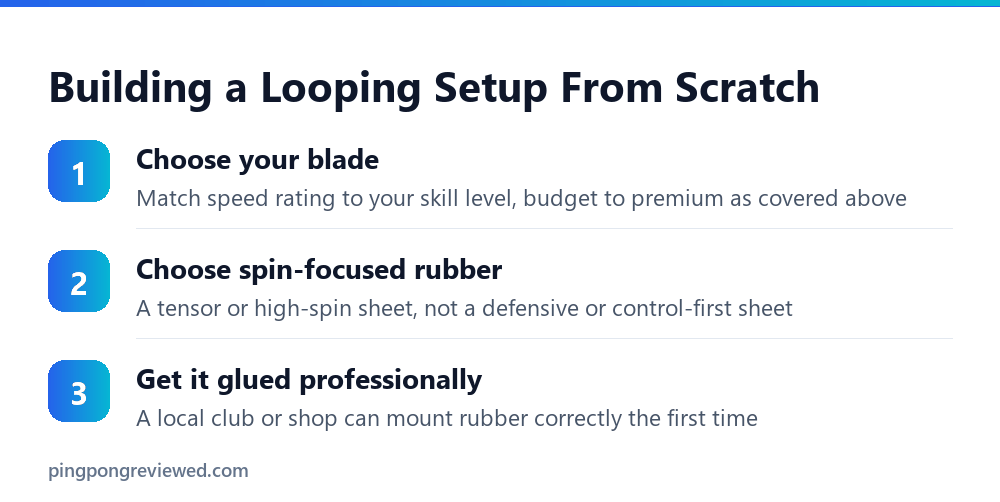
Don’t rush this step. A great blade paired with the wrong rubber, or rubber glued unevenly, will underperform a mediocre blade set up correctly. If you’re new to building your own paddle, ask at a local club before ordering, most experienced players are happy to walk a beginner through their first build.
Pairing Rubber With a Looping Blade
A bare blade is only half the equipment decision. For looping specifically, pair it with a tensor or high-spin rubber rather than a defensive or friction-light sheet, the blade provides the stiffness and speed, the rubber provides the grip that actually generates the topspin. Our rubber-for-spin guide covers real spin-focused sheets that pair well with any of the five blades above.
💡 Pro tip: Don’t buy the most expensive blade here as your first custom setup. A cheaper blade paired with good rubber will outperform an expensive blade paired with the wrong one, get the rubber choice right first.
Which Blade Fits Your Stage
Building your first custom setup and not sure looping is even your long-term style yet, start with the HAMAL HSB-03, it’s cheap enough to experiment without much risk. Want an established European brand at a moderate price, the GEWO Aruna Carbon Basic. Struggling to keep spin shots on the table with a faster blade, the VICTAS Swat Carbon’s control-first tuning is built for exactly that problem.
Committed to an aggressive fast-attack game and want a flared handle built for it, the Loki Liang JINGKUN. And if you’re already an intermediate or advanced player who knows looping is your identity on the table, the HAMAL HPB-05’s inner carbon construction is the most refined option here, worth the jump in price once you can actually feel the difference it makes.
What’s the difference between a looping blade and an all-round blade?
A looping blade is built stiffer and often includes carbon layers to support fast, topspin-heavy strokes. An all-round blade favors control and versatility across shot types rather than maximizing speed for one specific stroke.
Can beginners use a looping blade?
Technically yes, but it’s not the best starting point. Looping blades reward players who already have consistent stroke mechanics, a beginner is usually better served by a complete all-round paddle while they build fundamentals first.
Do I need carbon in a looping blade?
Not strictly, but most competitive looping blades include a carbon layer because it adds speed and stability through the stroke without adding much weight. All five blades on this list include carbon construction for that reason.
Why were most of the original picks on this list actually paddles?
A recurring mislabeling issue on this site, listings for complete pre-assembled paddles get miscategorized as ‘blades’ because the word gets used loosely in product titles. We caught and corrected it here, along with three other blade posts on this site.
What’s the difference between inner carbon and outer carbon construction?
Outer carbon sits on the surface of the blade and tends to produce a firmer, faster feel. Inner carbon is sandwiched between wood plies and tends to feel softer and more controlled at contact while still adding speed, a subtle difference that becomes more noticeable as your technique improves.
How much does a full looping setup cost including rubber?
Budget the blade price plus roughly $15-40 per side for tensor or high-spin rubber, so a full setup built on the budget HAMAL blade runs about $65-115 total, while the premium HAMAL blade with good rubber lands closer to $180-230.
Do I need a different blade for forehand and backhand looping?
No, one blade handles both sides. What can differ is the rubber, many players run a faster, spinnier sheet on the forehand for attacking loops and a slightly more controlled sheet on the backhand, but the blade underneath stays the same for both wings.
As an Amazon Associate, we earn from qualifying purchases through links on this page.

Ping Pong Reviewed is an equipment review site covering table tennis and baseball gear. Specifications are checked against manufacturer listings, and prices against live retail pages, before publication.