Best Butterfly Ping Pong Blades (5 Real Blades, 2026)
The best Butterfly ping pong blades are genuine bare blades — no rubber attached — and this list corrects a common mix-up: the Viscaria is Butterfly’s flagship professional blade, used by top players, while accessories like glue and care kits sometimes get miscategorized as ‘blades’ in other guides.
- →Butterfly sells genuine bare blades separately from accessories like glue, care kits, and edge tape — this list covers only the actual blades.
- →The Viscaria is Butterfly’s flagship professional blade, carbon-reinforced for speed and used by top-level players worldwide.
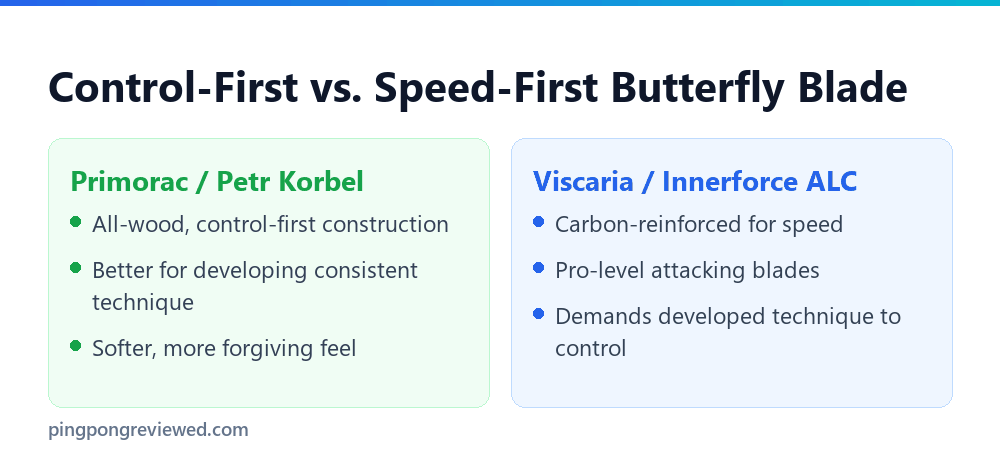
- →The Primorac and Petr Korbel are proven all-wood options prioritizing control, a better starting point for players newer to custom blade setups.
- →None of these blades include rubber — pair any pick here with a rubber sheet from our separate rubber guides.

Butterfly is one of the most established names in table tennis, and its blade lineup spans from beginner-friendly all-wood construction to the carbon-reinforced blades used by professional players. Every blade in this list ships without rubber, sold specifically for players who want to choose their own rubber separately — a genuinely different purchase from a complete pre-assembled paddle.
Table of Contents
Flagship Pick: Butterfly Viscaria

The Viscaria is Butterfly’s best-known professional blade, carbon-reinforced for real speed and used by top-level players internationally. It’s a demanding blade that rewards developed technique with genuine power and spin potential, but it’s not the right starting point for a player still building fundamentals.
- ✓Carbon-reinforced construction for real professional-level speed
- ✓Used by top-level players internationally
- ✓Excellent spin and power ceiling for developed technique
- ✕Demanding for players still building fundamentals
- ✕Priced at the premium end of Butterfly’s lineup
Best for Control: Butterfly Primorac
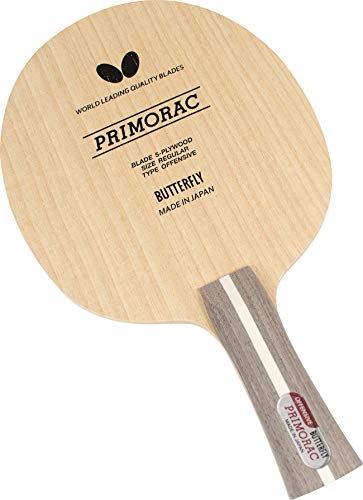
The Primorac is a proven all-wood blade prioritizing control and consistency over raw speed, a genuinely good starting point for a player moving from a complete paddle to a custom blade-and-rubber setup for the first time. Its forgiving construction doesn’t punish imperfect technique the way a faster carbon blade would.
💡 Pro tip: If this is your first Butterfly blade, start with the Primorac or Petr Korbel rather than the Viscaria — both let you develop technique on a forgiving platform before stepping up to a faster, more demanding blade later.
Classic All-Round: Butterfly Petr Korbel
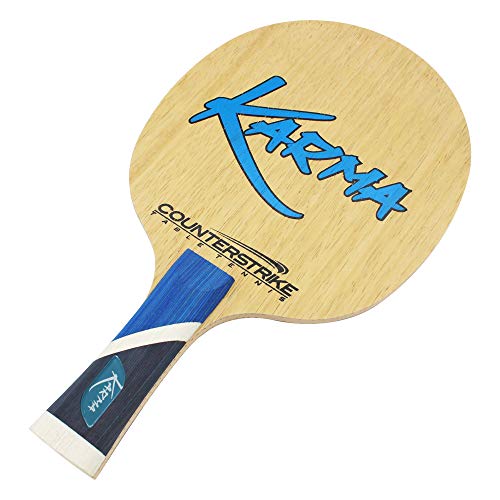
The Petr Korbel is another established all-wood Butterfly blade, similar in spirit to the Primorac but with its own distinct feel. It’s a genuine all-round option, reasonable for players who want balanced performance across offense and defense rather than committing early to a pure attacking style.
Speed Option: Butterfly SK Carbon
The SK Carbon uses TAMCA carbon fiber construction for added speed over the all-wood options, positioned between the control-focused Primorac and Petr Korbel and the full professional-level Viscaria. It’s a reasonable step-up pick for a player who has outgrown an all-wood blade but isn’t ready for the Viscaria’s full demands.
Pro Signature Blade: Harimoto Innerforce ALC
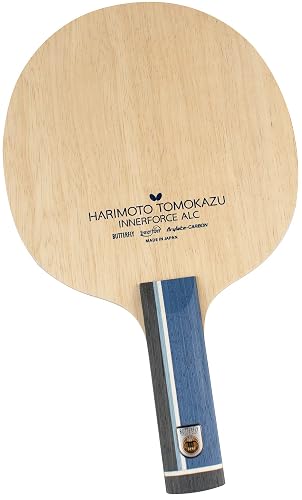
The Innerforce ALC is a signature blade associated with professional player Tomokazu Harimoto, using arylate-carbon (ALC) construction for power and speed comparable to the Viscaria. It’s genuinely advanced equipment, positioned alongside the Viscaria for players with developed, aggressive attacking technique.
Accessories That Aren’t Blades
Worth flagging directly: Butterfly also sells rubber cement (glue-free options like Chack II), racket care kits, and edge protection tape — all genuinely useful accessories, but none of them are blades. Some buying guides online lump these in with actual blade picks, which is misleading if you’re specifically shopping for a wood or carbon base. If you need a care kit or glue alongside your blade purchase, those are worth buying, just understood as a separate accessory purchase rather than part of the blade lineup itself.
How This Differs From Our General Blade Guide
Our separate guide to the best ping pong blades overall covers multiple brands side by side, including one Butterfly Primorac entry. This guide goes deeper on Butterfly specifically, covering five distinct models across the brand’s full range rather than picking just one representative option. Read the general guide if you’re comparing across brands; read this one once you’ve decided on Butterfly specifically and want the fuller picture within that lineup.
Edge Tape and Long-Term Protection
Most of these blades benefit from edge tape around the rim, protecting the wood or carbon edge from chips during accidental table or floor contact — a genuinely cheap way to extend a blade’s usable life well past what it would survive unprotected. Butterfly sells its own edge tape as a separate accessory, worth budgeting for alongside any blade purchase on this list, especially the pricier Viscaria and Innerforce ALC where protecting the investment matters more.
Matching a Butterfly Blade to Your Rubber
Butterfly’s own rubber lines, like Tenergy or Rozena, are commonly paired with these blades, but nothing requires staying within one brand — a DHS or 729 rubber works fine on a Butterfly blade. What matters more is matching intensity: the control-focused Primorac and Petr Korbel pair well with a moderately tacky rubber, while the Viscaria and Innerforce ALC suit a more aggressive rubber chosen to match their speed rather than compounding it further.
How Long a Butterfly Blade Actually Lasts
Unlike rubber, which typically needs replacing every few months of regular play, the blade itself is a much longer-term purchase — years of use under normal conditions, since the wood or carbon core doesn’t wear from routine play the way a rubber surface does. What actually ends a blade’s life is usually structural damage from a hard impact or repeated moisture exposure warping the wood layers, not wear from typical sessions. Budget accordingly: replace rubber often, expect the blade underneath to outlast several rubber replacement cycles.
Signs You’ve Outgrown Your Current Butterfly Blade
A few signals suggest it’s time to move up within this lineup. Shots that feel underpowered despite solid technique often point to a control-oriented blade like the Primorac reaching its ceiling — that’s the moment to consider the SK Carbon or eventually the Viscaria. Conversely, shots that feel wild and hard to place despite careful strokes usually mean a faster blade is currently outpacing your technique, in which case stepping back toward the Petr Korbel or Primorac to rebuild consistency is the better move than pushing forward.
Handle Options Across These Blades
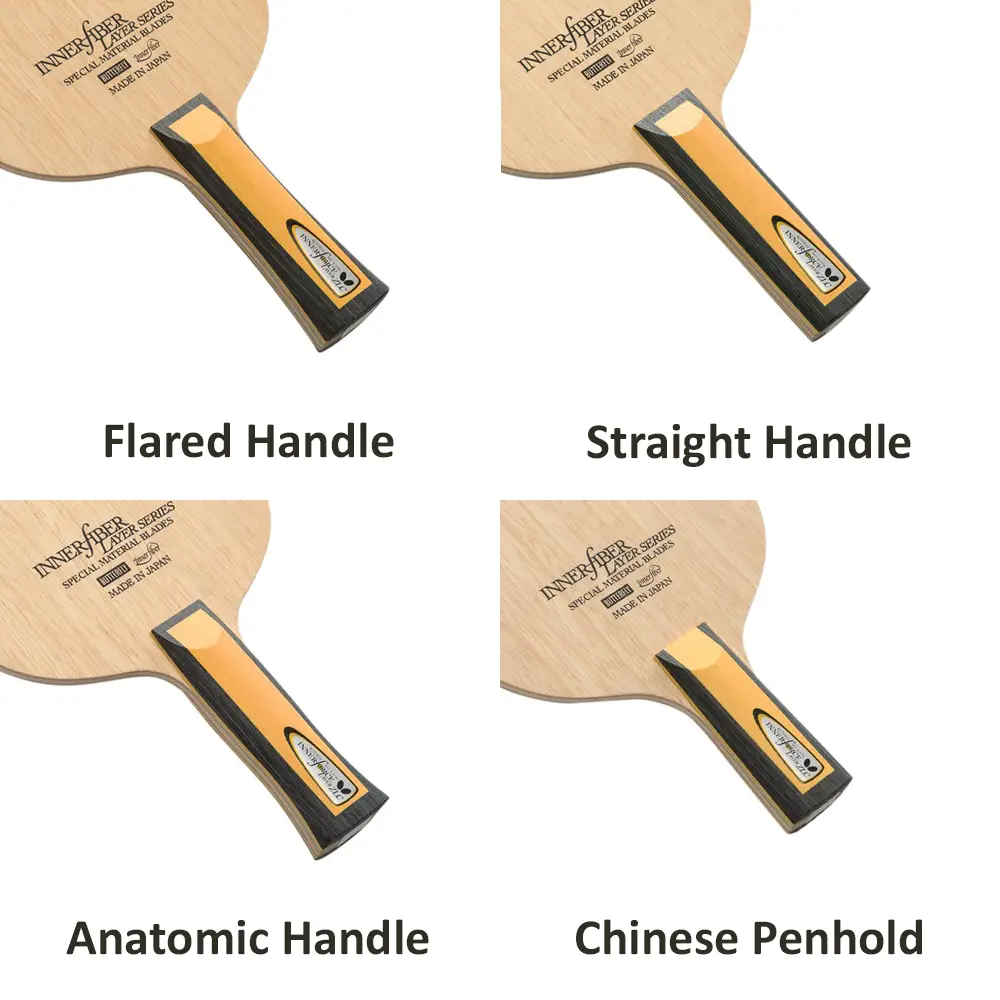
Most of these blades are available in FL (flared), ST (straight), or AN (anatomic) handle shapes depending on the specific model and listing. The Viscaria and Innerforce ALC in particular offer the widest handle selection, reflecting their position as Butterfly’s most popular professional-level blades. Check the specific listing for available handle options before ordering if you have a strong existing preference, since switching handle shape after purchase generally isn’t practical.
Where These Blades Are Manufactured
Every blade in this lineup is made in Japan, part of Butterfly’s core manufacturing operation and a detail worth knowing given how much cheaper unbranded blade construction has become available online. That manufacturing consistency is part of what buyers are paying for across this entire list — tighter quality control from blade to blade than lower-cost alternatives typically offer, which matters more the further up this lineup you go toward the premium, professional-level models.
Why Trust This List of Butterfly Blades
Every product referenced in this guide was verified individually against its actual listing before inclusion, specifically to avoid the mix-up common in other buying guides where glue, care kits, and even complete paddles from other posts get grouped in alongside genuine bare blades. Every entry here is confirmed to ship without rubber attached.
Why Butterfly Specifically?
Butterfly has manufactured table tennis equipment since the 1950s and remains one of the most trusted names among serious players, with a lineup spanning every skill level and playing style. That reputation isn’t just brand loyalty — Butterfly sponsors and equips a significant share of professional players internationally, which means its top-tier blades like the Viscaria and Innerforce ALC are genuinely tested at the highest competitive level rather than just marketed toward it.
Ply Construction Across This Lineup
The Primorac and Petr Korbel use all-wood construction across multiple thin layers, prioritizing a soft, controllable feel. The SK Carbon adds TAMCA carbon fiber layers for extra speed while keeping a wood core, landing between the pure-wood blades and the full carbon-reinforced Viscaria and Innerforce ALC. Each step up in carbon content trades some of that soft control for more raw speed and power potential — understanding where a blade sits on that spectrum matters more than any single spec when choosing between them.
Weight Differences Across These Blades
Weight varies across this lineup in ways that affect both swing speed and stability. The all-wood Primorac and Petr Korbel tend to run lighter, letting players swing faster and manage arm fatigue over a long session. The carbon-reinforced Viscaria and Innerforce ALC carry a bit more mass for their stiffness, trading some of that lightness for the added stability serious attacking play demands at high swing speed.
Break-In Period for a New Butterfly Blade
A newly assembled Butterfly blade and rubber setup typically needs a few sessions before it feels fully broken in — the glue bond settling and the rubber’s surface losing its factory stiffness both take real playing time, not just a single practice session. This applies to every blade on this list, though the premium Viscaria and Innerforce ALC in particular reward patience, since their full performance ceiling doesn’t show up until the whole setup has settled.
Butterfly’s Composite Naming, Decoded
Butterfly uses a set of abbreviations across its blade range that look impenetrable and are actually consistent once you know what each denotes. They describe the composite layer used, and that layer is the main thing separating one blade in the range from another.
- ALC (Arylate-Carbon): arylate fibre blended with carbon. The best-known category, offering carbon’s speed and enlarged sweet spot with a softer, less brittle feel than pure carbon. The usual recommendation for a first Butterfly composite.
- ZLC (Zylon-Carbon): a high-modulus blend, faster and more direct than ALC, with a distinctive feel that players tend to either strongly prefer or dislike.
- ZLF (Zylon-Fibre): zylon without the carbon component, producing a softer, more flexible blade than ZLC while keeping some of the sweet-spot benefit.
- Super ZLC: a denser zylon-carbon construction sitting at the top of the range for speed and price.
- All-wood: Butterfly also makes purely wooden blades, and these remain a legitimate choice rather than an entry tier, particularly for control-oriented play.
The practical ordering, roughly slowest and softest to fastest and stiffest, runs all-wood, then ZLF, then ALC, then ZLC, then Super ZLC. Price broadly tracks that ordering, which is why players sometimes assume the fastest is the best. It is the fastest, which is a different claim.
Why Butterfly Dominates the Conversation
Butterfly’s prominence in equipment discussion is not purely marketing, and understanding where it comes from helps calibrate how much weight to give the brand when choosing.
The company has been producing table tennis equipment since the 1950s and has sponsored top-level players across generations, which means its blades have been used and discussed at the highest level for decades. That produces an enormous body of accumulated player feedback, and it is why descriptions of how a given Butterfly blade plays tend to be reliable in a way that descriptions of newer brands’ models often are not.
It also produces a self-reinforcing effect. Players buy Butterfly because Butterfly is what gets discussed, which generates more discussion, which drives more purchases. That is worth being aware of, because it means the brand’s visibility exceeds its actual performance advantage over serious competitors.
The practical takeaway is to use Butterfly’s documentation and consistency as a genuine advantage while remaining sceptical of the implicit claim that the brand is categorically superior. Other established manufacturers make equipment that is competitive at equivalent construction, frequently for less.
Choosing Within the Range
Because Butterfly’s range is broad, the useful question is not whether a Butterfly blade is good but which part of the range matches your game.
If you are moving from a pre-made bat or a basic blade, the ALC tier is the conventional destination and for good reason. It supplies the sweet spot and speed increase that make the upgrade feel worthwhile without the demanding stiffness of the zylon blades.
If you already play with a composite blade and want more speed for a specific reason you can name, the ZLC tier is where that lives. If you cannot name the reason, it is usually the wrong purchase, since the extra speed magnifies errors as readily as winners.
If your game is built on control, placement and touch rather than pace, Butterfly’s all-wood blades deserve genuine consideration rather than being skipped as the cheap option. A control player on a fast composite blade is fighting their equipment.
Handle shape is the other axis and is independent of composition. Most models are offered in several handle types, so the choice of composition does not constrain the choice of handle, and both matter.
Matching the Range to Your Level
Reduced to a practical mapping, the range sorts reasonably cleanly onto stages of development.
- Improving beginner leaving a pre-made bat: an all-wood or ZLF blade, paired with controlled rubber. Fast composite blades at this stage magnify inconsistency rather than fixing it.
- Club player with established strokes: the ALC tier. This is where most of the range’s popularity sits, and it genuinely suits most players who train regularly.
- Advanced attacking player: ZLC or Super ZLC, if and only if you can articulate what additional speed is meant to solve.
- Control or defensive player at any level: all-wood, without treating it as a compromise.
The most common mispurchase in this range is a strong intermediate player buying at the top of the range because they have reached a level where premium equipment feels appropriate. Level and blade speed are related but not the same thing, and plenty of very strong players deliberately use slower blades than their standard would allow.
What ‘Feel’ Actually Means in a Blade Description
Blade reviews lean heavily on the word feel, which sounds subjective to the point of uselessness. It describes something real, and knowing what makes it easier to interpret descriptions you cannot test.
Feel is primarily about vibration and dwell. When the ball strikes the blade, the blade flexes and vibrates, and that vibration travels through the handle to your hand. A flexible all-wood blade transmits a rich, low-frequency vibration that communicates a great deal about where and how cleanly you struck the ball. A stiff composite blade vibrates less and communicates less.
Dwell is the closely related property: how long the ball stays in contact with the racket. Longer dwell gives more opportunity to impart spin and more sense of holding the ball, which is what players mean when they describe a blade as having good touch. Stiffer blades reduce dwell, which is why they feel more direct and less controllable on soft shots.
So when a description calls a blade crisp, direct or hard, it is describing low dwell and low vibration transfer. Soft, woody or controlled describes the opposite. Neither is better in the abstract, and matching that property to whether your game depends on touch or on pace is most of what choosing a blade involves.
Blade Size, Weight and Balance
Beyond composition, three physical properties vary across the range and are worth checking on any specific model.
Head size varies slightly between models. A larger head gives a marginally bigger sweet spot and slightly more air resistance during the swing; a smaller head is quicker to move. The differences are small but real, and a larger head suits players who mishit under pressure.
Weight varies between individual examples of the same model, because wood is a natural material. Some retailers let you specify a weight range, which is worth doing if you have a preference, and the figure that matters is the finished bat rather than the bare blade, since two rubber sheets add substantially.
Balance follows from weight distribution. A head-heavy blade feels more powerful through a full stroke and slower to reposition; a handle-heavy one feels quicker and less solid on contact. This is one of the properties least visible in online listings and most obvious the moment you hold a bat, which is a further argument for handling one in person if you can.
Handle Shapes Across the Range
Most Butterfly blades are offered in several handle shapes, and the choice is independent of composition, which means you can have any construction with any handle. It is also the property most likely to determine whether a bat feels right in the hand, and the one least assessable from a listing.
- Flared (FL): widens toward the base. The most common shakehand shape, and the most secure feeling, since the flare stops the hand sliding down.
- Straight (ST): uniform width along its length. Favoured by players who rotate the bat in hand, including anyone twiddling between two rubber surfaces.
- Anatomic (AN): contoured to fill the palm. Comfortable for those it suits and awkward for those it does not, and harder to find than the other two.
- Chinese and Japanese penhold (CS/JS): short handles for penhold grips, and not interchangeable with shakehand shapes.
If you have never compared handle shapes, holding a few at a club is worth more than any amount of reading. Handle preference is strongly individual, cannot be judged from a photograph, and unlike rubber it cannot be revisited once the bat is built.
Pairing Rubber With a Butterfly Blade
A blade is half a bat, and the rubber you pair with it changes the finished result more than the difference between two adjacent blades in the range would.
The governing principle is balance. A fast composite blade paired with fast, high-throw rubber produces a setup most players cannot keep on the table, while the same blade with controlled rubber gives you the sweet spot benefit without the speed becoming the limiting factor. Setups fail far more often by stacking speed on speed than by being too slow.
- ALC-tier blade: pairs comfortably with mid-tier tensioned rubber on both sides, which is the most common club-player configuration for good reason.
- ZLC or Super ZLC: generally wants more controlled rubber than instinct suggests, since the blade is already supplying substantial speed.
- All-wood: can carry livelier rubber comfortably, because the blade absorbs energy the rubber returns.
It is also worth changing one component at a time. Buying a new blade and new rubber together is two simultaneous variables, and you will have no way of attributing whatever happens to either. Moving your existing rubber onto a new blade first isolates the blade change cleanly, and our rubber guides cover the pairing logic in more depth.
Building the Finished Bat
A bare blade is one component of three, and it is worth planning the whole build rather than treating rubber as an afterthought once the blade has arrived.
- Two rubber sheets in different colours, chosen to balance the blade rather than picked independently. Our rubber guides cover the matching logic.
- Water-based glue, plus an applicator and ideally a roller. Our glue guide covers the process.
- Sealant, applied before the first rubber, particularly important on thin-veneer composite blades.
- Edge tape, fitted before rubber for an easier job.
- A case, which protects the finished bat between sessions.
Budget for the whole thing at once. Two sheets of decent rubber frequently cost as much as a mid-range blade, and a considered blade paired with whatever rubber was left in the budget is a setup that underperforms both components. If the total is beyond what you want to spend, buying a less expensive blade and better rubber is usually the stronger combination.
If This Is Your First Bare Blade
Buying a bare blade for the first time is a bigger step than it appears, because you are moving from a finished product to assembling one, and a few expectations are worth setting.
The blade will feel wrong at first, and that is not a sign you chose badly. Everything about your stroke is calibrated to the bat you were using, and a new setup resets that calibration. Give it several sessions before forming a view, and expect your serve and short game to be the last things to come back.
Budget for the whole build rather than the blade alone, since two sheets of rubber frequently cost as much again. If the total is more than you wanted to spend, a less expensive blade with better rubber is usually the stronger setup, because rubber is what contacts the ball and does most of the work on every shot.
And have the first one glued by a shop or a club-mate if you can watch. Seeing coat thickness and the drying stage done properly once teaches more than any written description, and it removes the main anxiety of ruining a blade you have just paid for. Most clubs contain someone who has done it dozens of times and is perfectly happy to show you once, and watching it done removes more uncertainty than reading about it ever will.
Is the Brand Premium Worth Paying?
Butterfly commands a price premium, and it is worth being honest about what that buys and where it stops being good value.
What you are genuinely paying for is manufacturing consistency, an extremely wide and well-documented range, and models with long production histories, which means the descriptions of how a given blade plays are reliable rather than speculative. For a player buying untested online, that predictability has real value.
What you are not necessarily getting is a blade that will make you play better than a well-chosen blade from another established manufacturer at a lower price. Several other brands produce excellent blades, and the performance gap at equivalent construction is smaller than the price gap.
The honest position: Butterfly is a safe choice rather than automatically the best value, and safety is worth something when you cannot try before buying. If you have access to a club where you can test blades from several brands, the case for paying the premium weakens considerably.
Comparable Blades From Other Manufacturers
Since this page covers one brand, it is worth being explicit that the rest of the market is competitive, and a reader who only compares Butterfly against Butterfly is choosing from a narrower field than they need to.
Several established manufacturers produce composite blades using similar construction principles at every tier discussed above, and at equivalent construction the performance differences are genuinely small. Where they differ more noticeably is in feel, which is individual, and in handle shapes offered, which is worth checking if you have a strong preference.
The argument for staying with a well-known brand is documentation and predictability, not superiority. If you can test blades in person at a club, cast the net wider. If you are buying blind online, the value of a model with a long track record and consistent published descriptions is real, and that is what the premium is genuinely purchasing.
Our general blade guides cover options across manufacturers, and our carbon blade guide goes into composite construction in more depth than a single-brand page usefully can.
Reading Blade Reviews Critically
Most of what is written about specific blades is written by people who own them, which introduces a predictable bias worth adjusting for when you are trying to decide.
Owners rarely conclude they made a poor choice, particularly at premium prices, and reviews written shortly after purchase capture novelty rather than settled opinion. The most useful reviews come from players who have used a blade for a season and can describe what it does badly as well as well.
Be sceptical of comparisons made from memory. A player comparing their current blade to one they used two years ago is comparing a current impression to a recollection, and equipment memory is notoriously unreliable. Comparisons made side by side in a single session carry far more weight.
The most reliable signal in any review is a specific, concrete observation, such as how the blade behaves on a particular shot or against a particular kind of ball. Generic praise, however enthusiastic, tells you almost nothing about whether the blade suits you.
Counterfeits and Buying Safely
Premium brands attract counterfeits, and Butterfly is among the most copied table tennis brands. A fake blade is not merely poor value, it plays nothing like the model it imitates, which makes every review you read about that model useless as guidance.
The defences are straightforward. Buy from established table tennis retailers or the brand’s own authorised sellers rather than from unfamiliar marketplace listings. Treat a price substantially below the general market as a warning rather than a bargain, because genuine premium blades are rarely discounted heavily.
Check the packaging and markings against official product images, and be wary of listings using generic stock photography rather than images of the actual item. Genuine blades carry consistent branding and model markings, and counterfeits frequently get small details subtly wrong.
If you are buying secondhand, the risk rises considerably, and a blade that already has rubber glued to it is both harder to authenticate and impossible to assess for surface damage underneath. Buying used blades is a reasonable way to try expensive models cheaply, but it is worth doing from someone you can ask questions of rather than an anonymous listing.
Five Ways This Purchase Goes Wrong
- Buying the blade a professional uses. Professional equipment is selected for strokes most players cannot reproduce, and a very fast blade in slower hands produces less, not more.
- Buying at the top of the range as a reward. Reaching a decent standard is not itself a reason to buy the fastest blade available, and plenty of strong players deliberately use slower ones.
- Changing blade and rubber together. Two variables at once means no useful conclusion about either.
- Skipping sealing. A one-time job that protects a thin veneer for the blade’s whole life, and one that cannot be done once rubber is attached.
- Buying from an unfamiliar marketplace listing. Counterfeits are common at this price point, and a fake plays nothing like the model whose reviews persuaded you.
The common thread is that a blade is a long-term, considered purchase rather than an impulse upgrade. Taking a little longer over it, and ideally handling one before committing, avoids nearly all of the above.
When to Upgrade, and When Not To
Blades are a durable purchase and an expensive one, so the timing of an upgrade matters as much as the choice.
The right moment is when you can describe a limitation in equipment terms. “My opening loop lacks the speed to trouble anyone” or “I mishit wide balls and they die” both point at properties a different blade genuinely changes. “I have been playing a while and want something better” does not, and upgrades made on that basis tend to disappoint.
The wrong moment is during a period of technical change. A new blade resets your calibration, and doing that while also rebuilding a stroke makes it impossible to tell which change produced which result. Wait until the technique has settled.
It is also worth checking whether the problem is actually the rubber. Rubber wears out on a schedule and blades do not, so a bat that has gradually felt worse over months is far more likely to have dead rubber than an inadequate blade. Replacing rubber is cheaper, faster and reversible, and it resolves this complaint more often than a blade change does.
Finally, if you do upgrade, keep the old blade rather than selling it immediately. Having a known reference to return to is genuinely useful during the adaptation period, and it is the only reliable way to tell whether the new blade is actually better for you or merely different.
Looking After a Premium Blade
A blade at this price is worth protecting, and the protections are inexpensive relative to the blade.
- Seal it before the first rubber application. Butterfly blades frequently use thin surface veneers, which are exactly what tears during rubber removal. Sealing is the single most valuable protective step.
- Fit edge tape. Edge chips are the usual starting point for delamination, and tape prevents most of them.
- Use a case. Protects against the knocks and pressure of transport.
- Remove rubber slowly and at a shallow angle, stopping if you feel resistance rather than pulling harder.
- Store somewhere dry and stable. Wood warps with humidity swings, and a warped blade cannot be corrected.
Done properly, a blade at this level outlasts many sets of rubber and can reasonably be expected to serve for years, which is what makes the initial cost easier to justify. Done carelessly, the same blade can be ruined during a single rubber change.
Questions Worth Answering
Is ALC or ZLC better? Neither. ALC is softer and more forgiving, ZLC is faster and more direct. ALC suits more players; ZLC suits players who specifically want what it does.
Do I need a Butterfly rubber on a Butterfly blade? No. Blade and rubber from different manufacturers pair perfectly well, and matching brands has no technical benefit.
Will a better blade fix my inconsistency? No, and a faster one will usually make it more visible. Inconsistency is a technique problem, and equipment that adds speed adds it to your errors too.
How long will one last? Years, with sealing, edge tape and careful rubber removal. Blades fail from specific damage rather than gradual wear.
Is the outgoing model worth buying when a new version appears? Frequently yes. Revisions are often incremental, and the previous generation is usually discounted while stock clears.
The Short Version
Butterfly’s range is wide and well documented, and the naming abbreviations describe composite construction rather than quality tiers. All-wood and ZLF are softer and more controlled, ALC is the popular middle, and ZLC and Super ZLC are faster and more demanding.
Most players moving up from a pre-made bat or a basic blade should be looking at the all-wood or ALC end rather than the top of the range, and should pair whatever they choose with controlled rubber rather than stacking speed on speed.
Buy from an authorised retailer, seal the blade before the first rubber goes on, and fit edge tape. Those three habits protect the purchase more than any amount of care afterwards, and the first two are considerably harder to do retrospectively.
What is the best Butterfly ping pong blade?
The Viscaria is Butterfly’s flagship professional blade, used by top-level players; the Primorac is the better starting point for less experienced players.
Is Butterfly glue the same as a blade?
No — Butterfly sells rubber cement and care kits as separate accessories, not blades; some guides mistakenly lump them together.
What’s the best beginner-friendly Butterfly blade?
The Primorac or Petr Korbel, both all-wood blades prioritizing control over raw speed.
Who uses the Innerforce ALC blade?
It’s a signature blade associated with professional player Tomokazu Harimoto, built with arylate-carbon construction for power and speed.
Do Butterfly blades come with rubber attached?
No — every blade in this list ships bare; rubber is purchased and glued on separately.
How long does a Butterfly blade actually last?
Typically years under normal use — the wood or carbon core doesn’t wear out from routine play the way rubber does, unlike rubber which needs replacing every few months.
Where are Butterfly blades manufactured?
Every blade in this lineup is made in Japan, part of Butterfly’s core manufacturing operation with tighter quality control than most lower-cost alternatives on the wider market.
As an Amazon Associate, we earn from qualifying purchases through links on this page.

Ping Pong Reviewed is an equipment review site covering table tennis and baseball gear. Specifications are checked against manufacturer listings, and prices against live retail pages, before publication.