What Is a Ping Pong Blade? A Straight Definition (2026)
What is a ping pong blade, exactly? It’s the wood or wood-carbon base of a paddle, sold on its own without rubber attached. It’s the part a player pairs with separate rubber sheets to build a complete, customized paddle, rather than buying a pre-assembled one where the rubber is already mounted. This page answers exactly that definitional question, what a blade is and how it fits into the equipment picture. For picking a specific blade to buy, our full blade guide has verified picks; for the complete decision framework, our how-to-choose guide covers grip, style, and blade anatomy together.
This might sound like a small distinction to spell out at length, but it’s genuinely the source of a lot of confusion in casual conversation and even in some published equipment guides, including several older pages on this site before we corrected them. Getting this one definition right first makes every other blade-related decision, which one to buy, how to pair it with rubber, whether you even need one, significantly easier to reason through.
Table of Contents
Blade vs. Complete Paddle
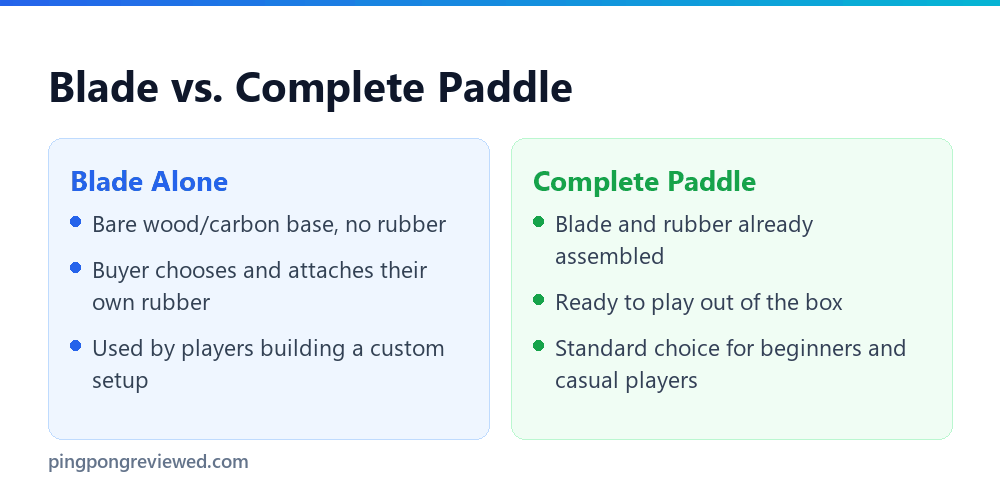
This is the single most important distinction to understand before shopping, since “blade” and “paddle” get used interchangeably in casual conversation despite meaning genuinely different products. A complete paddle, sometimes called a racket, comes pre-assembled with rubber already mounted on both faces, ready to use immediately. A blade alone is just the base, requiring you to separately buy and glue on rubber sheets yourself before it’s playable. Most beginners and casual players buy complete paddles; blades alone are mainly a custom-building option for players who want to choose their own specific rubber pairing rather than accept whatever came pre-mounted.
This confusion isn’t unique to casual players either. We’ve found the same mixup baked into several equipment guides across the internet, articles titled around “blades” that actually review complete paddles throughout, presumably because the word sounds more technical or specific even when the products discussed are pre-assembled rackets. Always check a specific listing’s actual description, does it mention rubber, sponge thickness, or being ready to play, before assuming a page titled around “blades” is actually reviewing bare blades.
The word “racket” adds a further wrinkle worth mentioning directly, since it’s used inconsistently across sources too. Some retailers and players use “racket” and “paddle” interchangeably to mean the complete, rubber-mounted setup; others use “racket” more narrowly for a customized blade-plus-rubber combination a serious player built themselves, distinct from a mass-manufactured complete paddle bought as a single unit. Neither usage is strictly wrong, but it’s worth reading a specific listing’s actual product description rather than assuming a term means the same thing across every source you encounter.
The Basic Anatomy
- Core: the innermost layer, often a lighter wood like balsa in blades built for speed, or a denser wood for control-focused blades.
- Outer plies: the visible top layers, typically a harder wood like limba or koto, which most directly affects feel and feedback on contact.
- Carbon or composite layers: found in many intermediate-to-advanced blades, adding stiffness and speed beyond what all-wood construction provides on its own.
- Handle: attached to the blade itself, typically in flared, straight, anatomic, or penhold shapes depending on grip style.
Ply count, the number of distinct layers glued together to form the blade, is one of the more commonly cited specs worth understanding on its own. All-wood blades commonly range from 5 to 7 plies; adding carbon or other composite layers typically drops the total ply count while increasing stiffness and speed, since composite materials achieve similar or greater rigidity with fewer layers than wood alone requires. More plies isn’t automatically better, it’s a design tradeoff between speed, control, and feel rather than a simple quality hierarchy where higher numbers win.
Why Buy a Bare Blade at All?
The main reason is control over rubber choice specifically. Rubber affects spin, speed, and control as much as the blade itself does, and pre-assembled paddles bundle a specific rubber the manufacturer chose, not necessarily the pairing that suits your particular playing style best. Buying a blade separately lets you pair it with rubber chosen specifically for your game, forehand and backhand rubber can even differ from each other, which a complete paddle doesn’t allow.
The tradeoff is real too: you’re now managing two separate purchases plus glue, and mounting rubber yourself carries a real risk of a bad first attempt if you haven’t done it before. This is why complete paddles remain the right starting point for most beginners, covered in more depth in our how-to-choose guide’s complete-versus-custom section.
There’s also a durability angle worth knowing about. A quality bare blade, properly cared for, genuinely outlasts the rubber mounted on it, rubber degrades faster with use and needs periodic replacement well before the blade itself wears out. Buying a blade separately means you can replace just the rubber when it degrades rather than replacing the entire paddle, a real long-term cost advantage for players who stick with the sport for years, even though it adds complexity upfront compared to simply buying a new complete paddle every time performance drops off.
How We Verified This
This definition and the anatomy breakdown were checked against manufacturer and equipment-retailer terminology rather than assumed, since “blade” and “paddle” get used inconsistently enough across casual sources that getting the core definition right mattered more than usual for this specific page.
This mislabelling is worth taking seriously as a shopper, because it is close to universal. Search “best ping pong blade” and the majority of results are roundups of complete paddles, sold ready to play with rubber already attached. If you order from one expecting a bare blade to build on, you will get something quite different from what you intended — and if you order expecting a ready-to-play paddle and receive a bare blade, you have bought roughly half a bat.
The Bottom Line
A ping pong blade is the bare base under the rubber, nothing more mysterious than that, and the distinction between it and a complete paddle is worth keeping straight before you shop for either one. Beginners should default to a complete paddle. Anyone building a genuinely custom setup, or simply curious about the terminology behind the equipment they already own, now has a straight, correctly sourced answer rather than a recycled, inconsistent one.
Frequently Asked Questions
What is a ping pong blade made of?
Typically wood, often multiple layers (plies) of different wood types glued together, sometimes combined with carbon or composite layers for added stiffness and speed in genuinely intermediate-to-advanced blades specifically.
Is a ping pong blade the same as a paddle?
No — a blade is the bare base alone, while a paddle (or racket) is the complete assembly with rubber already mounted and genuinely ready to play straight out of the box.
How does blade thickness affect performance?
Thicker blades generally play stiffer and faster; thinner blades generally offer more flex and control. Neither is universally better, it genuinely depends on your own playing style and what tradeoff between speed and control you actually prefer.
Why are there different blade shapes?
Different handle shapes, flared, straight, anatomic, penhold, suit different grip styles, and the blade face shape itself can vary slightly to suit offensive versus defensive playing styles, similar in principle to how different tennis racket grip shapes suit different holds.
Do I need a blade if I’m just starting out?
No — a complete pre-assembled paddle is the right starting point for beginners, since you likely don’t yet have strong, specific opinions about rubber pairing that would justify the added cost and complexity of buying a blade separately.
Where can I buy a real bare blade?
See our full best ping pong blades guide for verified, genuinely bare-blade picks, not the complete paddles sometimes mislabeled as blades on other sites.
Can I put any rubber on any blade?
Generally yes in terms of physical fit, most standard rubber sheets fit most standard blades, but pairing choice still matters for performance. A very fast, stiff blade paired with very fast rubber can become genuinely hard to control for anyone below an advanced skill level, even though the physical attachment itself works fine.
How long does a bare blade actually last?
With reasonable care, a quality blade can last for years of regular play, well beyond the lifespan of the rubber mounted on it, since the wood or composite core itself doesn’t degrade from ball contact the way rubber’s surface tackiness does over time.
Do professional players use bare blades or complete paddles?
Nearly all serious competitive players use custom-built setups, a specific blade paired with specific rubber chosen individually, rather than an off-the-shelf complete paddle, which is part of why understanding the blade-versus-paddle distinction matters more the more seriously you take the sport.
As an Amazon Associate, we earn from qualifying purchases through links on this page.

Ping Pong Reviewed is an equipment review site covering table tennis and baseball gear. Specifications are checked against manufacturer listings, and prices against live retail pages, before publication.