Best Carbon Ping Pong Blade: 5 Genuine Bare Blades
Table of Contents
Every Product on This List Used to Be a Paddle
We checked all seven original ASINs on this carbon ping pong blade post individually on Amazon. Every single one was a complete pre-assembled paddle, blade and rubber already glued together, several of them the exact same STIGA and PRO-SPIN products we’ve now found mislabeled as ‘blade’ on three other posts on this site. Zero of the seven were bare carbon blades.
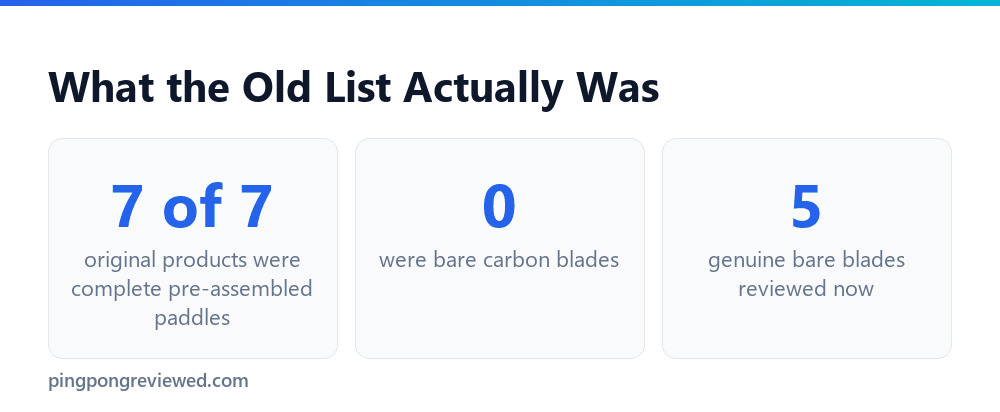
We’ve rebuilt this list from scratch with five genuine bare carbon blades, the wood-and-carbon base alone that you pair with your own choice of rubber, verified individually live on Amazon before publishing. Every price and availability figure below reflects that live check, not a stale listing snapshot.
1. HAMAL HSB-03 Elite Professional Blade
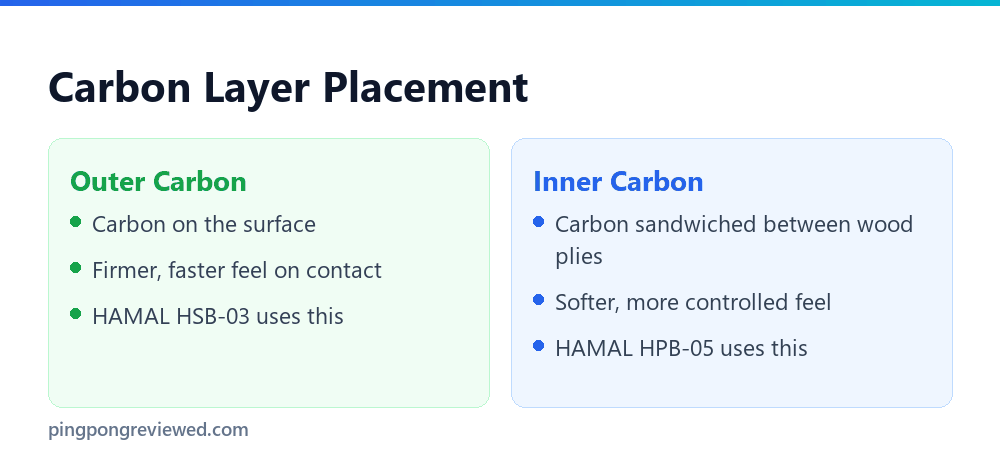
The budget entry point at under $35, built with outer carbon ZL fiber over a Koto outer ply and explicitly sold blade-only with no rubber attached. Outer carbon construction like this produces a firmer, faster feel on contact than an inner-carbon blade at a similar price.
Koto is a harder, denser wood than the softer plies used in control-first blades, and it’s part of why this blade can compete with options several times its price on raw looping performance. What you’re not getting at this price is the manufacturing consistency of a longer-established brand, expect slightly more unit-to-unit variance than the pricier picks below.
- ✓Lowest price of any genuine blade here
- ✓Outer carbon for a fast, firm feel
- ✓Explicitly sold blade-only
- ✕Less established brand than STIGA or Butterfly
- ✕Firmer feel less forgiving on mishits
2. GEWO Aruna Carbon Basic Offensive Blade
GEWO is a well-established German brand in the offensive-blade space, and the Aruna Carbon Basic is built specifically for fast, carbon-assisted offense. A reliable mid-tier pick from a brand you’ll also see recommended in our rubber guides.
“Basic” in the name signals this is GEWO’s entry point into their own offensive carbon line, not their flagship build. You get the brand’s manufacturing consistency and design philosophy without paying for the extra refinement a more advanced player would want, a sensible middle step between the budget HAMAL pick and the premium options further down this list.
3. VICTAS Swat Carbon Offensive Blade
VICTAS blades lean toward control-first offense rather than maximum pace, which suits carbon players who want the speed benefit of carbon construction without losing the placement control that pure speed blades sacrifice.
This distinction matters more for carbon blades specifically than for pure wood ones. Carbon adds speed and stiffness, and a blade that maximizes that too aggressively can actually work against you, it’s harder to keep heavily spun shots on the table when the blade itself is adding uncontrolled pace. VICTAS tunes for control first, letting your own spin and placement do the work rather than relying purely on blade speed.
4. STIGA Destiny Carbon Blade
STIGA’s own words for this blade are telling, marketed “for players who want to experience carbon fibre” with an emphasis on control and feel rather than raw speed. It’s the priciest pick here, reflecting STIGA’s brand position at the top of the market for a wood-and-carbon hybrid build.
STIGA has decades of history in this sport beyond just blades, tables, rubber, entire training programs, and Destiny Carbon reflects that institutional experience in its balance. It’s not chasing the highest possible speed rating, it’s tuned as an introduction to carbon play for someone stepping up from a pure wood blade who wants to feel the difference without an overwhelming jump in speed.
- ✓Recognized STIGA brand quality
- ✓Built for control and feel, not just speed
- ✓Genuine wood-and-carbon hybrid construction
- ✕Most expensive pick on this list
- ✕Premium price for a first carbon blade
5. HAMAL HPB-05 Table Tennis Blade
Inner carbon construction, sandwiched between wood plies rather than sitting on the surface, which produces a softer, more controlled feel than the outer-carbon HSB-03 above while still delivering real carbon speed. Aimed at intermediate to advanced players who can feel that distinction.
The Limba inner ply paired with the carbon layer is a common combination in higher-end offensive blades, Limba is a lighter African hardwood that keeps the overall blade weight manageable even with carbon added. If you’ve tried an outer-carbon blade and found the feel too harsh or unforgiving, this inner-carbon construction is the natural next thing to try, without giving up the real speed benefit carbon provides over a pure wood blade.
Which Carbon Blade Fits Your Stage
Testing whether carbon suits your game before committing serious money, start with the HAMAL HSB-03, its outer carbon delivers real carbon performance at the lowest price here. Want an established European brand’s take on carbon at a similar price tier, the GEWO Aruna Carbon Basic.
Finding pure-speed carbon blades hard to control, the VICTAS Swat Carbon trades some of that speed for placement. Want STIGA’s institutional take on an approachable first carbon blade, the Destiny Carbon. And if you’ve already tried outer carbon and want the softer, more controlled inner carbon feel, the HAMAL HPB-05 is the natural next step.
Outer Carbon vs. Inner Carbon, and Why It Matters
Not all carbon blades feel the same, and the difference mostly comes down to where the carbon layer sits in the construction. Outer carbon, like the HAMAL HSB-03, places the carbon fiber near the surface, producing a firmer, faster response that rewards a confident, committed stroke.
Inner carbon, like the HAMAL HPB-05, sandwiches the carbon between wood plies instead. That placement softens the feel at contact while still adding the speed and stability carbon provides, generally considered more forgiving and easier to control for players still developing consistent technique. Neither placement is objectively better, they suit different stroke styles and skill levels.
Protecting a Carbon Blade Long-Term
Carbon layers add speed and stability, but they don’t make a blade indestructible. The edges of any blade, carbon or not, are the most vulnerable point, a hard edge-first impact against the table or floor can delaminate the layers over time, even if it doesn’t cause visible damage immediately.
Store your blade in a case or cover between sessions rather than leaving it loose in a bag with balls and other gear. Extreme temperature swings, a hot car in summer or a cold garage in winter, can also stress the glue bonds between the wood and carbon layers over repeated exposure, so keep it somewhere climate-stable when you’re not playing, protecting a $30-200 purchase is worth the small extra effort a case requires.
Why This Overlaps With Our Looping Blade Guide
If you’ve read our best looping ping pong blade guide, three of these five picks will look familiar, the HAMAL HSB-03, VICTAS Swat Carbon, and HAMAL HPB-05. That’s not accidental duplication, carbon construction and looping performance are closely related in practice, most blades built for looping use carbon specifically because it supports the fast, spin-heavy stroke that style demands.
The two lists exist because they answer slightly different questions. This post answers “which blades genuinely have carbon construction,” the looping guide answers “which blades suit a looping-focused game specifically.” For most players those two questions converge on largely the same products, which is exactly what you’re seeing here rather than a sign that either list was padded out artificially.
What Carbon Actually Does in a Blade
A table tennis blade is a laminate of thin wood plies. A carbon blade adds one or more layers of composite fibre between wood plies, and understanding what that changes physically explains every buying decision on this page.
Composite layers are far stiffer than wood of the same thickness. That stiffness has two consequences. It returns more of the ball’s energy rather than absorbing it, producing more speed for the same stroke. And it spreads impact across a wider area of the blade face, enlarging the sweet spot so off-centre contacts behave more like centred ones.
What you trade away is feel. A flexible allwood blade deforms slightly on contact and transmits detailed information about what the ball did; a stiff composite blade deforms less and communicates less. For touch play near the net, that reduced feedback is a genuine cost, and it is why plenty of accomplished players still choose allwood deliberately rather than as a budget compromise.
The larger sweet spot is the reason carbon is often recommended to improving players, and the reduced feel is the reason it is often warned against for beginners. Both are true, which is why the answer depends on the specific player rather than being universal.
Sweet Spot, Explained Properly
The enlarged sweet spot is the benefit most often cited for carbon blades and least often explained, which leaves it sounding like marketing. It is not, it describes a measurable difference in how the blade behaves across its surface.
On any blade, a ball struck at the centre transfers energy efficiently and produces a predictable response. Struck away from the centre, more of the energy goes into flexing and twisting the blade rather than into the ball, so the shot comes off slower and at a slightly different angle. That difference between centre and edge contacts is what players experience as a small or large sweet spot.
A stiff composite layer resists that flexing and spreads the impact load across a wider area, so off-centre contacts behave more like centred ones. The sweet spot has not moved; the penalty for missing it has shrunk.
Why that matters practically depends entirely on how often you miss the centre. A player whose contact is already consistent gains little, which is part of why very strong players sometimes prefer allwood. A player under pressure, reaching wide, or still building consistency misses the centre often, and for them the forgiveness is worth real points.
It is also why carbon flatters a bat in casual hitting more than in a match. Comfortable rallying produces mostly centred contact where the difference is small; pressured match play produces the off-centre contacts where it shows.
The Composite Materials You’ll See Named
Blade listings use a range of fibre names, often abbreviated, and they are not interchangeable marketing terms, they describe genuinely different materials with different characteristics.
- Carbon in its plain form is the stiffest and fastest of the common options, and the least forgiving in feel.
- Arylate-carbon (ALC) blends aramid fibre with carbon, softening the response relative to pure carbon while keeping much of the speed and sweet-spot benefit. One of the most popular categories precisely because it compromises well.
- Zylon-carbon (ZLC) and similar high-modulus blends sit at the fast, expensive end, offering high speed with a distinctive feel that players tend to have strong opinions about in both directions.
- Aramid or glass-fibre layers without carbon increase stiffness and sweet spot more modestly, and often make a gentler introduction to composite blades than carbon proper.
The practical guidance is that plain carbon is not automatically the best choice simply because it is the fastest. For most players moving from allwood, a blended composite gives most of the sweet-spot benefit while preserving more of the feel that makes a blade pleasant to play with.
Ply Count and Where the Carbon Sits
Two construction details determine much of how a composite blade behaves, and both are usually stated in listings once you know to look for them.
Ply count is the total number of layers. Five-ply constructions tend to be more flexible and controlled; seven-ply constructions are stiffer and faster. Composite layers are counted in some conventions and not others, which is why a blade may be described as 5+2, five wood plies plus two carbon layers.
Carbon position is the detail covered in more depth elsewhere on this page, and it matters: carbon placed just under the surface engages early and gives an immediate, direct response, while carbon placed closer to the core engages later in the stroke and preserves more of the wood’s feel on soft contacts.
The overall thickness of the blade matters too, and is worth checking alongside ply count. A thicker blade is generally stiffer and faster for the same construction, and blade weight follows a similar pattern, both of which affect how the finished bat handles once rubber is added.
Blade Speed Ratings and How to Read Them
Blades are commonly described with speed categories, and like rubber ratings these are manufacturer-relative rather than standardised. The categories still convey useful information provided you read them as a rough band rather than a measurement.
- Allround (ALL, ALL+): slower, more flexible, maximum feedback. The category most coaches recommend for players building technique.
- Offensive (OFF-, OFF): the broad middle where most composite blades sit, and where most improving attacking players end up.
- Offensive plus (OFF+): very fast and stiff, demanding precise contact, and genuinely difficult to control without developed technique.
- Defensive (DEF): slow and often oversized, built to absorb rather than return energy, covered in our defensive equipment guides.
The useful discipline is to buy a category below where ambition suggests. A player who can control an OFF blade completely will beat the same player struggling with an OFF+, and control is what converts practice into consistency. Speed you cannot direct is not an asset.
Four Things Commonly Said About Carbon Blades
- “Carbon kills spin.” Not accurate as stated. Spin is generated overwhelmingly by the rubber’s grip and your brushing contact. What a stiff blade reduces is dwell time, which can make very fine touch spin marginally harder, but a carbon blade with good rubber generates enormous spin.
- “Carbon is only for advanced players.” Too absolute. The forgiveness of a larger sweet spot genuinely helps improving players. The caution is about speed, not about carbon itself, which is why a moderate composite blade often suits an improver better than a fast allwood one.
- “More carbon layers means better.” No. More layers means stiffer and faster, which past a point means less controllable. Layer count is a characteristic, not a quality grade.
- “You can feel the difference immediately.” Usually yes, but first impressions overweight speed and underweight control, which is precisely why a fast blade feels wonderful for a session and difficult for a season.
The common thread is that carbon changes specific, describable properties, stiffness, energy return, sweet-spot size, feedback, rather than making a blade generally better or worse. Every sensible buying decision on this page follows from asking which of those properties your game actually needs.
The Allwood Case, Stated Fairly
A page about carbon blades should be honest that many strong players deliberately do not use them, and that this is a reasoned preference rather than conservatism or cost.
Allwood blades flex more on contact, and that flex both dwells the ball on the racket fractionally longer and transmits more information back to the hand. Longer dwell helps spin generation; richer feedback helps the touch shots that decide a great many points at the table.
What allwood gives up is the enlarged sweet spot and the raw speed. For a player whose game is built on placement, spin and control rather than pace, that trade is straightforwardly worth making, and it is why allwood blades remain common at high levels rather than being confined to beginners.
The useful question is therefore not whether carbon is better in the abstract, but whether your game is limited by speed and off-centre forgiveness, which carbon addresses, or by touch and spin control, which it can make marginally harder. Answering that honestly about your own play is worth more than any review.
Handle Shapes and Why They Matter More Than Expected
Handle shape gets far less attention than blade composition and has a more immediate effect on how a bat feels in play, because it determines how securely and comfortably you can hold it through a fast rally.
- Flared (FL): widens toward the base. The most popular shakehand shape, and the most secure feeling for players who want the bat locked into the hand.
- Straight (ST): uniform width. Favoured by players who rotate the bat in hand, including those who twiddle between two different rubber surfaces.
- Anatomic (AN): contoured to the palm. A polarising shape, comfortable for those it suits and awkward for those it doesn’t, and harder to find.
- Chinese and Japanese penhold (CS/JS): short handles designed for penhold grips, not interchangeable with shakehand shapes.
If you have never held different handle shapes, this is genuinely worth doing at a club before ordering online. Handle preference is highly individual, cannot be assessed from a photograph, and is not something you can adjust after purchase in the way that rubber choice can be revisited.
Weight and Balance, and Why the Finished Bat Matters
Blade weight is stated in grams and varies noticeably even between examples of the same model, because wood is a natural material. That variation is normal and is why some retailers let you request a weight range.
What matters is the finished bat rather than the bare blade, since two rubber sheets add substantial weight. A heavy blade paired with thick rubber produces a bat that is slow to move into position, which costs you more in fast exchanges than the extra mass gains you in power.
- Lighter setups are quicker to manoeuvre and less tiring across long sessions, favouring fast close-to-table play and quick blocking.
- Heavier setups carry more momentum into the ball and feel more stable against pace, favouring bigger strokes played away from the table.
Balance point matters alongside total weight. A head-heavy bat feels more powerful through a full stroke and slower to reposition; a handle-heavy bat feels quicker and more responsive but less solid on contact. Neither is correct in the abstract, and it is one more reason to hold a bat before committing where that is possible.
Do You Actually Need Carbon?
Worth addressing directly, because carbon blades are marketed as an upgrade and are frequently bought before they help.
Carbon makes most sense for a player with established stroke mechanics who has identified a specific limitation: not enough speed on the attack, or too many mishits landing outside a small allwood sweet spot. Both of those are problems carbon genuinely addresses.
It makes least sense for a player still building consistency. The extra speed magnifies errors as readily as winners, and the reduced feel makes it harder to learn what the ball is doing, which is precisely the feedback a developing player needs most. A controlled allwood blade is a better teacher.
There is also a middle position worth knowing: many players who eventually settle on composite blades go through a blended-fibre blade first rather than jumping to pure carbon. That path gives up less feel while still enlarging the sweet spot, and it avoids the common experience of buying a fast carbon blade, finding it unmanageable, and concluding composites are not for you.
Choosing Your First Composite Blade
The step from an allwood blade or a pre-made bat to a first composite blade is the one most readers of this page are actually making, and a few principles make it much more likely to go well.
Go slower than you think. The most common regret is a blade that turned out faster than the buyer could control, and the second most common is nothing at all, because a slightly conservative choice rarely disappoints. If you are between two speeds, take the slower.
Prefer a blended composite over pure carbon for a first move. The sweet-spot benefit arrives either way, and a blend preserves more of the feel you are used to, which shortens the adaptation period considerably.
Keep your existing rubber if it still has life in it. Changing blade and rubber together is two variables, and you will not know which produced the difference. Moving your known rubber onto the new blade isolates the blade change cleanly.
Finally, seal the blade before its first rubber application. It costs very little effort once, protects a surface veneer that is often thin on composite blades, and makes every future rubber change substantially safer. Our sealing guide covers the process, and it is genuinely worth doing on the day the blade arrives rather than deciding later when rubber is already attached.
What Blade Price Buys
Blade pricing spans a very wide range, and unlike rubber, a blade is a durable purchase you may keep for years, which changes how to think about the cost.
At the budget end you get functional construction with less consistency between examples and simpler materials. At the middle you get reliable construction, established models with predictable characteristics, and the composite blends most players actually want. At the premium end you are paying for higher-grade veneers, tighter weight and stiffness tolerances, and the newest composite materials.
Because a blade lasts through many sets of rubber, the cost spread across its life is smaller than the sticker price suggests, which is a genuine argument for buying a good one. The counter-argument is that a player whose game is still forming does not yet know what they want a blade to do, and an expensive blade bought early is frequently sold on later at a loss.
The balanced position for most improving players is a solid mid-range blade kept for several years, with the money saved relative to a premium model spent on rubber, which is where the recurring cost sits and where a worn sheet does more damage to your play than a mid-tier blade ever will.
How to Test a Blade Before You Commit
Blades are harder to evaluate than rubber because you cannot meaningfully assess one without gluing rubber to it, and gluing rubber substantially reduces its resale value. That makes pre-purchase testing more valuable here than in any other equipment category.
- Borrow at a club. The single best option. Most clubs contain someone using the blade you are considering, and a few games tell you more than any amount of reading.
- Handle it dry. Even without playing, holding a blade tells you whether the handle shape and weight suit you, and those are two of the properties least visible online.
- Check the return policy. Some specialist retailers accept returns on unglued blades. Confirm before ordering rather than assuming.
- Buy the model below first. If choosing between two speeds in a range, the slower is the safer error and the easier one to grow into.
If you must buy untested, prioritise a well-established model with a long production history over a newly released one. Established blades have accumulated enough player feedback that the descriptions of how they play are reliable, which is much less true of a model released recently.
How Long a Blade Lasts and What Kills It
Unlike rubber, a blade is not a consumable, and a well-treated one can last many years and several rubber changes. Blades fail from specific damage rather than gradual wear, which means most blade deaths are preventable.
- Edge chips from knocking the bat against the table during play. Edge tape largely prevents this and costs very little.
- Delamination, where plies separate, usually starting from an edge chip or from moisture ingress. Once it spreads, the blade’s response changes permanently.
- Veneer tearing during rubber removal, which is the single most common self-inflicted blade injury and is covered in our glue and sealing guides.
- Warping from moisture or heat, most often from storage in damp or hot conditions rather than from play.
Sealing a blade before its first rubber application is the single most effective protective step, particularly on a composite blade where the surface veneer is often thin. It costs a small amount of time once and makes every subsequent rubber change significantly safer.
Store the bat in a case, away from heat and damp, and treat the edges as the vulnerable part they are. A blade treated this way will outlast many sets of rubber, which is what makes a considered blade purchase worth more thought than a rubber purchase.
Edge Tape and Small Protections
A few inexpensive additions protect a blade disproportionately well, and they are the easiest things in the world to skip once the blade purchase itself has already absorbed most of the budget you had set aside. They are also, between them, some of the best value in the entire equipment category, precisely because they prevent failures rather than improving performance.
Edge tape wraps the blade’s perimeter and absorbs the knocks that cause chips. Blade edges take repeated knocks against the table edge during entirely normal play, and a chip is the usual starting point for delamination further down the line, so edge tape addresses the single most common blade failure right at its source. It costs very little and takes a couple of minutes to apply, and it is far easier to fit on a bare blade before rubber goes on than to retrofit around glued sheets afterwards, which is a good reason to buy it at the same time as the blade rather than later once you have already noticed the first mark on an edge.
A proper case, meanwhile, protects the whole bat from the knocks and the pressure that come with being carried loose in a bag or a rucksack alongside everything else you take to a session. Hard cases protect better; soft sleeves are lighter and still far better than nothing at all. Either is enough to stop the bat being pressed against other kit in a bag, which is where most incidental damage to a blade edge actually comes from.
Together these two items cost a small fraction of a decent blade and prevent most of the damage that ends blades prematurely. If you are buying a bare blade at any real price, treating both as part of the purchase rather than as optional extras is the sensible framing, and it is a great deal cheaper than replacing a blade that chipped in its first month and then quietly began to delaminate from that same corner.
Buying a Bare Blade Means Building a Bat
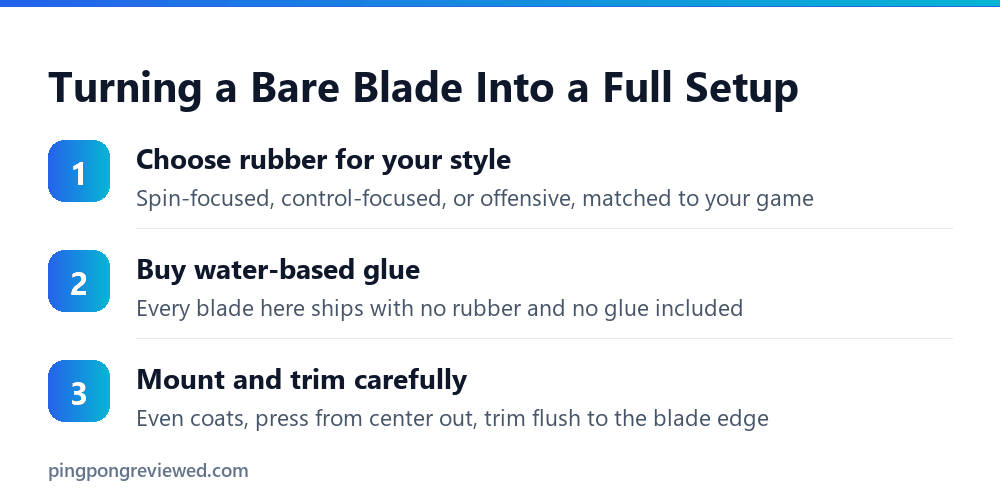
Everything on this page is a bare blade, which means the purchase is one part of a build rather than a finished product. It is worth being clear about what else that involves before ordering.
- Two rubber sheets, in two different colours to comply with the rules, chosen to suit the blade rather than picked independently. Our rubber guides cover the pairing logic.
- Glue, plus a little time. Our glue guide covers the process and the products.
- Optional edge tape, which protects the blade edge from the knocks that cause chips and delamination.
- Optional sealing, which protects the blade surface and makes future rubber removal safer, and is particularly worth considering on an expensive blade.
The total cost of a bare-blade build usually exceeds a pre-made bat at a similar headline price, which is the trade newcomers often miss. What you get for it is a bat matched to you in every component, and rubber that can be replaced independently as it wears rather than replacing the whole bat.
If you are not yet sure what you want from a blade, a quality pre-made bat is a legitimate stop on the way rather than a lesser choice. Building from parts pays off once you know what you are correcting for.
Putting a Complete Setup Together
Since a bare blade is half a purchase, it helps to think in terms of complete setups rather than individual components. The logic below is general rather than product-specific, and applies whichever blade on this page you choose.
- Improving attacker stepping up from a pre-made bat: a moderate composite blade with controlled mid-tier rubber both sides. Enough sweet spot to reward improving technique without the speed becoming the limiting factor.
- Established looper: a faster composite blade with a harder, higher-throw forehand sheet and something softer on the backhand, following the forehand/backhand logic in our rubber guides.
- Close-to-table blocker: a stiffer blade paired with lower-throw rubber, so blocks stay flat and low rather than being lifted by the equipment.
The consistent principle across all three is balance: the faster the blade, the more controlled the rubber should be, and vice versa. Setups that fail almost always fail by stacking speed on speed, and the result is a bat that feels exciting for ten minutes and unplayable for a match.
Budget accordingly as well. Two sheets of rubber frequently cost as much as the blade, and both sheets are consumables that will need replacing while the blade continues. Planning the full cost up front avoids the common outcome of an expensive blade paired with whatever rubber was left in the budget.
Questions Worth Answering Directly
Is a carbon blade worth it for a club player? Frequently yes, provided you choose a moderate speed rather than the fastest available. The larger sweet spot helps under match pressure, which is exactly where a club player loses points to off-centre contact.
Will carbon make me hit harder? It will return more of the energy you supply, so yes at a given stroke, but that cuts both ways: errors also travel faster and further. Extra speed you cannot place is not an advantage.
How long should a blade last? Years, with reasonable care. Blades fail from specific damage, edge chips, delamination, veneer tearing during rubber removal, rather than gradual wear, which means most blade replacements are avoidable.
Should I buy a blade or a pre-made bat? A pre-made bat if you are still learning what you want, since it is cheaper overall and requires no assembly. A bare blade once you can name what you want to change, because that is the point at which choosing each component separately starts paying off.
Does a heavier blade hit harder? It carries more momentum, but it is also slower to move into position, and in fast exchanges being late costs more than the extra mass gains. Judge the finished bat with rubber attached rather than the bare blade weight on a listing.
The Short Version
Carbon blades trade feel for speed and forgiveness. That trade is worth making if your game is limited by pace or by off-centre contacts costing you points, and not worth making if your game is limited by touch, spin control, or basic consistency.
If you are buying your first composite blade, go slower than ambition suggests, prefer a blended fibre over pure carbon, keep your existing rubber so the blade is the only variable, and seal the blade before the first rubber goes on. Those four decisions prevent the large majority of first-composite regrets.
And budget for the whole build rather than the blade alone. Two sheets of rubber often cost as much again, they are consumables while the blade is not, and a considered blade paired with leftover-budget rubber is a setup that underperforms both components.
What happened to the original products on this post?
All seven were complete pre-assembled paddles, not bare blades, the same mislabeling pattern we’ve now found on multiple blade posts on this site. We rebuilt the list from scratch with five genuine bare carbon blades.
What’s the difference between a carbon blade and a regular wood blade?
A carbon blade includes one or more carbon fiber layers within its wood construction, adding speed and stability that pure wood blades don’t provide. This generally suits offensive, looping styles better than pure control play, where a softer all-wood build is often preferred instead.
Do I need carbon if I’m not an advanced player?
Not necessarily. Carbon rewards a confident, committed stroke, if you’re still building consistent technique, a pure wood all-round blade may actually be more forgiving while you develop your fundamentals before adding carbon speed into the equation.
Is outer carbon or inner carbon better?
Neither is objectively better, outer carbon gives a firmer, faster feel that rewards committed strokes, inner carbon gives a softer, more controlled feel that’s generally more forgiving. Match it to your own stroke style and current skill level, not a fixed universal rule that applies to everyone.
How much does a full carbon blade setup cost including rubber?
Budget the blade price plus roughly $15-40 per side for rubber, so a full setup on the budget HAMAL blade runs about $65-115 total, while the premium STIGA blade with good rubber lands closer to $230-280.
Can I use any rubber with a carbon blade?
Yes, there’s no hard rubber-to-blade compatibility restriction. Pair a spin-focused or offensive rubber with these blades to make the most of the carbon’s speed and stability, a purely defensive rubber would waste much of what a carbon blade offers.
Will a carbon blade make me a better player automatically?
No, a carbon blade adds speed and stability the equipment can provide, but it doesn’t teach stroke technique or shot selection. Pairing new equipment with deliberate practice, not just the upgrade itself, is what actually improves your game over time, equipment amplifies existing technique rather than replacing the need to build it.
As an Amazon Associate, we earn from qualifying purchases through links on this page.

Ping Pong Reviewed is an equipment review site covering table tennis and baseball gear. Specifications are checked against manufacturer listings, and prices against live retail pages, before publication.