Mizuno Table Tennis Shoes: Full Lineup and US Options (2026)

Yes, Mizuno makes table tennis shoes: Mizuno Japan lists the Wave Drive Neo 4, Wave Drive EL 2, Wave Drive 9, Wave Medal 8 and Wave Kaiserburg 8, among others. But we found none sold through Mizuno USA, whose racquet sports range is tennis and pickleball shoes, and on October 8, 2026 we found no Mizuno table tennis shoe with a price and offer on Amazon.com. We haven’t tested any shoe, so this guide reports what Mizuno and Amazon state.
Search for Mizuno table tennis shoes and you’ll find old lists of running and volleyball shoes, retailer pages for single models and forum threads about sizing. What you won’t find is the full current lineup with Mizuno’s own weights and widths, or a plain answer to whether a US buyer can get any of it.
We read Mizuno’s own pages in Japan, Europe and the US, plus Amazon’s product data, on October 8, 2026. Below are the shoes Mizuno lists for the sport, what the US shelf has instead, and what we could not confirm. For other brands, see our Adidas table tennis shoes guide and Butterfly table tennis shoes guide.
- →Mizuno Japan lists eight table tennis shoes we could read in full, across the Drive, Medal and Kaiserburg families and a signature model.
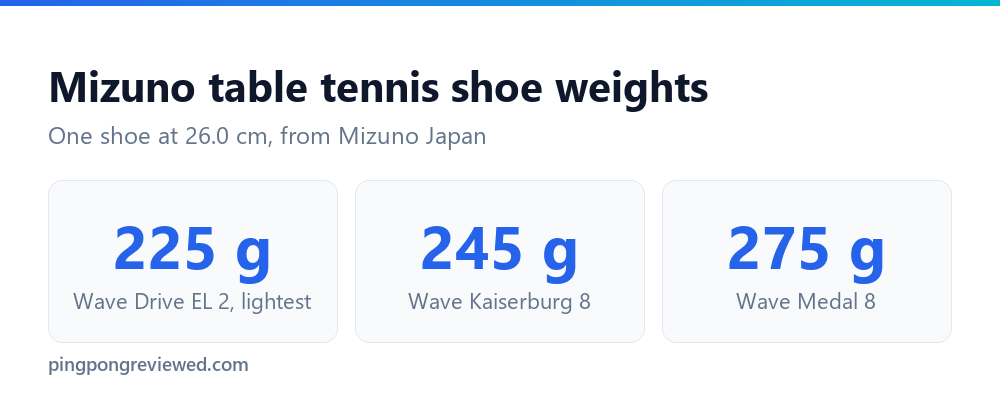
- →The Wave Drive EL 2 is the lightest at about 225 g per shoe (at 26.0 cm). The Wave Medal 8 is the heaviest of the standard models at about 275 g.
- →Two models, the Medal 8 Wide and the Kaiserburg 8, are listed as 3E width.
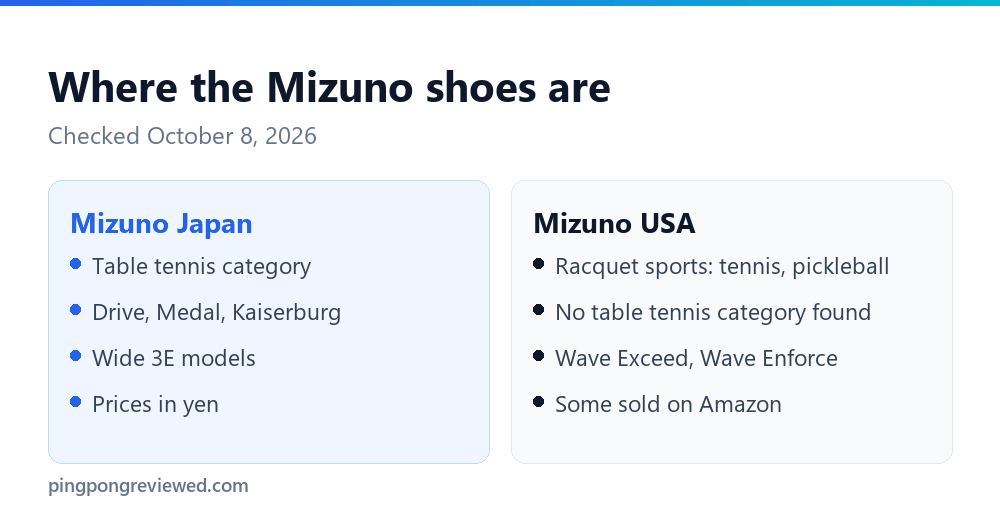
- →We found no table tennis category on Mizuno USA’s site. Its racquet sports shoes are tennis and pickleball shoes.
- →Mizuno Japan prices below are Japan list prices in yen. They are not US prices.
Table of Contents
Mizuno table tennis shoes: the current lineup
These are the table tennis shoes on Mizuno Japan’s table tennis page that we could read in full: the models in Mizuno’s own lineup table plus the BOA and signature versions. Some colors are listed on separate pages. Weights are for one shoe at 26.0 cm, as Mizuno states them. Prices are Japan list prices in yen with tax included, so don’t read them as US prices.
Mizuno’s own lineup table sorts the families this way: Drive for lightweight, flexible and a barefoot feel, Medal for stability and cushioning, and Kaiserburg for lightweight and wide. We are repeating Mizuno’s grouping, not testing it.
Wave Drive: the lightest family
The Wave Drive EL 2 is the lightest shoe in Mizuno’s table tennis lineup. Mizuno lists a synthetic leather and synthetic fiber upper, a synthetic sole and a removable cup insole. It is not a mesh shoe. Mizuno describes a non-marking sole with extra-grade rubber for grip and durability, a diagonal flex groove in the midfoot to support fast turns, and a midsole about 10 percent lighter than its ap+ material at the same rebound. The first color went on sale on November 28, 2025, and Mizuno says it is made in Vietnam.
The Wave Drive Neo 4 weighs about 265 g, and Mizuno describes it as sharpening the lightweight, barefoot feel. The Wave Drive 9 is described as the ninth generation of the Drive, with a new sole for lightness, flexibility and a barefoot feel, at about 235 g. In Europe, Mizuno’s site lists the Wave Drive Neo 3 under Table Tennis, with a stack height of 9.0 mm. It showed as out of stock there on October 8.
Wave Medal: the stability family
The Wave Medal 8 weighs about 275 g. Mizuno says it is the first table tennis shoe to use its ENERZY NXT midsole material. Its European page calls it an especially good option for players seeking stability, and shows the same 275 g. See Mizuno’s European page, which showed it out of stock on October 8.
There are two variants. The Medal 8 Wide keeps the weight and is listed as 3E, with an instep girth 6 mm above the normal last. The Medal 8 BOA adds a BOA dial fit system and weighs about 285 g.
Wave Kaiserburg 8: lightweight and wide
The Wave Kaiserburg 8 is listed at about 245 g in two colors and about 220 g in a third, measured at 24.0 cm. It is 3E width and made in Cambodia, and it has the lowest Japan list price in the table at 11,000 yen. Mizuno describes it as keeping the lightweight, wide feel. Together with the Medal 8 Wide, it is one of two Mizuno table tennis models we found in 3E width.
There is one more model for beginners. Mizuno’s European site lists the Crossmatch Sword 2 as a shoe for starting out, with a light weight, flat sole and flexibility. It gives no weight, price or sizes, and it showed as out of stock on October 8.
Can you buy Mizuno table tennis shoes in the US?
Not from Mizuno USA. Its home page lists shopping by sport, and racquet sports covers tennis and pickleball shoes, racquets, paddles, bags and apparel. The words table tennis don’t appear on its racquet sports page. We also searched Mizuno USA’s product sitemap of 1,290 product pages and found no Wave Drive, Wave Medal or Crossmatch. That is evidence of absence from a sitemap, not a statement from Mizuno.
On Amazon.com we ran 11 searches and found Mizuno tennis, pickleball, volleyball and running shoes, but no Mizuno table tennis shoe with a price and an offer. One catalog entry exists for the Wave Drive EL 2, titled in Japanese-style text, with no price or offer in Amazon’s data. We don’t link it, because we can’t tell it’s buyable. eBay shows Mizuno table tennis shoes from sellers, which is existence only, and we did not check prices or stock.
Mizuno’s Japanese store may ship abroad, and we did not check. If you want a Wave Drive or Medal, that is the question to answer first: who sells it to you and what they charge for shipping and returns.
Mizuno shoes you can buy on Amazon US: tennis and pickleball crossovers
If you want a Mizuno shoe in the US, the realistic route is a racquet sports shoe. Mizuno calls these tennis or pickleball shoes and never mentions table tennis, so this is a crossover choice and not a recommendation we can back with test data. Prices vary by size and color on Amazon. Mizuno USA’s own list prices are below, and the Tour 7 variants we checked on Amazon were priced from $145.73 to $155.00 on October 8.
Wave Exceed Court AC
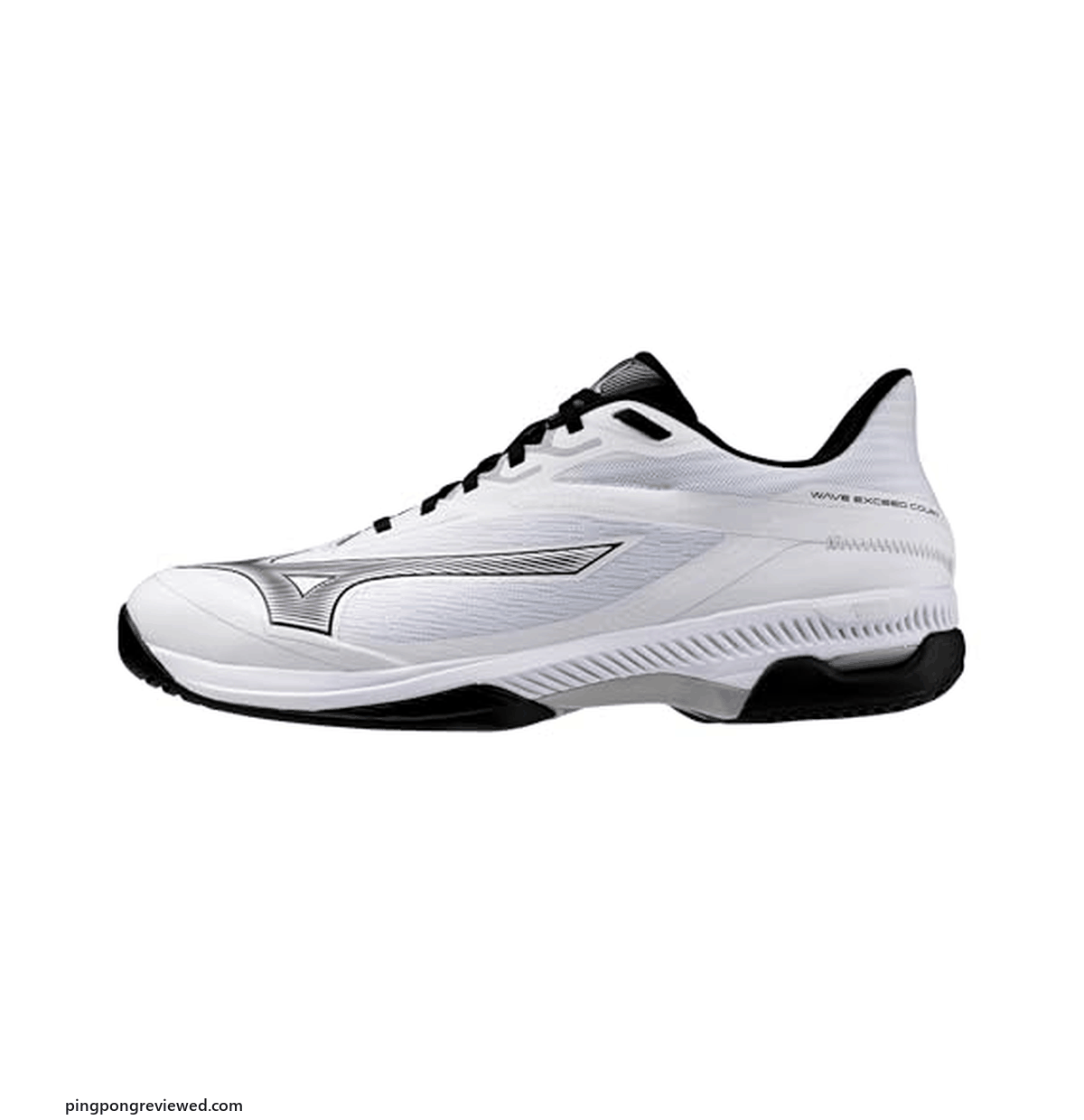
The men’s Wave Exceed Court AC lists at $120 on Mizuno USA. Mizuno says it is made for the active tennis or pickleball player and expands on the legacy of the Wave Exceed Light series, with a comfort last that has a spacious width, an ENERZY NXT midsole and an engineered mesh upper. A women’s version, the women’s Wave Exceed Court AC, is also listed at $120. Both Amazon listings are for one size and color.
Wave Exceed Tour 7 AC
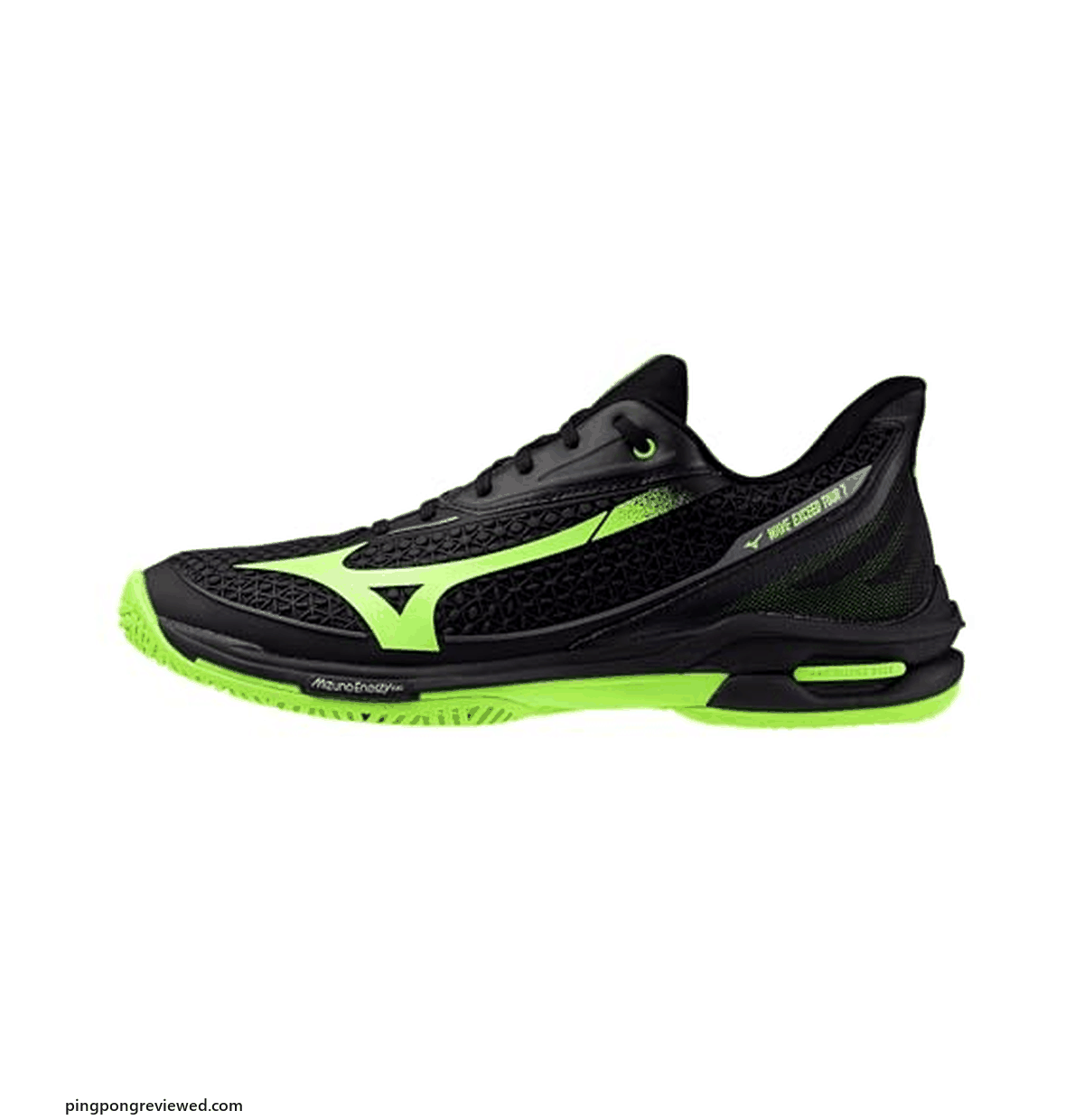
The men’s Wave Exceed Tour 7 AC lists at $155 on Mizuno USA, with an ENERZY XP midsole, a Wave plate and a DX Rubber outsole. Mizuno’s page claims a 6-month outsole guarantee. Mizuno’s outsole warranty page says the wear must come from tennis, pickleball or a normal hard court racquet sports surface, and the version of that page we read lists earlier Tour models, not the Tour 7, so check the terms before you rely on it.
Wave Enforce Court AC

The men’s Wave Enforce Court AC lists at $120 on Mizuno USA, which describes it as perfect for tennis or pickleball and gives it an X10 rubber outsole. Amazon’s listing describes the X10 outsole as durable carbon rubber for longer wear.
The Mizuno Wave listing text on Amazon says the Wave plate disperses energy from impact to a broader area, for a stable platform and cushioning. That is Mizuno’s marketing description. We didn’t check venue or federation footwear rules, so ask your venue what it requires before you buy a shoe from a different sport.
Mizuno shoe sizing: why we give no rule
Mizuno Japan sizes its table tennis shoes in centimeters, from 21.0 to 29.0 cm depending on the model. Other sites disagree on how that compares with Butterfly or US sizes. Pingpongbros says the Wave Drive 8 and Wave Medal 5 run 0.5 to 1 size smaller than regular shoes, Racket Insight lists the Wave Drive 8 as true to size, and some forum posters say Mizuno shoes come up large. Those reports are about older models and they conflict, so we don’t repeat any as a rule.
Measure your foot in centimeters and read Mizuno’s size chart, whose table we couldn’t extract. If you order from outside the US, check the seller’s return terms in case the size is wrong.
How other guides describe Mizuno table tennis shoes
Some editorial pages we read are out of date. Tabletennisspot’s Mizuno guide says the Wave Drive series seems to have been discontinued, while Mizuno Japan lists three Drive models in 2026. See that guide. Others cover only the Wave Drive 8 or Wave Medal 5, or list running and volleyball shoes as table tennis shoes. We found no editorial page that states the current lineup with Mizuno’s own weights, or says Mizuno USA doesn’t sell it.
How we checked this guide
We read Mizuno Japan’s product pages for each model, Mizuno’s European pages for the Neo 3, Medal 8 and Crossmatch Sword 2, Mizuno USA’s site, sitemap and product pages, and Amazon’s product data, all on October 8, 2026. We did not test any shoe, so we don’t say how any of them feel, grip or wear. Sources we couldn’t open, such as Decathlon and SportsShoes pages and Mizuno’s US size chart table, are left out. Prices and stock change, and Japan list prices are not US prices.
Frequently asked questions
Does Mizuno make table tennis shoes?
Yes. Mizuno Japan lists the Wave Drive Neo 4, Wave Drive EL 2, Wave Drive 9, Wave Medal 8 (plus Wide and BOA versions) and Wave Kaiserburg 8 as table tennis shoes. Mizuno’s European site lists the Wave Drive Neo 3, Wave Medal 8 and Crossmatch Sword 2 under Table Tennis.
Can I buy Mizuno table tennis shoes in the US?
Not from Mizuno USA, whose racquet sports range is tennis and pickleball shoes. We found no Mizuno table tennis shoe with a price and an offer on Amazon.com on October 8, 2026. A Wave Drive EL 2 catalog entry exists there with no price, so we don’t link it.
Is the Mizuno Wave Drive discontinued?
Not according to Mizuno. Mizuno Japan lists the Wave Drive Neo 4, Wave Drive EL 2 and Wave Drive 9 in 2026. One guide we read, Tabletennisspot, calls the Drive series discontinued, which is out of date.
Which Mizuno table tennis shoe is the lightest?
On Mizuno Japan’s pages the Wave Drive EL 2 is the lightest, at about 225 g per shoe at 26.0 cm. The Drive 9 is about 235 g, the Kaiserburg 8 about 245 g, the Neo 4 about 265 g and the Medal 8 about 275 g.
Does Mizuno make wide table tennis shoes?
In Japan, yes. The Wave Medal 8 Wide and the Wave Kaiserburg 8 are listed as 3E width, and the Medal 8 Wide has an instep girth 6 mm above the normal last. We did not find them in US stores.
What is the difference between Wave Drive and Wave Medal?
Mizuno’s own lineup table groups the Drive shoes as lightweight, flexible and barefoot-feeling, the Medal shoes as stability and cushioning, and the Kaiserburg as lightweight and wide. That is Mizuno’s description, not our test result.
Are Mizuno tennis shoes OK for table tennis?
Mizuno describes the Wave Exceed Court AC, Wave Exceed Tour 7 AC and Wave Enforce Court AC as tennis or pickleball shoes and does not mention table tennis. Mizuno’s Tour 7 page cites a 6-month outsole guarantee, and its warranty page describes tennis, pickleball and hard court wear and does not list the Tour 7, Court AC or Enforce Court AC. Treat them as a crossover choice, and check your venue’s floor rules.
How do Mizuno table tennis shoe sizes work?
Mizuno Japan lists sizes in centimeters, such as 22.0 to 29.0 cm for the Wave Drive EL 2. Fit reports from other sites are about older models and conflict, so we give no sizing rule. Measure your foot and use Mizuno’s size chart.
Sources
Lineup specs come from Mizuno Japan’s table tennis page and product pages for the EL 2, Neo 4, Drive 9, Medal 8, Medal 8 Wide, Medal 8 BOA and Kaiserburg 8. European listings are from Mizuno’s pages for the Neo 3, Medal 8 and Crossmatch Sword 2. US shoes come from Mizuno USA and Amazon’s product data.
As an Amazon Associate, we earn from qualifying purchases through links on this page.

Ping Pong Reviewed is an equipment review site covering table tennis and baseball gear. Specifications are checked against manufacturer listings, and prices against live retail pages, before publication.