Best Shoes for Playing Table Tennis: 3 Verified Picks (2026)

If you are looking for the best shoes for playing table tennis specifically, this guide covers purpose-built pairs only — not running or gym crossover shoes, and not arch-specific picks, both of which have dedicated guides elsewhere on this site. Three meaningfully different options follow, rather than a longer list padded with near-identical listings from the same manufacturer, which is how most table tennis shoe roundups reach ten.
This is one of several shoe guides on this site, and it’s worth being upfront about how they differ so you land on the right one. This page is the general purpose-built pick for anyone without a specific fit constraint. If you have high arches or need extra width, our dedicated arch-support guide goes deeper on that specific need. If you want one shoe that handles running, gym training, and table tennis reasonably well rather than three separate pairs, our crossover shoe guide covers that tradeoff directly.
Table of Contents
Why Table Tennis Needs a Specific Shoe
Table tennis demands rapid lateral movement and sudden direction changes in a small footprint, closer to badminton or squash footwork than running or general gym training. Purpose-built table tennis shoes use a non-marking gum rubber outsole for grip on indoor court surfaces, a lighter overall build than running shoes since you’re not absorbing repeated heel-strike impact, and reinforced lateral support the way a running shoe, built for forward motion, generally doesn’t need.
The outsole compound matters more than most players realize before switching to a purpose-built pair. Indoor table tennis courts are typically finished wood, vinyl, or rubberized sports flooring, and a running shoe’s sole is generally designed and rated for outdoor asphalt or treadmill use rather than for a fast, precise grip-and-release motion on a polished indoor surface. That mismatch shows up most under sudden lateral direction changes, exactly the movement table tennis footwork relies on most, where an under-gripping sole can slip and an over-gripping one can catch and strain a knee or ankle.
Weight distribution across the shoe also differs from most running shoe design. Running shoes generally concentrate cushioning under the heel for repeated forward impact, while table tennis shoes distribute support more evenly and often add reinforcement specifically around the outer edge of the midsole, where lateral pushes off the foot load the most force during a quick side step. That structural difference is part of why a genuinely good running shoe can still feel unstable during table tennis footwork despite being an excellent shoe for its intended purpose.
3 Verified Picks
1. Butterfly Lezoline Rifones — Best Overall
Butterfly Men’s Lezoline Rifones Table Tennis Shoes, $97.88, is a purpose-built competition shoe with shock-absorbing cushioning and a grip-focused outsole designed specifically around table tennis footwork. It’s the consistent top pick across the competitor guides we checked researching this page, not just our own preference in isolation.
2. Butterfly Lezoline Vilight — Best for Wider Feet
Butterfly Lezoline Vilight Table Tennis Shoes, $99.99, is a slightly roomier fit within the same Lezoline line, worth trying if the Rifones runs narrow for your foot shape. Both share the same core outsole grip technology, so the choice between them comes down mainly to fit rather than a real performance gap.
3. JOOLA Table Tennis Shoes — Best Budget Pick
JOOLA Table Tennis Shoes, $47.22, costs roughly half of either Butterfly pick while still being purpose-built for the sport rather than a generic athletic shoe repurposed for table tennis. Rating volume on this specific listing is thinner than the established Butterfly models, so treat it as a promising budget option rather than as proven at the same track-record level.
None of these three are wrong choices — they represent three genuinely different tradeoffs rather than a strict best-to-worst ranking. The two Butterfly picks differ mainly in fit rather than performance tier, and the JOOLA pick trades some of the Butterfly line’s established track record for a meaningfully lower price. Buying based on your actual foot shape and budget will serve you better than assuming a higher number one pick is automatically the right choice for everyone.
Why Not Just Use Running or Gym Shoes?
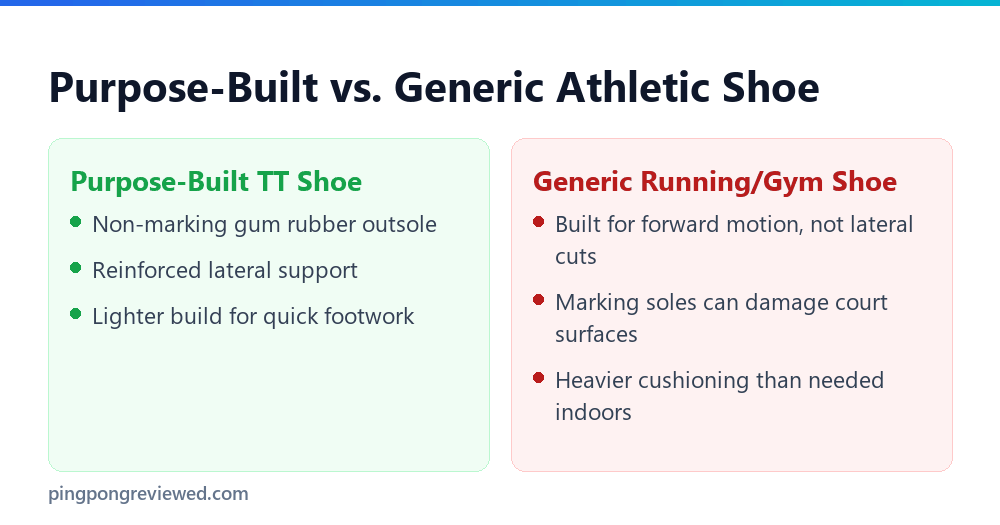
You can play casually in whatever athletic shoes you own, and plenty of recreational players do. The tradeoff is real though: running shoes are optimized for repeated forward impact absorption, not the lateral cutting and quick direction changes table tennis demands, and many running or generic gym shoes use soles that mark indoor court surfaces. If you’re playing occasionally and casually, this tradeoff may not matter enough to justify a dedicated pair. If you’re playing regularly enough that footwork and court etiquette matter, a purpose-built shoe is worth the investment. We cover genuine crossover options built to handle running, gym, and table tennis reasonably well in a separate dedicated guide for readers who specifically want one shoe for multiple activities.
Getting the Fit Right
- Leave a thumb’s width at the toe, the same rule as any athletic shoe — table tennis footwork involves quick stops that push your foot forward inside the shoe.
- Prioritize a snug midfoot and heel over toe-box room, since lateral stability depends more on the shoe not shifting around your foot than on toe space.
- Break them in before a real match, not during one — a few practice sessions in new shoes avoids discovering a fit problem mid-game.
- If you have wide feet or high arches specifically, our dedicated high-arch table tennis shoe guide covers picks built around those needs rather than standard-width options.
One fitting detail specific to table tennis shoes worth flagging separately: several brands, including some Butterfly models, are manufactured to a Japanese or European sizing standard and labeled accordingly on the listing rather than US standard sizing. Ordering your usual US shoe size without checking the specific listing’s conversion chart first is one of the more common return-and-reorder mistakes with this category of shoe specifically, more so than with mainstream running or gym shoe brands that consistently use US sizing throughout their entire catalog.
How We Verified These Picks
Each of the three picks above was checked against its own live Amazon listing individually for current price, current rating count, and that the listing genuinely describes a purpose-built table tennis shoe rather than a relabelled generic athletic one. Watch for that when comparing elsewhere: several near-identical Butterfly SKUs (“Athletic”, “Sneaker”, “Unisex”, “Womens Athletic”) circulate as if they were meaningfully different models.
We also cross-checked each pick’s positioning against multiple independent competitor guides rather than relying on a single source, since shoe recommendations shift as models get discontinued or replaced more often than most other table tennis equipment categories. A shoe recommended confidently a year or two ago can quietly disappear from a brand’s current lineup without much notice, the same pattern we’ve run into repeatedly rebuilding equipment guides across this site.
Frequently Asked Questions
What are the best shoes for table tennis?
Purpose-built options from Butterfly’s Lezoline line are the most consistently recommended across the guides we checked, with the Rifones and Vilight both being strong picks depending on fit. JOOLA’s table tennis shoe is a solid, meaningfully cheaper alternative.
Are Butterfly table tennis shoes worth the price?
For regular players, generally yes — the non-marking grip outsole and lateral support genuinely matter for footwork once you’re playing consistently. For occasional casual play, the price difference over a budget purpose-built option like JOOLA may not be worth it.
Do ASICS Gel-Rocket shoes work for table tennis?
Yes, as a genuine crossover option — we cover the Gel-Rocket 10 specifically in our high-arch table tennis shoe guide, where its thicker sole provides extra support some players need.
Are lightweight shoes better for table tennis?
Generally yes, within reason — less shoe weight means less fatigue over a long match or practice session, which matters more in a sport built around quick, repeated footwork than in sports with less constant movement.
What size should I choose for table tennis shoes?
Check the specific brand’s size chart rather than assuming your regular shoe size translates directly — several table tennis shoe brands, including some Butterfly models, run narrower than standard US sizing.
Can women wear the shoes listed above?
Yes, all three picks are available in sizing that fits both men and women, though always check the specific listing’s size chart since table tennis shoe brands don’t follow standardized US sizing conventions consistently.
How often should I replace table tennis shoes?
Roughly every 6 to 12 months for regular players, or sooner if you notice the outsole grip has visibly worn smooth or the cushioning has flattened. Playing on worn-out grip is a genuine injury risk given how much lateral movement the sport demands.
Do table tennis shoes work for badminton or squash too?
Often reasonably well, since all three sports share similar lateral-footwork demands and non-marking indoor-court requirements. They’re not a perfect substitute for a sport-specific shoe if you play that other sport seriously, but they’re a far better crossover fit than a running shoe would be.
As an Amazon Associate, we earn from qualifying purchases through links on this page.

Ping Pong Reviewed is an equipment review site covering table tennis and baseball gear. Specifications are checked against manufacturer listings, and prices against live retail pages, before publication.