Best Ping Pong Catch Net: Clamp-On or Freestanding, 6 Picks (2026)

The best ping pong catch net depends on one choice first: a net that clamps to the table, or a freestanding one on wheels. On October 8, 2026 the lowest-priced clamp-on net we could verify was the JOOLA iPong at $32.25 on Amazon ($39.95 on JOOLA’s site), and the lowest-priced freestanding picks were the lukar at $81.99 and the Yuanclllp at $119.70. We haven’t tested any net, so this guide reports what makers and listings state.
A ping pong catch net hangs behind your end of the table and stops balls before they scatter across the room. People buy one for solo serve practice, for multi-ball drills and for use with a robot. Most of the results we saw for a ping pong catch net are shop listings, and the two editorial guides we found give no prices and no clamp measurements.
This guide fills those gaps with figures from the makers’ own pages, Amazon’s product data and the ITTF rules, all checked on October 8, 2026. If you are deciding what to buy for a robot, our ping pong machine guide covers the robots themselves.
- →Only three of the nets here attach to the table: the JOOLA iPong, the PONGBOT and the Butterfly Collection Net 1. The rest stand on wheels behind the table.
- →Clamp openings are 3 in (iPong, per Megaspin) and 3 1/2 in (Butterfly Collection Net 1, per Megaspin). The PONGBOT’s Amazon title says for tables with sides under 3 inches.
- →The ITTF table is 1.525 m (about 60 in) wide. The four nets with a published width run from 66 in (iPong) to 92 in (Yuanclllp), all wider than that. PONGBOT and Butterfly’s Net 1 publish no width.
- →None of the sources we read give a catch rate or a setup time for any net. Be wary of listings that quote either.
- →Several generic listings reuse JOOLA’s wording for different, pricier nets. Seller copy is not evidence.
Table of Contents
Ping pong catch net types: clamp-on or freestanding
A clamp-on net attaches to the table. A freestanding net sits on the floor behind it, usually on wheels. Tabletennisspot, a guide we read, calls these fitted and non-fitted nets, and that is a fair way to think about them: the first depends on your table’s edge, and the second depends on your floor space.
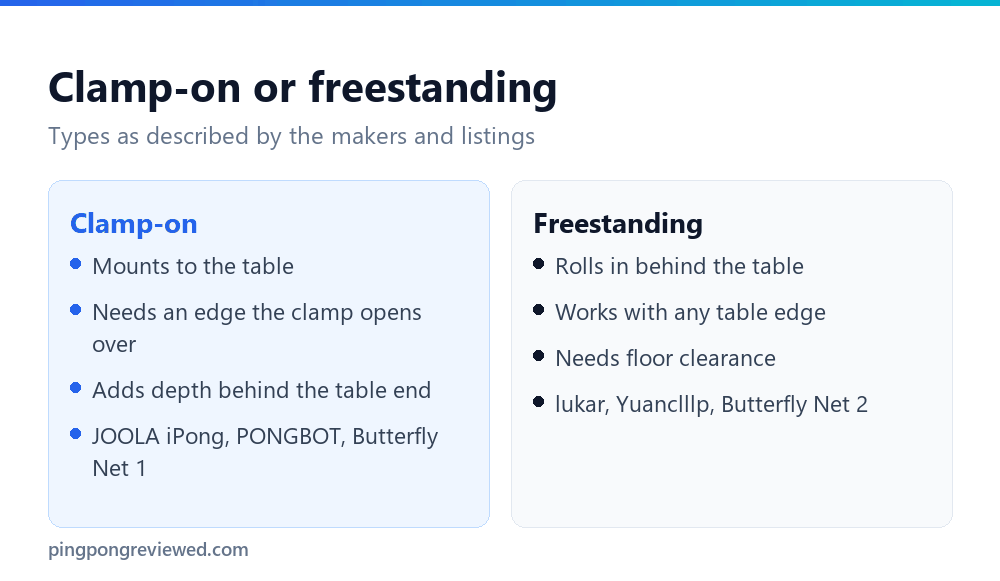
For a ping pong catch net, choose clamp-on if your table has an edge or frame the clamp can open over and you want something compact. Choose freestanding if your table edge is thicker than the clamp opening, or if you want to move the net out of the way between sessions. Butterfly makes the same point about its own freestanding net: it says the Collection Net 2 will work with all tables, unlike catch nets that attach directly to the table.
Ping pong catch net comparison: six nets with prices checked October 8, 2026
A note on stock. On October 8, the Yuanclllp showed only one left on Amazon and the lukar showed 13 left, so those listings may be gone by the time you read this. Butterfly’s shop showed the Collection Net 2 in stock with 11 units, while Megaspin showed the Collection Net 1 as notify-me, so the two sellers disagree on that one.
The clamp-on nets
1. JOOLA iPong Carbon Fiber Catch Net: the lowest-priced clamp-on net we could verify
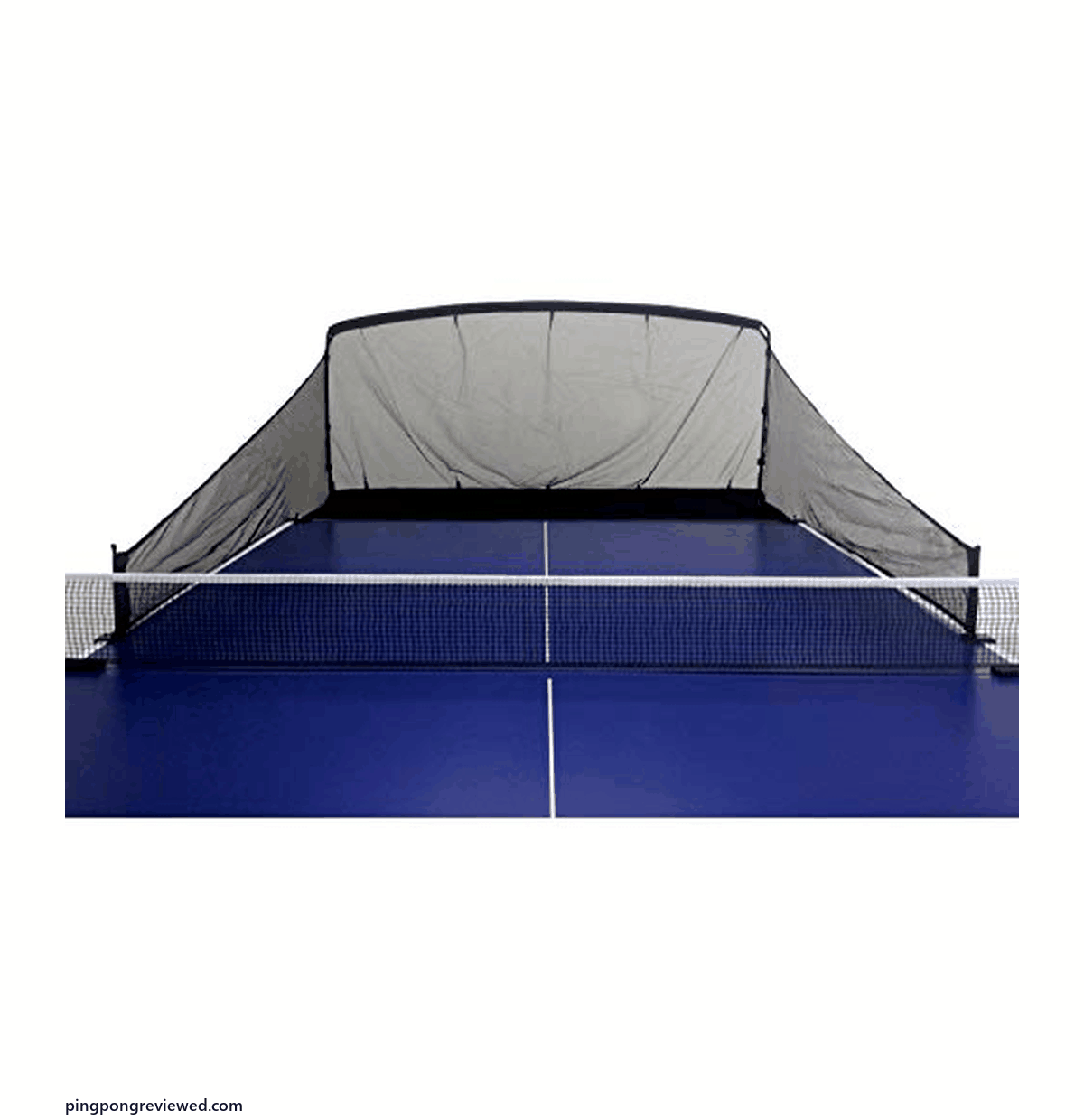
The JOOLA iPong catch net was $32.25 on Amazon on October 8, in stock, against a typical price of $39.95. JOOLA’s own price is $39.95. JOOLA gives its assembled size as 66 in by 18 in by 28 in (Megaspin lists the depth as 60 in, and we use JOOLA’s figure) and says it can be mounted directly onto all regulation-sized tables. See JOOLA’s page.
Amazon’s listing says it has side nets and an easy-access velcro panel at the bottom for funneling balls into a container, while JOOLA says the bucket or box is not included. Megaspin states it clips to table frames up to 3 in thick, opening to 3 1/16 in. See Megaspin’s page.
Two cautions. Tabletennisspot reports a tendency for balls to ricochet off the metal frame. And the sources disagree on the frame material: JOOLA’s name and Amazon say carbon fiber, while one bullet on Megaspin says ferroalloy, so we don’t state a material.
2. PONGBOT Table Tennis Ball Catch Net: the other clamp-on net on Amazon
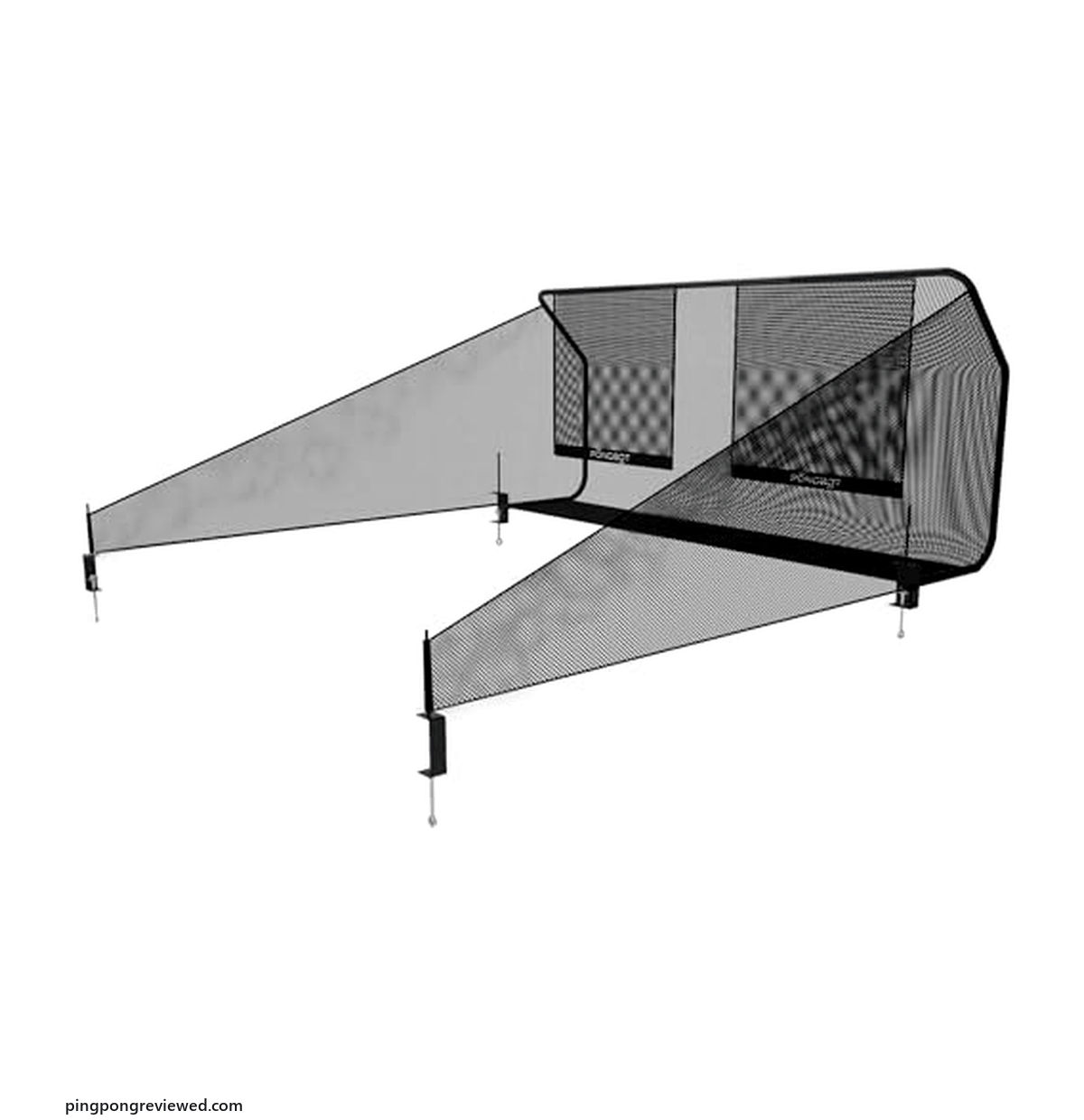
The PONGBOT catch net was $64.99 on Amazon on October 8 and $69.99 on PONGBOT’s own store. Amazon’s title calls it a catch net and ball recycling net for solo training, for tables with sides under 3 inches.
PONGBOT’s own copy says it is designed to catch and gather balls quickly, to reduce pickup time and to keep the practice area organized. It gives no dimensions or attachment details, and it doesn’t mention robots. Amazon’s title says it is for tables with sides under 3 inches and its photo shows table clamps, so we treat it as table-mounted. Amazon’s item dimensions look like packaging, so we don’t give a size. It does not say the net works with a robot or returns balls to a hopper, and we found no source that does.
3. Butterfly Collection Net 1: the brand-direct clamp-on option
Butterfly’s shop sells the Collection Net 1 for $159.99. It says the net clamps onto the corners of the table, that side nets catch stray balls, and that it is quick and easy to attach and remove. Butterfly publishes no dimensions. Megaspin, a retailer, says the clamp opens up to 3 1/2 in and that the net is about 2 ft high. See Megaspin’s page. We found no Amazon listing we could verify for it, so there is no Amazon link here.
The freestanding nets
4. lukar wheeled catch net: a wide freestanding option at a moderate price
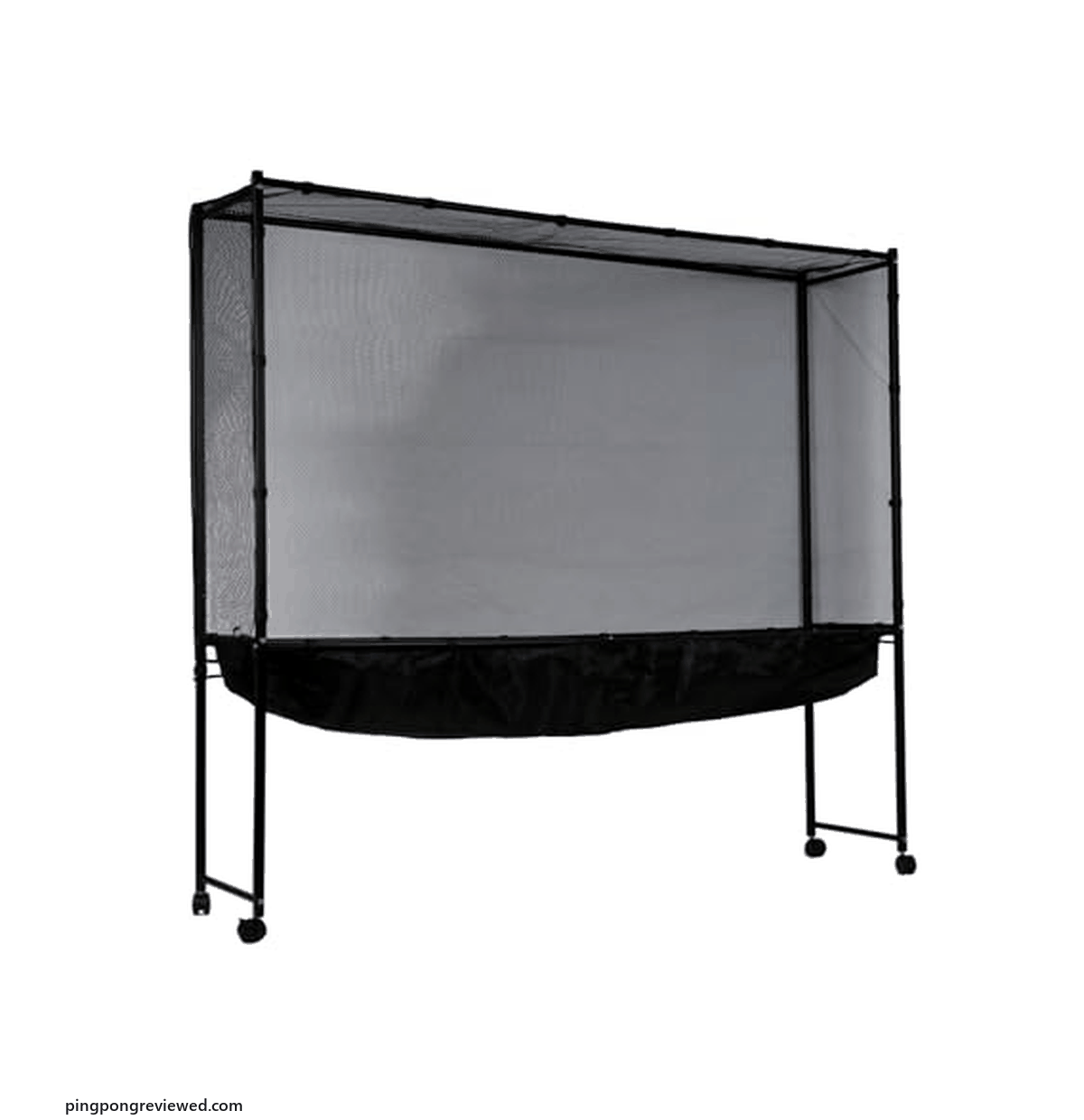
The lukar net was $81.99 on Amazon on October 8, with 13 left in stock. Its listing describes a protective area of approximately 70.9 inches, four rollers with an independent braking system, and a hook and loop opening at the bottom.
The listing doesn’t state a depth or height, so we can’t tell you how much floor it takes. Stickandbat, a guide we read, also lists a lukar net at about 70.9 in and mentions the rollers and brake.
5. Yuanclllp ball recycle equipment: bigger and pricier, with one left
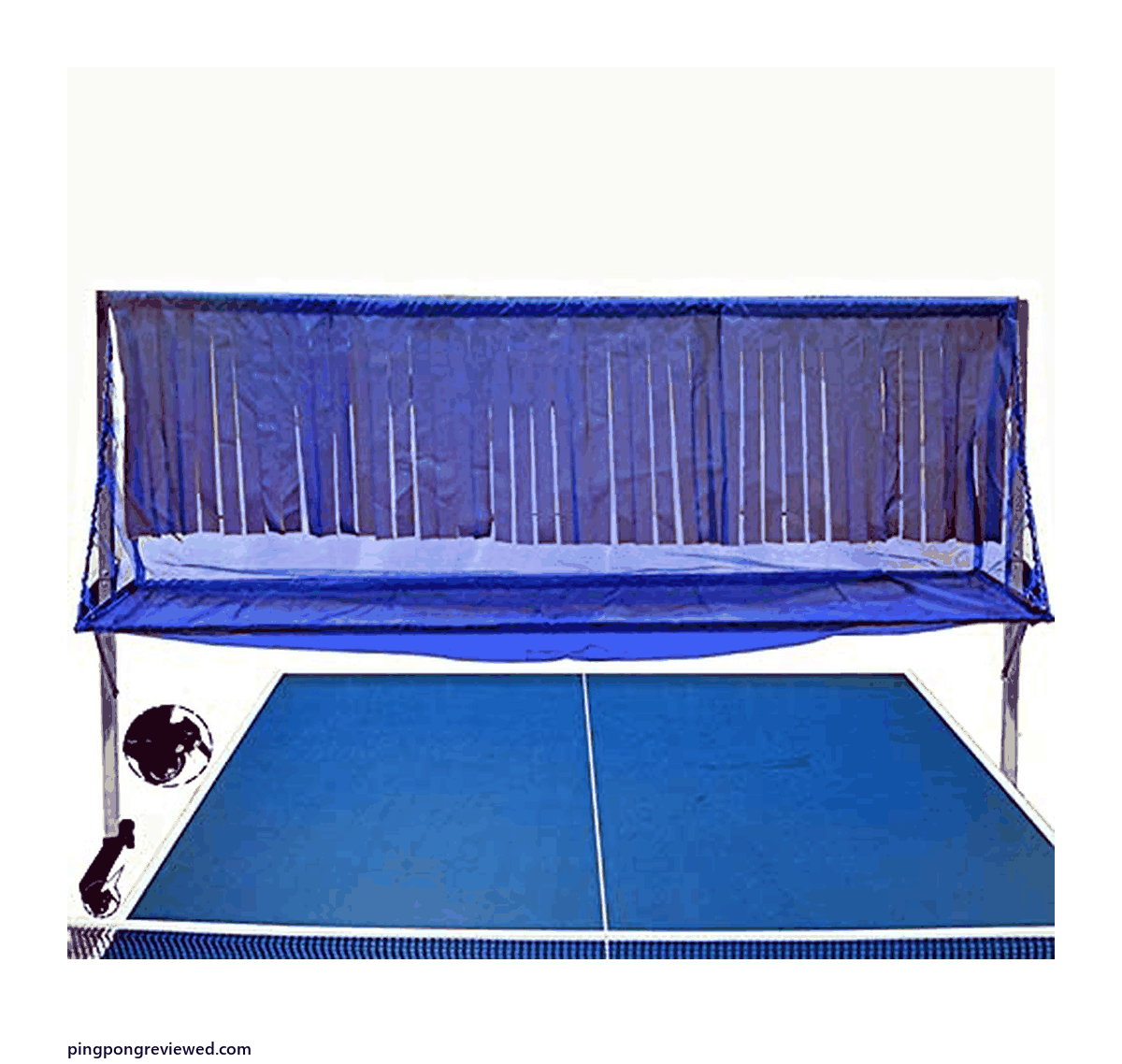
The Yuanclllp net was $119.70 on Amazon on October 8, with only one left. Its title gives 92 in by 18 in by 54 in, which Amazon’s size field lists as 92 in wide, 18 in deep and 54 in high, with a stainless steel frame and metal wheels, and the listing adds tassels and a side net to stop balls rebounding out. It weighs 11.05 lb.
This is a different design from the PONGBOT, not a lower-priced version of it: it stands on the floor, and the PONGBOT mounts on the table.
6. Butterfly Collection Net 2: the most expensive one we verified
Butterfly’s shop lists the Collection Net 2 at $209.99, in stock with 11 units on October 8. It measures 7 ft 5 in wide, 4 ft tall and 1 ft 5 in deep. Butterfly says that, being freestanding, you roll it into position anywhere around the table, and that it works with all tables.
At about 89 in wide it is the second-widest net here, after the Yuanclllp. We found no Amazon listing we could verify for it, so there is no Amazon link.
Measure before you buy a ping pong catch net
Take three measurements before you buy, and the first two come from the sources above. First, the thickness of your table’s edge or frame, compared with the clamp opening: 3 in for the iPong per Megaspin, up to 3 1/2 in for Butterfly’s Net 1, and sides under 3 inches for the PONGBOT per its Amazon title. The ITTF rules don’t set a top thickness, so the clamp opening is not the same as the thickness of the playing surface. For typical tops, see our table dimensions guide.
Second, the width of the net against the table. The ITTF Statutes 2026 set the playing surface at 2.74 m long and 1.525 m wide, which is about 60 in. See the Statutes. The iPong at 66 in is about 6 in wider than the table end, and Butterfly’s Net 2 at about 89 in is about 29 in wider. That is our arithmetic from the published figures.
Third, floor space for a freestanding net. The Yuanclllp is 18 in deep and Butterfly’s Net 2 is 1 ft 5 in deep, before you allow room to roll it in and out. The lukar publishes no depth.
⚠️ Watch out: Some listings are narrower than the table end. The ERRULAN wheeled net, for example, comes in a 1.35 m (53 in) variant that is shorter than the 60 in table end. Check which size variant a listing is before you buy.
Using a ping pong catch net with a robot or for solo serving
A ping pong catch net is most useful when balls fly past the table, which is what happens with multi-ball drills, a robot or solo serving. JOOLA markets the iPong as a companion to its iPong training robot and says it collects balls during service, multi-ball or robot practice. For a robot guide, see our ping pong machine guide and beginner robot guide.
What a ping pong catch net doesn’t do is catch everything. We found no catch-rate figure for any net. Tabletennisspot reports a tendency for balls to ricochet off the metal frame of the iPong, and a poster in a 2016 TableTennisDaily thread reported balls bouncing out of an attached net back onto the table. Setup time is also unsourced. We read about four clamps on the iPong, and nothing reliable on how long any net takes to set up, so we don’t give a time.
After the session: picking balls up
A ping pong catch net stops balls. It doesn’t gather the ones that still reach the floor. For that, a handheld picker is the usual tool, and we compare them in our ping pong ball picker guide.
What to skip
Skip any ping pong catch net listing that prices a similar-looking net far above the ones here. We found three generic Amazon listings, at about $210 to $250, that reuse JOOLA’s iPong wording, including the lines about fitting most regulation tables and a velcro panel at the bottom, for different nets. Seller copy is not evidence that two nets are alike. We also skip any listing whose stated dimensions contradict themselves, for example one that gives a height of 515 inches.
A net called the Rockible Recycle Catcher appears in some older lists. Its original Amazon page is gone, and the Rockible-titled listings we found are generic-brand ones at $672.99, so we left it out.

How we checked this guide
We read each maker’s own page where one exists, including JOOLA, PONGBOT and Butterfly, plus Megaspin’s retailer pages for clamp openings that makers don’t publish. Amazon’s product data gave prices, stock and listing wording on October 8, 2026. We read the ITTF Statutes 2026 for the table width and two editorial guides, from Tabletennisspot and Stickandbat, for context. We did not test any net, so we don’t say how any of them performs. We could not confirm US sales of STIGA’s Collect catcher, and we left out Newgy because its site wouldn’t load for us. Prices and stock change quickly, so treat the numbers as a snapshot.
Frequently asked questions
Does a catch net clamp to every table?
Not necessarily. JOOLA says the iPong mounts directly onto all regulation-sized tables, and Megaspin lists its clamp as opening to 3 1/16 in. Butterfly’s Collection Net 1 clamps to the table corners and Megaspin says it opens up to 3 1/2 in. The PONGBOT’s Amazon title says it is for tables with sides under 3 inches. Check the thickness of your table’s edge or frame against those figures before you order.
Is a clamp-on or a freestanding net better for a ball robot?
We found no maker or test data that answers this. A clamp-on net sits right behind the table end. A freestanding net rolls into position behind it and needs floor clearance. A poster in a 2016 TableTennisDaily thread said a roll-up net would not work with their robot because its recycling mechanism sat at the bottom of the catch area. That is a single opinion, so check how your robot returns balls before you choose.
How wide should a catch net be compared with the table?
The ITTF sets the playing surface at 1.525 m wide, which is about 60 in. The nets with a published width run from 66 in (JOOLA iPong) to about 70.9 in (the lukar listing’s protective area), 7 ft 5 in (Butterfly Collection Net 2) and 92 in (Yuanclllp), so each is wider than the end of the table. PONGBOT and Butterfly’s Net 1 publish no width. The width of your net matters less than whether it covers the area your misses actually fly to, and we found no source on that.
Do catch nets stop every ball?
No source we found gives a catch rate. Tabletennisspot’s review of catch nets reports a tendency for balls to ricochet off the metal frame of the iPong, and a poster in a 2016 TableTennisDaily thread reported balls bouncing out of an attached net back onto the table. Treat any quoted catch percentage as unsourced.
Do I need a bucket?
For the JOOLA iPong, yes. JOOLA’s page says the net directs balls into a bucket or box that is not included. Amazon’s listing describes a velcro panel on the bottom that lets you funnel balls into a container.
Which brands make catch nets?
JOOLA (the iPong), Butterfly (Collection Net 1 and 2) and PONGBOT make nets sold in the US. STIGA lists a Collect Ball Catcher Net on its euro-priced shop at 159.90 euros, and we could not confirm that it is sold in the US.
What is the difference between a catch net and a ball picker?
A catch net stops balls during play and drills. A picker gathers balls from the floor afterward. Pickers have their own guide on this site, so they are not repeated here.
Sources
Specs and prices come from JOOLA’s iPong page, PONGBOT’s store, Butterfly’s Collection Net 1 and Net 2 pages, Megaspin’s iPong page and Net 1 page, and Amazon’s product data. Context comes from Tabletennisspot’s catch net guide, and the table width from the ITTF Statutes 2026.
As an Amazon Associate, we earn from qualifying purchases through links on this page.

Ping Pong Reviewed is an equipment review site covering table tennis and baseball gear. Specifications are checked against manufacturer listings, and prices against live retail pages, before publication.