Tomokazu Harimoto: World Number 4, No Singles World Title Yet
Tomokazu Harimoto is the youngest player ever to win an ITTF World Tour men’s singles title, at fourteen years and sixty-one days old. He is also, at world number 4, a player who has never once won a singles medal at a World Championships.
Both of those sentences are true about the same career, and neither is the whole story on its own. Here is the record behind the reputation.
Short answer: Tomokazu Harimoto was born Zhang Zhihe on 27 June 2003 in Sendai, Japan, to Chinese table tennis players who moved to Japan for coaching work; the family naturalized as Japanese citizens in 2014. He is right-handed, 1.78 metres tall, and ranked world number 4 as of September 2026. He holds an Olympic team bronze from Tokyo 2020 and three World Championship silver medals, in mixed doubles and the team event. He has never won a World Championship medal in singles. Verified across his own tournament record on 4 September 2026.
Table of Contents
The Prodigy Without a World Singles Medal
Harimoto won an ITTF World Tour men’s singles title at fourteen years and sixty-one days old, at the Czech Open in August 2017. No one younger has done it since. That result is what built his reputation before he had played a single senior World Championships.
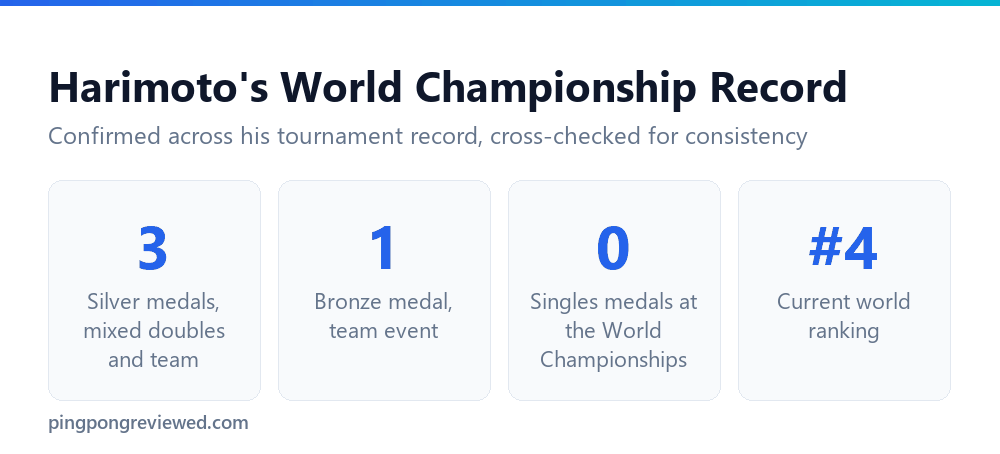
So the World Championships specifically, the sport’s biggest individual stage every two years, has given him three silvers and a bronze, and none of them in singles. His Asian Championships singles gold in 2024 shows the individual results are there at continental level. The World Championships singles medal simply hasn’t landed yet.
Born Zhang Zhihe
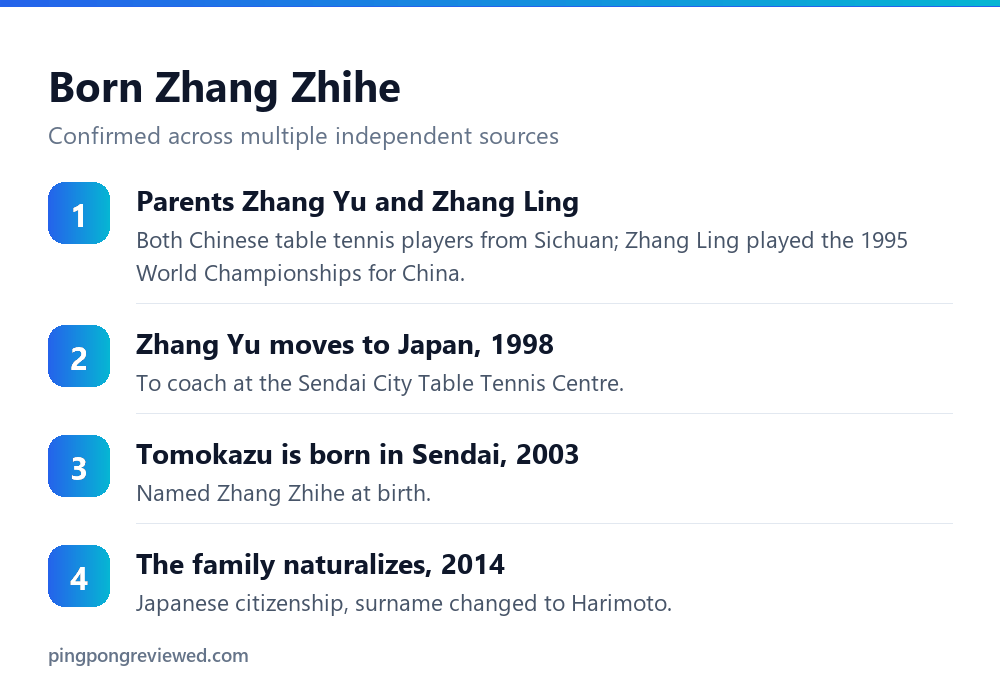
Harimoto’s parents, Zhang Yu and Zhang Ling, were both table tennis players in China, from Sichuan. Zhang Ling represented China at the 1995 World Championships.
Zhang Yu moved to Japan in 1998 to coach at the Sendai City Table Tennis Centre. Tomokazu was born there in 2003, named Zhang Zhihe. The family became Japanese citizens in 2014, and the surname changed to Harimoto at that point.
So the player representing Japan at the highest level of the sport was raised inside a household built around competitive Chinese table tennis, coached from birth by two people who had played the sport at international level themselves.
📊 Note: This background is worth knowing specifically because it explains the technical foundation commentators describe in his game, built early and by coaches with direct international playing experience, rather than crediting it to raw talent alone.
Reputation vs. Record
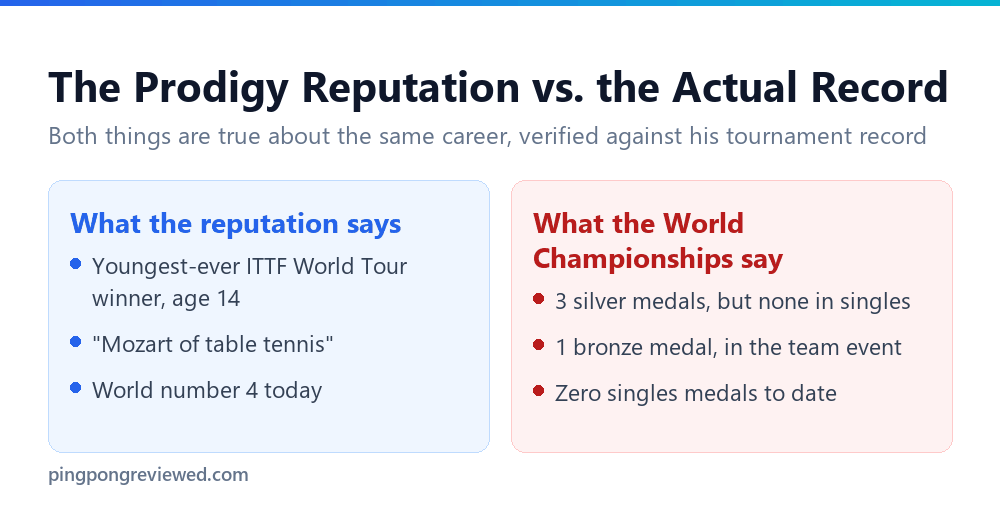
So it’s worth holding both facts at once, because they’re not in conflict. They describe different parts of the same career.
The prodigy reputation is earned and specific: youngest-ever ITTF World Tour singles winner, a nickname, “Mozart of table tennis,” that stuck because it’s the kind of talent people reach for a nickname to describe, and a ranking that backs it up today.
The record gap is just as specific: three World Championship medals, all silver or bronze, none in singles. Both things are true right now. Only one of them tends to get repeated.
💡 Pro tip: Watch for this pattern with other young stars covered on this site too. A junior or early-career nickname often outlives the specific result that earned it, and keeps getting repeated well after the player’s actual record has moved on from it.
His Equipment
Harimoto plays a Butterfly Harimoto Tomokazu Innerforce Super ALC blade, a signature model built and named for him rather than an off-the-shelf choice. He runs Butterfly Zyre 03 on both forehand and backhand.
Running the identical rubber on both wings is less common at the very top of the men’s game than a mixed setup, where players often run a different sheet on each side for different jobs. A matched setup suggests a game built on consistency between both wings rather than one dominant attacking side.
Where He Sits in the Modern Era
Japanese men’s table tennis has produced a small group of players who define the current generation, and Harimoto’s specific gap stands out clearly against them.
- Harimoto holds the earliest, loudest prodigy reputation of the group, but no individual World Championships medal yet.
- Team and mixed doubles success has come steadily since 2018, giving him a genuine multi-event resume even without the singles result.
- The Asian Championships singles gold in 2024 shows the individual ceiling is there at a continental level, which raises rather than lowers expectations for the World Championships specifically.
He was 23 at the start of the current World Championship cycle, still well inside a competitive window for the sport. The singles medal is the specific, checkable thing left to complete the record his ranking already suggests he’s capable of.
What to Watch When He Plays
So a few specific things are worth watching for, beyond just the score.
First, watch the backhand. Because his setup runs the same rubber on both wings, his game doesn’t rely on one wing being obviously the stronger option, which shows up as a willingness to attack from either side without a clear tell.
Second, watch how he handles the biggest points against the other members of his generation. The gap this article covers, medals in team and doubles but not singles, tends to show up specifically in tight, deciding games rather than across a match as a whole.
Then watch his results at the next World Championships specifically. That’s the one line on his record this article is actually about, and it’s a checkable, updateable fact rather than a prediction.
So none of this is a prediction about what happens next. It’s a clear statement of where the record actually stands right now, kept separate from the reputation that gets repeated about him regardless of the specific results.
Ranked world number 4, still only in his early twenties, with team and doubles medals already banked, he has time and standing on his side. What’s missing is specific enough to name, which is rarer than it sounds for a player this accomplished.
So the next World Championships is the specific date worth marking, not a vague sense of “eventually.” A player with his ranking and his junior record has already shown he can win the biggest matches. The only open question is whether that translates to the one event that’s stayed just out of reach so far, and this page will get updated the moment that changes.
The 2017 Czech Open, in Detail
So the result that built the reputation deserves more than a passing mention. In August 2017, at fourteen years and sixty-one days old, Harimoto won an ITTF World Tour men’s singles title at the Czech Open.
No player, before or since, has won a World Tour singles title younger. That record has held for years across a sport with a deep pipeline of junior talent, which is exactly why it still gets repeated in nearly every introduction to his career.
It’s worth being precise about what that record does and doesn’t establish. It confirms he could beat senior professional opposition on the World Tour at an unprecedented age. It doesn’t, on its own, guarantee a World Championships singles medal later, which is exactly the gap this article has focused on.
How the Ranking and the Medal Gap Coexist
So how does a player rank world number 4 without an individual World Championships medal? The ranking system and the World Championships measure different things.
World ranking points accumulate across a full season of tournaments: WTT events, Grand Smashes, and more, weighted by the level of each event. A player can build a high ranking through strong, consistent results across many tournaments without ever winning the single biggest one.
The World Championships, by contrast, happens once every two years for the singles event, and rewards one specific week of results over everything else in the calendar. A single bad round, or a single elite opponent on their own best day, ends the run regardless of how strong the rest of the season looked.
⚠️ Watch out: This distinction matters beyond Harimoto specifically. A high world ranking and a World Championships medal are correlated but not the same achievement, and treating them as interchangeable is a common way player records get misread.
What Comes Next
So the honest framing of where his career stands right now: the ranking and the reputation both say he belongs among the very best players in the world. The one specific gap in his record, an individual medal at a World Championships, is still open.
That gap is neither a prediction nor a criticism. It’s simply the most specific, checkable thing left for a player whose career has otherwise matched or exceeded the expectations set for him at fourteen years old.
Tomokazu Harimoto Questions, Answered
How old is Tomokazu Harimoto?
He was born on 27 June 2003 in Sendai, Japan. He is right-handed, 1.78 metres tall, and plays with a shakehand grip.
What is Tomokazu Harimoto’s real name?
He was born Zhang Zhihe. His family, originally from Sichuan, China, became Japanese citizens in 2014 and changed their surname to Harimoto at that point.
Has Tomokazu Harimoto won a World Championships singles medal?
No. His three World Championship medals are all silver, in mixed doubles (2021, 2023) and the team event (2026), plus a team bronze in 2022. He has not won an individual singles medal at the World Championships to date.
What is Tomokazu Harimoto’s world ranking?
He was ranked world number 4 as of September 2026, with 6,333 ranking points.
Why is Tomokazu Harimoto called the Mozart of table tennis?
The nickname reflects his exceptional talent at a young age, including becoming the youngest-ever winner of an ITTF World Tour men’s singles title at fourteen years and sixty-one days old, at the 2017 Czech Open.
What equipment does Tomokazu Harimoto use?
A Butterfly Harimoto Tomokazu Innerforce Super ALC blade, his own signature model, with Butterfly Zyre 03 rubber on both the forehand and backhand.
Are Tomokazu Harimoto’s parents also table tennis players?
Yes. Both Zhang Yu and Zhang Ling played table tennis for China; Zhang Ling competed at the 1995 World Championships. Zhang Yu moved the family to Japan in 1998 to coach at the Sendai City Table Tennis Centre.
The Short Version
- →Born Zhang Zhihe in Sendai in 2003, to Chinese table tennis players who moved to Japan in 1998.
- →Youngest-ever ITTF World Tour men’s singles winner, at fourteen years and sixty-one days old.
- →World number 4 as of September 2026, with an Olympic team bronze from Tokyo 2020.
- →Three World Championship silvers, in mixed doubles and the team event, plus one team bronze.
- →No World Championships singles medal to date, despite the ranking and reputation.
- →Plays his own signature Butterfly blade with Zyre 03 on both wings.
Prodigy and gap are both real, and only one of the two is unfinished business. The record so far says he’s already delivered on the earliest half of that reputation. Whether the second half arrives is the one line worth watching at the next World Championships.

Ping Pong Reviewed is an equipment review site covering table tennis and baseball gear. Specifications are checked against manufacturer listings, and prices against live retail pages, before publication.