Can a Coach Talk During a Table Tennis Match? Yes, Since 2016
This is a rule that changed in 2016, so older descriptions of it may still say coaching is only allowed between games and during a timeout.
This page covers what changed, what the rule says today, and the main restriction that remains.
Short answer: Yes, since 1 October 2016, players may receive coaching advice at any time except during rallies themselves, as long as play is not thereby delayed (ITTF Statutes 2026, Regulation 3.5.1.3). Before that date, coaching was restricted to between games or during a called timeout.
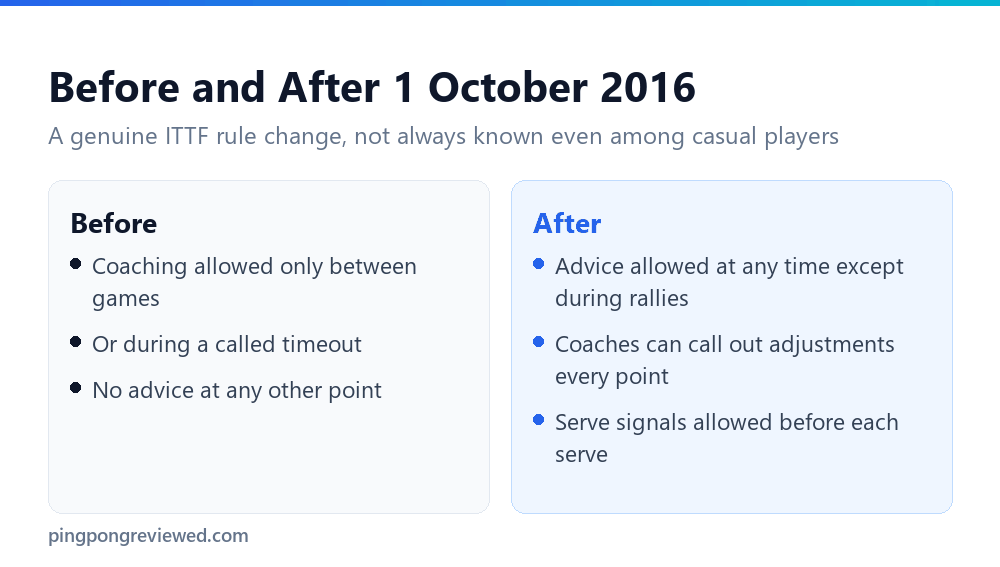
Table of Contents
What Actually Changed in 2016
Before 1 October 2016, the rule was straightforward and restrictive: a coach could only give advice between games, or during a player’s called timeout. Any coaching during active play, even between individual points within the same game, was against the rules. That changed with a specific ITTF rule amendment, and the new version is meaningfully more permissive: players may now receive advice at any time except during rallies themselves, provided the advice doesn’t cause a delay in play.
The current rule language, from ITTF Statutes 2026, Regulation 3.5.1.3: “Players may receive advice at any time except during rallies provided play is not thereby delayed (3.4.4.1).” In practice, this means a coach can give advice between points, as long as play is not held up, rather than waiting for the next game or a timeout.
The Only Real Restriction Left: Not During Rallies
The rule’s remaining boundary is simple to state: no advice during an active rally, and no advice that delays play. Once the ball is in play, a coach has to wait until that specific point ends before communicating anything to their player. Between points, between games and during timeouts, advice is permitted under the current rule, provided play is not thereby delayed. In an individual event, a player or pair may receive advice only from one person, designated beforehand to the umpire (Regulation 3.5.1.2).
⚠️ Watch out: Two other points are easy to overlook. In an individual event, advice may come only from one person designated beforehand to the umpire, and if an unauthorised person gives advice the umpire holds up a red card and sends that person away from the playing area (Regulation 3.5.1.2). Advice also must not delay play (Regulation 3.5.1.3).
Why the Rule Changed at All
One account of the change, published on the coaching site tabletenniscoaching.com in August 2016, says the ITTF made it because officials believed coaches were circumventing the old restriction with illegal coaching during matches, while noting that this was not a widespread problem. That is commentary, not an ITTF statement of reasons: the Statutes state the rule but give no reasons for it.
The New Gray Area This Change Created
The rule’s wording ties advice to delay: advice is allowed provided play is not thereby delayed (Regulation 3.5.1.3). Coaching commentary on tabletenniscoaching.com raised the concern that players might stall play, for example by walking over to consult a coach between points.
💡 Pro tip: If you’re coaching under these rules, keep between-point communication brief. The rule permits advice only provided play is not thereby delayed (Regulation 3.5.1.3).
How Advice Actually Gets Delivered in Practice
Coaching commentary on tabletenniscoaching.com (December 2016) notes that calling out advice is risky because the opponent, or someone near the opponent, may know the language. It also notes that a coach can sometimes whisper to a player when a ball happens to come by the barrier where the coach is. These are practical observations from that commentary, not part of the rule.
What Happens if a Coach Breaks This Rule
Under Regulation 3.5.1.3, if any authorised person gives advice illegally, the umpire holds up a yellow card to warn that any further such offence will result in dismissal from the playing area. Under Regulation 3.5.1.4, if anyone again gives advice illegally in the same match, the umpire holds up a red card and sends that person away from the playing area, whether or not that person was the one warned. In an individual event the dismissed adviser may not return until the individual match has ended (Regulation 3.5.1.5).
- ✓Give tactical advice freely between points, games, and during timeouts
- ✓Keep advice brief enough that it does not delay play
- ✓Wait until a rally has actually ended before communicating anything
- ✓Remember that in an individual event only one designated adviser may give advice
- ✕Attempt to communicate advice during an active rally
- ✕Encourage a player to deliberately slow-walk retrieving a ball for extra coaching time
- ✕Shout instructions loudly if a quieter, more discreet approach is available
- ✕Assume the old pre-2016 between-games-only restriction still applies
What This Means for Solo and Self-Coached Players
For a player without a dedicated coach, a common situation at recreational and even many club levels, this rule change is largely academic, since there’s no adviser present to exercise the expanded permission in the first place. Where it matters most is for players training and competing within a structured program with regular coaching support, where the expanded between-point communication window represents a real, usable competitive tool that simply didn’t exist before 2016.
This is worth knowing even for a self-coached player, though, since understanding the current rule helps correctly interpret what you’re seeing when watching higher-level competitive matches where coaching is visibly happening between points, that’s not necessarily a rules violation, because advice between points is permitted under the current rule.
The Short Version, Restated
Coaching during a table tennis match has been legal at any point except during an actual rally since 1 October 2016, after a rule change in the ITTF Regulations. The remaining restrictions are the rally itself and advice that delays play, and illegal advice draws a yellow card and then, if repeated in the same match, a red card and dismissal from the playing area.
If you hear coaching between points at a competitive match, that is not a rule being broken as long as it is not during a rally and does not delay play.
Why the Rule Applies to Recreational Play Differently
This entire rule structure, the yellow card enforcement, the one-adviser limit, the rally boundary, is built for officiated, sanctioned competition where an umpire is actively watching and empowered to issue cards. In casual club or recreational play without a dedicated umpire, none of the enforcement mechanism actually applies, even though the underlying principle (don’t coach during an active rally, since it could distract or unfairly assist mid-point) remains good sporting etiquette to follow voluntarily.
For casual players organizing their own matches with informal coaching from the sideline, treating the ITTF rule as a reasonable default etiquette standard, no talking during the actual rally, free to advise between points, avoids the kind of dispute that can arise when players have different unstated expectations about what’s fair.
How This Rule Interacts With Team Events
In team competition formats specifically, where multiple players and coaches may be present courtside simultaneously, the same rally-based restriction applies to any authorized adviser, not just a single designated head coach. This matters because team events often have more people in a position to potentially call out advice than an individual match would, and the rule doesn’t carve out a lesser standard just because multiple people are present, and under Regulation 3.5.1.4 a second illegal piece of advice in the same team match draws a red card for whoever gives it, whether or not that person received the earlier warning.
How the 2016 Change Was Explained
The only explanation of the 2016 change checked for this page is commentary on tabletenniscoaching.com, which says officials believed coaches were circumventing the old restriction through illegal coaching during matches, although the author said this was not a widespread problem. The same commentary reports that the USATT Umpires and Referees Committee formally opposed adopting the rule in American tournaments. Local leagues and tournaments can set their own rules, so check the rules of the event you are playing.
Common Questions
Can a coach talk to a player during a table tennis match?
Yes, at any time except during an active rally and provided play is not delayed, since a 1 October 2016 ITTF rule change. Before that date, coaching was restricted to between games or during a timeout.
Is coaching allowed between individual points?
Yes, this is the main practical change from the 2016 rule update. Coaches can now give advice between every point, not just between full games.
What happens if a coach gives advice during a rally?
A first offense draws a yellow card warning. A repeat offense results in the coach or adviser being dismissed from the playing area.
Can a coach give advice right before a match starts?
The 2026 ITTF Statutes restrict advice only during rallies and where it would delay play (Regulation 3.5.1.3). Check the rules of your own competition for any additional pre-match limits.
Why do coaches sometimes still whisper instructions quietly?
One coaching commentary notes that calling out advice is risky because the opponent, or someone near the opponent, may know the language, even though advice between points is permitted.
Does this rule apply in casual, non-officiated play?
The enforcement mechanism (yellow cards, dismissal) requires an umpire, so it doesn’t formally apply. Following the same no-talking-during-the-rally principle voluntarily is still good etiquette.
Does the rule apply differently in team events with multiple coaches present?
In a team event, players may receive advice from anyone authorised to be at the playing area (Regulation 3.5.1.1), and the same restriction on advice during rallies applies.
Is this coaching rule the same at every level of competition?
The enforcement mechanism assumes an umpire is present to issue cards, so it applies fully at officiated events. Casual play without an umpire has no formal enforcement, though the same principle is reasonable etiquette to follow voluntarily.
The Short Version
One rule change in 2016, one main boundary: no advice during the rally, and no advice that delays play.
- →Since 1 October 2016, coaching is allowed at any time except during rallies.
- →Before that date, coaching was restricted to between games or during timeouts.
- →In an individual event, advice may come only from one designated adviser.
- →Advice is permitted only provided play is not thereby delayed.
- →Illegal advice during a rally draws a yellow card, then dismissal on repeat.
- →Older descriptions of the rule may still reflect the pre-2016 restriction.

Ping Pong Reviewed is an equipment review site covering table tennis and baseball gear. Specifications are checked against manufacturer listings, and prices against live retail pages, before publication.