Dimitrij Ovtcharov: Born in Ukraine, Six Olympic Medals for Germany
Dimitrij Ovtcharov was born in Kyiv. He has never once represented Ukraine. His family moved to Germany when he was an infant, and every result of his eighteen-year career belongs to the country he grew up in, not the one he was born in.
That’s the short version of a career that also includes six Olympic medals, a world number one ranking, and, in 2026, a 38-year-old still ranked inside the world’s top 25.
Short answer: Dimitrij Ovtcharov was born on 2 September 1988 in Kyiv, then part of the Soviet Union, and has represented Germany his entire career after his family relocated there in his infancy. He is right-handed, 186cm tall, and was ranked world number 24 as of September 2026. He holds six Olympic medals across five Games from 2008 to 2024, two silver and four bronze, and briefly held the world number one ranking in January 2018. Verified across his own Olympic and tournament record on 4 September 2026.
Table of Contents
Six Olympic Medals, Four Games
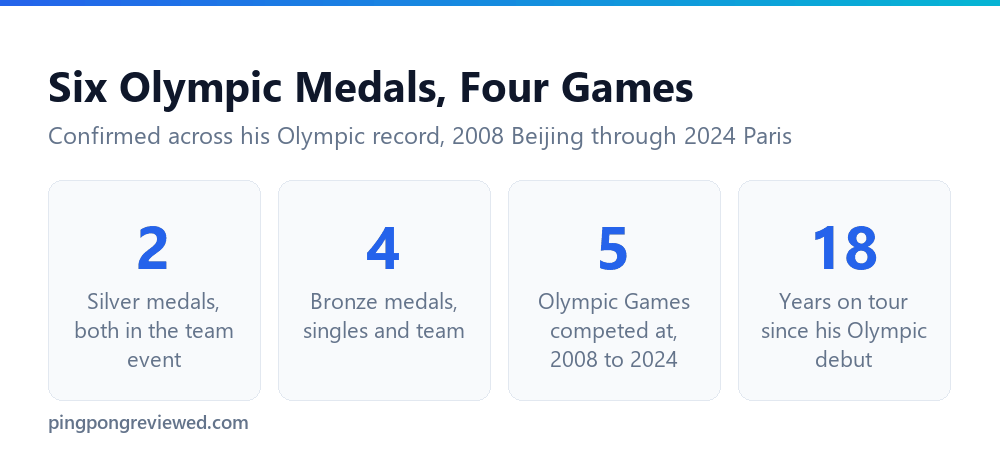
Ovtcharov has competed at five Olympic Games, from Beijing 2008 through Paris 2024, and medaled at four of them.
Two singles bronze medals, in 2012 and 2020, sit alongside four team medals. Winning an individual Olympic medal twice, twelve years apart, says something the team results alone don’t: he has been a genuine singles threat at an elite level across more than a decade, not just a strong contributor to a deep German team.
At Paris 2024, at 35, he lost a round-of-16 match 4-3 to Felix Lebrun, one of the sport’s rising French stars. Extending an Olympic career to a fifth Games and taking a close, competitive match off a player of the current generation is itself a marker of where his level still sits.
Born in Kyiv, Built in Germany
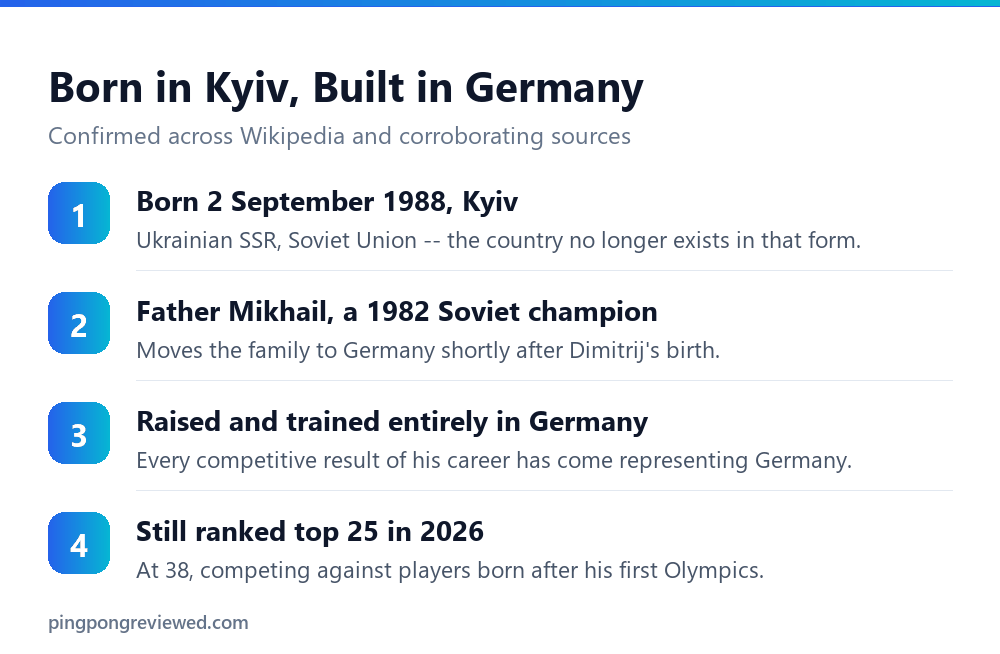
Ovtcharov’s father, Mikhail, was a Soviet table tennis champion in 1982. He moved the family to Germany shortly after Dimitrij was born in Kyiv in 1988, while Kyiv was still part of the Soviet Union.
So Ovtcharov was raised and trained in Germany from infancy. Every result on his competitive record, from his junior years through five Olympic Games, belongs to Germany. There is no competitive career representing the country of his birth to speak of at all.
📊 Note: His father’s own background as a 1982 Soviet champion places Ovtcharov’s career inside a family table tennis lineage, similar in shape to Tomokazu Harimoto’s, though the two stories differ in when and why each family relocated.
Kyiv itself no longer sits inside the country it did when Ovtcharov was born there. The Soviet Union dissolved in 1991, three years after his birth, and Ukraine became independent. The Germany he grew up in, meanwhile, is the country his entire competitive identity has belonged to from the start.
The Time Magazine Serve
In 2008, at his first Olympics, Ovtcharov’s serve technique was selected by Time magazine as one of the year’s top 50 innovations, under the headline “The new ping-pong serve.”
That’s an unusual crossover for a table tennis story, a sport that rarely gets mainstream Western press attention outside Olympic years. It happened at the very start of his senior international career, the same year he won his first Olympic medal.
2008 Beijing vs. 2024 Paris
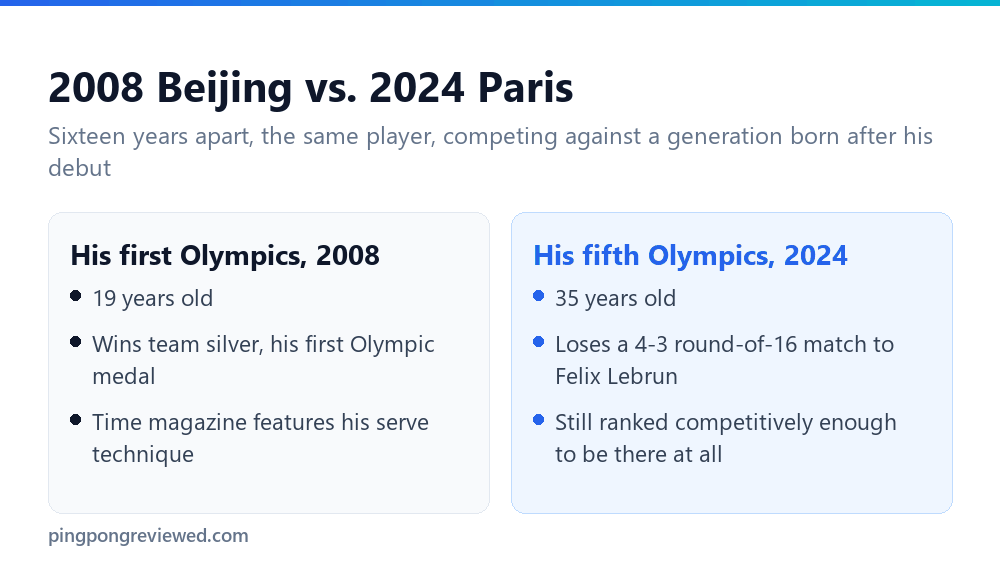
So the distance between his first and most recent Olympics is the clearest way to see the length of this career. Sixteen years separate a 19-year-old winning his first team silver from a 35-year-old taking a rising star to seven games in the round of 16.
He reached world number one in January 2018, a decade into his senior career rather than at the start of it. That’s a different shape of career peak than the current generation of teenage prodigies this site has profiled, who tend to arrive at their first major results in their early teens.
💡 Pro tip: Ovtcharov’s career is worth reading as a counterpoint to the prodigy narratives that dominate coverage of table tennis’s current generation. Sustained, decade-plus competitiveness is its own kind of achievement, separate from early, explosive talent.
Equipment
Ovtcharov plays a Butterfly Ovtcharov Innerforce ALC blade, another signature model built and named for its player, the same pattern as Harimoto’s setup. He runs Dignics 09C on the forehand and Dignics 05 on the backhand.
Dignics is Butterfly’s newer, more expensive rubber line, the successor technology to Tenergy covered elsewhere on this site. Running two different Dignics sheets, rather than matching rubber on both wings, splits the job between the two sides of the bat rather than treating them identically.
Where He Sits Among Europe’s Veterans
German men’s table tennis has produced a run of internationally competitive players across recent decades, and Ovtcharov’s specific claim inside that group is longevity paired with real results, not just participation.
- Two individual Olympic bronzes, twelve years apart, confirm he was a singles threat across more than a decade, not a single peak season.
- A world number one ranking, reached a full decade into his senior career, shows the peak came from sustained development rather than an early ceiling.
- A fifth Olympics at 35, with a competitive result against a current top prospect, is the clearest single data point for how much level remains this late in his career.
World Championships and European Record
Beyond the Olympics, Ovtcharov’s record includes four World Championship silver medals in the team event, in 2010, 2012, 2014, and 2018, plus a doubles bronze in 2023.
Two European singles titles, four years apart, sit alongside the team results. As with his Olympic record, the pattern is the same: individual results spread across a long span rather than clustered into one short peak.
The World Cup gold in 2017 came the year before he reached world number one, part of the same stretch that marked the high point of his individual results.
A Career That Predates Most of His Opponents
So it’s worth putting his debut in context. Ovtcharov’s first Olympics, Beijing 2008, happened before several of the players he now competes against were born.
Wang Chuqin, the current world number one profiled elsewhere on this site, was born in 2000. Tomokazu Harimoto, also profiled here, was born in 2003. Both were toddlers or not yet born when Ovtcharov won his first Olympic medal.
That gap is the real story behind the Paris 2024 result. Losing a close seven-game match to Felix Lebrun, a player roughly half his age, is not a sign of decline so much as a sign of exactly how long he’s sustained competing near the top of a sport that skews young.
⚠️ Watch out: Table tennis, like most fast-reaction racket sports, tends to reward younger players as reflexes and recovery speed become larger factors. A player still ranked inside the world’s top 25 at 38 is working against that general pattern, not benefiting from it.
What Keeps a Career This Long Going
So what actually explains eighteen years of top-level competitiveness, rather than a gradual fade after one strong decade? Part of the answer is visible directly in the record: the second individual Olympic bronze, in 2020, came twelve years after the first team medal in 2008.
That’s not a career that peaked early and coasted on reputation. It’s one that kept producing genuine results deep into what would be considered veteran territory in most fast, reaction-based sports.
💡 Pro tip: For anyone studying longevity in racket sports generally, Ovtcharov’s career is a useful case study precisely because the results, not just the participation, extended so far past when most careers in the sport start to decline.
None of that guarantees a sixth Olympics. But nothing in the record so far suggests betting against him has been a good idea at any earlier point either. A player who took a current top prospect to seven games at 35 isn’t someone whose level can be assumed to have simply run out.
Whatever happens at his next event, the body of work already stands on its own. Six Olympic medals, a former world number one ranking, and eighteen years of results that never fully stopped arriving.
So the honest read on where his career stands: still ranked, still competitive, still capable of taking a set off the sport’s next generation. That’s a rarer combination this deep into a career than the raw years-on-tour number alone suggests.
Dimitrij Ovtcharov Questions, Answered
Where was Dimitrij Ovtcharov born?
In Kyiv, in 1988, when it was part of the Ukrainian SSR within the Soviet Union. His family moved to Germany shortly after his birth, and he has represented Germany his entire competitive career.
How many Olympic medals does Dimitrij Ovtcharov have?
Six, across four Games that produced a medal: silver in the team event at 2008 Beijing and 2020 Tokyo, and bronze in singles (2012, 2020) and team (2012, 2016). He also competed at Paris 2024 without medaling.
Has Dimitrij Ovtcharov ever been world number one?
Yes, reaching the top ranking in January 2018, roughly a decade into his senior international career.
What is Dimitrij Ovtcharov’s current world ranking?
He was ranked world number 24 as of September 2026, with 1,715 ranking points, at age 38.
What equipment does Dimitrij Ovtcharov use?
A Butterfly Ovtcharov Innerforce ALC blade, his own signature model, with Dignics 09C on the forehand and Dignics 05 on the backhand.
What happened to Dimitrij Ovtcharov at the 2024 Paris Olympics?
He was eliminated in the round of 16, losing a close 4-3 match to French player Felix Lebrun, without adding to his Olympic medal total.
Why was Dimitrij Ovtcharov featured in Time magazine?
His serve technique was selected as one of Time’s top 50 innovations of 2008, under the headline “The new ping-pong serve,” the same year as his Olympic debut.
Has Dimitrij Ovtcharov won the European Championships?
Yes, twice in singles, in 2013 and 2015, plus multiple team gold medals across the 2007 to 2019 period.
How long has Dimitrij Ovtcharov been competing at the top level?
Since his Olympic debut in 2008, making 2026 his eighteenth year on the senior international circuit, with a fifth Olympics competed at Paris 2024.
The Short Version
- →Born in Kyiv in 1988; his family moved to Germany in his infancy, and he has never played for Ukraine.
- →Six Olympic medals across five Games, 2008 through 2024: two silver, four bronze.
- →Two individual Olympic bronzes, in 2012 and 2020, twelve years apart.
- →Reached world number one in January 2018, a decade into his senior career.
- →Still ranked world number 24 at 38, as of September 2026.
- →His serve technique was recognized by Time magazine as a top-50 innovation of 2008.
The Ukraine-to-Germany story explains where the career started. The medal record across five Games explains why it’s still worth watching this far into it.
Two facts, read together, sum up why his page belongs alongside the current generation’s on this site rather than in a historical archive. He is still ranked. He is still winning games against the players who will define the sport’s next decade. That combination, not the medal count alone, is the actual story here.
Ping Pong Reviewed is an equipment review site covering table tennis and baseball gear. Specifications are checked against manufacturer listings, and prices against live retail pages, before publication.