How to Chop in Table Tennis: Defence That Wins Points
A chop is a defensive stroke that returns the ball with heavy backspin, usually played several steps back from the table. Raise the paddle to chest height with an open face, then slice down and forward under the ball as it drops. The backspin forces your opponent to lift every attack — and one tired lift into the net is all you need.
Modern table tennis is obsessed with attacking, which is exactly why a good chop is so disruptive. Most players have spent years learning to loop and almost no time learning to play against heavy backspin arriving from four metres back. You become a problem they’ve never practised.
- →A chop is not a push — it’s played from distance, off a dropping ball, against topspin
- →The backspin forces your opponent to lift, and lifting is where errors live
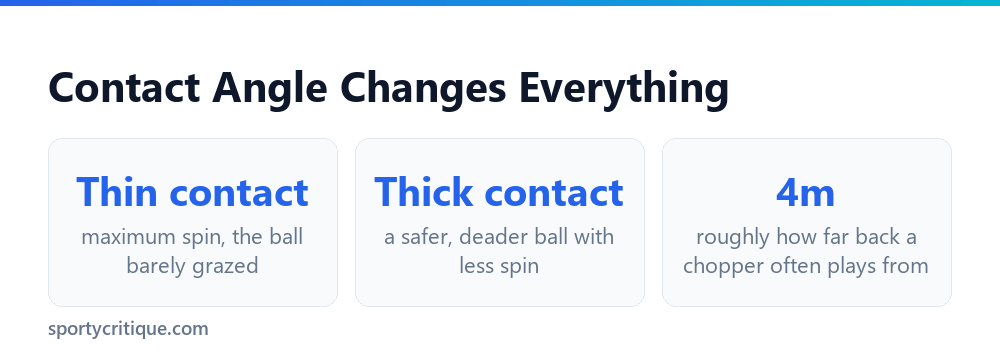
- →Contact thin for maximum spin, thick for a safer, deader ball
- →The chop block is the close-to-table version — no retreating required
- →Equipment matters here more than almost anywhere: defensive rubbers exist for a reason
Table of Contents
What a chop actually does
A drive or a loop brushes up the back of the ball, creating topspin that dives the ball onto the table. A chop does the exact opposite: it slices down and under, sending the ball back rotating backwards.
You’re not trying to win the point. You’re trying to make their winning shot as awkward as physics allows.
That backspin does something specific to your opponent. When a backspin ball hits their rubber, it wants to shoot downward — so they must open their racket face and swing upward to lift it over the net. And the harder they lift, the higher and slower the ball comes back to you. That’s the chopper’s trade: you surrender the initiative, and in exchange you collect errors and easy balls.
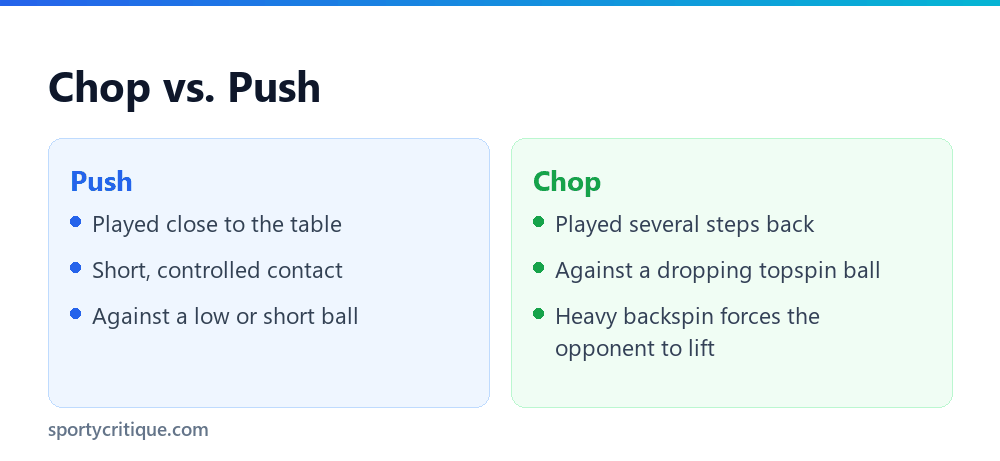
A chop is not a push (this confuses everyone)
These get used interchangeably and they’re genuinely different strokes with different jobs. Getting the distinction right is most of the battle:
The backhand chop, step by step
💡 Pro tip: Contact thickness is your dial. Brush thin (barely graze the ball) for maximum backspin and a floaty ball. Contact thick (more of the ball) for less spin but far more control and depth. Good choppers vary this deliberately, ball to ball, which is why their opponents keep misreading them.
The forehand chop
Same principle, less natural. Rotate side-on, take the ball later and lower than you would for a forehand drive, and slice under it with an open face. The motion travels from high on your forehand side down and across toward the net.
Most defenders chop backhand and counter-attack forehand — that’s the classic modern defensive setup, and it’s why you’ll see choppers suddenly explode into a loop when you feed them anything soft. Chopping both wings is a genuine specialty and it’s rare, because it means surrendering your best attacking shot to defence.
The chop block: backspin without the retreat
You don’t have to back away to use backspin defensively, and this is the version most club players should learn first.
The chop block takes an incoming loop right off the bounce — you stay at the table, but instead of a passive block you make a short, sharp downward chopping motion at contact. The result is a low, skidding ball with mixed spin that arrives much faster than a full chop.
- Heavy backspin
- Slow, floaty arrival
- Buys you time
- Needs space behind you
- Moderate backspin
- Fast, skidding arrival
- Takes their time away
- Works in any room
- Short backspin
- Low over the net
- Sets up your own attack
- Everyone’s basic tool
Against a one-speed looper — the player who hits the same loop at the same pace every ball — a chop block is genuinely nasty. They’re expecting their topspin to come back as topspin. It comes back skidding and low, and they net it.
Equipment: this stroke depends on it
Chopping is the one area where equipment isn’t an excuse — it’s a genuine prerequisite. A fast, springy setup built for attacking will fight you on every chop, because the catapult you want when looping is exactly what you don’t want when trying to kill a ball’s energy.
Long pips deserve a mention because they’re the classic chopper’s weapon. The pips bend on contact and return the incoming spin rather than generating their own, which produces a ball that behaves in ways attackers find genuinely disorienting. They’re also a commitment — pips play so differently that switching means relearning your backhand. Our rubber guide covers the options honestly, and the paddle guide flags control-oriented builds.
Getting it wrong
- ✓Back up before the ball arrives, not as it does
- ✓Let the ball drop past its peak — patience is the stroke
- ✓Slice down and forward — forward clears the net
- ✓Vary your contact thickness deliberately
- ✓Stay low throughout; the chop is played from a bent-knee base
- ✓Expect to hit thirty in a rally, not one
- ✕Chop from the table — that’s a push and it won’t work against a loop
- ✕Hit the ball at its peak — you’ll pop it up
- ✕Slice straight down — the ball goes into the net
- ✕Use the same contact every ball — you become readable
- ✕Stand up between chops — you’ll be late for the next one
- ✕Try it with a fast carbon blade and expect it to behave
⚠️ Watch out: The chop is a rally stroke, not a shot. Beginners try one chop, it lands, and they revert to attacking. That’s not defence — that’s a novelty. Real chopping means committing to a pattern: chop, chop, chop, and wait for the error or the weak ball you can attack. If you’re not prepared to hit ten in a row, don’t start.
Why almost nobody chops any more
Worth being honest about, because it explains what you’re signing up for.
Before the 1950s, defence dominated table tennis — hard bats couldn’t generate enough spin to end a rally, so the game was a war of patience. (The 1936 World Championships produced a single point lasting 2 hours 12 minutes between two defenders — the story is in our history of table tennis.) Then sponge rubber arrived, the loop was invented, and attacking became overwhelmingly the better strategy almost overnight.
What you get in exchange for that difficulty is scarcity. Almost nobody in your club has practised against a chopper, so your ordinary chop is functionally an exotic weapon. That’s a real edge — and it’s why the few remaining defensive specialists at professional level are so consistently annoying to the attackers who out-rank them.
How to learn it
📊 Note: Chopping demands more court coverage than any other style — you’re defending a huge area, several metres back, for thirty-ball rallies. It is genuinely the most physically demanding way to play table tennis. Fitness isn’t optional here; it’s the style’s entry fee.
- →Reading spin — you can’t chop what you can’t read
- →The forehand loop — every chopper needs a counter-attack
- →Drills — the structured practice that builds a defensive game
- →Rubber guide — long pips and defensive setups explained
Frequently asked questions
Is a chop the same as a push?
No. A push is short, played at the table, against backspin. A chop is long, played from several metres back, against topspin, off a dropping ball. Different stroke, different job.
Can I chop with a normal attacking paddle?
You can, badly. A fast carbon blade returns too much energy — your chops fly long and lack spin. It’s one of the few strokes where equipment genuinely gates you.
Why does my chop go into the net?
You’re slicing straight down instead of down and forward. The forward component is what carries it over. Also check you’re not contacting too early — the ball should be dropping.
Why does my chop pop up high?
Contacting at or before the peak of the bounce, or with too open a face. Wait for the drop and close the face slightly.
Are long pips legal?
Completely — they’re ITTF-approved and used at professional level. The one requirement is that your two racket sides are clearly different colours, one of which must be black.
Is chopping viable at club level?
Very. Most club players have never practised against heavy backspin from distance, so an average chop performs like an above-average weapon. The ceiling is lower than attacking, but the club-level return is high.
How long does it take to learn?
A recognisable chop in a few weeks. A chop you can hit thirty times in a row under pressure, with varied spin, is a year-plus project — which is why so few people bother, and why it works.

Ping Pong Reviewed is an equipment review site covering table tennis and baseball gear. Specifications are checked against manufacturer listings, and prices against live retail pages, before publication.