Is Robot Ping Pong Real? What You’re Actually Buying

Is robot ping pong real? It depends entirely on which product you mean, and the term “ping pong robot” gets used for two completely different things that consumers regularly confuse. If you’re picturing a robot that plays back and forth against you like a human opponent — see our companion guide on the real research behind that kind of robot, which does exist but isn’t for sale. If you’re shopping for something to buy for home practice, what’s actually on the market is a ball launcher, and that distinction matters a lot for what to expect.
Table of Contents
Where the Confusion Comes From
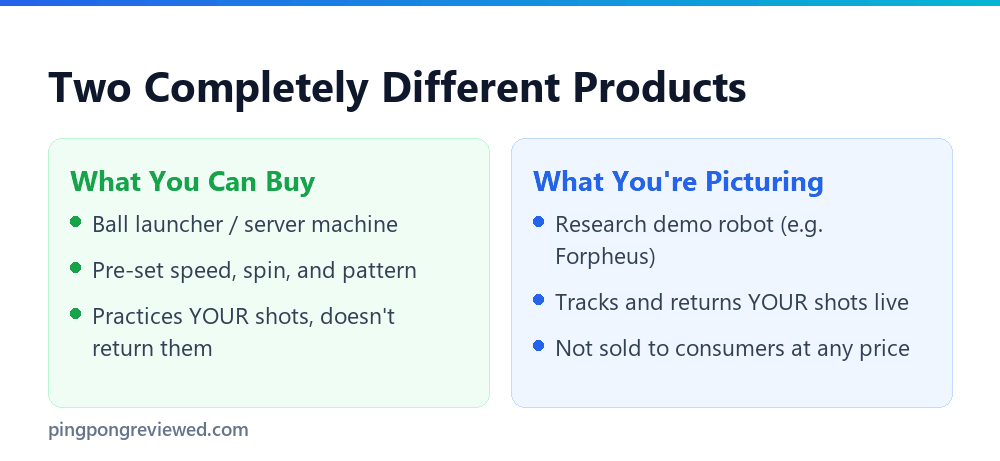
Marketing copy for consumer training machines often leans on “robot” and “AI” language because it sounds more advanced than “ball launcher,” even though the underlying product hasn’t fundamentally changed in decades. A ball launcher fires balls at you in a pre-set or randomized pattern of speed, spin, and placement so you can practice your own shots — it has no idea what you actually do with the ball once it’s launched, and it never reacts to your return in any way whatsoever. That’s not a criticism of these machines; they’re genuinely useful training tools, covered in-depth in our training robot buying guides across several price tiers. It’s just a different product entirely from what “robot ping pong” implies to someone picturing a full, reactive opponent.
What Genuinely Is Real
Splitting the question into these two categories — a purchasable practice tool and a non-purchasable research demonstration — resolves almost every version of “is robot ping pong real” that actually gets asked. Both categories are genuinely real; neither is fake or vaporware. The confusion comes entirely from treating them as one product when they’re not.
Ball Launchers Are Absolutely Real and Useful
These are legitimate, widely available training tools — brands like Newgy, iPong, and Pongo Robo make machines that reliably feed balls at adjustable speed, spin, and frequency, letting a player drill footwork and stroke consistency without needing a training partner. This is the product overwhelmingly sold under the “ping pong robot” name on Amazon and specialty retailers.
Return-Hitting Robots Are Real, But Not for Sale
Genuine research robots that track and return a human’s live shots — Omron’s Forpheus being the best-known public example — do exist and have been demonstrated publicly for well over a decade now. They’re corporate and academic research platforms, not products you can order at any price, and they play a meaningfully simplified version of the sport even in their very best public demonstrations to date.
How to Spot the Marketing Gap Before You Buy
A few specific tells reliably separate honest ball-launcher listings from ones leaning too hard on “robot”/”AI” language to imply something the product doesn’t actually do:
- Look for the word “returns.” If a listing says the machine “returns your shots” rather than “launches” or “serves” balls, read the full description carefully — this is the single most common overstatement.
- Check for a camera or sensor spec. A genuine shot-tracking product needs a vision system; a listing with no camera or sensor spec, just a motor and wheel description, is a launcher regardless of the product name.
- Read the actual product photos, not just the title. Every real consumer “ping pong robot” photographed in use shows a stationary unit firing balls, never an arm reaching out to hit a ball back.
- Price is a strong signal. Consumer ball launchers range roughly $150-$600; nothing close to a genuine return-hitting robot exists at consumer prices, since no such consumer product exists at all.
What’s Actually On the Market
The consumer training-robot category is dominated by a handful of established brands, all making genuine ball launchers rather than anything resembling a return-hitting AI opponent:
- Newgy Robo-Pong: one of the longest-running names in the category, known for reliable oscillation and a wide range of speed/spin settings across several price tiers.
- iPong: popular in the budget-to-midrange segment, commonly bundled with a folding table stand and a ball-catching net.
- Pongo Robo and similar newer entrants: generally compete on app-connected settings and preset drill programs layered on top of the same core launcher mechanism.
Every one of these, across every price tier, works on the same fundamental principle: a motorized wheel or paddle mechanism propels balls at a chosen speed, spin, and trajectory. None of them contain a camera system or any capability to track and react to a human’s return shot — that capability simply doesn’t exist yet in a product you can buy, regardless of price point or how the listing describes it.
This isn’t likely to change soon, either. The gap between a motorized ball launcher and a genuine vision-and-prediction system like Forpheus isn’t a matter of adding one more feature — it’s a fundamentally different, far more expensive category of engineering, which is exactly why consumer prices for these two product types remain so far apart.
Frequently Asked Questions
What is robot ping pong, really?
Two genuinely different things depending on context: a consumer ball launcher (real, buyable, widely available today) or a research robot that tracks and returns live shots (real, but not sold to consumers). Most “robot ping pong” marketing refers to the former while borrowing language that implies the latter.
How do ping pong robots work?
Consumer ball launchers use a motorized wheel or paddle mechanism to fire balls at a set speed and spin, often with adjustable oscillation to vary placement across the table. They don’t track or react to your return in any way — see our companion guide for how the different, far more complex return-hitting research robots work instead.
Are there professional robot ping pong players?
No — there’s no competitive league or format where robots compete against humans or each other as “players.” Research robots like Forpheus are demonstrated in exhibition contexts, not sanctioned competitive play.
Can humans play against robot ping pong?
Against a ball launcher, yes, in the practice sense — the machine feeds balls for you to hit at your own pace. Against a genuine return-hitting robot, only in research and demonstration settings, since none of those robots are commercially available for home or club use anywhere today.
Should I buy a ball launcher if I want to improve my game?
Yes, for most players — a ball launcher is one of the most effective solo training tools available since it lets you drill specific shots repeatedly without needing a partner. Just go in expecting a practice tool, not an opponent that reacts to you.
Why does this confusion matter if I’m just buying a training tool?
Because expecting a return-hitting opponent and receiving a ball launcher is a common source of buyer disappointment and returns. Knowing exactly what a ball launcher does — and doesn’t do — before purchasing means you buy the right product for what you actually want to practice.
Do any consumer robots have cameras or sensors at all?
Some higher-end launchers include sensors for things like ball count tracking or app connectivity to control settings remotely, but none use that sensor data to track a human’s return shot or adjust the next launch based on how you actually hit the previous ball. The sensing, where it exists, serves convenience features, not gameplay reaction.
Is ‘AI-powered’ marketing language ever accurate for these products?
Rarely in any meaningful sense. Some launchers use basic randomization algorithms to vary speed, spin, and placement in a way that’s harder to predict than a simple repeating pattern, and marketing sometimes labels this “AI,” but it’s a fixed randomization script, not a system that observes or reacts to the player in real time the way the term implies to most buyers.
What should I actually look for when shopping for a launcher?
Adjustable speed and spin range matched to your skill level, reliable oscillation if you want varied placement rather than fixed-spot repetition, a decent ball capacity so you’re not constantly refilling, and genuine user reviews rather than marketing copy alone — our training robot buying guides cover specific model recommendations across several price tiers.

Ping Pong Reviewed is an equipment review site covering table tennis and baseball gear. Specifications are checked against manufacturer listings, and prices against live retail pages, before publication.