
Can a Robot Play Ping Pong Against a Human? The Real Research
Can a robot play ping pong against a human? Yes — a small number of research robots can genuinely rally against a human ping pong player, tracking the ball, predicting its trajectory, and returning real shots in something close to real time. This is a narrower, much more specific claim than “robots can play ping pong” as a blanket statement, and it’s worth being precise about which robots we’re actually talking about — because what you can buy for home use is a completely different category of machine, covered in our related guide on whether robot ping pong is real in a consumer sense.
Table of Contents
How a Ball-Returning Robot Actually Works
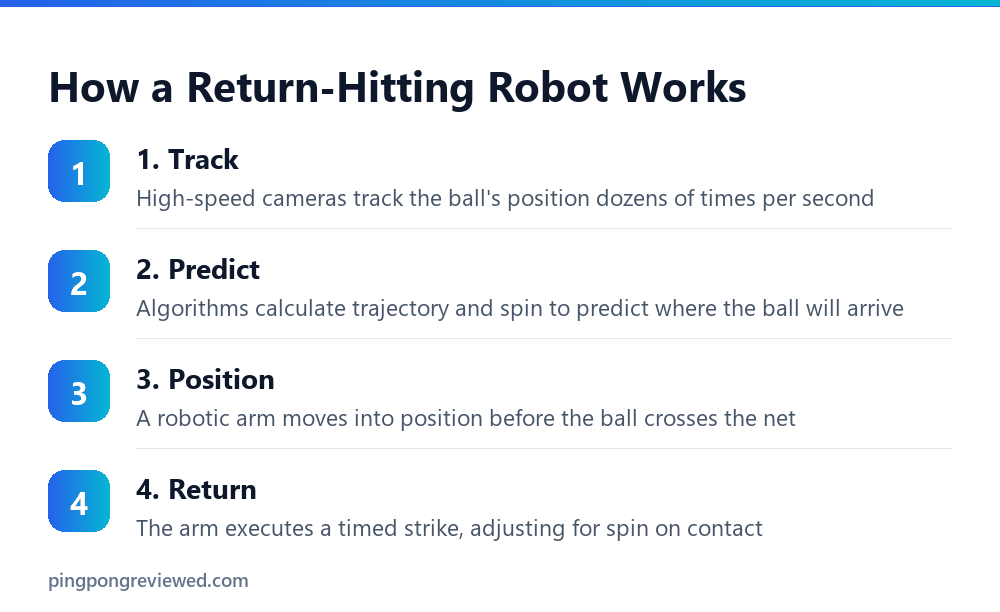
Returning a ping pong shot in real time is a genuinely hard robotics problem — the ball can travel over 60 mph and the robot has a fraction of a second to track it, predict where it will land, move an arm into position, and execute an accurate strike with the right spin response. This requires high-speed vision systems (often 60-course to a few hundred frames per second), real-time trajectory prediction algorithms, and precise motor control on the robotic arm itself.
Real Robots That Actually Do This
Omron Forpheus
Forpheus, developed by Japanese automation company Omron, is the best-known example — it’s been publicly demonstrated since 2013 and has been refined through multiple generations since. It uses high-speed cameras and AI prediction to track a human opponent’s shots and return them, while also analyzing the human player’s form and adjusting its own difficulty to keep the rally going. Forpheus is a research and demonstration platform, not a commercial product — it isn’t for sale.
MIT and Academic Research Robots
Several university robotics labs, including MIT, have built table tennis robots as testbeds for real-time motion planning and computer vision research. These robots are typically single-purpose research platforms built to test specific algorithms, not general-purpose products, and most aren’t publicly demonstrated outside academic papers and conference showcases.
What These Robots Can’t Do Yet
Even the most advanced research robots today play a significantly simplified version of the sport — usually cooperative rallying rather than competitive point-scoring play, and typically against a human hitting at reduced pace and predictability compared to a genuine competitive match. None of the current publicly known robots can beat a strong competitive human player in an actual scored match, and none handle the full range of deceptive serves, unpredictable placement, and tactical variation that a skilled human opponent brings to a real, uncooperative rally.
A Brief History of Ping Pong Robotics Research
Table tennis has been a robotics research target since the 1980s, when early academic projects first attempted simple ball-tracking and paddle-control systems using the primitive computer vision hardware available at the time. Those early systems could barely track a slow-moving ball, let alone predict spin or plan a full-arm return — the sport was chosen specifically because it was hard, a genuine stress test for vision and control systems rather than an easy showcase.
Progress accelerated significantly through the 2000s and 2010s as camera frame rates, processing power, and machine learning techniques all improved together. Omron’s Forpheus, first publicly shown in 2013, represented a major step forward by combining reliable real-time tracking with a robot that could sustain an actual rally against a human opponent rather than just returning a single pre-programmed shot. Since then, several other corporate and academic labs have built their own versions, each pushing incremental improvements in speed, accuracy, and the complexity of shots the robot can handle.
Why Companies Build These Robots At All
Very few companies building ping pong robots actually care about table tennis as a sport — the robots exist as public demonstrations of broader robotics and AI capability that has commercial applications well outside sports entirely. Omron, for instance, is primarily an industrial automation company; Forpheus exists to showcase sensing, prediction, and control technology that also applies directly to manufacturing and quality-control systems on a factory floor. The sport functions as a compelling, easy-to-understand public demonstration of technology that’s genuinely difficult to showcase in its actual, less visually exciting industrial context.
This is worth understanding because it explains why progress in this space doesn’t move at the pace of a typical consumer product race. These robots are proof-of-concept demonstrations tied to corporate research budgets and academic funding cycles, not products being iterated toward a market launch — which is also why none of them are for sale despite years of public demonstrations. It also explains why development sometimes seems to stall publicly for long stretches between major announcements: the underlying research continues, but a public demo cycle depends on the company’s marketing calendar as much as on genuine technical milestones being reached internally.
Why This Is Such a Hard Robotics Problem
Ping pong compresses an unusual combination of demands into a very short time window: high-speed object tracking, spin prediction (which changes a ball’s trajectory mid-flight in ways that are hard to model), fast full-arm motion planning, and precise contact timing, all within well under a second per shot. Many robotics benchmarks use table tennis specifically because it stresses real-time perception and control systems harder than slower-paced tasks do — the sport is genuinely useful as a difficult test case for general robotics research, which is part of why so much of this work happens in academic and corporate research labs rather than as a commercial product race.
Spin prediction in particular remains one of the hardest unsolved parts of the problem. A ball’s spin isn’t directly visible to a camera the way its position is — it has to be inferred from subtle changes in trajectory curvature over several tracked frames, and getting that inference wrong by even a small margin can cause a robot to badly misjudge where and how to make contact. Human players read spin partly from watching the opponent’s paddle angle at contact, a visual cue that’s much harder for a robot’s vision system to interpret reliably than the ball’s flight path alone.
Frequently Asked Questions
How do robots play ping pong?
Through a combination of high-speed camera tracking, trajectory and spin prediction algorithms, and a robotic arm capable of fast, precise motion to intercept and return the ball — see the full mechanics breakdown above for the complete four-step process.
Can robots beat humans in ping pong?
Not in a genuine competitive match yet, no. Current research robots can sustain simplified rallies against a human, but none publicly known today can win a full scored match against a strong competitive player.
What technology do ping pong robots use exactly?
High-speed vision systems for ball tracking, real-time prediction algorithms for trajectory and spin, and precision robotic arms for the actual strike itself — Omron’s Forpheus is the most publicly documented example of this full technology stack working together.
Are ping pong robots used for training?
The research return-hitting robots covered here generally aren’t — they’re demonstration and research platforms. The robots actually used for training are a different category entirely: ball-launching machines, which this site covers extensively in our training robot buying guides.
Is there a robot I can actually buy that plays like this?
No — every publicly known return-hitting, real-time-rallying robot today is a research or corporate demonstration platform, not a consumer product. What’s actually sold as a “ping pong robot” for home use is a ball launcher, a meaningfully different and much simpler machine.
Will a robot ever beat a human world champion?
It’s a reasonable long-term expectation given the pace of progress in vision and control systems, but no credible public timeline exists today. The gap isn’t primarily about raw hardware speed — it’s about handling the full range of human deception, unpredictable placement, and adaptive in-match strategy a top competitive player brings to a genuinely contested real match.
How is this different from a ball-launching robot?
A ball launcher fires balls at a pre-set pattern, speed, and spin for a human to practice against — it never tracks or reacts to anything the human actually does during play. A return-hitting robot like Forpheus does the opposite: it watches the human’s shot and reacts to it in real time, which is a fundamentally harder engineering problem involving live perception and prediction rather than a fixed, pre-programmed sequence of launches.
Do any professional table tennis players train against these robots?
Occasionally, in demonstration or exhibition contexts rather than as regular training tools — these robots aren’t widely deployed in professional training programs the way ball launchers are today. Their primary role remains public demonstration and robotics research rather than genuine elite athlete development.

Ping Pong Reviewed is an equipment review site covering table tennis and baseball gear. Specifications are checked against manufacturer listings, and prices against live retail pages, before publication.