Table Tennis Forehand Loop: The Brushing Stroke Explained
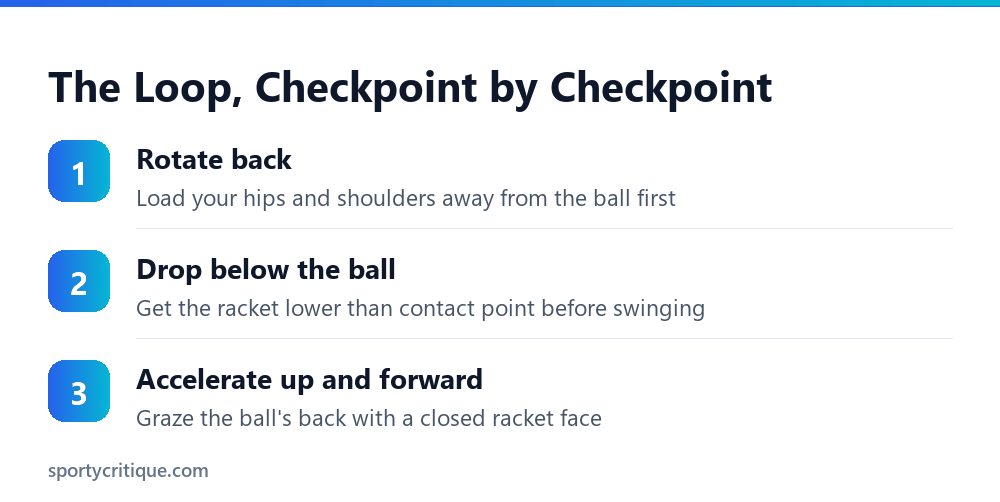
Quick Answer: The forehand loop is a brushing stroke, not a hitting one: rotate your hips back, drop the racket below the ball, then accelerate up and forward, grazing the ball’s back with a closed racket face. Power flows legs → hips → shoulders → arm → wrist. The topspin you create is what makes the ball dive onto the table — which is why a loop can attack balls a flat drive could never land.
The loop is the stroke that made modern table tennis. Before the sponge revolution of the 1950s, the game was patient pushing and blocking; after players learned to brush the ball into heavy topspin, it became the fastest, spinniest sport on earth. Every attacking player’s game is built around this one stroke, and learning it properly is the single biggest jump you will make.
It’s also the stroke most people get wrong for years, because it contradicts every instinct from other racket sports. You’re not trying to hit the ball hard. You’re trying to graze it.
Table of Contents
Why the loop beats everything else
Understanding what topspin does is the difference between copying the motion and knowing why. A ball spinning forward experiences the Magnus effect: the air moves differently over the top and bottom of the spinning ball, generating a downward force. The ball dives onto the table.
That downward force is your safety margin. It’s why you can swing hard at a ball that a flat drive would send sailing long — more spin means more dip, and more dip means you can add more speed. Spin and safety go up together, which is a genuinely rare free lunch in sport.
And it doesn’t stop at the bounce. A heavy topspin ball kicks forward off the table and jumps at your opponent, arriving faster and higher than they expect. That’s why a good loop wins points even when the opponent gets a racket on it — they’re returning a ball that behaves wrongly.
| Stroke | Contact | Ball path | Use it when |
|---|---|---|---|
| Drive | Flat-ish, through the ball | Fast, low, straight | Rallying at net height |
| Loop | Thin brush up the back | Arcs, dips, kicks off the bounce | Any ball — the all-purpose attack |
| Smash | Flat, maximum force | Straight and terminal | High balls only |
| Loop drive | Between the two — thicker contact | Faster, less arc | When you want speed over spin |
The technique, checkpoint by checkpoint
- Stance: feet wider than shoulders, right foot slightly back for right-handers, knees genuinely bent, weight on the balls of your feet. If your legs are straight, stop — the loop starts from the ground.
- Rotate and load. Turn your hips and shoulders away from the table, letting the arm drop naturally. Racket ends up below the level of the ball — knee height against backspin, waist height against topspin.
- The chain: legs → hips → shoulders → arm → wrist. Push off the back leg, rotate the hips, and let that rotation drag the shoulder, then the arm, then the wrist. Each link accelerates the next.
- Contact: brush, don’t hit. Racket face closed roughly 45–60°, and you graze up the back of the ball. Think of striking a match against a matchbox — that glancing, friction-heavy contact is exactly right.
- Timing: top of the bounce for your first months. On the rise is for pressure; on the drop is for looping backspin from distance.
- Follow through up and across — the racket finishes near your forehead — then recover immediately to neutral.
⚠️ The single test that tells you if you’re brushing: listen. A loop makes a soft fffft sound. A hit makes a sharp clack. If you hear clack, you’re hitting the ball, not brushing it — and no amount of extra effort will turn a hit into spin. Slow the whole stroke down by half and find the sound first.
The adjustment table (the part that separates drills from matches)
Here’s what most guides never make explicit: looping backspin and looping topspin are almost different strokes. The motion is the same family, but the racket angle, backswing height and contact timing all change. This single table is the difference between looping beautifully in practice and having no idea what to do in a game:
| Incoming ball | Backswing | Racket angle | Swing direction | Contact timing |
|---|---|---|---|---|
| Heavy backspin (a push) | Low — knee height or below | More open (~30–45°) | Strongly upward — you must lift | Ball dropping |
| Light backspin / dead ball | Waist-low | ~45° | Up and forward | Top of bounce |
| Block / light topspin | Waist height | Closed (~60°) | More forward than up | Top of bounce |
| Heavy topspin (counter-loop) | Compact, higher | Very closed (70°+) | Forward and over the ball | On the rise |
The logic behind it: you have to fight the incoming spin. Backspin is rotating backwards, so it wants to shoot downward off your racket — you counter that by opening the face and lifting. Topspin is rotating forwards and wants to jump upward off your racket — you counter by closing the face and driving over it.
If reading the incoming spin is your bottleneck (it is for most players), start with our spin guide — you cannot select the right adjustment if you can’t tell what’s coming.
The loop family
| Variant | What it is | When |
|---|---|---|
| Loop (spin loop) | Maximum brush, maximum arc | Opening up against backspin; safe attacking |
| Loop drive | Thicker contact, more speed, less spin | When the opponent is out of position and you want it over fast |
| Counter-loop | Looping against their loop, taken early | The rally-winning shot at higher levels |
| Hook loop | Sidespin added — ball curves left (for righties) | Bending the ball around a blocker |
| Fade loop | Opposite sidespin | Wide angles |
Learn the spin loop first and live there for months. The loop drive arrives naturally once your contact is reliable. Counter-looping is advanced — it means attacking a ball that’s already loaded with topspin and kicking at you, which requires reading spin at speed and total confidence in your contact.
The five loop-killers
| Mistake | Symptom | Fix |
|---|---|---|
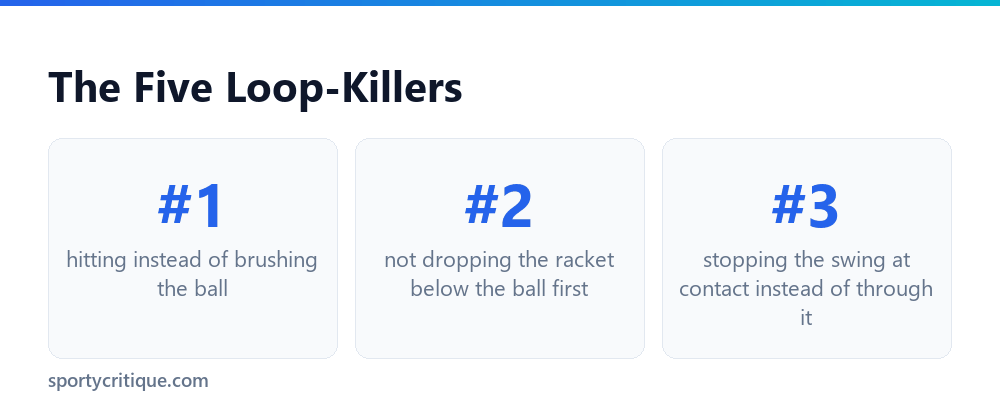
| Arm-only swinging | Sore elbow, no spin, no power | Legs and hips first — the arm is the last link, not the engine |
| Hitting flat out of impatience | Ball flies long every time | You’re striking, not brushing. Listen for the fffft |
| Standing tall | Late, weak, cramped contact | Bend the knees. The loop is a squat that ends in a swing |
| Wrong angle for the spin | Backspin balls into the net; topspin balls off the end | The adjustment table above. Learn it cold |
| No footwork | Lunging, reaching, mistiming | Move first, swing second — always |
Number one is the universal beginner problem and it’s worth being blunt about: if your arm hurts after a session, you are looping with your arm, and your loop will never be good until that changes. The arm is a whip on the end of a rotating body. It doesn’t generate the power; it delivers it. More on the whole family of these faults in our common mistakes guide.
When not to loop
The loop is the answer to most balls, not all of them, and knowing the exceptions saves you free points:
| Situation | Loop it? | Do this instead |
|---|---|---|
| Ball is short, bouncing twice on the table | No — you can’t get under it | Flick, or push it short |
| Ball is very high above the net | No — you’re wasting a gift | Smash it |
| Opponent is lobbing from 4m back | Rarely | Smash, or drop it short |
| You’re out of position and off balance | No | Block or push, reset, loop the next one |
| Heavy backspin, and you’re tight to the table | Hard | Step back half a metre first — you need room to lift |
The out-of-position rule is the one recreational players ignore most. A loop played while lunging isn’t a loop — it’s an arm-swing with no legs, which means no spin, which means no dip, which means the ball flies long. Resetting with a block and looping the next ball wins more points than a heroic loop off the wrong foot. Patience is a stroke too.
Where the loop came from
Worth knowing, because it explains why the stroke feels so unlike the rest of the sport’s history. Table tennis spent its first seventy years as a game of pushing, chopping and flat hitting — hard bats with pimpled rubber couldn’t grip the ball enough to do anything else.
Then came sponge. When Japan’s Hiroji Satoh won the 1952 World Championships with a thick sponge-backed paddle, he broke the sport open — sponge gave dwell time, dwell time gave friction, and friction gave spin. Japanese players developed the looping stroke through the late 1950s and 1960s, and within a decade the entire sport had reorganised around it. The defensive chopping game that had dominated for generations became a specialist curiosity almost overnight.
That’s why the loop contradicts your instincts: it wasn’t in the original game. It’s an invention layered on top of it by equipment that didn’t exist for the sport’s first half-century. The full story is in our history of table tennis.
Practice progression (the order actually matters)
- Shadow strokes, 20 a day. No ball. Mirror if you have one. Groove the chain — legs, hips, shoulders, arm — until it’s one motion rather than four.
- Loop against block, cross-court. Partner blocks steadily; you loop. Target 20 in a row before you think about power.
- Loop against backspin. Partner pushes; you lift. This is the hard one and the important one — most match loops are against backspin.
- The third-ball pattern: you serve backspin, partner pushes, you loop. The single most common point in amateur table tennis, drilled in full in our drills guide.
- Random: partner mixes push and block without telling you. Now you’re actually playing.
💡 A robot that switches between backspin and topspin feeds is the fastest way through steps 2–5, because the adjustment table only becomes instinct through volume. Forty loops against backspin in five minutes beats an hour of rallying.
Equipment: the one stroke where it genuinely matters
The loop depends on friction. That’s the entire mechanism — the rubber grips the ball, holds it for a few milliseconds, and flings it off spinning. Which means:
- Grippy, tacky rubber is doing real work here. A slick, worn, or hard rubber sheet cannot generate the friction the stroke needs, and no technique compensates.
- A blade with some flex gives you dwell time — the ball stays on the rubber a fraction longer, which is where spin comes from.
- A hard, fast carbon blade punishes beginners — the ball leaves too fast to brush properly.
- Dirty rubber kills spin instantly. If your loops died recently and nothing else changed, clean the rubber — see our paddle cleaning guide.
If you’re looping on a $15 pre-made paddle with hard, shiny rubber, the stroke will feel impossible no matter how good your form is — and you’ll conclude you can’t loop, which isn’t true. Our rubber guide covers spin-friendly sheets and the blade guide covers builds that help rather than fight you.
Frequently asked questions
Why do my loops go into the net?
Almost always because you’re looping backspin with a topspin technique — closed racket, forward swing. Backspin needs an open face and a strongly upward swing. Check the adjustment table.
Why do my loops fly off the end?
Either you’re hitting flat instead of brushing (no topspin to bring it down), or you’re looping topspin with a backspin technique — too open, too much lift.
How long does it take to learn the forehand loop?
A recognisable loop against block: a few weeks. A reliable loop against backspin: a few months. A loop you trust at 9–9: a year of drilling. It’s the deepest skill in the sport and it never stops improving.
Should I learn the loop or the drive first?
Drive first, briefly — it teaches contact and timing. Then loop, and stay there. The modern game is looping; players who build their whole game on flat drives hit a hard ceiling.
Can I loop with a pre-made paddle?
A decent one, yes. A cheap one with hard shiny rubber, genuinely no — the friction isn’t there. That’s not an excuse, it’s physics; the stroke needs grip to work.
What’s the difference between a loop and a topspin?
Nothing — ‘loop’ is the table tennis word for a topspin attacking stroke. European coaches say ‘topspin’, Americans and Asians tend to say ‘loop’. Same stroke, different vocabulary.

Ping Pong Reviewed is an equipment review site covering table tennis and baseball gear. Specifications are checked against manufacturer listings, and prices against live retail pages, before publication.