Which Serve Is Most Effective in Table Tennis? Coaching Answer
There’s no honest way to name a single “most effective” serve in table tennis, and every coaching source that actually studies this seriously says so directly. That’s not a dodge, it’s the actual finding, and it points to something more useful than a ranking would anyway.
Short answer: No single serve type is objectively most effective. Coaching sources consistently point to disguise and variation as what actually wins points, not the specific serve family used. The pendulum serve is the most common foundation most players build around, with the reverse pendulum and tomahawk used as targeted variations to stop an opponent settling into a read. Even elite players like Ma Long win with a standard pendulum made effective through disguise rather than through unusual mechanics. Verified against independent coaching sources on 5 September 2026.
Table of Contents
Why “Which Serve” Is the Wrong Question
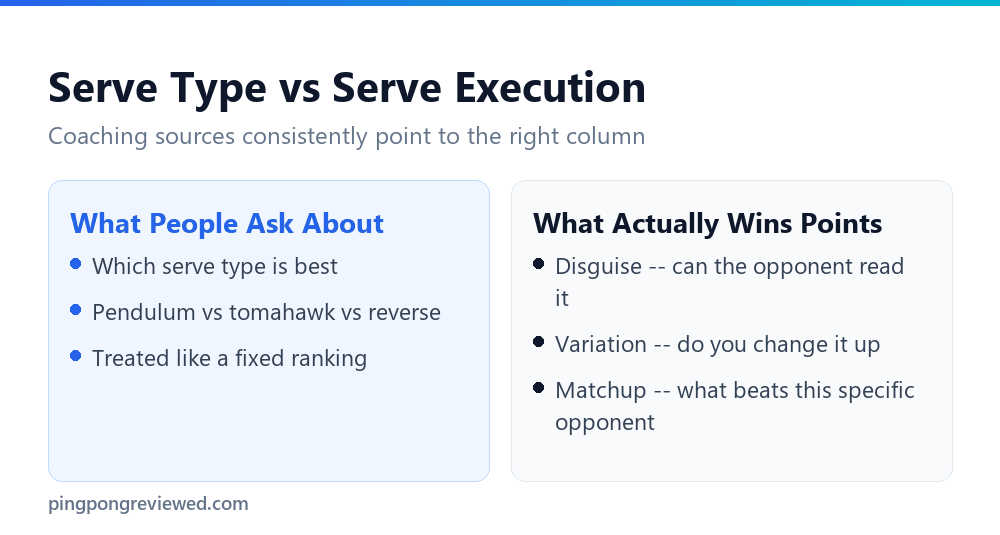
Asking which serve type is most effective assumes effectiveness is a property of the serve itself, the way a car’s top speed is a fixed number you can look up. Serve effectiveness doesn’t work that way. The same pendulum serve can be nearly unreturnable against one opponent and completely readable against another, depending entirely on how well it’s disguised and how much the receiver has already adapted to seeing it.
That’s why coaching sources studying this question consistently land on the same conclusion: the serve family matters far less than execution. A well-disguised, well-placed serve from any of the three main families beats a poorly disguised, predictable serve from any of the others.
The Pendulum Serve: The Default Foundation
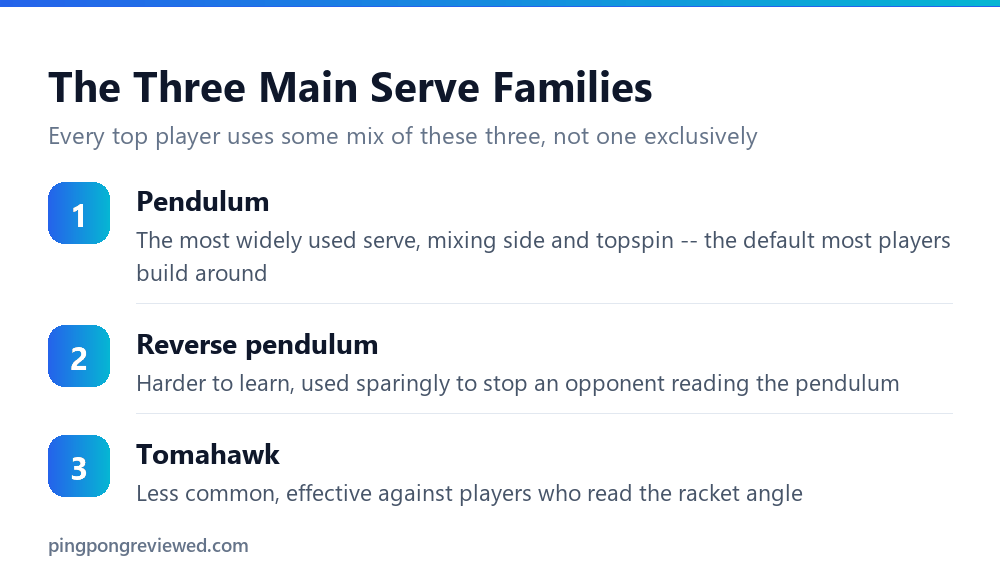
The pendulum serve is the most widely used serve in the sport, and for most players it’s the foundation everything else gets built around. It combines side and topspin in a motion that’s relatively natural to learn and highly adjustable, small changes in contact point and racket angle let a player vary the spin significantly while keeping the same basic swing, which is exactly what makes disguise possible within a single serve family.
Ma Long’s serve is a useful concrete example here: coaching sources describe it as a standard pendulum serve, not an unusual or unique motion, made devastating through his mastery of deception within that standard shape. That’s a strong, sourced illustration of the whole point, the serve type wasn’t special; the execution was.
The Reverse Pendulum: A Targeted Counter
The reverse pendulum serve is harder to learn than the standard pendulum and used far more sparingly, and coaching sources are specific about why: its main job is stopping an opponent who has started reading the pendulum and is cheating early toward their backhand in anticipation. Mixing in a reverse pendulum a couple of times a match is often enough to keep that read honest, without needing to make it a primary serve at all.
This is a clean example of why variation, not a single best serve, is the actual skill being described. The reverse pendulum’s value comes specifically from being used occasionally against an opponent who’s adapted to something else, not from being inherently superior to the pendulum it’s mixed in against.
The Tomahawk: Effective Against a Specific Read
The tomahawk serve is less common than either pendulum variant, and it’s specifically effective against players who read the racket angle to anticipate spin, since the tomahawk’s motion disguises that angle differently than a pendulum does. It’s easier to learn than the reverse pendulum, and it’s associated at the highest level with Dimitrij Ovtcharov, who uses it to generate explosive spin and disguise against elite opponents.
What Actually Determines Effectiveness
Three factors show up across every coaching source that addresses this seriously: disguise (can the receiver actually read the spin before it’s too late to react), variation (does the server change type, placement, and speed enough to prevent the receiver adapting), and matchup (does this particular serve exploit this particular opponent’s specific weaknesses). A serve that’s strong on all three beats a technically more “advanced” serve that’s weak on any of them.
This is exactly why elite players don’t converge on one serve type, they converge on being excellent at disguising and varying whichever serves they’ve chosen to specialize in, which is a skill set, not a single technique.
- ✓Build one reliable primary serve you can execute under pressure
- ✓Mix in a secondary serve type occasionally to prevent a read
- ✓Vary placement and speed within the same serve motion
- ✓Study what a specific opponent struggles to return before a match
- ✕Chase a single ‘best’ serve type as if one exists
- ✕Use the same serve repeatedly without any variation
- ✕Assume a harder-to-learn serve is automatically more effective
- ✕Ignore disguise while focusing only on spin or speed
⚠️ Watch out: A technically difficult serve executed without disguise is often less effective than a simple serve executed well. Difficulty of learning and effectiveness in a match are not the same thing.
Why Beginners Get Different Advice Than Advanced Players
It’s worth separating what a beginner should focus on from what the effectiveness question actually resolves to at higher levels, because the honest answer shifts depending on where a player actually is. A beginner does benefit from picking one serve family, usually the pendulum, and drilling it until the basic motion and contact point become reliable, since there’s nothing to disguise or vary yet if the underlying serve itself isn’t consistent.
The “no single best serve” answer becomes relevant once a player already has a reliable serve and is looking for the next improvement. At that stage, adding disguise and a second serve type does more for match results than continuing to polish the same single serve in isolation, which is exactly the point at which most intermediate players plateau if they don’t make that shift.
💡 Pro tip: If you’re still building your first reliable serve, don’t worry about the ranking question at all yet. Get one serve consistent first, the effectiveness conversation about disguise and variation matters most once you already have something reliable to vary.
Other Serve Types Worth Knowing About
Pendulum, reverse pendulum, and tomahawk cover the large majority of competitive serves, but they’re not the only families in use. Backhand serves, played from the backhand side of the body rather than the forehand, are common at the highest levels specifically because they can disguise spin differently than any forehand serve can, and some players build their entire service game around a strong backhand serve rather than a forehand pendulum.
There are also more exotic, highly specialized serves that show up occasionally in elite play or in exhibition contexts, but they’re far less common precisely because they trade reliability for novelty, a serve that’s hard for an opponent to read is often also hard for the server to execute consistently under pressure, which is the same trade-off the reverse pendulum makes in a more moderate form.
The Receiving Side of This Question
It’s worth flipping the question around briefly, since it clarifies why variation matters so much. A receiver facing the same serve repeatedly gets more reads on it with every repetition, by the fifth or sixth identical serve in a match, most competent receivers have adjusted, regardless of how good that serve objectively is. That adjustment process is exactly what variation is designed to interrupt, by never letting the receiver accumulate enough reps against any one serve to fully solve it.
This is also why matchup specifically matters as much as it does: a serve that a given receiver has faced thousands of times in their own training, from players with a similar style, may already be well-read before the match even starts, while the same serve against an unfamiliar opponent starts from a real advantage. “Most effective” depends on who’s standing on the other side of the table, not just on the serve itself.
A Practical Way to Apply This
Rather than asking which serve to learn as “the best one,” the more useful framing coaching sources point toward is building a reliable primary serve first, for most players, some form of pendulum, and then adding one or two variations specifically to keep opponents from settling into a read on that primary serve. The variations don’t need to be used often to be valuable; their value comes partly from the opponent knowing they might show up.
That’s a fundamentally different project than ranking serve types against each other, and it’s the one coaching sources actually recommend players pursue, because it maps onto how points are really won, through an opponent’s uncertainty, not through any single serve’s inherent properties.
📊 Note: This same logic explains why watching professional matches can be misleading for beginners trying to copy a single ‘best’ serve. What looks like one dominant serve on a highlight reel is usually one moment from a much larger, varied service game built over years.
The Short Version, Restated
No serve type wins a fixed ranking, because effectiveness isn’t a property of the serve alone, it’s a property of how disguised, varied, and well-matched to the opponent it is. The pendulum, reverse pendulum, and tomahawk each answer a different tactical situation, and elite players use combinations of all three rather than committing to one as objectively best.
If there’s a single actionable takeaway, it’s this: invest in disguise and variation within whichever serves you choose, rather than searching for a serve type that wins on its own.
None of this makes the question meaningless, it just relocates the useful version of it from “which serve” to “how disguised, how varied, and how well-matched to this opponent.” That’s a harder question to answer in a single word, but it’s the one that actually predicts what wins points.
Every question below comes back to that same short list, what to build, what to add, and when.
Serve Effectiveness Questions, Answered
Is there a single most effective serve in table tennis?
No. Coaching sources consistently point to disguise, variation, and matchup against a specific opponent as what determines effectiveness, not any one serve type.
What is the most commonly used serve at the top level?
The pendulum serve. It’s the default foundation most players build around, combining side and topspin in an adaptable motion.
Why do players use the reverse pendulum if it’s harder to learn?
To stop an opponent who has started reading their pendulum serve and is anticipating it early. It’s used sparingly as a counter, not as a primary serve.
What makes the tomahawk serve effective?
It disguises the racket angle differently than a pendulum, which makes it specifically effective against players who read racket angle to anticipate spin.
Does a harder-to-learn serve automatically win more points?
No. A simpler serve executed with strong disguise often outperforms a technically harder serve executed without it.
That’s the whole picture worth taking away: not a ranking to memorize, but a short list of what to actually train, one reliable serve first, real disguise within it, a second serve type to keep opponents guessing, and the judgment to know when each one actually applies.
The Short Version
- →No single serve type is objectively the most effective.
- →The pendulum serve is the most common foundation most players build around.
- →The reverse pendulum counters an opponent reading the pendulum.
- →The tomahawk beats players who read the racket angle.
- →Disguise and variation matter more than serve type alone.

Ping Pong Reviewed is an equipment review site covering table tennis and baseball gear. Specifications are checked against manufacturer listings, and prices against live retail pages, before publication.