Can I Change My Grip During a Match? Table Tennis Rules
Yes, you can change your grip during a match, at any point, including mid-rally if you somehow wanted to. The Laws of Table Tennis simply don’t regulate how you hold the racket, which makes this one of the more straightforward rules questions in the sport, once you know where to look for the answer, which is: nowhere, because there’s nothing written about it at all.
Short answer: Changing your grip during a match is completely legal. Nothing in the rules restricts how a player holds their racket, so switching between grip styles, or adjusting your grip mid-point, carries no penalty of any kind. What is regulated is the racket itself, its rubber colors, and whether it can be replaced mid-match, which is a separate set of rules entirely, easy to mix up with the grip question but different. Verified against independent sources on 5 September 2026.
Table of Contents
Why the Rules Are Silent on This
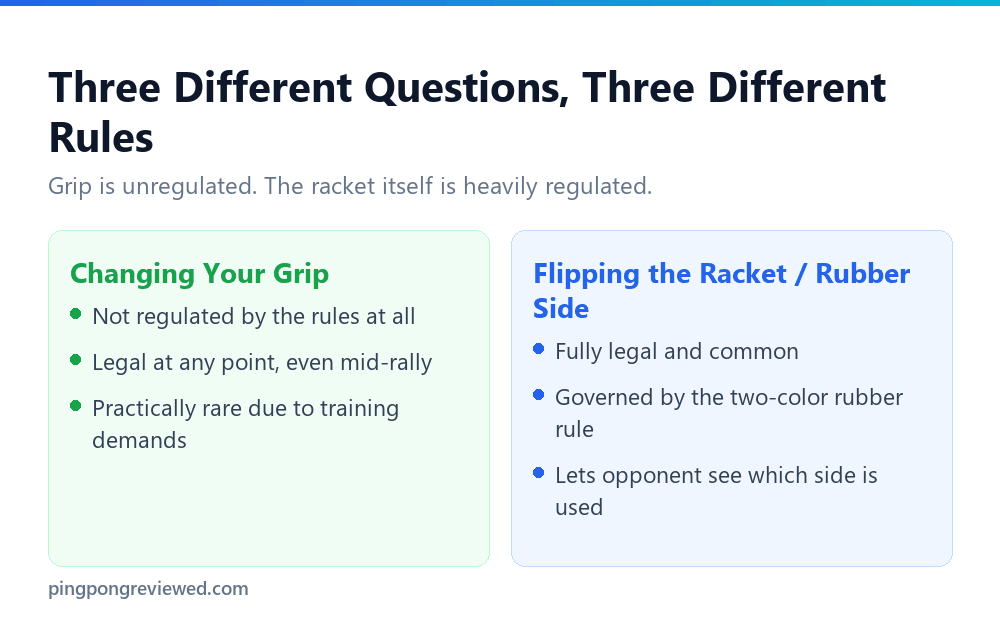
The Laws of Table Tennis regulate the equipment extensively, racket size, the composition of the blade, the color and approval status of the rubber covering, but they say nothing at all about grip. That’s a deliberate gap, not an oversight: grip is a technique choice, and the rules generally don’t regulate technique the way they regulate equipment. How you stand, how you swing, and how you hold the racket are all left entirely up to the player.
That silence is actually the full answer. There’s no clause permitting grip changes because there’s no clause restricting them in the first place, permission was never the question, since nothing needed to grant it.
Why It Almost Never Actually Happens
Despite being fully legal, switching grip styles mid-match is vanishingly rare at any level of the sport, and the reason is purely practical rather than a rules constraint. A grip, shakehand, penhold, or any variant, is a deeply trained motor pattern built over years of repetition. Reaching a competent level with a second grip style takes serious, dedicated practice, not something a player can toggle on demand mid-point for a tactical edge.
This is worth separating clearly: the rules impose zero barrier, but the skill required to make a grip change actually useful is an extremely high barrier on its own. Most players who’ve spent years training one grip would see their performance collapse, not improve, if they tried switching styles mid-match, which is why essentially nobody does it in practice even though nothing stops them.
💡 Pro tip: If you’re experimenting with grip as a beginner, do it in practice sessions, not matches. There’s no rules reason not to experiment mid-match, but there’s also no tactical reason to, it’s purely a training-room decision.
What’s Actually Regulated Instead
Two adjacent things get confused with the grip question, and both of them actually are regulated. The first is flipping the racket to use the other rubber side, fully legal and common, and governed by the two-color rule requiring one side to be black and the other a distinctly different bright color, specifically so an opponent can see which side is in play and react to its spin characteristics. Flipping the racket between shots is a normal, expected part of the game, not a rules gray area at all.
The second is replacing the racket itself with a different one mid-match, which IS restricted. Under the Laws of Table Tennis, a racket can’t be swapped during an individual match unless it’s been damaged badly enough that it can no longer be used, at which point it must be replaced immediately. Swapping in a different racket for any other reason mid-match isn’t allowed.
- ✓Adjust your grip whenever it feels right, including mid-point
- ✓Flip your racket between the two rubber colors freely
- ✓Replace a racket that’s been damaged badly enough to be unusable
- ✓Practice a second grip style in training if you want to develop it
- ✕Assume grip changes require any kind of permission or notice
- ✕Confuse flipping the racket with changing your actual grip
- ✕Swap to a different racket mid-match for a reason other than damage
- ✕Expect a mid-match grip switch to work without years of prior training
A Worked Example
Imagine a shakehand player who also trained penhold for years as a junior and can play both competently. Mid-match, down a game and looking to change momentum, they switch to their penhold grip for a stretch of points. Nothing in the rules stops this, no referee intervenes, no fault is called, nothing needs to be shown or declared. The only thing standing between this scenario and most players is the years of dual-grip training it actually requires to pull off without simply playing worse.
Compare that to a player who tries to swap in a spare racket mid-match because their first one feels slightly off, with no damage involved. That’s the one restricted action in this whole comparison, and it would be stopped by the rules immediately, in a way a grip change never would be.
Does This Apply the Same Way in Doubles?
Yes. Grip remains unregulated in doubles exactly as it is in singles, with no additional restriction tied to the doubles rotation or partnership. The two rules that ARE regulated, racket color and racket replacement, also carry over unchanged, applying individually to each player on the doubles team rather than being shared or restricted between partners in any special way.
📊 Note: Coaches occasionally advise young players to commit to one grip early and stick with it, precisely because dual-grip competence is so rare to develop. That’s coaching advice about long-term development, not a rule, the sport itself has no opinion on how many grips you learn or when you use them.
Why Coaches Still Warn Against It
If the rules place no restriction on grip changes, it’s worth asking why coaches so consistently advise against experimenting with grip mid-match anyway. The answer has nothing to do with legality and everything to do with performance under pressure. A match is exactly the wrong moment to test an unfamiliar or half-trained grip, because the fine motor control a grip depends on tends to degrade fastest under competitive stress, not improve.
A player reaching for a rarely-used second grip mid-match is far more likely to fumble a routine shot than to unlock some hidden tactical advantage. That’s a performance argument, not a rules one, but it’s the real reason grip experimentation almost always gets pushed to the practice table instead of the match table, even though nothing on the rules side is stopping anyone.
What About Adjusting Grip Slightly, Not Switching Entirely?
Most of what actually happens mid-match isn’t a full grip-style switch at all, it’s a small adjustment within the same broad grip family, like loosening or tightening the hold for a particular shot, or shifting finger placement slightly for better backhand leverage. These minor adjustments are even more clearly unregulated than a full style switch, since they’re barely distinguishable from normal play and every player does some version of this constantly without thinking about it as a “change” at all.
That’s worth naming directly because it’s actually the more common real-world version of this question. Players rarely mean “can I switch from shakehand to penhold” when they ask this, more often they’re asking whether it’s fine to adjust their existing grip slightly between points or shots, which the rules treat exactly the same permissive way as a full style change: not regulated at all, in either direction.
How This Compares Across Racket Sports
Table tennis’s silence on grip isn’t universal across racket sports, which is part of why the question comes up. Some sports and formats impose equipment or technique restrictions that table tennis simply doesn’t carry. Players arriving from a background in a more heavily regulated sport sometimes assume table tennis must have a similar restriction somewhere and go looking for it, when the honest answer is that it was never written into the rules in the first place.
That absence is worth taking at face value rather than searching for an unwritten exception. If a rule restricted grip, it would appear explicitly in the Laws of Table Tennis the same way the racket color and replacement rules do, regulated actions in this sport are written down, not left to inference.
Save the actual decision-making for the training hall, where a new grip or a subtle adjustment can be tested, repeated, and judged honestly without the scoreboard pressure warping the result. The rules gave you the freedom either way, what you do with it is entirely a coaching question, not a legal one.
The Short Version, Restated
Grip is entirely unregulated. Change it whenever you want, including mid-point, and no rule anywhere restricts that. What does carry real restrictions is the racket itself, its rubber colors, which are regulated but not restrictive, and its replacement, which is limited to cases of damage.
Keep those three things, grip, racket flip, racket replacement, as three separate questions with three separate answers, and none of them stay confusing for long.
None of this needs to feel complicated in practice. If you’re asking whether you’re allowed to hold your racket differently at any point in a match, the answer is simply yes, full stop, and you can stop looking for a catch, because there isn’t one written into the rules anywhere.
Ask the question once, get the flat answer, and move on to whatever is actually going to help your game more, because this particular rule, unusually for table tennis, really is that simple.
Grip Rule Questions, Answered
Can I change my grip during a table tennis match?
Yes. Nothing in the Laws of Table Tennis restricts how you hold the racket. You can change your grip at any point, including mid-rally, without penalty.
Is switching from shakehand to penhold mid-match legal?
Yes, it’s legal, though extremely rare in practice since competence with a second grip style takes years of dedicated training to develop.
Is flipping the racket to the other rubber color the same as changing grip?
No. Flipping the racket to use the other color rubber is a separate, common, fully legal action governed by the two-color rule, not a change to how you’re holding the racket.
Can I swap to a different racket mid-match if I just don’t like my current one?
No. A racket can only be replaced mid-match if it’s been damaged badly enough to be unusable. Swapping for any other reason isn’t allowed.
Does the grip rule differ in doubles?
No. Grip is unregulated in doubles exactly as it is in singles, with no additional restriction from the doubles format.
One rule, or rather one absence of a rule, and the rest of this question resolves itself the moment you stop looking for hidden conditions that were simply never written into the Laws of Table Tennis in the first place.
The Short Version
- →Grip is not regulated by the Laws of Table Tennis in any way.
- →You can change your grip at any point during a match, even mid-rally.
- →Grip changes are legal but practically rare due to the training required.
- →Flipping the racket’s rubber side is a separate, common, legal action.
- →Replacing the racket itself is restricted to cases of real damage.


Ping Pong Reviewed is an equipment review site covering table tennis and baseball gear. Specifications are checked against manufacturer listings, and prices against live retail pages, before publication.