Short vs Long Serves in Table Tennis: Which Wins More Points?
Short serves are used far more often than long ones at every competitive level, and there’s a specific, well-documented mechanical reason why. But “short is better” isn’t the complete answer, coaching sources are consistent that long serves remain a real, undiscarded weapon precisely because most players default to short, which is a more useful answer than a flat comparison gives.
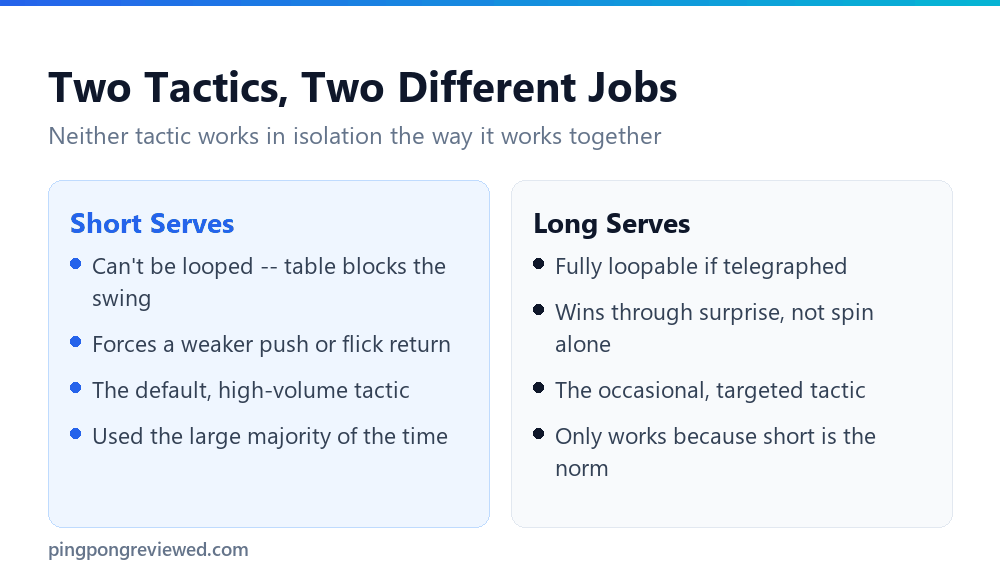
Short answer: Short serves are the preferred default at advanced levels because the table physically blocks a full loop swing on a ball that stays short, forcing a weaker return. Long serves aren’t worse in some absolute sense, they’re a deliberately occasional tactic that works specifically because opponents are conditioned to expect short, which makes a well-timed long serve a surprise weapon rather than a primary strategy. Verified against independent coaching sources on 5 September 2026.
Table of Contents
The Mechanical Reason Short Serves Dominate
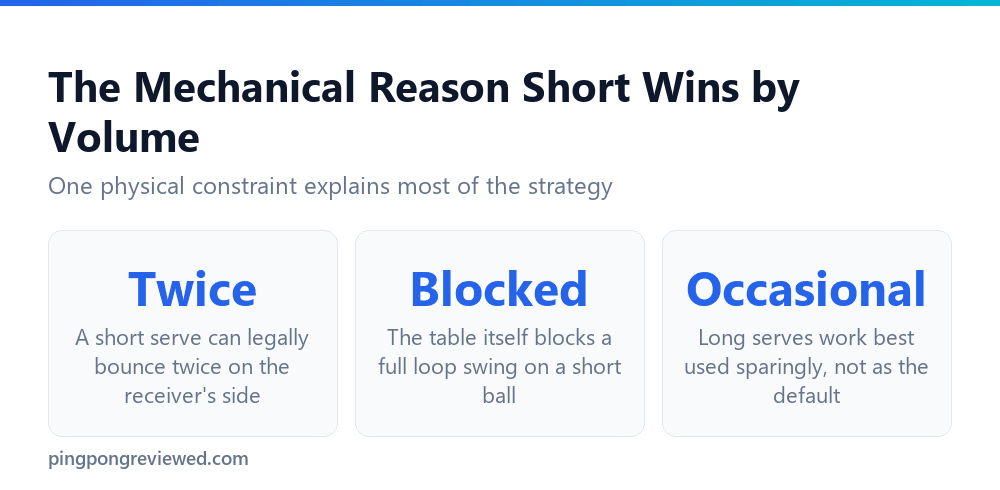
A short serve, one that would bounce twice on the receiver’s side of the table if left alone, forces the receiver to make contact close to the net, often reaching over the table to do it. That position makes a full, powerful loop stroke physically difficult or impossible, the table itself is in the way of the swing a receiver would otherwise use to attack a deeper ball. A short serve essentially removes the receiver’s best attacking option before the point has really started.
That single mechanical fact explains most of why short serves dominate at advanced levels. Coaching sources are direct about the consequence: if you can’t serve short reliably, you’re at a real disadvantage against good players, because every serve you send deep enough to loop is handing them their favorite shot.
Why Long Serves Haven’t Disappeared
If short serves are mechanically superior in this specific way, the natural next question is why anyone still serves long at all. The answer coaching sources give is about conditioning and surprise, not about long serves being secretly better in general. A receiver who has faced short serve after short serve gets increasingly primed to expect one, positioning and preparing for a short-ball push or flick before the serve even happens.
An occasional long, fast serve against that exact expectation catches the receiver out of position and unprepared, often producing a weak return or an outright missed one, not because the long serve itself is unreturnable, but because it arrives when the receiver is set up for something else entirely. Coaching sources describe this as one of the most common and effective service strategies in the sport at both amateur and professional levels: serve short most of the time, and use long serves sparingly enough that they stay a genuine surprise.
💡 Pro tip: The value of a long serve depends partly on how disciplined you’ve been about serving short beforehand. A long serve thrown in randomly, without a pattern of short serves setting it up, loses most of its surprise value and becomes just a loopable ball.
What “Soft” and “Hard” Add to the Comparison
The question pairs “short soft” against “long hard,” which adds a speed dimension worth separating from the short/long distinction itself. A short serve is almost always played soft, with low speed and heavy backspin or sidespin, because the goal is control and placement close to the net, not pace, a fast short serve is difficult to execute accurately and doesn’t gain much from the added speed given how little distance it travels.
A long serve, by contrast, usually pairs its extra distance with real pace, since speed is a large part of what makes a long serve dangerous in the brief moment before the receiver adjusts. The short/soft and long/hard pairings in the question aren’t arbitrary, they reflect how these two serve types are actually played by players who use both well.
- ✓Make short serves your default, high-volume tactic
- ✓Keep short serves soft and low for maximum control
- ✓Mix in a fast long serve occasionally, not on a predictable pattern
- ✓Watch for when an opponent starts anticipating short and adjust
- ✕Serve long often enough that it stops being a surprise
- ✕Serve short with unnecessary extra pace that reduces control
- ✕Use the exact same long-serve timing or placement repeatedly
- ✕Assume ‘short is better’ means long serves have no place at all
How This Changes at Different Skill Levels
This comparison matters more at higher skill levels than it does for beginners, and coaching sources are specific about why. A beginner receiver often can’t loop a long serve effectively regardless of how it’s played, which means the short serve’s biggest advantage, blocking the loop, isn’t yet doing much work against a receiver who wasn’t going to loop it anyway. At that stage, serve placement and basic consistency matter more than the short/long strategic split.
As a receiver’s attacking game develops and looping becomes a real threat on anything deep, the short serve’s mechanical advantage starts mattering a great deal more, which is exactly why the short-serve-as-default pattern becomes standard practice at intermediate levels and above rather than being a beginner priority.
📊 Note: If you’re newer to the sport and your opponents aren’t yet looping consistently, don’t feel pressured to overhaul your serve strategy around this comparison. It becomes important once looping enters the picture as a real threat, not before.
A Worked Example of the Full Pattern
Picture a game where a server opens with four straight short serves, each one forcing a soft push return that the server then attacks. By the fifth serve, the receiver has adjusted, positioning tighter to the table and ready to pounce on anything short. That’s exactly the moment a long, fast serve pays off, the receiver, primed for short, is caught flat-footed by the sudden depth and pace, and either misses the return entirely or sends back something weak enough to attack.
Run that same long serve as the very first serve of the match, before any short-serve pattern has been established, and it’s just a fast, deep ball with no surprise behind it, exactly the kind of serve a competent receiver loops for a clean winner. Same serve, same execution, completely different outcome, based entirely on what came before it.
What Counts as “Short” and “Long” in Practice
“Short” specifically means a serve that would bounce twice on the receiver’s side of the table if the receiver didn’t touch it, the second bounce needs to happen close enough to the net that the receiver has to reach in over the table to make contact before it does. “Long” means the opposite: a serve deep enough that it would only bounce once on the receiver’s side, landing with room for a receiver to set up a full swing well behind the end line.
There’s also a middle length, sometimes called a half-long serve, that lands close to the point where the second bounce would happen right at the edge of the table. This length is trickier to read for depth and is its own tactical tool, distinct from both clearly short and clearly long serves, though the same underlying logic applies, length is being used deliberately to control what kind of return is even physically available to the receiver.
The Placement Dimension, Not Just Length
Length isn’t the only variable in play, and coaching sources are clear that placement, serving to the receiver’s forehand, backhand, or directly at their playing elbow, the awkward transition point between the two, interacts with the short/long decision rather than replacing it. A short serve to the backhand and a short serve to the forehand can demand completely different receiver responses even though both share the same length-based mechanical constraint against looping.
This means the real service game most advanced players run is a genuine grid of length and placement combinations, not a single short/long dial. Two players can both correctly favor short serves as their default and still have very different, similarly effective service games based entirely on how they vary placement within that shared short-serve preference.
Why This Debate Persists Despite Being Settled at the Top
If elite and advanced coaching sources agree so consistently on the short-serve-as-default pattern, it’s worth asking why the question still gets asked as if it were open. Part of the answer is that plenty of players below the advanced level haven’t yet felt the specific mechanical pressure that makes short serves necessary, if nobody you’re playing against can loop a long serve anyway, the short-serve advantage simply hasn’t shown up in your own results yet, which makes the question feel more open than it actually is at higher levels.
The other part is that “short is better” and “long is worthless” get conflated in casual conversation, when the actual coaching position is more precise than either extreme: short is better as a default, and long remains valuable specifically because it’s used as the exception rather than the rule. Both halves of that sentence are necessary to describe the real strategy accurately.
⚠️ Watch out: Watching a single professional match and noticing a player winning points with long serves doesn’t contradict any of this, it’s usually confirmation of it, since that long serve is almost certainly landing after a string of short ones set up exactly the surprise being described here.
The Short Version, Restated
Short soft serves aren’t simply better than long hard ones, they’re the correct default for a specific mechanical reason: the table blocks a full loop on a short ball. Long hard serves earn their place through timing and surprise, working specifically because most players default to short, and losing almost all of their value the moment they stop being occasional.
The real skill isn’t picking one over the other. It’s using short serves as the reliable foundation and long serves as the well-timed exception, in a ratio that keeps a receiver guessing rather than settled.
Short vs Long Serve Questions, Answered
Are short serves better than long serves in table tennis?
Short serves are used far more often because the table blocks a full loop return on a short ball. Long serves aren’t worse overall, they work as an occasional surprise tactic instead.
Why can’t you loop a short serve effectively?
The ball stays close to the net, forcing contact over the table, which physically prevents the full swing a loop stroke needs.
Why do players still use long serves if short is preferred?
Because opponents get conditioned to expect short serves, which makes an occasional long, fast serve a genuine surprise that can win a cheap point.
How often should long serves be used?
Sparingly. Coaching sources describe serving short most of the time and mixing in a long serve now and then, since overusing it removes the surprise that makes it effective.
Does the short-versus-long strategy matter for beginners?
Less so. It matters most once a receiver can loop deep serves consistently, which is typically an intermediate-level skill, not a beginner one.
The Short Version
- →Short serves block a full loop return because the table is in the way.
- →Short serves are the correct default at intermediate levels and above.
- →Long serves work as an occasional surprise, not a primary strategy.
- →Overusing long serves removes the surprise that makes them effective.
- →The comparison matters more once opponents can loop deep serves.

Ping Pong Reviewed is an equipment review site covering table tennis and baseball gear. Specifications are checked against manufacturer listings, and prices against live retail pages, before publication.