Killerspin Jet 200 Review: Real Specs, Price and Color Rules
This Killerspin Jet 200 review uses only the maker’s data and public rules. The Jet 200 is an entry-level paddle that Killerspin sells directly for $34.99 in two colorways, Mocha and BluVanilla. Killerspin lists a five-layer plywood blade, Killerspin rubber, a flared handle and a Memory Book Case, and calls it suitable for recreational play. We found no ITTF approval claim for it, so treat it as a casual paddle. Prices and stock below were checked on October 1, 2026, and we have not played with it.
Search for this paddle and you’ll hit a maze. Killerspin sells it. A retailer says it’s discontinued. Amazon shows a listing at a very different price. So where does it stand?
We checked the sources that matter: Killerspin’s own product data, Amazon’s product data, Megaspin, the ITTF’s laws and a copy of the ITTF’s list of authorized rubbers. Everything here comes from those, and we haven’t played with the paddle. You won’t find feel descriptions or a verdict based on use. You’ll find the maker’s numbers, the prices we saw, and what the rules say about using it.
- →Killerspin sells the Jet 200 at $34.99, with both colorways available on October 1, 2026.
- →Amazon’s single-paddle listing showed $58.89 with no stock information, so we don’t link it as a buy option.
- →Killerspin’s ratings are Control 8.5, Spin 7 and Speed 6, which are the maker’s numbers on its own scale.
- →The Jet 600 Spin N2 is $55 more, about 2.6 times the price, and Killerspin pitches it at intermediate to advanced players.
- →We found no Jet 200 rubber on the ITTF list we checked, so don’t plan on tournament play with it.
Table of Contents
Killerspin Jet 200 specs, as the maker lists them
Notice what is missing. Killerspin doesn’t publish a sponge thickness, and its page makes no ITTF approval claim for the paddle. Some third-party pages quote a sponge thickness. We left it out because we couldn’t find it from the maker.
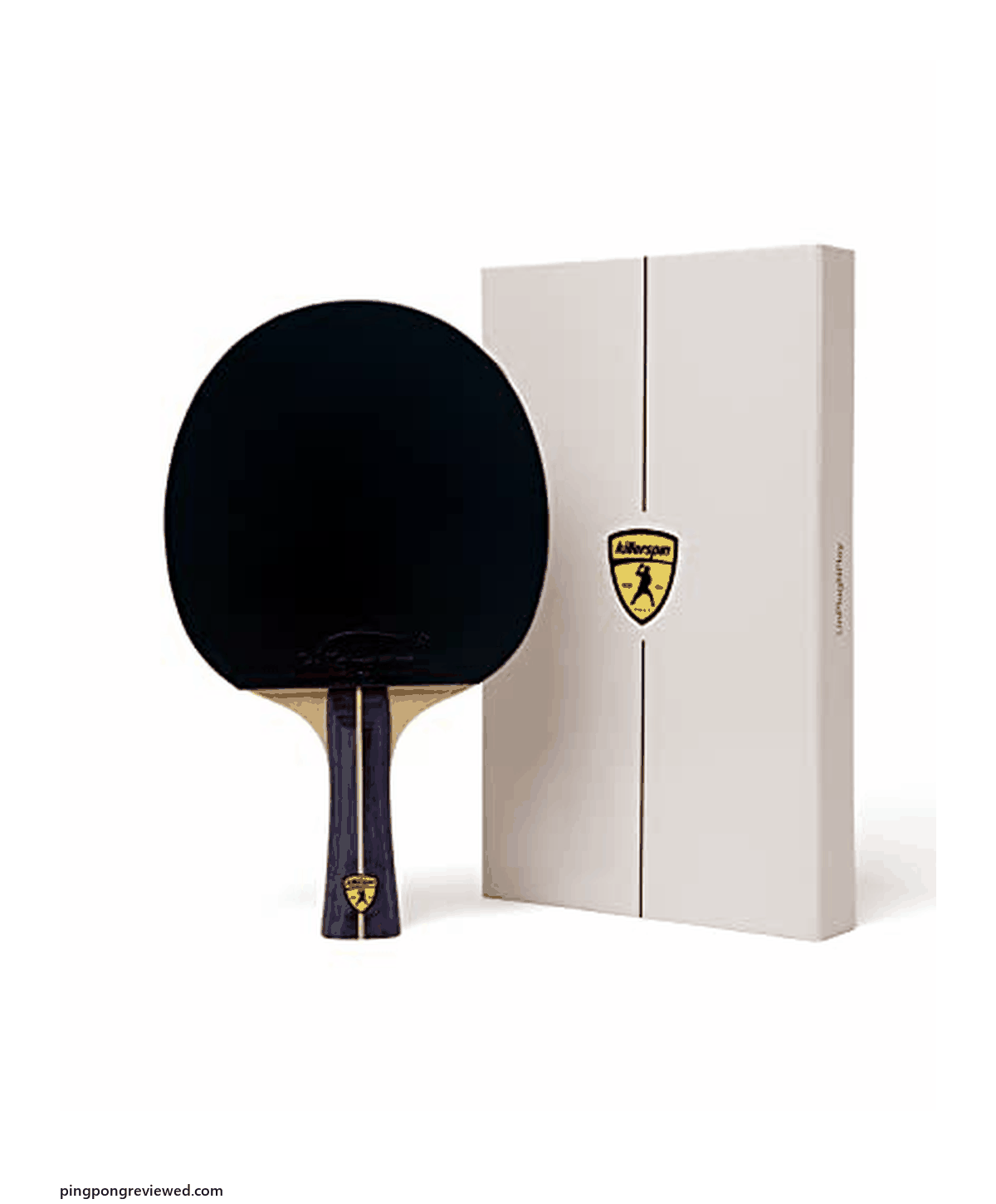
Where to buy the Killerspin Jet 200
The pattern is clear enough. Buy from Killerspin if you want the Jet 200 at its listed price. The Amazon single-paddle listing costs about $23.90 more than Killerspin’s price and gave no stock information, so we don’t treat it as a reliable option. We found no statement from Killerspin that the paddle is discontinued.
⚠️ Watch out: We could not test Killerspin’s checkout, so a listing showing available does not guarantee shipping. If the price or stock looks wrong when you get there, trust what the checkout shows.
Killerspin Jet 200 vs Jet 600 Spin N2
Killerspin’s own pages put the two paddles at different levels. Here are the maker’s numbers side by side.
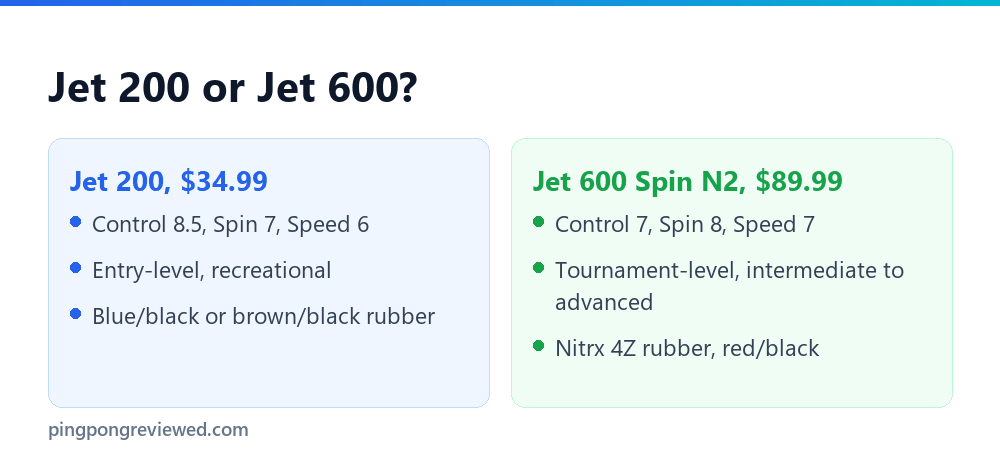
The price gap is $55.00, so the Jet 600 costs about 2.6 times as much. Killerspin’s numbers shift toward spin and speed on the Jet 600 and toward control on the Jet 200. Remember that those ratings are Killerspin’s own on its own scale, so they only compare Killerspin paddles with each other.
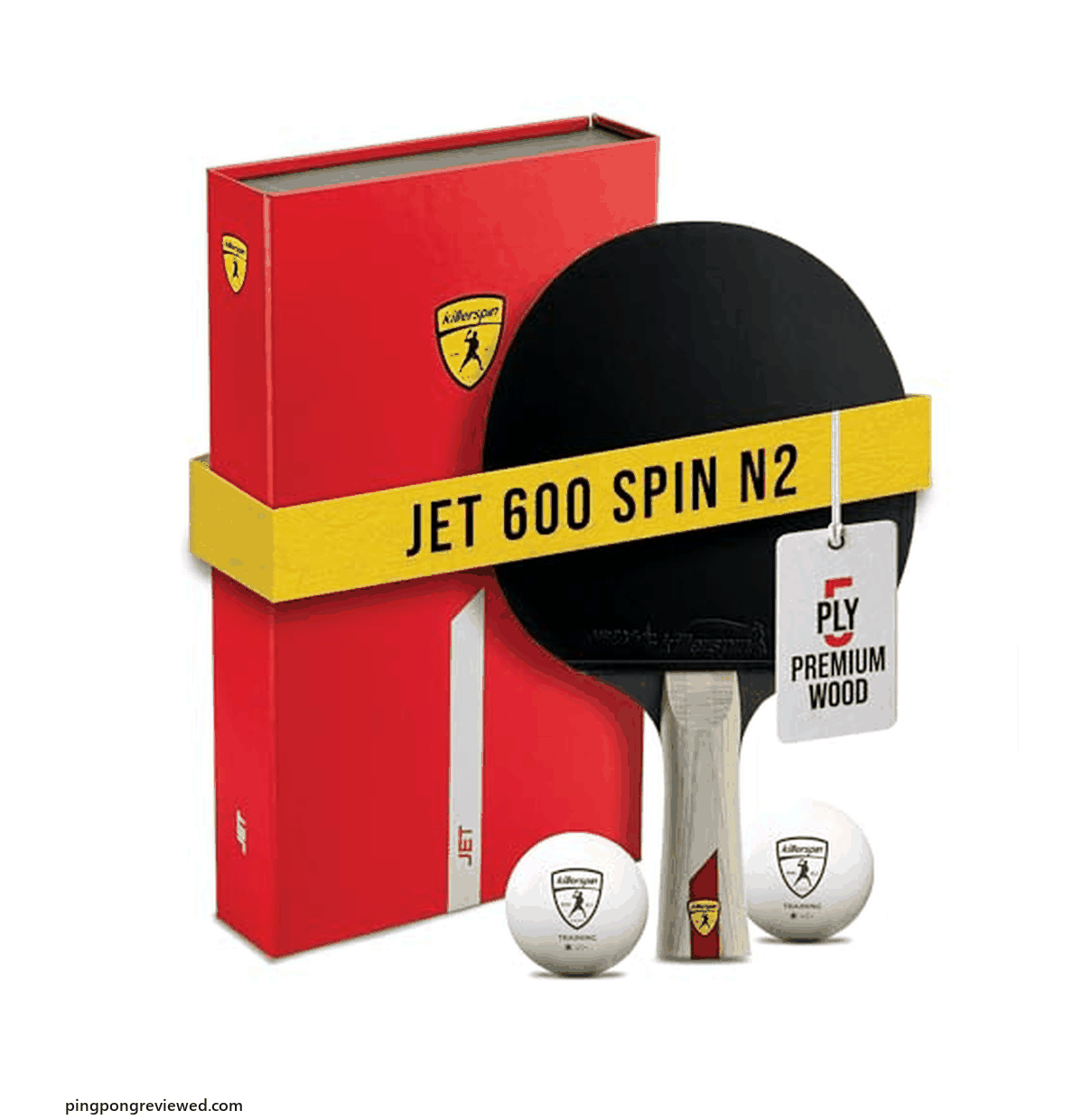
The Jet 600 is on Amazon at the same price. We checked the Killerspin Jet 600 Spin N2 listing on October 1: $89.99 and in stock.
Is the Killerspin Jet 200 legal for tournaments? The color and rubber rules
This is where paddle pages tend to get sloppy, so we’ll stick to the documents. ITTF Law 2.4.6 says the surface of a racket covering must be matt, black on one side, and a bright color clearly distinguishable from black and from the color of the ball on the other. The law doesn’t name specific colors.
The ITTF added new colors in 2021. Its article of September 30, 2021 (archived copy) says pink, purple, green and blue became officially authorized from October 1, 2021 and may be used instead of red, while one side must still be black. The list of authorized coverings uses its own color key: red, black, green, blue, pink and violet. Brown is not in that key.
There is a second rule, and it matters more. The ITTF’s Regulations for International Competitions require coverings to be authorized (Regulation 3.2.1.3) and say a covering must be used as authorized, without any physical, chemical or other treatment (Regulation 3.4.2.2). We searched the January 3, 2026 list of authorized racket coverings, as hosted by the French federation, for Killerspin. It shows two Killerspin coverings, Fortissimo and Nitrx-4Z, each in black and red. It shows no covering matching the Jet 200’s rubber, which Amazon’s listing calls Jet Basic.
So here’s our cautious reading. The Jet 200’s colorways are listed as blue/black and brown/black, brown is not a listed covering color, and we found no Jet 200 rubber on the list. We can’t tell you how an umpire or organizer would treat it. We’d treat it as a recreational paddle.
📊 Note: Our check used a copy of the list hosted by the French federation, because the ITTF’s own site blocked our checks. Lists are updated, so confirm on the ITTF’s current list before you rely on this. Our guide to checking ITTF approval shows how.
Recreational play vs sanctioned play
The rules above matter only if you play under ITTF-style rules. The ITTF’s Regulations for International Competitions say the laws and regulations are presumed to apply unless variations are agreed in advance or made clear in the published rules, and they let some international tournaments run by unaffiliated bodies follow the organizer’s own rules. That is about international competitions. Our own inference is that a family game, a club night or a school event may not check your rubber at all.
Megaspin states the other side of this clearly. It says most recreational rackets do not comply with official ITTF regulations, either because both rubber sheets are the same color or because the rubber isn’t approved for competition. It also puts the responsibility on the player to make sure the rubber is approved at the time of competition.
So the Jet 200’s colors and rubber are a non-issue for a backyard game. They only become an issue if you enter an event that follows ITTF rules. That’s why our advice is to ask the organizer first, and to treat the paddle as a casual one until you’ve confirmed otherwise.
How we’d decide, in four steps
Who the Killerspin Jet 200 suits, in the maker’s words
Killerspin’s own words are the safest guide here: an entry-level paddle for beginners, suitable for recreational play. That’s all we can say from the sources. What follows is our reading of the price and the maker’s positioning, not a test result.
- You want a single starter paddle from Killerspin.
- You plan to play casually, at home or for fun.
- You’re fine buying direct from Killerspin.
- You like that it ships in a case.
- You want to enter sanctioned events.
- You want a paddle with a clear ITTF approval statement.
- You’d rather buy from Amazon at a reliable price.
- You want several paddles for a group.
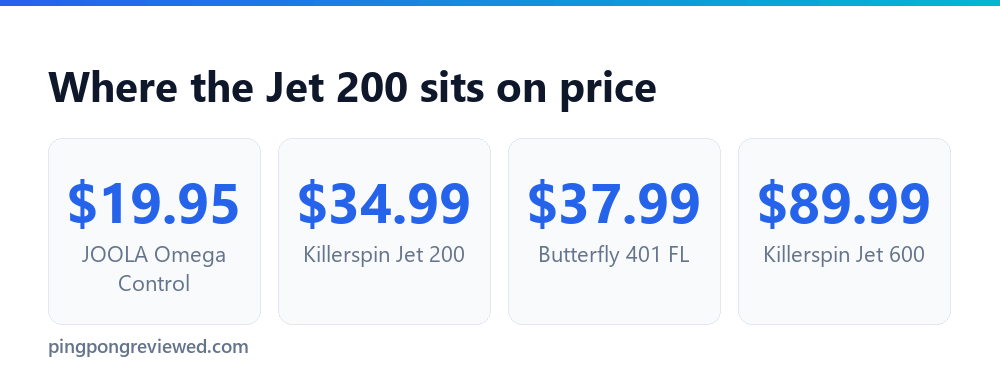
- Our beginner guide lists three paddles from $19.95 to $34.49.
- The Butterfly 401 is $37.99 with a listed ITTF approval.
- The Jet 600 is $55 more and aimed at a higher level.
How the Jet 200’s price compares with other starter paddles
Here are the prices we checked on October 1, 2026, for the paddles our other guides cover. They are different products, so this isn’t a ranking.
For a deeper look at upgrading from a starter paddle, our best ping pong paddle guide sorts eight paddles by skill level. For care, start with our paddle cleaning guide.
Why the maker’s ratings only work inside one brand
Killerspin rates the Jet 200 Control 8.5, Spin 7 and Speed 6 out of 10. That looks easy to compare with other paddles, and it isn’t. Every brand picks its own scale.
Look at one paddle, the JOOLA Omega Control, which appears in our beginner guide. JOOLA’s own site lists Speed 75, Spin 75 and Control 97. The Amazon listing for the same paddle lists Speed 4, Spin 7 and Control 8 on a 1 to 10 scale. STIGA’s Pro Carbon, on STIGA’s site, is Speed 99, Spin 100 and Control 80. Those three scales have nothing to do with each other.
So use Killerspin’s numbers to compare Killerspin paddles, such as the Jet 200 and the Jet 600. Don’t line them up against another brand’s numbers. The one thing the ratings do tell you is how Killerspin positions the two paddles: more control on the Jet 200, more spin and speed on the Jet 600.
What Killerspin publishes and what it doesn’t
The gaps are the useful part. They don’t mean the paddle is bad. They mean the answers aren’t on the page, so don’t fill them in yourself.
The colorways: Mocha, BluVanilla and the older ones
Killerspin’s site lists two colorways today, Mocha and BluVanilla, and gives the rubber as Blue/Black and Brown/Black. Older Amazon listings name more. We found double packs called Mocha, BluVanilla and Lime, plus a recreational Killerspin paddle in Navy Blue that Amazon also lists with Jet Basic rubber.
That matters for one reason. If you see a color you don’t recognize, check what you’re buying before you assume it’s the current Jet 200. All four of those older listings showed as currently unavailable when we checked, so they’re a clue to the past, not a place to shop.
A five-check list for a paddle with mixed stock information
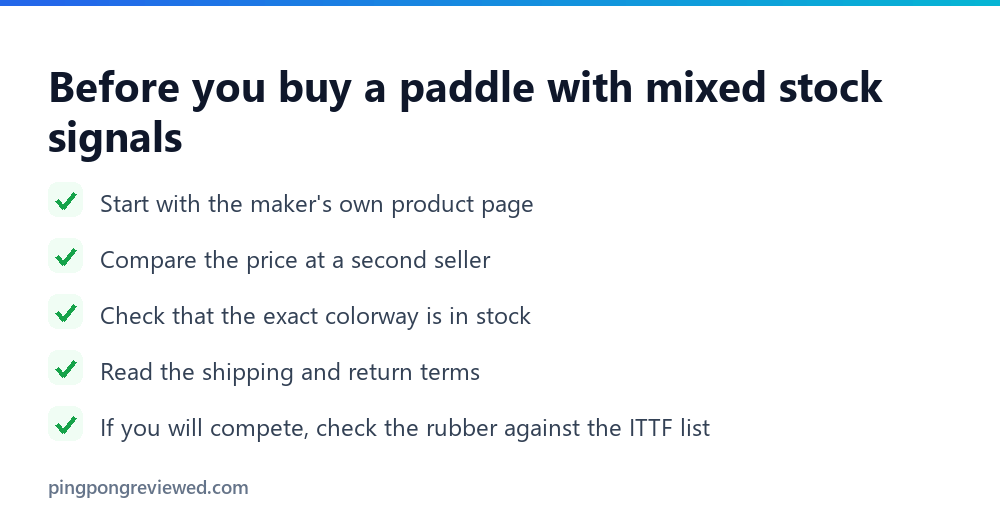
The Jet 200 is a good example of why. The maker shows it available at $34.99, a retailer shows it discontinued, and Amazon shows a higher price with no stock information. Those are three different answers about the same paddle, and each is what that seller’s data showed.
🛒 Frequently Bought Together: Complete Paddle Match & Care Kit
When ordering table tennis equipment, tournament competitors frequently bundle protection and maintenance gear in the same Amazon shipment to maintain equipment tack and avoid separate delivery fees:
Selected Tournament Paddle
Your chosen offensive or all-around competition racket
Deluxe Padded Racket Case with Ball Storage
Shockproof zip case with foam protection to prevent chipped edges
Rubber Cleaning Foam Spray & Rejuvenating Sponge
Restores surface tack, dissolves sweat grease, and doubles rubber life
Frequently asked questions
Is the Killerspin Jet 200 still sold?
Killerspin’s own site lists the Jet 200 at $34.99 in two colorways, Mocha and BluVanilla, and both showed as available on October 1, 2026. Megaspin, a retailer, shows both colorways as discontinued, and the Amazon listings we found were unreliable, so Killerspin’s site is the place to check.
How much does the Killerspin Jet 200 cost?
$34.99 on Killerspin’s site on October 1, 2026. An Amazon listing for a single Jet 200 showed a $58.89 price with no stock information the same day.
What are the Killerspin Jet 200 specs?
Killerspin lists a five-layer plywood blade, Killerspin rubber in blue/black or brown/black, a flared handle, flexible PVC edge tape and a weight of 0.397 to 0.419 pounds. It rates the paddle Control 8.5/10, Spin 7/10 and Speed 6/10 on its own scale.
Is the Killerspin Jet 200 ITTF approved?
We found no ITTF approval claim for it on Killerspin’s page or on Amazon. Killerspin describes it as suitable for recreational play. We also found no Jet 200 rubber on the ITTF list of authorized racket coverings copy we checked.
What is the difference between the Killerspin Jet 200 and the Jet 600?
On Killerspin’s pages the Jet 200 is an entry-level paddle at $34.99 and the Jet 600 Spin N2 is a tournament-level paddle for intermediate to advanced players at $89.99. Killerspin’s own ratings are Control 8.5, Spin 7, Speed 6 for the Jet 200 and Control 7, Spin 8, Speed 7 for the Jet 600.
Can I use a Killerspin Jet 200 in a tournament?
We would not plan on it. The ITTF’s rules for international competitions require coverings to be authorized, and the list copy we checked has no Jet 200 rubber. Brown is also not among the covering colors in that list’s key. Check with the event organizer for the rules that apply.
Why does Amazon show a different price for the Jet 200?
We can’t tell from the data. Amazon’s product data showed $58.89 for a single Jet 200 with no availability information on October 1, 2026, while Killerspin’s own site listed $34.99. Check the maker’s price before you pay more.
Does Killerspin sell the Jet 200 as a set?
Killerspin’s product page sells a single paddle per colorway. Older Amazon listings showed double packs, and the ones we found were unavailable.
Does the Killerspin Jet 200 come with a case?
Killerspin says each Jet 200 comes in its Memory Book Case.
Sources and what we checked
Specs, ratings, prices and availability come from Killerspin’s Jet 200 page and its Jet 600 Spin N2 page, checked October 1, 2026. Amazon figures come from Amazon’s product data the same day. The discontinued notice is from Megaspin’s redirect pages. The rules are in the ITTF Statutes, the ITTF’s September 30, 2021 article on new covering colors, and the January 3, 2026 list of authorized racket coverings as hosted by the French federation.
The older Amazon listings we mention are ASINs B0727R47VZ, B072DXHNJ1, B071DQ4X5T and B002GJY338, all showing as currently unavailable on October 1, 2026. We did not play with this paddle, we do not quote customer reviews or star ratings, and we do not quote a sponge thickness because Killerspin does not publish one. Prices and stock change.
As an Amazon Associate, we earn from qualifying purchases through links on this page.

Ping Pong Reviewed is an equipment review site covering table tennis and baseball gear. Specifications are checked against manufacturer listings, and prices against live retail pages, before publication.