Are Sportout Bats ITTF Approved? How to Actually Check
Sportout paddles are sold on Amazon with “ITTF Approved” printed right in the product title. That’s the seller’s own claim, made in a marketplace listing, and it’s worth being direct about the difference between a listing that says ITTF approved and a rubber that’s actually, currently listed on the ITTF’s own database.
Short answer: We could not independently confirm a specific Sportout rubber’s current status against the ITTF’s own searchable database (equipment.ittf.com) for this article, that’s a live lookup you can run yourself in under a minute using the rubber’s exact name, and the steps below show exactly how. What we can confirm is that ITTF approval only actually matters if you’re entering a sanctioned tournament; for casual, club, or recreational play, it has no practical effect at all. Verified against independent sources on 5 September 2026.
Table of Contents
Why This Question Doesn’t Have a Simple Yes or No
ITTF approval isn’t a brand-level certification, it’s granted to individual rubber sheets, by exact name, after the manufacturer submits that specific product for testing and pays an annual renewal fee. A brand can have some rubbers currently approved and others that aren’t, or that were approved once and let the certification lapse. That means “is Sportout ITTF approved” is really asking about one specific rubber, at one specific point in time, not about the brand as a whole.
That’s exactly why a product listing claiming “ITTF Approved” in its title isn’t the same thing as current approval. It might be accurate. It might describe a status that was true when the listing was written and has since lapsed. It might be describing a different, similarly-named rubber than what’s actually in the box. The only way to know for a specific product, right now, is to check the database directly.
How to Actually Check
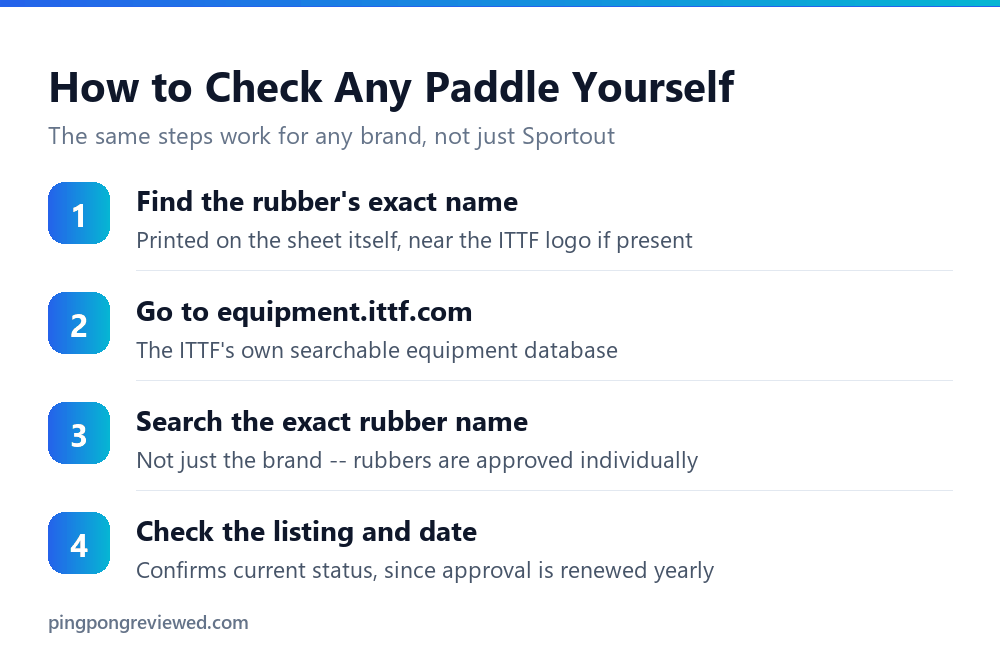
The ITTF maintains a List of Authorised Racket Coverings (LARC), updated twice a year, searchable at equipment.ittf.com. The process is the same for any rubber, from any brand: find the exact name printed on the rubber sheet itself, usually near an ITTF logo if one is present, then search that exact name in the database. A current listing confirms approval; no result means it either was never approved or the approval has lapsed.
This takes under a minute once you have the rubber in hand, and it’s the only way to get a definitive answer for the specific product you actually own, rather than relying on what a listing title claims or what a review site guessed.
- ✓Check the exact rubber name against equipment.ittf.com yourself
- ✓Look for a printed ITTF logo and approval code on the sheet
- ✓Re-check before a sanctioned event, since approval lapses yearly
- ✓Buy a budget paddle for casual play without worrying about this at all
- ✕Assume a listing title claiming ‘ITTF Approved’ is automatically current
- ✕Confuse brand reputation with individual rubber approval
- ✕Assume an old printed logo still reflects current approval status
- ✕Worry about approval status if you never play sanctioned tournaments
Why Approval Exists, and When It Actually Matters
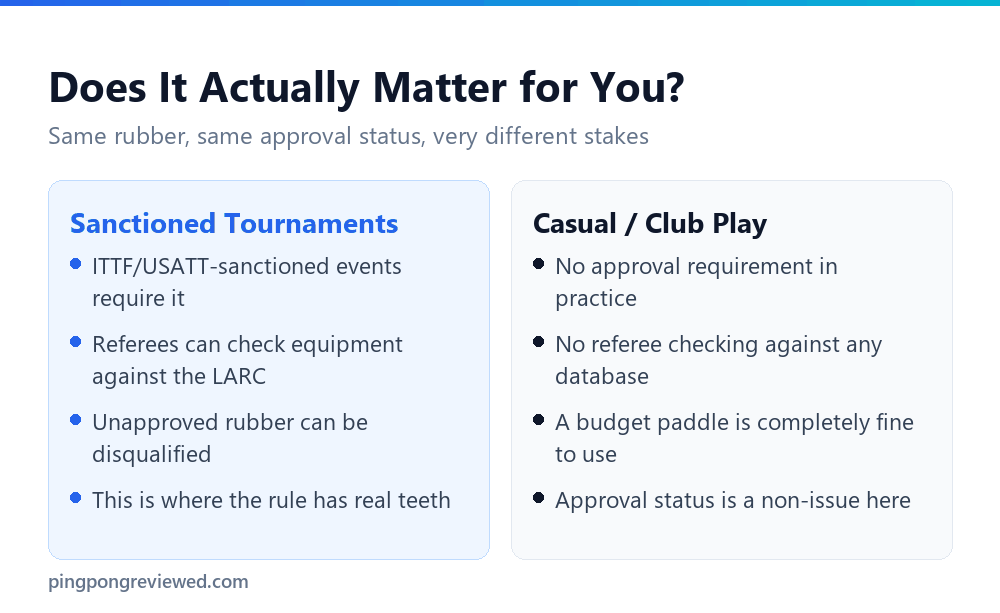
The approval process exists to keep tournament equipment within consistent, tested performance bounds, checking things like thickness, speed, and spin characteristics so that no rubber gives a player an equipment advantage the rules weren’t designed to allow. That’s a real, meaningful check, but it’s specifically aimed at sanctioned competition, where a referee can and does verify equipment against the current LARC before a match.
Outside of that context, the approval status of your paddle simply isn’t checked by anyone. A casual game at home, a club session, or a friendly tournament with no official referee doesn’t involve anyone cross-referencing your rubber against a database. The rule has real teeth in one specific setting and essentially none outside of it.
What This Means If You Own a Sportout Paddle
If you bought a Sportout paddle for casual games, club practice, or general improvement, its ITTF approval status doesn’t matter to how you can use it. It’ll play the same whether or not it’s currently listed on the LARC, and nobody in a recreational setting is going to ask to see documentation before you play.
If you’re planning to enter a sanctioned tournament specifically, that’s the one situation where it’s worth spending the minute to check the exact rubber’s current status yourself at equipment.ittf.com before you rely on it, rather than trusting either a listing title or a review site’s assumption in either direction.
⚠️ Watch out: Even an ITTF-approved rubber can still fail an equipment check at a sanctioned event if it’s expired, damaged, or doesn’t meet the required color rule (one side must be black, the other a distinctly different bright color). Approval status is only one part of what a referee checks.
Budget Paddles and This Question in General
Sportout isn’t unusual in marketing a budget paddle with an ITTF approval claim front and center, it’s a common pattern across Amazon-sold, entry-level equipment generally, since the phrase reads as a meaningful quality signal to a buyer who doesn’t yet know how to verify it. That doesn’t make any individual claim false; it just means the phrase alone, on its own, isn’t proof either way, for this brand or any other budget paddle making the same claim.
The honest, useful habit is the same regardless of brand: treat “ITTF Approved” in a product title as a claim worth checking if it actually matters for your purposes, not as something to accept or dismiss on sight. The database exists precisely so buyers don’t have to take a seller’s word for it.
What Approval Actually Tests
It’s worth knowing what the ITTF is actually checking when it approves a rubber, since it clarifies why the process is per-rubber rather than per-brand. Testing covers things like the rubber’s thickness within the allowed sponge-plus-topsheet limit, its surface texture and pimple structure if it’s a pips-style rubber, and general speed and spin characteristics staying within bounds the sport has agreed keep the game balanced between offense and defense.
A manufacturer can pass that testing on one rubber in their lineup and never submit another, entirely legally, there’s no requirement to get every product approved, only a requirement that you use an approved one if you’re playing in a sanctioned event that enforces the rule. A brand’s unapproved rubbers aren’t illegal to sell or own; they’re simply not eligible for that specific competitive context.
Reading a Listing Claim Critically, Without Assuming Bad Faith
None of this means a seller claiming ITTF approval is necessarily being dishonest. Approval claims in product listings often start out accurate, at the time the rubber was tested and listed for sale, and simply don’t get updated if the certification later lapses on renewal. A listing can also technically be accurate about one variant of a rubber while a buyer receives a slightly different version, especially with private-label or licensed products sold under a retailer’s own brand name.
The practical lesson isn’t to distrust every equipment claim by default, it’s to know that a listing title is marketing copy first and a verification tool second, and that the actual database exists specifically because marketing copy alone was never meant to be the final word for anyone who needs a current, confirmed answer.
📊 Note: This same verification process applies to blades as well as rubbers, though blades are checked less strictly in most casual and even many club settings, rubber composition is where the sport’s equipment rules focus almost all of their enforcement attention, since it’s what most directly affects spin and speed.
A Quick Gut-Check Before You Worry About This At All
Before spending time verifying any paddle’s approval status, it’s worth asking the more basic question: are you actually playing in a setting where anyone checks? If the honest answer is club nights, casual games with friends, or general practice with no referee present, the entire approval question can be set aside without any practical downside, regardless of what a listing claims one way or the other.
If the honest answer involves an actual sanctioned tournament on your calendar, that’s the specific moment this stops being trivia and becomes worth five minutes of verification, not before, and not as a general rule for every paddle you’ll ever own.
Buying a paddle shouldn’t require a certification audit before you can enjoy it. For the overwhelming majority of players, a Sportout paddle, or any similarly priced budget option, is a perfectly reasonable way to play the game, whatever its current LARC status happens to be on the day you check.
The Short Version, Restated
“ITTF Approved” in a listing title is a claim, not a guarantee, because approval is granted per rubber, renewed yearly, and only confirmable by checking the exact product against the ITTF’s own database. That check takes under a minute and is the only way to get a real answer for a specific paddle.
For the vast majority of buyers playing casually or at a club, none of this actually changes anything about how the paddle performs or whether it’s fine to use. It only becomes worth checking if a sanctioned tournament is actually on your calendar, and even then, the check itself costs nothing but a few minutes and the product’s exact name.
That’s really the whole framework this question needs: know that approval is checkable, know where to check it, and know whether your own situation ever puts that check in front of a referee in the first place. Everything else, brand reputation, price point, how confident a listing sounds, is secondary to those three facts.
ITTF Approval Questions, Answered
How do I check if a rubber is ITTF approved?
Search the rubber’s exact name at equipment.ittf.com, the ITTF’s official equipment database. A current listing confirms approval; no result means it isn’t currently approved.
Does ITTF approval matter for casual or club play?
No. Approval status is only checked and enforced at sanctioned tournaments. Casual and club play has no equivalent equipment check.
Can a rubber lose ITTF approval over time?
Yes. Approval is renewed yearly, and manufacturers pay a renewal fee. A rubber can lose its listing even if it still displays an older ITTF logo printed on the sheet.
Is a budget paddle automatically not ITTF approved?
No. Approval depends on whether the specific rubber was submitted and passed testing, not on price. Some budget rubbers are approved; some premium ones may not currently be listed.
What else does a referee check besides approval status?
The racket’s color rule, one side black, the other a distinctly different bright color, along with general condition, since damaged rubber can also fail an equipment check regardless of approval status.
Whichever direction this turns out to go for your specific paddle, the underlying takeaway stays the same: verification is available, free, and quick, so there’s never a real reason to stay uncertain about it if it actually matters for what you’re about to do.
The Short Version
- →ITTF approval is granted per rubber, not per brand, and renews yearly.
- →Check equipment.ittf.com with the exact rubber name for a real answer.
- →A listing title claiming approval isn’t the same as a current database listing.
- →Approval only matters in practice for sanctioned tournament play.
- →For casual or club play, an unapproved paddle is completely fine to use.

Ping Pong Reviewed is an equipment review site covering table tennis and baseball gear. Specifications are checked against manufacturer listings, and prices against live retail pages, before publication.