Best Ping Pong Robot Under $100 (2026, Verified)
If you are searching for the best ping pong robot under $100, the honest starting point is that the category barely exists. Most listings at this price are rebound trainers rather than true robots, and many come from dropship storefronts with no track record behind them. There is one genuine option worth knowing about, and the more useful part of this page is the distinction that tells you which is which before you spend anything.
It’s also worth being upfront about what “under $100” genuinely buys you in this category: entry-level, battery-powered, fixed-feed launchers, not the app-controlled, oscillating, programmable-drill machines covered in our main ping pong machine guide. That’s not a downside so much as a different, more basic product tier worth understanding before you buy.
Table of Contents
The Verified Pick: JOOLA iPong Play

JOOLA iPong Play Table Tennis Trainer Robot is currently sold directly by Amazon at $39.95, well under the $100 budget this page targets, with 313 ratings at a 3.8-star average at the time we checked. It’s made by JOOLA, an established Olympic-affiliated table tennis brand, not an unfamiliar storefront name, which matters more than it might seem in a product category where genuinely obscure brands are common at the low end.
- Battery-powered, fully wireless: runs on 4 AA batteries, no outlet or wiring needed, placeable anywhere on the table.
- Fixed feed rate: shoots up to 30 balls per minute at a set pace, no oscillation, spin, or placement control at this price point.
- Ships assembled: no setup beyond inserting batteries, no app or pairing required.
- Includes 20 training balls: 40mm ABS balls included in the box, one less thing to buy separately when getting started.
- Compact: 7.1″ x 7″ x 12″, genuinely easy to store between sessions.
What you’re not getting at this price is oscillation across the table, spin variation, or programmable drills, features covered in our main ping pong machine guide’s app-controlled tier. This is a straightforward, fixed-rhythm ball feeder for building basic stroke consistency and reaction timing, not a full training system.
Real Robot vs. Rebound Trainer: Know the Difference
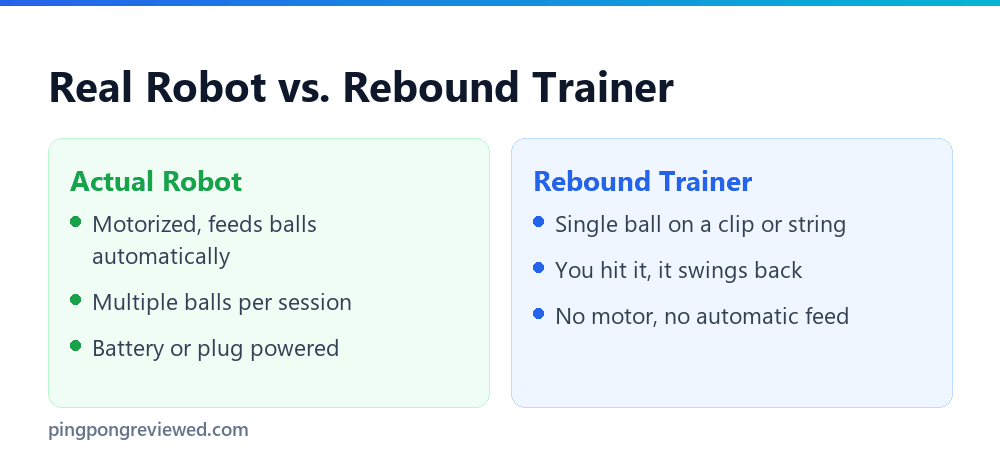
Searching “ping pong robot under $100″ turns up two genuinely different product categories worth telling apart before you buy, since some of the cheapest listings, often $15 to $25, aren’t robots in any meaningful sense. A true robot, like the JOOLA pick above, is motorized and automatically feeds a stream of balls at you, letting you hit dozens of shots in a row without retrieving anything.
A rebound trainer, sometimes still marketed with “robot” or “training robot” in the listing title, is a single ball attached to a clip, rod, or elastic string mounted near the table. You hit the one ball, it swings back on the string or rod, and you hit it again. There’s no motor, no automatic feed, and no way to build the kind of rapid-fire repetition an actual robot provides. It’s a legitimate, genuinely cheaper practice tool for basic stroke feel, just a meaningfully different product from what most people picture when they search for a “ping pong robot.”
Neither product type is inherently better, they solve different problems. A rebound trainer is fine for solo stroke-feel practice on a tight budget; an actual motorized robot like the JOOLA pick is what you want if building real match-paced repetition and reaction timing is the actual goal. Check which category a specific listing actually falls into before buying, the product title alone often doesn’t make it obvious.
Who a Budget Robot Actually Makes Sense For
A fixed-feed robot under $100 is a genuinely good fit for beginners building basic stroke consistency, players working solo between regular practice sessions with a partner, or anyone who wants dramatically more repetitions than manual multiball feeding by hand allows without investing in a full training system. The repetitive, predictable feed is actually an advantage early on, since it removes the variable of unpredictable placement while you’re still building the underlying stroke mechanics.
It’s a weaker fit for intermediate or advanced players specifically working on shot selection, footwork under varied placement, or match-realistic scenarios, since a fixed feed can’t replicate what an actual rally or an oscillating machine provides. If that’s genuinely your training focus, the extra cost of an oscillating machine from our under-$300 guide is likely to pay off faster than staying at this budget tier and outgrowing it within a few months.
Kids and casual family players are another genuinely good fit at this price point, where the appeal is more about having a consistent, low-effort way to rally solo than building serious competitive technique. The JOOLA pick’s simple on/off operation, no app or setup complexity, matters more in that context than it would for a dedicated training regimen.
What to Expect at This Price, Honestly
A fixed-feed, no-oscillation robot like this delivers balls to roughly the same spot at a steady rhythm, which is genuinely useful for grooving a single stroke repeatedly but won’t simulate the varied placement a real rally or a more expensive oscillating machine provides. Treat it as a tool for repetition and timing, not a full substitute for varied, game-like practice.
If consistent, varied placement across the table genuinely matters more to your training than staying under $100, our under-$300 and under-$400 robot guides cover oscillating and app-controlled options that address exactly that gap, worth checking if budget flexibility exists.
Worth Adding Later: A Catch Net
One accessory worth knowing about even though it pushes you past the $100 budget this page targets: a ball catch net, like JOOLA’s own carbon fiber option with over 1,500 ratings, attaches to the far end of the table and collects balls as they come off the robot’s feed, so you’re not stopping every 20 balls to pick everything up off the floor. It’s not essential to get started, but it’s worth budgeting for separately once you know you’ll be using a robot regularly and often, rather than treating it as an occasional novelty you’ll pick up once or twice a month.
How We Verified This
The JOOLA iPong Play recommendation was checked directly against its live Amazon listing for current price, seller, rating count and star average. Several other budget listings in the category were priced alongside it to confirm that the true-robot-versus-rebound-trainer distinction holds across the current market rather than applying only to this one product.
The Short Version
The JOOLA iPong Play, verified live and currently sold at $39.95 with a real, substantial review history, is a genuinely solid entry point if you want an actual motorized robot under $100. Just go in knowing exactly what that budget tier realistically buys you: fixed feed rate, no oscillation or spin control, and a meaningfully different product category entirely from the cheaper rebound-string trainers that also show up under “robot” search terms on Amazon.
Frequently Asked Questions
What’s the best ping pong robot under $100?
The JOOLA iPong Play, verified live at $39.95 with 313 ratings at a 3.8-star average, a genuine motorized robot from an established table tennis brand.
Is a $100 ping pong robot worth buying?
For basic stroke repetition and reaction timing, yes — just expect fixed feed rate with no oscillation or spin control, features reserved for pricier app-controlled machines.
What’s the difference between a ping pong robot and a rebound trainer?
A robot is motorized and automatically feeds a stream of balls; a rebound trainer is a single ball on a clip or string that swings back after you hit it, no motor or automatic feed involved.
Do budget ping pong robots include balls?
Often yes — the JOOLA iPong Play pick here includes 20 training balls in the box, one less separate purchase when getting started.
Can a budget robot help me actually improve?
Yes, for stroke consistency and timing specifically — it won’t replicate varied, game-like placement the way a pricier oscillating machine does, but repeated fixed-feed practice genuinely builds basic stroke reliability.
Why do some cheap listings marketed as robots not actually launch balls?
Some budget listings under $25 are rebound-string trainers, not motorized robots, despite “robot” appearing in the title, so check whether a listing describes automatic ball feeding before assuming it’s a true robot.
Should I upgrade from a budget robot later?
If varied ball placement or programmable drills become important to your training, our under-$300 and under-$400 robot guides cover oscillating, app-controlled options worth considering at that point.
Does the JOOLA iPong Play need to be plugged in?
No — it runs on 4 AA batteries and is fully wireless, so it can be placed anywhere on the table without needing an outlet or cord nearby.
Is a budget robot a good gift for a beginner?
Yes, generally — the simple on/off operation and included training balls make it an easy, low-setup gift for someone just starting out in the sport, without the complexity of a pricier app-controlled system to figure out first.
As an Amazon Associate, we earn from qualifying purchases through links on this page.

Ping Pong Reviewed is an equipment review site covering table tennis and baseball gear. Specifications are checked against manufacturer listings, and prices against live retail pages, before publication.