Best ASICS Shoes for Table Tennis (Crossover Picks, 2026)
Looking for ASICS shoes for table tennis? ASICS doesn’t make a dedicated table tennis shoe — every option here is a crossover from another sport. The Gel-Rocket 11, built for volleyball, is the closest match, since indoor volleyball footwork overlaps with table tennis more than tennis or pickleball do.
- →ASICS has no table tennis-specific shoe line — every pick here is a genuine crossover from volleyball, tennis, pickleball, or general indoor court shoes.
- →The Gel-Rocket volleyball line is the closest match, since indoor volleyball footwork overlaps with table tennis more than outdoor tennis does.
- →Tennis-specific ASICS models (Gel-Resolution, Gel-Game) work but carry more ankle support and weight than table tennis footwork actually needs.
- →Both men’s and women’s versions exist across most of these lines, generally identical in construction with different sizing and colorways.
This gap comes up constantly in search: “ASICS table tennis shoes” is one of the highest-demand queries in this category, and yet ASICS simply doesn’t sell a dedicated model. What follows are the closest real crossover options, sorted by how well their original sport’s footwork actually matches table tennis, not by pretending a tennis or pickleball shoe was secretly designed for this sport.
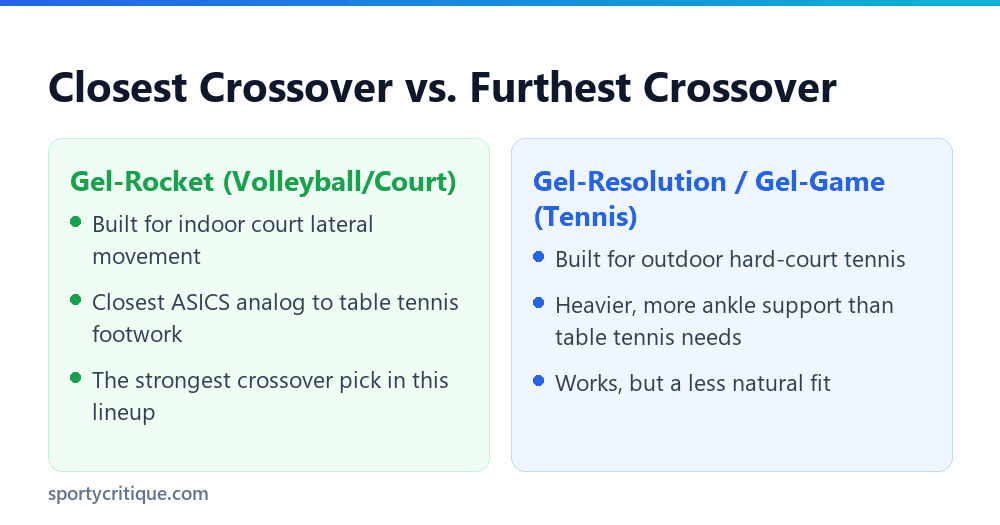
Table of Contents
Closest Match: Gel-Rocket 11 (Volleyball)

The Gel-Rocket 11 is built for indoor volleyball, a sport whose constant lateral shuffling and quick direction changes line up closely with table tennis footwork — closer than any other ASICS line reviewed here. It’s the single best recommendation in this list precisely because its original sport asks for similar movement, not because ASICS marketed it that way.
- ✓Built for indoor court lateral movement, closest real match to table tennis
- ✓Non-marking sole appropriate for indoor courts
- ✓Available in both men’s and women’s versions
- ✕Not purpose-built for table tennis specifically, still a genuine crossover
- ✕Runs a bit heavier than a dedicated table tennis shoe would
Budget Crossover: Gel-Rocket 10 2E (Wide)

The Gel-Rocket 10 2E is the previous generation of the same volleyball line, offered in a wider 2E fit for players who need more room in the toe box. It shares the same core lateral-movement advantage as the Gel-Rocket 11 at a typically lower price, since it’s a step behind the current model.
Pickleball Crossover: Gel-Renma

The Gel-Renma is ASICS’s dedicated pickleball model, and pickleball’s footwork sits reasonably close to table tennis too — both sports demand quick, small lateral steps on a hard indoor or outdoor court surface. It’s a solid second option behind the Gel-Rocket line specifically for players who also play pickleball and want one shoe covering both.
💡 Pro tip: If you split time between table tennis and another racket or court sport, picking the ASICS model built for whichever sport shares the most footwork with table tennis — usually volleyball or pickleball over tennis — gets you the best crossover value from a single pair of shoes.
Tennis Crossover: Gel-Dedicate 8 and Gel-Resolution 9

The Gel-Dedicate 8 and Gel-Resolution 9 are both built for outdoor hard-court tennis, which demands more forward-and-back movement and less pure lateral quickness than table tennis. They work as a crossover, but they’re a less natural fit than the volleyball or pickleball lines — expect more ankle support and weight than table tennis footwork actually needs.
General Indoor Crossover: Upcourt 6 and Gel-Game 9

The Upcourt 6 is a general indoor court shoe, less specialized than the Gel-Rocket line but still a reasonable option, while the Gel-Game 9 leans toward tennis like the Gel-Dedicate and Gel-Resolution above. Both are fine budget-conscious picks if the more specialized volleyball or pickleball lines aren’t available in your size.
Women’s Sizing Across These Lines
Most of these lines have a direct women’s equivalent: the Womens Gel-Game 9 Pickleball, Womens Gel-Resolution 8, and Womens Gel-Game 9 Tennis all mirror their men’s counterparts in construction, differing mainly in sizing and colorway rather than underlying performance. The same crossover logic applies — prioritize the volleyball or pickleball lines over the tennis-specific models for the closest footwork match.
How This Compares to Our Mizuno Guide
Our separate Mizuno guide covers Mizuno’s table tennis shoes, which Mizuno Japan and Europe list but Mizuno USA doesn’t sell.
Upper Material Differences Across These Lines
The Gel-Rocket and Gel-Renma lines use lighter, more breathable mesh uppers suited to fast indoor movement, while the tennis-focused Gel-Dedicate and Gel-Resolution models lean on more durable synthetic overlays built to survive outdoor abrasion against a hard court. Indoors, that extra durability is largely wasted weight — the lighter mesh construction on the volleyball and pickleball lines is the better match for a surface that won’t scuff or abrade a shoe the way concrete does.
Traction Compared: Indoor Court vs. Outdoor Hard Court
Outdoor tennis shoes use a firmer, more durable rubber compound designed to survive thousands of miles of hard-court abrasion, which trades away some outright grip compared to a softer indoor-court compound. The Gel-Rocket’s volleyball-tuned sole uses a softer compound that grips a clean indoor floor more confidently during a sharp lateral cut, at the cost of wearing down faster if you ever took it outdoors. For table tennis specifically, played almost exclusively indoors, that tradeoff favors the softer indoor compound every time.
Why ASICS Doesn’t Make a Dedicated Model
ASICS is a large, mainstream athletic brand whose product lines target mass-market sports — running, tennis, volleyball, pickleball — where sales volume justifies dedicated engineering. Table tennis has a smaller, more specialized shoe market globally, served by brands such as Butterfly and Mizuno that make table tennis shoes. That’s a business decision about where ASICS’s resources go, not a signal that its crossover shoes perform poorly for table tennis specifically.
Sole Grip: What to Check Across These Lines
Every line reviewed here uses ASICS’s own indoor or all-court rubber compounds, but they’re tuned for different surfaces. Gel-Rocket’s volleyball-tuned sole is built specifically for wood or synthetic indoor court grip, the closest match to a typical table tennis playing surface. The tennis-focused Gel-Dedicate and Gel-Resolution lines are tuned more for outdoor hard courts, which can feel slightly different underfoot on an indoor table tennis floor even though both are technically non-marking.
Weight Differences Across These ASICS Lines
Tennis-focused ASICS models generally run heavier than the volleyball and pickleball lines, since outdoor hard-court tennis demands more structural support for repeated impact over a long match. That extra weight works against you in table tennis, where fast, repeated lateral resets reward a lighter shoe over one built for outdoor durability. The Gel-Rocket and Gel-Renma lines are the lighter options here, which reinforces why they’re the better crossover picks.
Cushioning: GEL Technology Explained
ASICS’s GEL cushioning system, present across every line reviewed here, absorbs impact at the heel and forefoot during lateral movement and quick stops. It’s a genuine benefit for table tennis footwork, which involves plenty of both, even though ASICS engineered it primarily for running and general athletic impact rather than racket-sport-specific lateral cuts. It’s one of the reasons these crossover shoes perform reasonably well despite not being purpose-built for the sport.
Break-In Time Across These Models
Most ASICS lines reviewed here need minimal break-in, typically a session or two before the shoe feels fully comfortable rather than stiff. The tennis-focused models, with their heavier, more structured builds, tend to take slightly longer to break in than the lighter Gel-Rocket and Gel-Renma options. None of these require the extended break-in period some stiffer performance shoes demand.
Who Each ASICS Line Actually Fits Best
Players training table tennis several times a week get the most value from the Gel-Rocket 11 specifically, since its volleyball-tuned footwork match holds up best under repeated use. Casual and recreational players who already own a pair of ASICS tennis shoes can reasonably keep using them without feeling like they’re missing much, since the performance gap only becomes noticeable at higher training intensity. Players deciding between ASICS lines from scratch, with no existing pair to build around, should default to the Gel-Rocket or Gel-Renma over anything from the tennis-focused side of the lineup.
Price Comparison Across the Lineup
The Gel-Rocket and Upcourt lines generally sit at the more accessible end of this lineup, while the newer Gel-Resolution and Gel-Renma models command a premium reflecting their more recent release and more specialized construction. None of these ASICS crossovers approach the price of a genuine table tennis-specific shoe from Butterfly or Mizuno, which is part of the appeal for players not ready to commit to a specialized purchase.
Crossover Shoes vs. Purpose-Built Table Tennis Shoes
Since ASICS doesn’t make a dedicated table tennis model, everything on this page is a crossover from another indoor sport. That’s a legitimate route, but it’s worth being clear about what you gain and give up relative to a purpose-built shoe from Butterfly, Mizuno, or Li-Ning.
What purpose-built table tennis shoes optimise for is a narrow set of demands: very low weight, a thin sole that keeps you close to the floor for fast direction changes, gum rubber tuned for indoor wood, and lateral support for side-to-side movement in a small area. They deliberately skip the forward cushioning a running shoe needs, because table tennis involves almost no sustained forward running.
Volleyball and badminton crossovers, which is what the closest ASICS matches are, share most of those priorities, which is why they work. Tennis crossovers share fewer of them: outdoor tennis shoes carry more cushioning, a stiffer sole, and outsole compounds designed for hard court rather than indoor wood, all of which add weight and reduce floor feel.
- You gain wider size and width availability, easier local purchase, often better value, and a shoe usable for other sports.
- You give up some weight saving, the thinnest sole profiles, and outsole compounds specifically tuned for table tennis flooring.
- It matters most for competitive players training several times a week; for recreational play the difference is genuinely small.
What to Actually Check on Any Crossover
If you’re buying a crossover rather than a dedicated model, four properties determine whether it will work, and they’re checkable from a product listing without trying the shoe on.
- Outsole compound. Gum rubber or a non-marking indoor compound. Anything with a deep outdoor tread pattern is the wrong shoe, and will grip unpredictably on indoor wood.
- Sole thickness and drop. Lower and flatter is better. A thick heel raises your centre of gravity and slows direction changes.
- Weight. Lighter is better within reason, since you change direction constantly. Compare stated weights rather than assuming category norms.
- Lateral support. Table tennis footwork is predominantly side-to-side. A shoe built for straight-line running will feel unstable on hard lateral pushes regardless of how comfortable it is otherwise.
The one thing you genuinely can’t check from a listing is fit, and it’s the one that matters most. Buy from somewhere with a straightforward returns policy and test the shoe indoors on a clean surface before committing to it.
Women’s Fit and Narrower Feet
Crossover buying has one genuine advantage worth calling out: mainstream athletic lines carry far broader size and width ranges than specialist table tennis brands, whose women’s ranges are often limited or absent entirely.
Two things are worth understanding. Some models are sold as unisex on a men’s last, where a women’s size is reached by converting down, typically by around one and a half sizes. Others are built on a women’s-specific last, genuinely narrower through the heel and midfoot rather than simply smaller. The second fits better if you have a narrow heel, which is the most common complaint with converted unisex sizing.
If a shoe is offered only as unisex and the heel slips, that is a last-shape problem rather than a sizing one, and going down a half size to fix it usually creates a toe-box problem instead. A heel grip pad, or lace-locking through the top eyelets, solves it far more reliably than changing size.
Trying Them On Properly
Court shoes need to be assessed differently from casual shoes, and a few minutes of the right checks in the shop prevents most regretted purchases.
- Try them late in the day, when feet are slightly larger than in the morning, and in the socks you’ll actually play in.
- Push off laterally, not just forward. Step side to side and feel whether your foot slides inside the shoe, that’s the movement table tennis actually demands.
- Check heel lift by rising onto your toes. The heel should stay seated; slippage here won’t bed in with wear.
- Leave roughly a thumb’s width at the toe. Too little and hard forward stops will jam your toes against the end.
How Long a Crossover Pair Should Last
Court shoes have a usable life shorter than their visible life, and crossovers are no exception. The outsole under the ball of the foot and along the inside edge is where lateral pushes concentrate, and once the tread there has polished smooth, grip is compromised on exactly the movements you depend on, however much rubber remains elsewhere.
Midsole compression is the less visible half. Foam loses its ability to absorb and return load well before it looks collapsed, and the symptom is usually felt rather than seen, new foot or knee soreness after sessions that never used to produce it. If nothing else in your routine changed, shoe age is a reasonable first suspect.
For a player training two or three times a week, a season is a reasonable expectation, though abrasive or dusty floors shorten it considerably. Keeping court shoes for indoor use only is the single biggest thing you can do to extend that, since outdoor surfaces abrade gum rubber far faster than indoor wood does.
Keeping Them Playable
Crossover court shoes respond to the same basic care as any indoor shoe, and the single biggest factor is simply not wearing them outside. Outdoor surfaces abrade gum rubber far faster than indoor wood, and grit picked up outdoors then gets carried onto the court where it reduces grip and marks the floor.
- Keep them strictly for indoor play, and change into them once you have arrived at the venue rather than wearing them there.
- Wipe the soles before play, a slightly damp cloth restores grip in seconds.
- Air them out after sessions rather than sealing them in a bag.
- Never machine wash or force dry them, since heat is what destroys midsole foam and the adhesive bonds holding the shoe together.
When a Crossover Is Genuinely the Right Call
Rather than leaving this as an abstract comparison, it’s worth being concrete about who should buy a crossover and who should hold out for a dedicated model.
- Buy a crossover if you play recreationally or train once or twice a week, need a width or size dedicated brands don’t offer, want one shoe across several indoor sports, or want to try court shoes before committing to a specialist pair.
- Hold out for a dedicated model if you train several times a week, compete, or have already noticed your current shoes limiting fast direction changes.
- Either way, a proper indoor court shoe of any kind is a substantial upgrade over running shoes, which are genuinely the wrong tool here, built for forward motion with cushioning and heel drop that actively work against lateral stability.
That last point is the one worth acting on first. The gap between running shoes and any court shoe is far larger than the gap between a crossover court shoe and a dedicated table tennis model, so if you’re currently playing in runners, almost anything on this page is a meaningful improvement.
Does ASICS make a table tennis-specific shoe?
No — ASICS has no dedicated table tennis line; every option is a crossover from volleyball, tennis, pickleball, or general indoor court shoes.
Which ASICS shoe is best for table tennis?
The Gel-Rocket 11, built for volleyball, is the closest match since indoor volleyball footwork overlaps most closely with table tennis.
Are ASICS tennis shoes good for table tennis?
They work, but they carry more ankle support and weight than table tennis footwork needs, making them a less natural fit than the volleyball or pickleball lines.
Is the Gel-Renma pickleball shoe a good table tennis option?
Yes — pickleball’s quick lateral footwork on a hard court sits reasonably close to table tennis, making it a solid second choice.
Should I buy ASICS or a dedicated table tennis brand?
If budget allows, a genuine table tennis shoe from Mizuno or Butterfly will outperform any ASICS crossover; ASICS is the better choice mainly if you already own one for another sport.
Do ASICS indoor court shoes work well on a table tennis playing surface?
Yes — the indoor-tuned rubber compounds on the Gel-Rocket and Gel-Renma lines grip a typical indoor table tennis floor better than the outdoor-tuned compounds on the tennis-focused lines.
Does GEL cushioning actually help with table tennis footwork?
Yes, indirectly — it absorbs impact during the lateral cuts and quick stops table tennis footwork demands, even though ASICS engineered it mainly for running.
As an Amazon Associate, we earn from qualifying purchases through links on this page.

Ping Pong Reviewed is an equipment review site covering table tennis and baseball gear. Specifications are checked against manufacturer listings, and prices against live retail pages, before publication.