Best Light Table Tennis Shoes in 2026
The best light table tennis shoes overall come from the Mizuno Wave Exceed Light — built specifically for fast indoor court movement at a genuinely low weight. For a Butterfly option, the Butterfly Lezoline Vilight is purpose-built for table tennis rather than adapted from another sport.

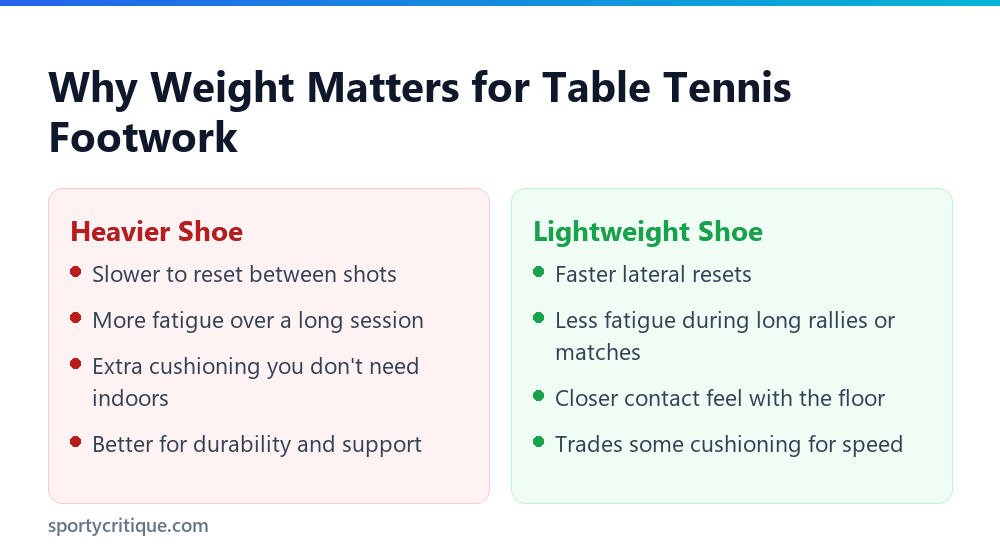
- →Lighter shoes let you reset your stance faster between shots, which matters more in table tennis than in almost any other racket sport.
- →Mizuno and Butterfly both make dedicated table tennis shoes, unlike some brands that just repurpose tennis or badminton models.
- →Lighter construction usually trades away some cushioning — fine for most sessions, worth checking if you play very long matches back to back.
- →Asics’ Gel-Rocket line is a lighter-weight general indoor court shoe that crosses over reasonably well if you want more brand options.
Table tennis footwork is short, explosive, and constant — you’re resetting your stance between nearly every shot. That makes shoe weight matter more here than in most sports. We compared six real lightweight options built for or adapted to fast indoor court movement, from dedicated table tennis brands to crossover picks that still perform well for this exact kind of footwork demand.
Table of Contents
Best Lightweight Table Tennis Shoes Compared
1. Mizuno Wave Exceed Light — Best Overall Lightweight Pick

The Mizuno Wave Exceed Light is built specifically for indoor racket sports, with a low-profile sole and genuinely light construction that supports fast lateral resets. It’s the safest default pick on this list for players prioritizing speed over cushioning.
2. Mizuno Wave Exceed Light 2 — Best Updated Mizuno Model

The Wave Exceed Light 2 refines the original with updated materials and fit. If buying new rather than looking for a deal on the earlier model, this is the current version worth checking first.
3. Butterfly Lezoline Vilight — Best Butterfly Lightweight Option

The Lezoline Vilight is Butterfly’s dedicated lightweight table tennis shoe, built from the ground up for the sport rather than adapted from another one. A strong alternative to Mizuno if you prefer Butterfly’s fit and sizing.
💡 Pro tip: Table tennis-specific shoes from Mizuno and Butterfly tend to run narrower than general athletic shoes. Check the brand’s specific sizing chart rather than assuming your usual shoe size carries over directly.
4. Butterfly Men’s Sneaker — Best Butterfly Budget Option

This Butterfly sneaker covers the fundamentals at a lower price than the Lezoline Vilight, a reasonable entry point if you want to try a dedicated table tennis shoe without the premium price tag first.
5. Butterfly Athletic Shoes — Best Butterfly All-Around Pick

The Butterfly Athletic line sits between the brand’s budget and premium options, balancing weight against a bit more cushioning for players who want some comfort without giving up too much speed.
6. Asics Gel-Rocket 10 — Best Crossover Option

The Asics Gel-Rocket 10 isn’t table tennis-specific, but it’s a genuinely light general indoor court shoe that crosses over well. Worth considering if you want more brand options beyond the two dedicated table tennis makers here.
Who Actually Benefits Most From a Lightweight Shoe
Not every player needs to prioritize weight above everything else. Fast, aggressive players who cover a lot of ground laterally get the most from a lighter shoe, since every reset between shots benefits directly. Slower, more positional players who don’t move as explosively see a smaller real-world difference and might reasonably prioritize cushioning or durability instead. Match the shoe to your actual playing style rather than assuming lighter is universally correct for everyone at every skill level.
Sole Profile and Ground Feel
Weight isn’t the only thing separating a light table tennis shoe from a general athletic shoe. Sole profile matters just as much. A thick, cushioned midsole absorbs impact well for running, but it also raises your center of gravity slightly and dulls the ground feel that helps with quick direction changes. The lightest shoes on this list pair a low sole profile with minimal weight for exactly that reason — the two specs work together rather than independently.
Breathability and Session Length
A lighter shoe often uses more breathable mesh in the upper, which matters over a long session or a hot gym without strong air conditioning. That breathability is a genuine side benefit of lightweight construction, not just a marketing add-on — less material generally means more airflow, and that combination is part of why dedicated racket-sport shoes tend to feel noticeably cooler than a standard cross-trainer during an hour-plus session on a warm court.
Dedicated vs. Crossover: Does It Matter
Mizuno and Butterfly design their table tennis lines around the sport’s specific footwork demands — low-profile soles, reinforced lateral support, minimal weight where it counts. A crossover shoe like the Asics Gel-Rocket, built for badminton and squash more broadly, still performs well since those sports share similar footwork patterns, but it’s a slightly less precise fit than a shoe designed around table tennis specifically from the ground up rather than adapted afterward.
What to Check Before Your First Session in New Shoes
New shoes, lightweight ones especially, benefit from a short break-in period before a full match or intense session. Wear them around the house or during a light practice first, checking for pressure points or rubbing that wouldn’t show up in a quick try-on. Lightweight construction often means thinner materials in the upper, which can highlight fit issues faster than a bulkier shoe would. Catching that early avoids discovering a fit problem mid-match, when it’s too late to do anything about it.
Color and Style: A Minor but Real Factor
Performance specs matter most, but color and style options do influence which shoe players actually reach for regularly. Mizuno and Butterfly both offer their lightweight lines in a handful of colorways, while the Asics Gel-Rocket tends to have the widest range given its broader appeal beyond table tennis specifically. If two shoes are otherwise close on performance, this is a reasonable tiebreaker rather than a primary decision factor to lead with.
Non-Marking Soles: Why It Really Matters Indoors
Most gyms and club venues require non-marking soles, which means the rubber compound is formulated specifically not to leave scuff marks on the floor. All six shoes here are built for indoor court use and should meet that standard, but it’s worth confirming on the specific listing before your first visit to a new venue, since a shoe that leaves marks can get you turned away at the door regardless of how well it otherwise performs.
How Price Compares Across These Six
The dedicated table tennis models from Mizuno and Butterfly generally cost more than the crossover Asics option, reflecting the more specific engineering that goes into sole profile and weight distribution for this exact sport. That premium is worth paying if table tennis is your primary racket sport. If you split time between table tennis and other indoor sports like badminton, the crossover option’s broader usefulness might make more sense for your budget overall, since one shoe covers more of your actual weekly activity.
Durability: The Real Tradeoff
Lighter shoes generally wear out faster than heavier, more reinforced models. Thinner materials that save weight also have less to give before showing real wear, especially at high-friction points like the outer edge of the sole where lateral pivoting happens constantly. Expect somewhat shorter usable life from any shoe on this list compared to a bulkier training shoe, and factor that into the price comparison rather than judging value on sticker price alone without weighing how long it will actually last you.
How Often to Replace Table Tennis Shoes
Most players training 3-4 times a week see meaningful sole wear within 6-12 months, sooner for the lightest options here given the tradeoff above. Watch the outer sole edge specifically, since that’s where lateral pivoting wears fastest, well before the upper material shows any real damage. A shoe that still looks fine from the top can already have lost meaningful grip where it actually matters most during play, so check the sole itself, not just the visible upper condition.
Bottom Line
For most players prioritizing fast footwork, the Mizuno Wave Exceed Light or its updated Light 2 version is the safest overall pick, built specifically for this kind of movement rather than adapted from a different sport. Butterfly’s lineup offers a similarly dedicated alternative if you prefer that brand’s fit, and the Asics Gel-Rocket 10 remains a reasonable crossover choice if you split time across multiple indoor racket sports rather than focusing on table tennis alone.
FAQ
What makes a table tennis shoe lightweight?
A low-profile sole, minimal cushioning material, and construction optimized for fast lateral movement rather than shock absorption or long-term durability overall.
Is a lighter shoe always better for table tennis?
Not universally — lighter shoes trade away some cushioning, which matters more for players doing very long sessions or with joint sensitivity issues. For most players, the speed benefit outweighs that tradeoff.
Do Mizuno and Butterfly table tennis shoes run true to size?
Both tend to run slightly narrower than general athletic shoes — check the brand’s specific sizing chart rather than just assuming your usual size will fit.
Can I use a badminton or squash shoe for table tennis?
Yes, reasonably well — those sports share similar lateral footwork demands, though a dedicated table tennis shoe is still a slightly more precise fit.
How long do lightweight table tennis shoes typically last?
6-12 months of usable life for regular players, sometimes shorter than heavier shoes since lighter materials wear faster — watch the outer sole edge specifically for signs of real wear before the upper shows anything.
As an Amazon Associate, we earn from qualifying purchases through links on this page.

Ping Pong Reviewed is an equipment review site covering table tennis and baseball gear. Specifications are checked against manufacturer listings, and prices against live retail pages, before publication.