Can the Ball Hit the Net Twice in Table Tennis? Rules Explained
Yes, the ball can hit the net twice in table tennis, and depending on which shot it happens on, that’s either a complete non-event or the reason the point gets replayed entirely. Both of those are correct at the same time, which is exactly why the question comes up so often.
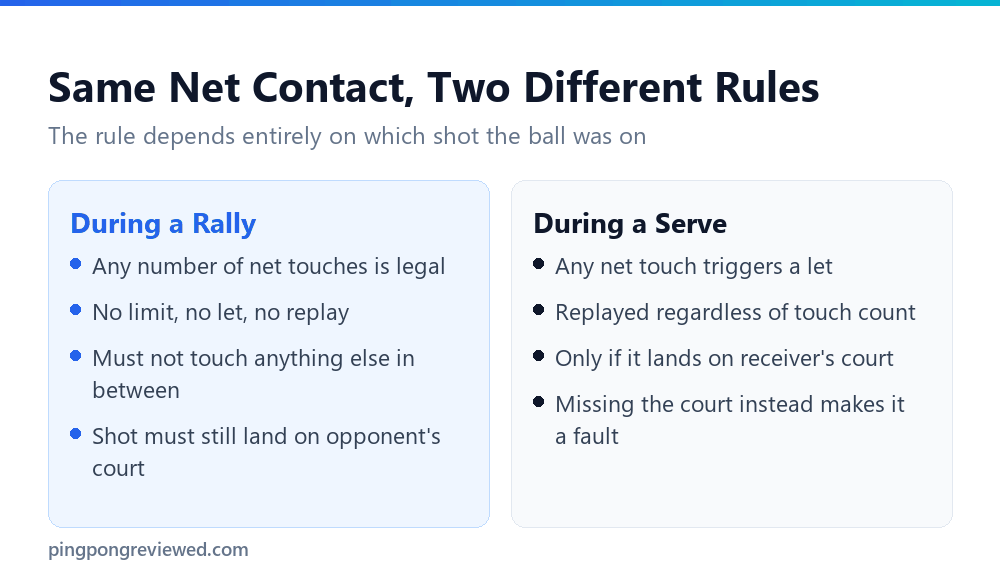
Short answer: During a rally, the ball can touch the net any number of times, including twice, and play continues normally as long as it doesn’t touch anything else in between and the shot still lands on the opponent’s court. During a serve, any net contact — once or several times — that still lands legally on the receiver’s court makes it a let, replayed without penalty, and without limit on how many times this can happen. Verified against independent sources on 5 September 2026.
Table of Contents
Two Rules, One Physical Event
The ball touching the net is a single, simple physical event. What changes is which shot it happens on, and the rules treat those two situations completely differently. That split is the entire answer to this question, and once it clicks, there’s nothing left to memorize beyond which of the two situations you’re actually in.
During a Rally: No Limit at All
Once the point is underway, past the serve, into an ordinary rally, the ball touching the net carries no special ruling whatsoever. If it clips the net and continues on to land on the opponent’s side of the table, it’s a completely legal shot, exactly as if it had never touched the net at all. If it happens to touch the net twice in the course of that same shot, a graze off the top of the tape followed by a second brush against a post, for instance, the ruling doesn’t change. There’s no count, no maximum, no special case that kicks in on the second touch.
The only thing that actually matters is that the ball doesn’t touch anything else in between those net contacts. If it clips the net, then touches the floor, a player, or anything off the table before continuing, that’s a different fault entirely, unrelated to the net touches themselves, not a special penalty for having touched the net more than once.
During a Serve: Any Touch Means a Let
The serve is where the more familiar version of this rule lives. If a served ball touches any part of the net assembly and still goes on to land legally on the receiver’s court, the point is a let: stopped, not scored, and replayed from the same server. This applies regardless of how many separate net touches happen during that one serve motion. One graze, or several in quick succession, both produce the exact same outcome, provided the rest of the serve was otherwise legal and it still reaches the receiver’s side.
There’s also no cap on how many times this can happen in a row. A serve that clips the net can be replayed, clip the net again on the retry, and be replayed again, for as many attempts as it takes to produce a serve that either clears the net cleanly or fails to land legally at all. Frustrating to watch, but not against the rules in any way.
⚠️ Watch out: A let only applies if the served ball still lands on the receiver’s court. If it touches the net and then misses the table, or lands on the server’s own side, that’s a fault, not a let, and the receiver wins the point outright.
What Counts as “the Net”
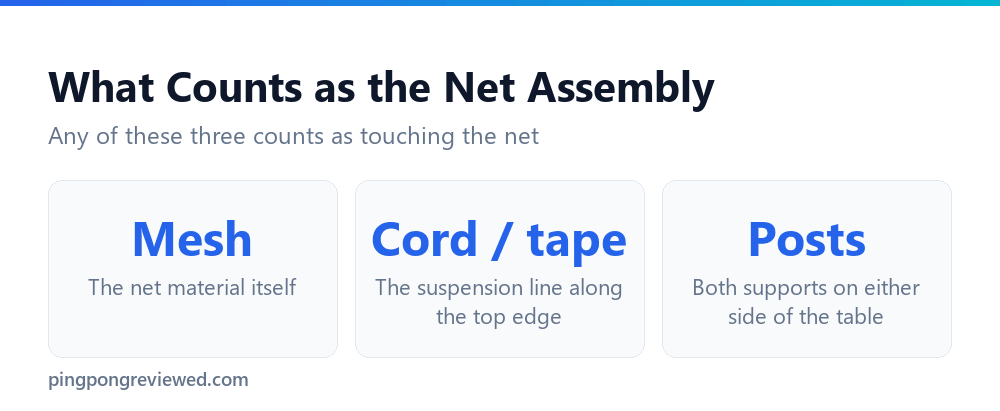
For both rulings, “the net” means the whole net assembly, not just the mesh itself. That includes the suspension cord or tape running along the top edge, and the two posts holding the assembly up on either side of the table. A ball that clips a post rather than the mesh is treated exactly the same as one that clips the net material directly, there’s no separate rule for the posts specifically.
This matters most on serves that go wide rather than straight through the middle, where a post touch is actually more likely than a mesh touch. The ruling doesn’t change based on which part of the assembly was involved, which keeps the rule simpler in practice than it might sound on paper.
Why This Trips People Up
The confusion almost always comes from generalizing the serve rule to the whole point. Players who know the “let serve” rule well sometimes assume any net touch, at any point in the rally, must trigger some kind of replay or special treatment, since that’s the only net-touch rule most casual players ever actually see called out loud at the table. In practice, a let is specifically a serve concept. Once the ball is in open rally play, a net touch simply isn’t a distinct rules event at all, it’s just part of the shot, the same as any other deflection the ball might take.
The double-touch version of the question makes this even more pointed, because it’s tempting to assume that if one net touch is borderline, two must tip it over some kind of threshold into an illegal shot. There is no such threshold anywhere in the rules for rally play. A ball can touch the net any number of times in a single shot and remain completely legal, exactly the way a ball can bounce off a paddle’s edge, catch a fingernail, or take any other unusual deflection mid-rally without it becoming a separate violation.
💡 Pro tip: If you’re ever unsure whether something you just watched was a let or a legal point, check which shot it happened on first. Serve: check whether it landed on the receiver’s court. Rally: it’s almost certainly just a legal, if lucky, shot.
A Doubles Wrinkle Worth Knowing
The same rally rule applies identically in doubles play, a shot that clips the net once or twice during a doubles rally is treated no differently than in singles, with no extra restriction tied to the doubles serving and receiving rotation. The let-serve rule also carries over unchanged: a doubles serve that clips the net and still lands correctly, including landing in the required diagonal service box, is replayed exactly like a singles let.
Where doubles adds a genuine extra layer is in the rotation itself, who serves, who receives, and which diagonal the ball must land in, but none of that changes anything about how net touches specifically are scored. It’s a separate rule sitting alongside this one, not a modification of it.
Why the Rally Rule Is So Permissive
It’s worth asking why the rally rule is this loose in the first place, since it would be easy to design the sport differently, penalizing any net contact after the serve, the way some other racket sports treat contact with the net or its supports. Table tennis simply doesn’t draw that line, and the reason comes back to what makes a serve different from every other shot in the point.
A serve is the one shot a player has complete, deliberate control over before it happens, they choose the toss, the contact point, the spin, all of it, with no interference from the opponent. That’s exactly why the rules regulate serves so heavily, including the let rule for net touches. Every other shot in the rally is a reaction to whatever the opponent just did, with far less control available, and the rules reflect that by not adding extra penalties for incidental contact like a net clip once the ball is already in open play.
Put differently: the serve rules exist to stop the server from gaining an advantage they didn’t earn through skill. A net clip mid-rally isn’t something either player is trying to engineer, it’s just a deflection, the same category of event as a ball clipping the edge of the table or catching a slight wobble off an opponent’s racket, and none of those get special treatment either.
How This Compares to Other Racket Sports
Players coming from tennis or badminton sometimes expect a net touch by the ball to carry some kind of penalty by default, since tennis in particular treats a player’s own body or racket touching the net during a live point as a fault. Table tennis doesn’t carry that rule over in either direction: a player’s racket or body touching the net assembly isn’t specifically addressed the way the ball touching it is, and the ball touching it, as covered above, is simply legal during a rally regardless of how many times it happens.
That’s a different design choice from what a lot of players carry over from other sports, and it’s worth resetting expectations on specifically, rather than assuming any racket sport’s net rules generalize to table tennis by default.
The Short Version, Restated
A net touch is only ever a special rules event on a serve. There, any number of touches that still land legally produce a let, replayed with no limit. Everywhere else in the rally, a net touch, once, twice, or more, is simply part of the shot, with no penalty, no replay, and no cap on how many times it can happen.
Keep those two situations separate and this stops being a confusing rule and becomes one of the simpler ones in the sport: know which shot you’re watching, and the ruling follows automatically.
Net Touch Questions, Answered
Can the ball hit the net twice during a rally?
Yes. There’s no limit on how many times the ball can touch the net during a rally shot, as long as it doesn’t touch anything else in between and still lands on the opponent’s court.
What happens if a serve hits the net twice in a row?
It’s replayed as a let both times, as long as the ball still lands legally on the receiver’s court each time. There’s no cap on how many times a serve can be replayed this way.
Is hitting the net during a rally a fault?
No. A net touch during a rally is not a fault by itself. It only becomes relevant if the shot then fails to land on the opponent’s court for some other reason, such as going wide or long.
Does touching the net post count the same as touching the net?
Yes. The net assembly includes the mesh, the top cord or tape, and the posts. A touch on any of these is ruled the same way.
What’s the difference between a let and a fault on a serve that hits the net?
If the served ball touches the net and still lands legally on the receiver’s court, it’s a let and is replayed. If it touches the net and doesn’t land legally, it’s a fault and the receiver wins the point.
The Short Version
- →During a rally, the ball can touch the net any number of times legally.
- →During a serve, any net touch that still lands legally is a let and is replayed.
- →There’s no limit on how many times a serve let can be replayed.
- →The net assembly includes the mesh, the top cord, and both posts.
- →A net touch during a rally is never a fault by itself.

Ping Pong Reviewed is an equipment review site covering table tennis and baseball gear. Specifications are checked against manufacturer listings, and prices against live retail pages, before publication.