The Table Tennis Timeout Rule: One Per Match, Explained
That distinctive T-sign a player flashes mid-match isn’t a penalty appeal or a request to the crowd, it’s a specific, rules-defined signal with a precise procedure behind it, and understanding it clears up one of the more visible but least explained moments in competitive table tennis.
This page covers how the rule works, how a timeout is requested and recorded, and how players commonly decide when to spend theirs.
Short answer: Each player or pair may claim one timeout of up to 1 minute during an individual match, not one per game (in a team match, that means each individual match within it). It’s requested with a T-sign made with the hands, and can only be requested between rallies in a game, never mid-rally. Once used, no further timeout is available in that individual match.
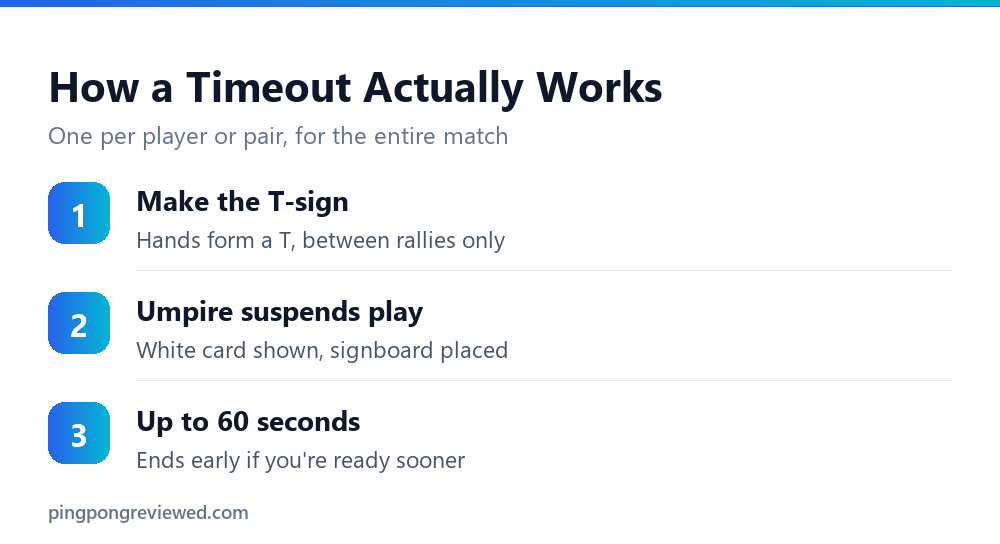
Table of Contents
One Timeout, for the Whole Match
The key detail in this rule: the one-timeout allowance applies to the individual match, not to each game within it. A best-of-five or best-of-seven match doesn’t reset the timeout count at the start of each new game. Once a player or pair has used their one timeout, whether that’s in game one or game four, they have no more timeouts available for the rest of that individual match.
This makes the decision of when to actually call a timeout a real strategic question, not a routine break a player can take whenever convenient. Using it too early, in a game you go on to win comfortably anyway, means it’s unavailable later if a close, high-pressure moment arrives in a later game.
How to Actually Request One
A player or pair requests a timeout by making a T-sign with their hands. On a valid request, the umpire suspends play and holds up a white card on the side of the player or pair who asked, and a white card or another appropriate marker is placed on that side’s court. In an individual event the request may be made by the player or pair or by the designated adviser; in a team event it may be made by the player or pair or by the team captain.
⚠️ Watch out: A timeout can only be requested between rallies, once a rally has already started, it’s too late to call one for that point. Plan ahead rather than trying to call a timeout mid-exchange when a rally starts going badly.
The Full Minute Isn’t Mandatory
A timeout is capped at up to one minute, but that’s a maximum, not a requirement, if the player or pair that called it feels ready to resume before the full 60 seconds elapse, play picks back up immediately rather than waiting out the clock. This matters tactically: a player calling a timeout purely to break an opponent’s momentum, rather than because they need the recovery time, can end it early once that momentum-breaking goal is achieved, without being forced to sit through an unnecessary full minute.
How the Match Tracks That You’ve Used It
According to the ITTF Handbook for Match Officials (16th edition, July 2019, section 13.1.2), when the timeout ends the special signboard or white marker is removed from the table and a white marker is placed near the score indicator, next to the score of the player or pair who requested it. This gives everyone a visible record that the timeout has been used. It’s worth knowing if you ever scorekeep or umpire casually.
Strategic Timing: When to Call It
Given the single-use constraint, a common approach is to save the timeout for a high-leverage moment, such as a late-game deficit against momentum that needs breaking, an opponent on a serving streak that needs interrupting, or a moment where a player needs to reset mentally before a decisive point. Calling it reflexively early in a match, before it is clear whether the match will even reach a close, high-pressure stage, risks having no timeout left when it would matter most.
💡 Pro tip: A useful mental framework: before calling a timeout, ask whether this specific moment is more critical than any moment likely to occur later in the match. If you’re not confident it is, it’s often worth holding onto the timeout a little longer.
The Mental Timeout: a Different Use Case Worth Knowing
Beyond breaking an opponent’s momentum, a timeout can also be used simply to pause and reset composure. The Statutes set no condition on why a timeout is requested: the requirements are a valid request, made between rallies in a game, from a player or pair that has not already used their one timeout.
- ✓Save your one timeout for a high-leverage moment rather than using it reflexively
- ✓Call it between rallies specifically, plan ahead rather than reacting mid-point
- ✓End it early if you’re ready sooner, rather than treating the full minute as mandatory
- ✓Track your own eligibility, since it’s a whole-match resource, not a per-game one
- ✕Assume you get a fresh timeout at the start of each new game in the match
- ✕Try to call a timeout once a rally has already started
- ✕Wait out the full minute if you’re ready to resume sooner
- ✕Use your timeout purely as a habit early in a match without a specific tactical reason
What a Player Actually Does With 60 Seconds
Beyond the rules mechanics, here is how a timeout is commonly used, since the minute itself is short. A common approach is a quick, focused tactical adjustment: identify one specific pattern in the opponent’s play that has been working against you and agree on one concrete change to counter it, rather than trying to overhaul an entire strategy in under a minute. A brief physical reset, such as toweling off, a few deep breaths or a sip of water, also fits within the window without eating into the tactical discussion time.
Attempting too much in the available window is a risk: a player returning from a timeout with three or four new things to remember has more to process under the pressure of resuming play than one returning with a single clear adjustment.
The Short Version, Restated
One timeout, up to 60 seconds, for the entire match, not per game. Requested with a T-sign between rallies, trackable via a marker near the scoreboard, and available to use for any reason a player judges worthwhile, tactical or mental. Spend it wisely, since there’s no second chance once it’s gone.
The scarcity is the whole point, a resource this limited rewards patience and clear-headed judgment about timing far more than it rewards reflexive use.
What Happens if the Timeout Request Is Disputed
The Statutes define the request as a T-sign made with the hands. In casual play without an umpire, it helps if both players agree before the match on a clear way to signal a timeout request.
Timeouts and the Expedite System, Compared
It’s worth distinguishing this rule from the expedite system, since both affect match pace but serve different purposes. A timeout is a player-requested pause, limited to one per individual match. The expedite system comes into operation after 10 minutes’ play in a game, or at any time when requested by both players or pairs, and is not introduced in a game if at least 18 points have been scored (ITTF Statutes 2026, 2.15). The Statutes treat the two rules separately.
Common Questions
How many timeouts does each player get in table tennis?
One, for the entire match, not one per game. Once used, it’s unavailable for the rest of the match regardless of how many games remain.
How long does a table tennis timeout last?
Up to 60 seconds, though it ends early if the requesting player or pair is ready to resume sooner.
How do you request a timeout in table tennis?
By making a T-sign with your hands between rallies, it cannot be requested mid-rally.
Can a coach call a timeout for a player?
In an individual event the designated adviser may request it on behalf of the player or pair; in a team event the team captain may. If they disagree with the player or pair, the player or pair decides in an individual event and the team captain decides in a team event.
What happens after a timeout is used?
A white marker is placed near the score indicator to record that it has been used (ITTF Handbook for Match Officials, 16th edition), and that player or pair cannot request another one in that individual match.
Is a table tennis timeout the same as expedite?
No. A timeout is a player-requested, optional pause limited to one per individual match. The expedite system comes into operation after 10 minutes’ play in a game, or earlier if both players or pairs request it, and is separate from timeouts.
Can I call a timeout to calm down mentally, not just for tactics?
Yes. The Statutes set no condition on the reason for a timeout, so a player may use it to reset mentally as well as tactically.
The Short Version
- →One timeout per player or pair, for the whole match, not per game.
- →Maximum 60 seconds, but ends early if the requesting side is ready sooner.
- →Requested with a T-sign, and only between rallies.
- →A white marker near the score indicator records that it has been used.
- →The designated adviser (individual event) or the team captain (team event) can also request it.
- →Save it for a high-leverage moment, there’s no second timeout.

Ping Pong Reviewed is an equipment review site covering table tennis and baseball gear. Specifications are checked against manufacturer listings, and prices against live retail pages, before publication.