Tibhar Evolution MX-P Review: Specs, Price, and Who It’s For
Tibhar Evolution MX-P is the rubber that gets recommended constantly as “the German alternative to Tenergy,” usually by someone who has never put a number next to that claim. So this page puts numbers next to it.
What follows is Tibhar’s own published specifications, current retail pricing, and an honest comparison against the rubber it’s most often compared to. Not a claimed hands-on verdict.
📊 Note: What this review is. We have not logged hours on this sheet, and we’re not going to describe a feel we haven’t felt. What follows is verified pricing, Tibhar’s own specification numbers, and the buying decisions that follow from them. For subjective playtesting impressions, RacketInsight has actually hit with this rubber, and we link their review below.
Table of Contents
What Tibhar Evolution MX-P Costs Right Now
US retailers price standard Evolution MX-P at $59.95 to $59.99 a sheet, consistent across Megaspin, Paddle Palace, and Table Tennis Store at the time of writing. A harder variant, MX-P 50, runs $64.95.
One sheet covers one side of a bat, same as any inverted rubber. A full two-sheet setup runs roughly $120, meaningfully less than the roughly $160 a full Tenergy 05 setup costs at Butterfly’s own $79.99 price.
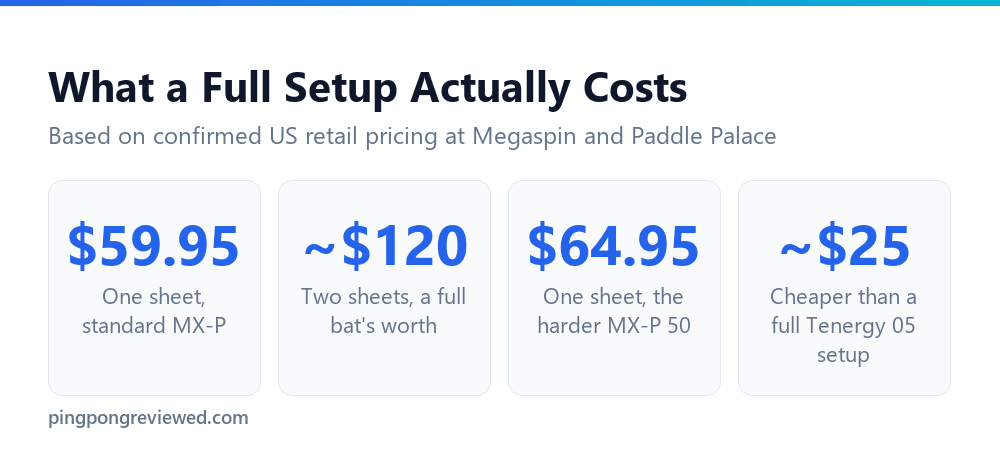
💡 Pro tip: If price is the reason you’re looking past Tenergy 05, MX-P is a legitimate place to land. It’s not a budget rubber, but it undercuts the reference rubber by roughly a quarter on a full setup.
Evolution MX-P is listed on Amazon in both black and red across the full thickness range, alongside the specialist retailers above.
The Official Specifications
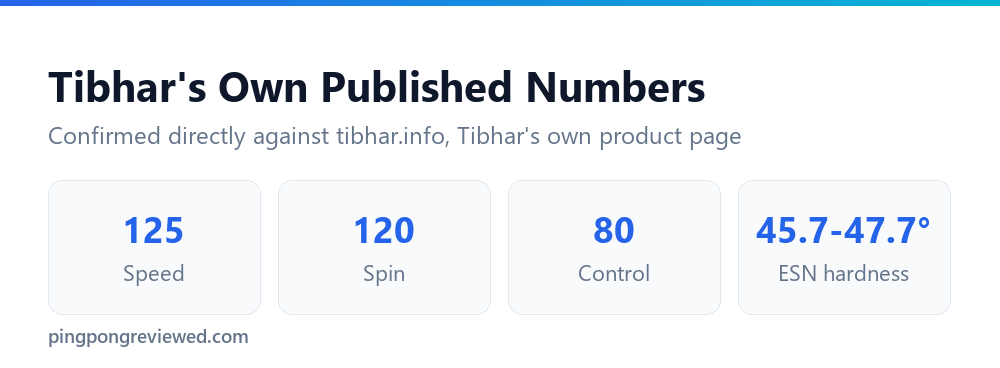
Tibhar publishes four numbers for Evolution MX-P, taken directly from their own product page rather than a reviewer’s estimate.
The hardness figure is the one worth sitting with. At 45.7 to 47.7 degrees ESN, MX-P sits toward the firmer end of what attacking players typically run. A hard sponge generally rewards a fast, committed stroke and punishes a tentative one.
⚠️ Watch out: Tibhar’s own numbers are on Tibhar’s own scale. They are not directly comparable to Butterfly’s speed/spin/arc figures, which use a different in-house system. Comparing raw numbers across brands without accounting for that is a common mistake, covered in more detail below.
How It Actually Compares to Tenergy 05
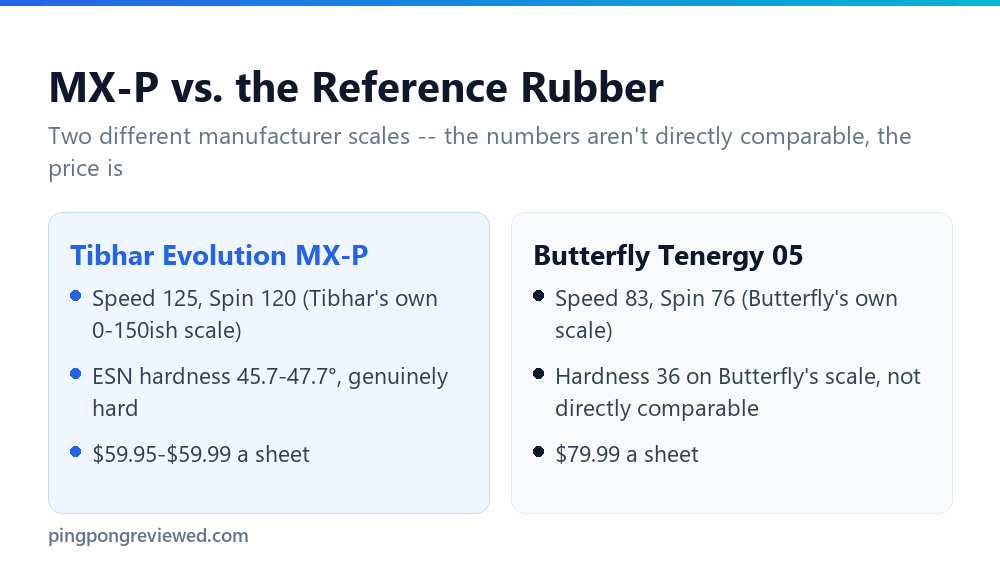
Tenergy 05 is the rubber every other topspin sheet gets measured against, including on this site. So it’s the natural comparison for MX-P, with one important caveat up front.
What is directly comparable is the ESN hardness figure, since ESN degrees are a shared, brand-independent scale. MX-P’s 45.7-47.7° sits firmer than Tenergy 05, which review sites commonly convert to roughly 48° ESN from Butterfly’s own 36. The two land in a broadly similar hardness range on that shared scale, closer than the mismatched brand numbers suggest.
Price is the cleanly comparable figure. MX-P runs $20 less per sheet than Tenergy 05, a real difference across a full two-sheet setup.
Who Evolution MX-P Is Actually For
Tibhar’s own positioning is specific: players who want to feel real pressure in their strokes, both close to the table and at mid-distance. That’s a description of an established attacking game, not a starting point.
- ✓You already generate real racket speed and want a hard, high-output sheet
- ✓You play an attacking game close to and away from the table
- ✓You’re comparing options against Tenergy 05 on a tighter budget
- ✓Your technique is settled enough that the rubber, not the stroke, is the limit
- ✕You’re a beginner still building a consistent stroke
- ✕You mostly block, push, or play a controlled, defensive game
- ✕You want the softest, most forgiving rubber available
- ✕You haven’t played a hard-sponge rubber before and want to test the category cheaply first
The hardness figure is the practical filter here. A 45.7-47.7° ESN sponge gives very little back on a slow or incomplete swing. It rewards committed contact, and it will make a hesitant stroke feel worse, not better.
Which Thickness to Buy
Tibhar offers Evolution MX-P in four thicknesses: 1.5-1.6mm, 1.7-1.8mm, 1.9-2.0mm, and 2.1-2.2mm. As with most inverted rubbers, more sponge means more of the effect the rubber is built around.
- 2.1-2.2mm is the thickest option and the one most attacking players reach for, maximizing the speed and spin the sponge is rated for.
- 1.9-2.0mm gives up a small amount of output for a bit more control, a reasonable middle ground.
- 1.7-1.8mm and 1.5-1.6mm trade real output for control, worth considering on a backhand that blocks more than it attacks.
💡 Pro tip: Running the thickest sponge on the forehand and something thinner on the backhand is common practice, not a compromise. The two wings usually have different jobs.
The MX-P 50 Variant
Tibhar also sells Evolution MX-P 50, priced $5 higher at $64.95, positioned as a harder version of the standard sheet. For a rubber already sitting at the firm end of the hardness range, that pushes further in the same direction.
📊 Note: MX-P 50 is worth knowing exists, mainly so it doesn’t get confused with the standard MX-P when comparing prices or reading reviews online. The two are related but distinct products.
The Case for Looking Elsewhere First
A hard, high-output OFF+ rubber is not a forgiving starting point. If the specification numbers above, particularly the hardness figure, sound more demanding than exciting, that’s a reasonable signal to look at a softer rubber first.
That’s not a knock on MX-P. It’s built for a specific kind of player, and Tibhar’s own positioning says as much directly. A rubber built around maximum output rewards a stroke that already exists, rather than helping build one.
⚠️ Watch out: As with any specialist attacking rubber, buying based on the speed and spin numbers alone, without weighing the hardness figure, is the most common way players end up with a bat that fights them instead of helping them.
What “OFF+” Actually Tells You
Tibhar classifies Evolution MX-P as OFF+ in its own strategy system. That label is worth understanding on its own, since it appears across Tibhar’s entire rubber range and isn’t specific to this one sheet.
OFF+ follows a strategy-classification convention used widely across the rubber industry, running roughly from defensive and control-first ratings up through ALL, OFF, and OFF+, each step trading control for more speed and spin output. OFF+ sits at the aggressive end, the classification generally reserved for rubbers built around maximum attacking output rather than balance.
So the OFF+ label and the hardness figure are telling a consistent story from two different angles. Both point at a rubber built for players who already attack, not one designed to ease a developing player into attacking play.
📊 Note: Tibhar uses the same OFF+ classification across several rubbers in its lineup, so the label alone doesn’t distinguish MX-P from its siblings. The speed, spin, and hardness numbers are what actually separate one Tibhar rubber from another within that shared classification.
Buying It Alongside a Blade
Tibhar doesn’t publish a small, official list of recommended blades for MX-P the way some manufacturers do for their flagship rubbers. So this section sticks to the general principle rather than naming specific models we couldn’t verify against Tibhar’s own materials.
A rubber this firm generally wants a stiff, offensive blade underneath it, since a soft or flexible blade combined with a hard sponge tends to produce an unpredictable, hard-to-control bat. The stiffer end of any manufacturer’s offensive blade range is the safer starting point.
💡 Pro tip: If you’re building a new bat around MX-P rather than replacing rubber on an existing one, buy the blade and one sheet of rubber first, and hold off on the second sheet until you’ve hit with the pairing. A hard rubber on the wrong blade is a more expensive mistake to discover after both sides are already glued.
Gluing follows the same water-based process any modern inverted rubber uses. Spread the adhesive thin on both the blade and the rubber, let both surfaces go touch-dry rather than tacky, then lay the sheet down from one edge to avoid trapping air underneath it.
Counterfeits and Where to Buy It
MX-P isn’t counterfeited at anywhere near the rate Tenergy is, since it carries less brand recognition outside serious competitive circles. But the same basic precautions apply to any rubber worth $60 a sheet.
- Buy from an established table tennis retailer or Tibhar’s own distribution, not an unfamiliar marketplace seller with no rating history.
- A price meaningfully below the $59.95-$59.99 range confirmed here is worth treating with suspicion rather than excitement.
- Check that the packaging carries the correct thickness and color markings matching what you ordered before gluing it to a blade.
Common Questions
How much does Tibhar Evolution MX-P cost?
US retailers price it at $59.95 to $59.99 per sheet. A full two-sheet setup runs roughly $120. A harder variant, MX-P 50, costs $64.95 per sheet.
What are Tibhar Evolution MX-P’s official specifications?
Tibhar’s own product page lists Speed 125, Spin 120, Control 80, ESN hardness 45.7-47.7 degrees, and a Strategy classification of OFF+.
Is Tibhar Evolution MX-P comparable to Butterfly Tenergy 05?
The raw speed and spin numbers aren’t directly comparable, since Tibhar and Butterfly use different in-house scales. ESN hardness, a shared scale, puts the two in a broadly similar range. MX-P costs about $20 less per sheet.
Is Evolution MX-P good for beginners?
Generally no. Its hardness sits at the firm end of what attacking players use, and it rewards a fast, committed stroke rather than helping build one.
What’s the difference between MX-P and MX-P 50?
MX-P 50 is a harder variant of the standard MX-P sheet, priced $5 higher at $64.95 per sheet.
What thickness of Evolution MX-P should I buy?
2.1-2.2mm is the thickest option and the one most attacking players choose for maximum output. Thinner options trade some speed and spin for more control.
The Verdict
The short version: Evolution MX-P is a hard, high-output attacking rubber at a real price advantage over Tenergy 05. If your stroke is already built and you want a firm, high-spin sheet without paying Tenergy prices, it’s a legitimate option. If you’re still developing your technique, the hardness figure alone is reason to look at something softer first. Verified directly against Tibhar’s own product page on 4 September 2026.
- →Tibhar’s own numbers: Speed 125, Spin 120, Control 80, ESN hardness 45.7-47.7°.
- →Priced at $59.95-$59.99 a sheet, about $20 less than Tenergy 05.
- →Tibhar’s and Butterfly’s speed/spin scales are not directly comparable to each other.
- →ESN hardness, the shared scale, puts MX-P and Tenergy 05 in a broadly similar range.
- →Built for players with an established attacking stroke, not beginners.
- →A harder variant, MX-P 50, exists at $64.95 for those wanting even more firmness.
So the closing question is simple: does your stroke already produce the speed this sponge is built to reward? If yes, MX-P is a legitimate, cheaper way to get there than Tenergy. If not, the money is better spent on something softer for now.
As an Amazon Associate, we earn from qualifying purchases through links on this page.

Ping Pong Reviewed is an equipment review site covering table tennis and baseball gear. Specifications are checked against manufacturer listings, and prices against live retail pages, before publication.