Table Tennis Drills: The Practice System That Breaks Your Plateau

Quick Answer: Drills should be at least half your table time — the players who improve fastest spend 70% of their hours on structured repetition and 30% playing matches. Start with the Falkenberg footwork drill and third-ball attack patterns; add multiball once you have anyone willing to feed you. Matches test what you have. Drills build what you don’t.
Here’s the uncomfortable truth about improving at table tennis: you can play matches three nights a week for ten years and stay exactly the same player. It happens constantly — clubs are full of people who have played for a decade and plateaued in year two. The difference isn’t talent or equipment. It’s that matches only use the skills you already own, while drills are the only thing that builds new ones.
This guide organizes drills by what you actually have available (a partner? a robot? an empty room?) and by what you’re trying to fix — because the standard ‘here are 20 drills’ list leaves you no way to choose.
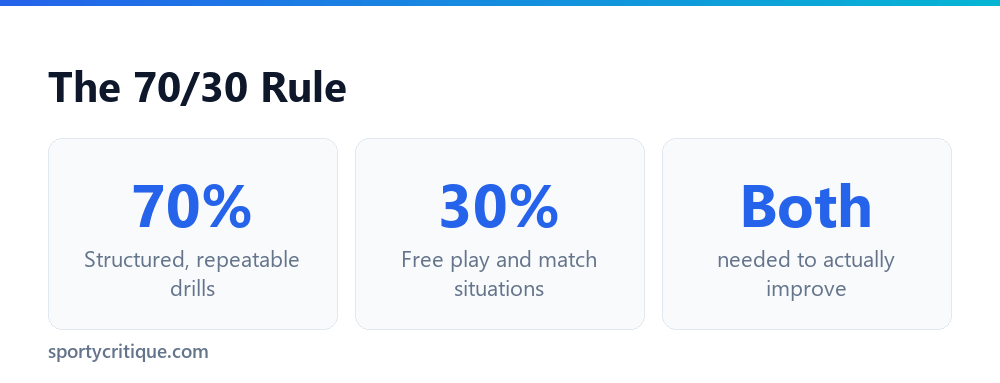
Table of Contents
The 70/30 rule
Professional players spend three to four hours a day on drills. The Chinese national team — the most successful program in the sport’s history — dedicates roughly a third of practice time to multiball alone. Nobody at the top reached it by playing games.
For a recreational player, the honest target is 70% drills, 30% match play. That ratio feels wrong because matches are more fun, and it’s the single biggest predictor of whether someone improves. If you get two hours of table time a week, that’s roughly 85 minutes of structured work and 35 minutes of playing — and yes, you’ll still enjoy the games more. You’ll just start winning them.
⚠️ The plateau trap: matches reward your existing strengths, so you unconsciously play in ways that avoid your weaknesses. Ten years of that and your backhand is exactly as bad as it was in month three — you’ve simply become excellent at not using it. Drills are the only place your weak shots get forced repetitions.
How to structure a session
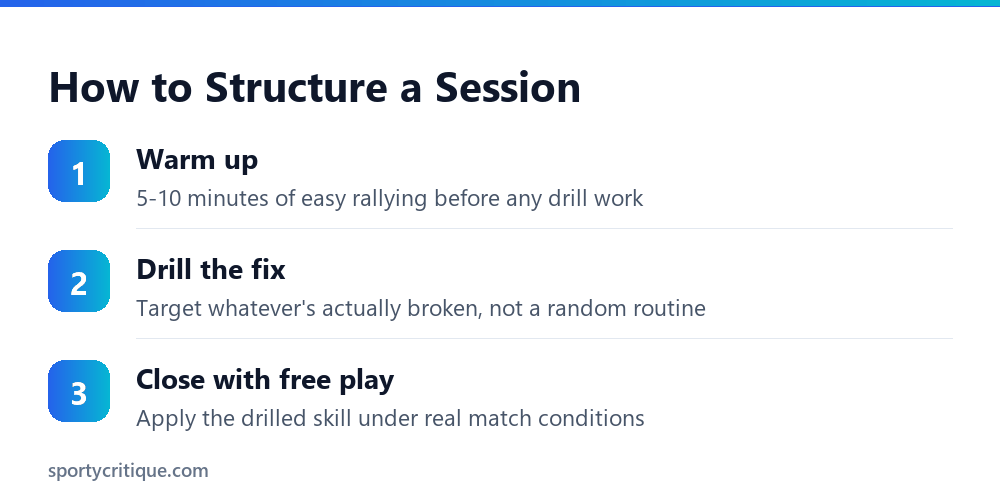
A 60-minute session that actually builds something:
| Time | What | Why it’s in that slot |
|---|---|---|
| 0–10 min | Warm-up + easy rallying | Cold shoulders and wrists is how you get hurt |
| 10–25 min | Consistency drills (FH-to-FH, BH-to-BH) | The base everything sits on |
| 25–45 min | Footwork / pattern drills | The hardest work, done while you’re still fresh |
| 45–55 min | Serve & third-ball practice | The most game-transferable 10 minutes you’ll spend |
| 55–60 min | Match points | Test what you just built, under a little pressure |
The ordering is deliberate. Footwork sits in the middle because it’s physically demanding but requires precision — do it last and you’re grooving tired technique; do it first and you’re grooving cold technique. Serves go late because they’re low-intensity and high-focus, and because ending on match points sends you home having used what you drilled.
💡 Only have 30 minutes? Cut the consistency block and the match points. Warm up, drill footwork for 15, serve for 10. A short focused session beats a long unfocused one — and ‘I only had half an hour’ is the most common reason people skip practice entirely, which is the actual enemy.
Solo drills (no partner, no problem)
If you train alone regularly, an automated feeder can accelerate your muscle memory. Check our reviews of the Best Table Tennis Robots, and keep your rubber grippy with our guide on How to Clean Your Paddle.
Most people believe table tennis practice requires a second person. It doesn’t — some of the most valuable work is solo, and it’s how you make progress in the weeks nobody’s available.
- Shadow strokes — 5 minutes daily. Full forehand and backhand strokes in front of a mirror, no ball. Sounds pointless; it’s how you groove swing path and weight transfer without the distraction of a bouncing ball. Do 20 of each, slowly, checking your form.
- Ball bouncing ladder. Bounce the ball on your paddle: 50 forehand side, 50 backhand, then alternating, then alternating with the edge. Pure touch training and genuinely addictive.
- Playback rallying. Fold one half of the table vertical and rally against it. The bounce is unrealistic but the timing work is real — and it’s the classic solo setup for a reason.
- Serve practice with targets. Put a shoe box or a paddle case on the far side and serve into it. 20 serves each of: short backspin, long fast, sidespin to the corner. This is the highest-value solo drill in the sport, because the serve is the one shot nobody can interfere with.
- Wall drills. Rally against a smooth wall with a line taped at net height. Terrible for spin, excellent for reaction speed and consistency.
If you’re serious about solo work, the equipment that changes everything is a table tennis robot — but a shoe box and 20 minutes of serve practice will beat a robot you never set up. Start with what’s free.
🏓 Training Gear That Helps You Execute These Drills
Consistent footwork and multi-ball routines require a racket with linear feedback and predictable rubber throw angles. Don’t let an erratic paddle derail your practice sessions:
Partner drills: the classics that actually work
1. Forehand-to-forehand, 50-ball target
The most boring drill in table tennis and the most irreplaceable. Both players hit forehand cross-court, aiming for 50 consecutive balls. It sounds trivial until you try it — most club players can’t reliably do 50 without a mistake. Consistency is the base of every other skill, and this is where it’s built.
2. The Falkenberg (the sport’s signature footwork drill)
Named after the Swedish club, and used by essentially every serious player on earth. Your partner blocks everything to your backhand corner. You play:
- Backhand from the backhand corner
- Step around and play a forehand from the backhand corner
- Move across and play a forehand from the wide forehand corner
- Recover to the backhand corner and repeat
Three shots, constant movement, and it drills the exact pattern that wins real points: covering your backhand while looking for a forehand attack. Do it for two minutes and your legs will tell you why it’s the standard.
3. Two-one switching
Partner feeds two balls to your backhand, one to your forehand, in rhythm. It trains the transition between wings — which is precisely where most players break down under pressure, because the switch is a footwork problem disguised as a stroke problem.
4. Random half-table
Your partner plays anywhere on your backhand half; you return everything cross-court. Introduces controlled unpredictability — you know where you’re hitting but not where the ball’s coming from. The bridge between drilling and match play.
5. Third-ball attack (the most game-relevant drill there is)
You serve backspin short. Partner pushes it back. You loop. That’s it — and it’s the single most common point pattern in amateur table tennis. Drill it for ten minutes a session and you’ll win points you currently lose. The technique lives in our forehand loop guide.
Multiball: the professional shortcut
Multiball is a partner or coach feeding balls from a box at a steady rhythm, one after another, while you hit. No rallying, no waiting, no dead time — pure repetition at whatever pace and pattern you choose.
The top Chinese players use multiball for roughly a third of their practice. That’s not a coincidence. In a normal rally you might play 15 balls a minute, half of them recovering from your partner’s mistakes. In multiball you play 40, all of them the exact shot you’re working on.
| What multiball builds | How |
|---|---|
| Footwork | Feeder alternates corners at a pace you can just about handle |
| Power & technique | Same ball, same spot, 40 times — you can actually feel the change |
| Reaction & anticipation | Feeder goes random; you stop thinking and start reading |
| Fitness | Two minutes of hard multiball is brutal in a way rallying never is |
| Confidence on a weak shot | Volume fixes what avoidance never will |
The catch: you need a feeder, a box of balls (100+), and somebody willing to stand there. That’s why club players under-use it and pros live on it. If you can persuade a training partner to trade — ten minutes feeding you, ten minutes you feeding them — you’ve unlocked the most efficient practice in the sport. Bulk training balls are cheap; feeding is a skill worth learning.
💡 No feeder? A robot is multiball that never gets bored — it’s the single best equipment purchase for a player without regular training partners. Set it to backspin, drill your loop 40 times, change the setting, repeat.
Footwork patterns: the two you need
Almost all table tennis movement reduces to two patterns, and knowing which one you’re supposed to be using fixes a surprising amount:
| Pattern | What it is | When to use it |
|---|---|---|
| Sidestep (shuffle) | Short lateral steps, feet never cross, stance stays square | Near the table, ball within reach — 80% of your movement |
| Crossover | One foot crosses behind/in front to cover distance | Wide balls you can’t shuffle to — the emergency option |
The classic error is crossing over for everything because it feels faster. It isn’t — crossover leaves you off-balance and slow to recover, which is why you end up watching the next ball go past. Shuffle by default; cross over only when the ball is genuinely out of reach. Watch any professional in slow motion and you’ll see small, busy, square-stance shuffling almost the entire time.
What’s broken? Pick the drill that fixes it
This is the table nobody publishes, and it’s the only one that matters when you’ve got 45 minutes and a partner:
| Your problem | The drill that fixes it | How long |
|---|---|---|
| ‘I miss easy balls’ | FH-to-FH 50-ball consistency | 10 min every session for a month |
| ‘I’m always out of position’ | Falkenberg | 2-minute blocks, 5 sets |
| ‘My backhand is weak’ | Multiball to backhand only, 40 balls | 10 min — volume is the cure |
| ‘I can’t attack backspin’ | Third-ball: serve backspin, partner pushes, you loop | 10 min, every session |
| ‘My serve gets attacked’ | Target serving — box on the table, 20 serves per type | 10 min solo |
| ‘I panic in fast exchanges’ | Random half-table, then robot on random | 5-min blocks |
| ‘I lose long rallies’ | Multiball for fitness — 2 min hard, 1 min rest, ×5 | 15 min |
| ‘My smash goes in the net’ | Robot on high-ball feed; 30 smashes in a row | 10 min |
Weekly plans by how much time you actually have
| Available | Plan |
|---|---|
| 2 hours/week | One 60-min full session + one 30-min serve & footwork session. Yes, that’s enough to improve |
| 4 hours/week | Mon/Wed/Fri 60-min full sessions + one 60-min match-play evening |
| 6+ hours/week | Add multiball blocks and a dedicated weak-shot session; you’re now training, not playing |
| 30 min/week | Shadow strokes at home daily + one serve session. Not ideal — but it beats nothing, and it compounds |
The four ways people waste drill time
- Drilling only what you’re good at. It’s fun and it’s worthless. Give your weakest shot the first 15 minutes, when you’re fresh and patient.
- Going too fast. A drill you can’t complete isn’t training, it’s flailing. Slow it down until you can hit 20 in a row, then raise the pace.
- No target. ‘Practice my loop’ isn’t a drill. ’20 consecutive loops cross-court from a backspin feed’ is. Count everything.
- Turning drills into games. The moment you start trying to win the drill, you stop practicing technique and start playing points. Keep them separate.
And one more habit worth building: fix the technical faults before you drill them in. Repetition makes things permanent, not correct — 500 reps of a bad stroke gives you a very reliable bad stroke.
Drills You Can Do Without a Partner
Most drill guides assume two players, which leaves the sessions you practise alone unstructured. These need no partner and no equipment beyond a bat and, for some, a ball.
- Shadow strokes. Full stroke motion without a ball, in front of a mirror if possible. Removes ball tracking entirely so you can attend to the motion itself, and it is the fastest way to correct a specific technical fault you have identified.
- Ball bouncing on the bat. Bouncing the ball on alternating faces builds bat awareness and light touch. Unglamorous and genuinely useful for beginners.
- Serve practice with a bucket. The single most valuable solo drill at any level, because the serve is the only shot entirely under your control and it is practised far less than its importance warrants. Set targets and serve to them.
- Footwork patterns without a ball. Side-to-side and in-and-out movement around the table, focusing on recovery to a ready position after each imagined stroke.
- Wall or rebound practice. Hitting against a wall or rebound board builds timing and consistency, though the trajectory is unlike a real return, so treat it as timing work rather than stroke work.
Serve practice deserves particular emphasis. It requires no partner, no machine and very little space, it is the shot that starts every second point you play, and a genuinely good serve wins points outright at club level. Players who spend twenty minutes a week on serves alone typically improve their match results faster than players who spend the same time on any other single thing.
Structuring a Session So the Drills Stick
Which drills you run matters less than how you organise them. A session of scattered drills produces less change than a focused one on a single objective, even though it feels more productive at the time.
- Pick one objective per session. Not one drill, one objective, which several drills can serve. “Opening against backspin” is an objective; “do some looping” is not.
- Do the hard work early. Technical change requires concentration, and concentration is highest at the start. Leave enjoyable rallying for the end.
- Repeat across weeks, not within one session. Motor learning consolidates between sessions. The same drill run for twenty minutes weekly beats an hour of it once.
- Finish before quality drops. Repetitions performed with a tiring, deteriorating stroke teach the deteriorated version, which is worse than stopping.
- Take one thing into a match. A technique that has never been tried under pressure has not really been learned yet.
It also helps to know when to stop working on something. A drill that no longer produces noticeable improvement has done its job, and continuing it out of habit is a common way for practice time to quietly stop producing returns.
Tracking Whether a Drill Is Working
The hardest part of solo or unsupervised practice is knowing whether it is achieving anything, since improvement at this scale is too gradual to feel from session to session.
Make at least one drill per session countable. Serves landing in a marked area out of thirty, consecutive successful returns before an error, or targets hit out of a fixed number of attempts. A number you can write down turns a vague sense of progress into evidence, and evidence is what tells you when to move on.
Expect the numbers to move slowly and unevenly. A drill score that dips for a session or two while you are consciously changing technique is normal and often a good sign, since deliberate change temporarily disrupts an automatic motion before improving it.
When a score plateaus across several weeks despite consistent practice, that is the signal to change something, either the drill, its difficulty, or the technique you are drilling. A plateau is information rather than failure.
Adapting Drills to What You Have
Most published drills assume a partner of similar standard, a full table and unlimited time, and very few players have all three. Drills are more adaptable than they look.
With a much weaker partner, have them feed rather than rally, which lets you practise a specific stroke while they practise controlled placement. Both of you get useful work, which is not true of a mismatched game.
With limited time, cut the number of drills rather than the repetitions in each. Fifteen minutes on one thing beats five minutes each on three, because the shorter blocks end before meaningful change begins.
With a compact or non-standard table, most stroke drills transfer fine, though footwork drills lose value because the distances are wrong. Prioritise technique work in that setting and save footwork for a full-size table.
Frequently asked questions
How much should I drill vs play matches?
70/30 in favour of drills if you want to improve. Pros do 3–4 hours of drills daily. If your table time is all matches, expect your current level to be roughly your permanent level.
Can I practice table tennis alone?
Yes, and productively: shadow strokes, target serving, playback rallying against a folded table half, and ball bouncing. Serve practice alone is arguably the highest-value hour in the sport.
What is multiball training?
A feeder delivers balls continuously from a box while you hit — no rallying, no dead time. It’s roughly a third of elite Chinese practice, and the fastest way to build a weak shot.
How long before drills show results?
Footwork and consistency drills show up in matches within 3–4 weeks. Stroke changes take 6–8 weeks to survive pressure. The plateau breaks slowly and then all at once.
Do I need a robot?
No — but if you lack regular training partners, it’s the best equipment money you’ll spend, because it turns solo hours into real multiball. See our robot reviews for what different budgets buy.
Which single drill should I start with?
The Falkenberg. It builds footwork, forces the backhand-to-forehand transition, and exposes exactly how unfit you are — all in two minutes. Everything else can follow.

Ping Pong Reviewed is an equipment review site covering table tennis and baseball gear. Specifications are checked against manufacturer listings, and prices against live retail pages, before publication.