How to Smash in Table Tennis (And Fix a Net-Bound Smash)
Quick Answer: To smash in table tennis: get side-on early, raise your paddle above the ball’s peak, strike it at the top of the bounce with a flat face, driving forward-and-slightly-down using hips and legs — not arm. Only smash balls that are above net height. Below the net, a smash physically cannot go in, and that’s why yours hits the net.
The smash is the most satisfying shot in table tennis and the one beginners miss most. That’s not a coincidence — it’s the shot where excitement most reliably overrides technique. You see a high ball, your brain screams kill it, and you swing like you’re chopping wood. The ball goes into the net, or off the end, or into a wall.
Here’s what’s actually going on, and how to build a smash you can trust at 9–9.
Table of Contents
When to smash — the rule that fixes half your misses
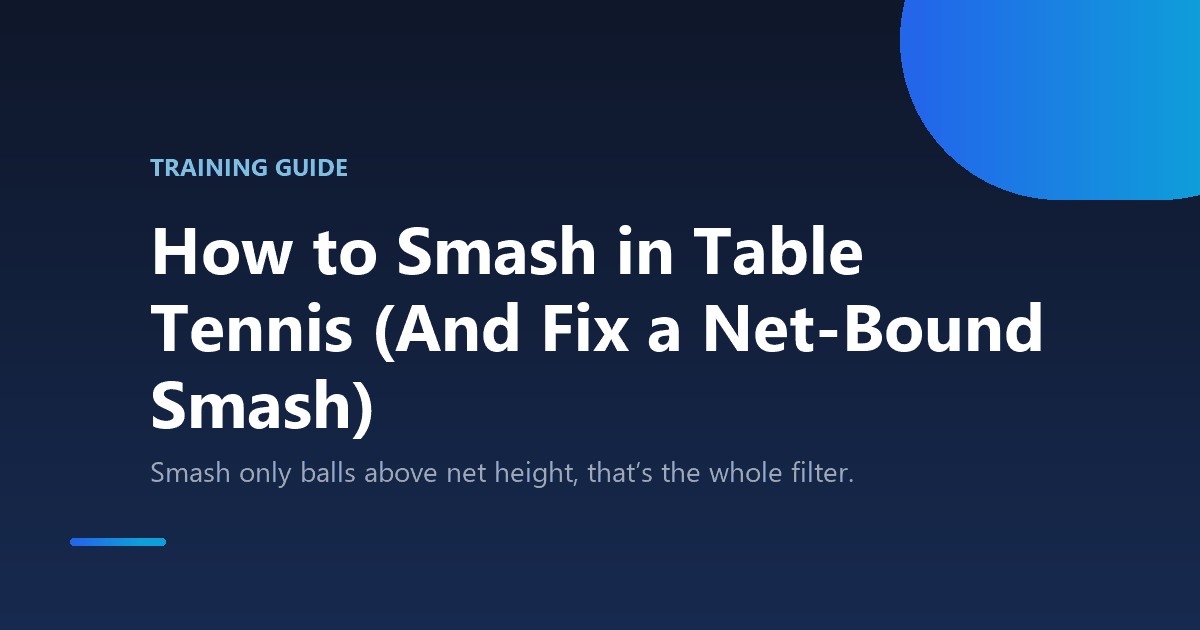
Smash only when the ball is above net height. That’s the whole filter, and most beginners ignore it.
Here’s the geometry. The net is 15.25 cm high. If the ball is below that when you hit it, a flat, downward smash has to travel upward to clear the net — which means you’re not smashing, you’re hoping. The shot has no margin. When you hit a low ball flat and hard, physics gives you two outcomes: the net, or off the end of the table.
| Ball height at contact | Correct shot | Why |
|---|---|---|
| Well above the net (a lob or pop-up) | Smash | You can hit down through it — full margin |
| Around net height | Drive or fast loop | Needs a little topspin to bring it down |
| Below net height | Loop with topspin | Spin is what makes a rising ball land — see our loop guide |
| Below net, heavy backspin | Lift with brush contact | Flat hitting here is a guaranteed net ball |
⚠️ The height rule is not advice, it’s arithmetic. If you’re missing smashes into the net, you almost certainly aren’t smashing wrong — you’re smashing the wrong balls. Watch your next session and count: how many of your smashes were on balls below the net? For most club players it’s more than half.
The forehand smash, step by step
- Read it early and move your feet. The instant you see the ball popping up, get side-on to its landing spot. Smashing while reaching is the single biggest cause of misses — if you’re stretching, you have no hips, and with no hips you have no smash.
- Rotate and load. Turn your hips and shoulders back, weight onto your back foot. Your paddle comes up to roughly shoulder height or above — higher than the ball’s peak, because you’re going to come down through it.
- Wait for the top of the bounce. The highest point gives you the widest safe window into the table. Hitting early (on the rise) is for experts; hitting late (dropping) kills your angle and forces you to lift.
- Strike flat, forward and slightly down. Racket face nearly vertical, maybe a touch closed. This is the one shot in modern table tennis that isn’t about spin — you want raw speed through the ball.
- Drive from the ground up. Legs push, hips rotate, shoulders follow, arm delivers. The arm is the last link in the chain, not the engine.
- Follow through across your body — and then recover immediately, because good opponents lob smashes back and the ball you just hit at 60 mph is coming back in two seconds.
💡 Aim at the elbow, not the corner. Everyone smashes to the wide corners, and everyone’s opponent expects it. The opponent’s playing elbow is the hardest place to react from — they have to decide forehand or backhand with no time to do either. It’s the highest-percentage smash target in the sport and almost nobody uses it.
The backhand smash
Less powerful, quicker to deploy. Elbow up and out in front, paddle drawn toward your non-playing shoulder, then extend through the ball at its peak with a firm wrist and a sharp forearm snap. The power comes from the elbow extension plus wrist, since you can’t get the same hip rotation.
The honest tactical read: on genuinely high balls, step around and use your forehand if you have time — it’s simply a bigger shot. The backhand smash earns its place on mid-height balls arriving fast at your backhand, where stepping around would leave you stranded. Learn it, but don’t expect it to be your weapon.
The six smash-killers
| Mistake | What it looks like | The fix |
|---|---|---|
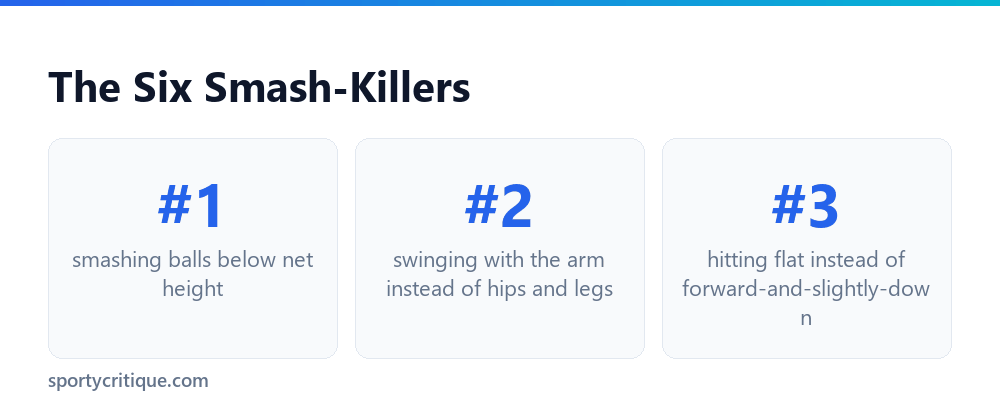
| Swinging down like a volleyball spike | Ball goes straight into the net | Drive forward through the ball; it’s already high, you don’t need to send it down |
| Smashing off the back foot | No power despite huge effort | Transfer weight forward — the ball goes where your weight goes |
| Letting the ball drop first | Late, cramped, into the net | Strike at the peak; move your feet earlier |
| Death-gripping the handle | Tense, wild, inconsistent | Loose grip, tighten only at contact — see the grip guide |
| Standing too close | Leaning back mid-swing | Give yourself an arm’s length; crowded smashes have no power |
| Admiring the shot | Lob comes back, you’re still watching | Recover before it lands |
Number one deserves emphasis, because it’s the instinct everyone brings from other sports. Volleyball and tennis overheads want a downward chop. Table tennis doesn’t — the table is 2.74 m long and the ball only has to travel a couple of metres. Speed forward, not force downward. That mental switch fixes more smashes than any drill.
Power: why hitting harder makes you worse
Here’s the counter-intuitive part. Try to smash at 100% and your technique collapses — the swing gets long, the head lifts, the contact point drifts, and the ball goes anywhere. Smash at 80% with clean form and it’s faster in practice, because the contact is centred and the shot actually lands.
Professional smashes look effortless for exactly this reason. The power is coming from a rotating body, not a thrashing arm — the same principle as a golf swing or a boxer’s cross. If you’re red-faced and the ball isn’t fast, you’re doing arm work that your hips should be doing.
There’s a placement corollary too: a smash that lands is infinitely better than a faster one that doesn’t. At club level, a well-placed 70% smash to the elbow wins the point almost as reliably as a 100% one to the corner — and it goes in three times as often.
How to actually practise it
The smash has a practice problem: you need a supply of high balls, and nobody wants to feed you lobs for twenty minutes. Your options, in order of usefulness:
| Method | How | Quality |
|---|---|---|
| Robot on high feed | Set it to lob repeatedly; smash 30 in a row | Best — endless, consistent, patient |
| Multiball | Partner feeds high balls from a box, 40 at a time | Excellent — see our drills guide |
| Partner lobbing | They lob deliberately; you smash; they lob it back | Good, and doubles as their defensive practice |
| Backspin serve return | Partner serves high backspin; you smash | Realistic — this is how real high balls arrive |
A robot is genuinely the answer here if you can afford one — the smash is the shot that most rewards mindless repetition, and a robot never gets bored of lobbing. Thirty smashes in a row will teach you more about your contact point than a month of matches.
💡 The counting drill: smash until you make 20 in a row. Not 20 total — 20 consecutive. It forces you to dial back to a repeatable power level, which is exactly the lesson. Most players discover their reliable smash is at about 75% of their maximum effort, and that number is worth knowing before you need it at 9–9.
The other side: how to survive a smash
Worth knowing, because the person you’re smashing at is trying to do this to you — and because understanding the defence tells you where to aim.
Your options when a smash is coming:
| Defence | How | When it works |
|---|---|---|
| The lob | Back away from the table, hit high and deep with topspin | Buys time; a deep lob is genuinely hard to smash repeatedly |
| The block | Stay at the table, short compact stroke, absorb the pace | Only on smashes that aren’t fully committed |
| The fish | A low, spinny counter from mid-distance | Advanced — turns defence into a rally |
| Getting out of the way | Honestly, sometimes | A perfect smash is a perfect smash |
The lob is the one worth practising, and it’s why the smash isn’t a guaranteed point at higher levels. A good lobber sends the ball five metres up and deep to your corner with topspin, and now you have to smash again — and again — from a ball dropping out of the ceiling. Rallies where one player smashes six times and loses the point are a genuine spectacle, and they happen because the smasher gets impatient and goes for too much on the fifth one.
The lesson for your smash: be ready to hit two or three. Players who assume the first smash ends the point are the ones who lose to lobbers. Recover, set your feet, and hit the next one at the same 80% — the lobber will miss before you do, provided you don’t get greedy.
Smashing in doubles
Doubles changes the calculus in one important way: you must clear out immediately for your partner. The alternation rule means the moment you’ve hit, your partner needs the space you’re standing in — so a smash that leaves you frozen admiring it doesn’t just cost you the follow-up, it costs your partner their shot.
Practical adjustments: smash slightly less hard than you would in singles (you want to be balanced enough to move out), aim for the opponent standing furthest from where they need to be next, and communicate — ‘yours’ and ‘mine’ called early prevents the classic doubles disaster where both players go for the same high ball and neither hits it. The full rotation logic is in our doubles rules guide.
Does your equipment matter here?
More than for most shots, yes. The smash is a flat-hitting stroke, and very soft, spin-oriented control setups genuinely mute it — all that dwell time you want for looping works against you when you’re trying to hit through the ball. If your smash feels like it’s being absorbed, it might be.
That said: this is the last thing to blame. Fix the ball-height rule, fix the hips, count your 20-in-a-row — and if your smash is still dead after all that, then look at your setup. Our paddle guide covers which builds favour flat hitting, and the rubber guide explains the speed/control trade-off honestly.
Frequently asked questions
Why does my smash always hit the net?
Almost always one of two things: you’re smashing balls that are below net height (arithmetic, not technique), or you’re swinging downward instead of driving forward. Check the height first — it’s the usual culprit.
Should I smash or loop a high ball?
Above the net, smash — it’s faster and simpler. Around net height or below, loop. The loop’s topspin is what brings a rising ball down onto the table; a flat smash has no such help.
How fast is a table tennis smash?
The fastest recorded is around 116 km/h (72 mph). Because the ball only travels a couple of metres, that leaves your opponent 60–80 milliseconds — less than human visual reaction time. More numbers in our statistics page.
Can you smash a backspin ball?
Only if it’s high. Backspin makes the ball dip and kick down off your racket, so a low backspin ball smashed flat goes into the net every time. High backspin lobs, though, are smashable — just contact slightly higher on the ball than you’d think.
Why do pros smash less than amateurs?
Because opponents at that level rarely give them a ball above net height, and the loop is a safer, spin-loaded attack that works on any ball. The smash is a punishment shot for mistakes — and pros make fewer mistakes.
What’s the difference between a smash and a drive?
Intent and margin. A drive is a controlled attacking shot with a little topspin, used in rallies. A smash is a flat, maximum-speed shot designed to end the point, used only on high balls. Different tools, different situations.
🏓 Need More Finishing Power on High Floating Balls?
A solid wood blade with responsive carbon layers generates blistering smash speed with minimal arm strain. If your current racket feels hollow on impact, find a paddle built for aggressive attacking:

Ping Pong Reviewed is an equipment review site covering table tennis and baseball gear. Specifications are checked against manufacturer listings, and prices against live retail pages, before publication.