Smaller Ping Pong Table Dimensions: All 3 Sizes Compared

Table of Contents
Every ‘Smaller’ Table Size, Compared Honestly
Search results for smaller ping pong table dimensions turn up a genuinely confusing mix of numbers, because “smaller” covers at least three distinct, standardized classes, junior, midsize, and mini/tabletop, plus no shortage of vague or outright inconsistent claims about what each one actually measures.
We publish two dedicated deep-dive guides on this site, one on junior table sizing and one on midsize table sizing, and this post exists to lay out all the smaller options side by side using the exact same verified numbers those two guides use, rather than repeating loose approximations.
The Spec That Doesn’t Shrink: Height
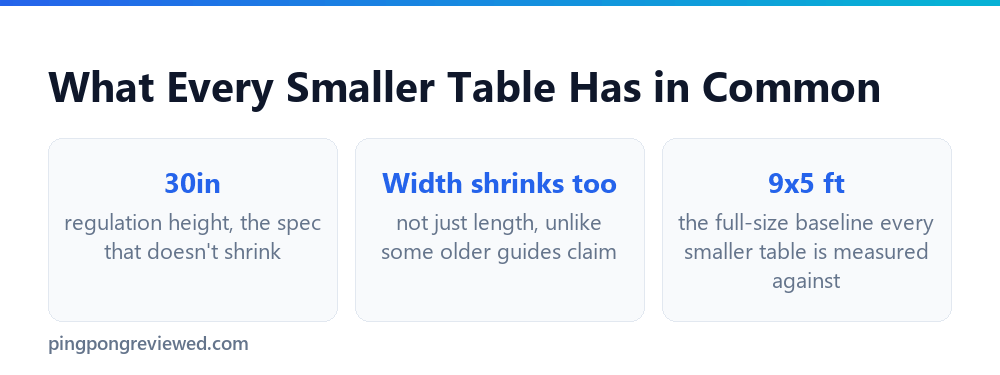
Whatever the playing surface size, a genuine training-grade smaller table keeps the full 30-inch regulation height. Only the playing surface itself gets smaller. This is the single most important thing to check before buying, a table that shrinks the height along with the surface isn’t a scaled-down training tool, it’s closer to a toy your child will need to unlearn once they move to a regulation table.
Width Shrinks Too, Not Just Length
One claim worth correcting directly: it’s not accurate that a smaller table’s width “stays the same” as a full-size table’s 5 feet while only the length shrinks. Genuine junior and midsize tables scale both dimensions down together, proportionally, not just the length. A table that’s shorter but still full width would have an oddly stretched, non-proportional playing surface that doesn’t match any standard class sold by real manufacturers.
The Three Real Classes of Smaller Table
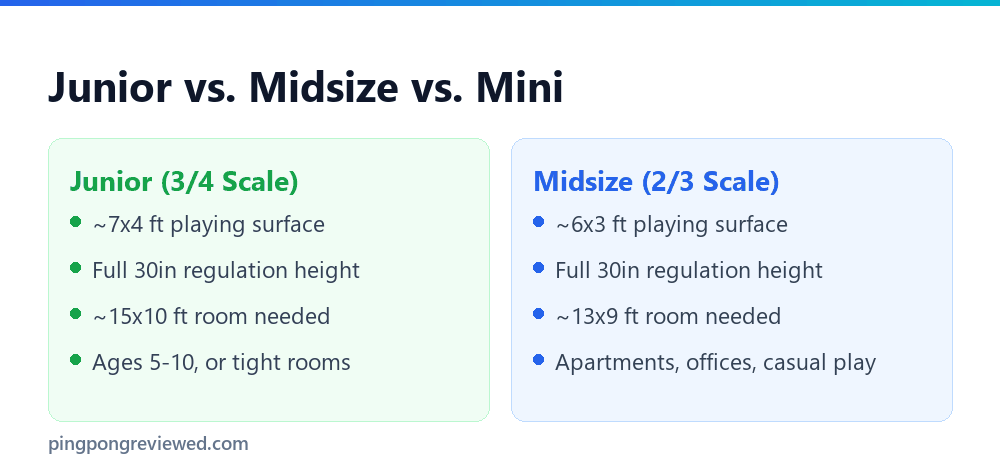
Junior (three-quarter scale): roughly 7×4 feet at the full 30-inch height, needing about 15×10 feet of room. Best for ages 5-10, or any age when room size, not the child’s size, is the actual constraint. Our full junior table guide covers this class in depth.
A junior table’s proportionally smaller surface still preserves the actual geometry of the sport, serve angles, the depth of a proper loop, the width needed for real footwork, just scaled to a smaller room and a smaller player. That’s the meaningful difference between a junior table and a toy-grade mini table, the physics of the game stay intact even though the surface shrinks.
Midsize (two-thirds scale): roughly 6×3 feet, also at the full 30-inch height, needing about 13×9 feet of room. This is the class best suited to apartments, home offices, and casual family play where a junior table would still be too large. Our dedicated midsize table guide goes deeper on this size specifically.
Midsize tables trade more playing-surface realism for space savings than junior tables do, at 6×3 feet the surface is noticeably tighter for full adult-length rallies. That trade-off is the right one for a household prioritizing fitting the game into a small space over training realism, but it’s worth knowing you’re making that trade rather than assuming a midsize table plays identically to a junior or full-size one.
Mini or tabletop: 3-5 feet, with height varying by model since most mini tables aren’t meant as serious training tools at all, they’re built for toddlers, travel, or as a novelty gift. Don’t expect regulation height or genuine training value from this class, it’s a different product category entirely from junior and midsize tables.
Mini tables typically sit on an existing surface, a dining table or desk, rather than standing on their own legs, which is part of why height varies so much between models, it’s determined by whatever surface you’re placing it on rather than a fixed regulation-adjacent standard the way junior and midsize tables maintain, so treat any height claim on a mini table listing as informational rather than a training spec.
Folding and Storage Options at Each Size
Most junior and midsize tables sold today fold in half on wheeled legs, the same design full-size tables use, which matters more for smaller tables specifically since the whole point of buying one is usually limited space. A table that can’t fold down between uses defeats much of the purpose of choosing a smaller class in the first place.
Check the folded footprint specifically, not just the playing dimensions, before buying. A junior table folded in half still needs a genuine storage spot roughly 4×4 feet, and that spot needs to be somewhere you can actually roll the folded table to and from without navigating stairs or tight doorways, a detail that’s easy to overlook when you’re focused on the playing-surface dimensions alone.
Mini and tabletop tables solve the storage problem differently, most are lightweight enough to lean against a wall or slide under a bed rather than needing wheeled folding legs. That portability is part of their appeal for travel or occasional use, though it comes at the cost of the sturdier, more realistic playing feel a wheeled junior or midsize table provides.
Nets and Accessories Scale Down Too
A genuine junior or midsize table typically ships with a properly sized net rather than expecting you to source one separately, since a full-width regulation net wouldn’t fit a narrower playing surface correctly. If you’re buying a smaller table secondhand or without an included net, check the width specification before ordering a replacement, a 72-inch regulation net will overhang a midsize table’s 36-inch width significantly.
Paddles and balls don’t need to scale down at all, regulation-size equipment works identically on any of these smaller table classes. The only genuinely table-specific purchase is the net itself, everything else in your equipment bag carries over regardless of which size table you’re playing on, which keeps the overall equipment cost reasonable.
Two Figures That Are Widely Quoted Wrong
Two smaller-table figures circulate in a mangled form often enough to be worth flagging. The first is a midsize table given as “72 inches by 5 inches” — a transcription error that has propagated across a number of sites, since a table five inches wide is not a table. The correct midsize figure is roughly 72 inches by 36 inches (6 feet by 3 feet). The second is the 3/4 scale junior class listed as “6 feet long and 3 feet wide,” which is actually the midsize footprint; the junior figure is roughly 7 by 4 feet. If a size chart gives you either of those, treat the rest of it with caution.
Which Smaller Size Actually Fits Your Space
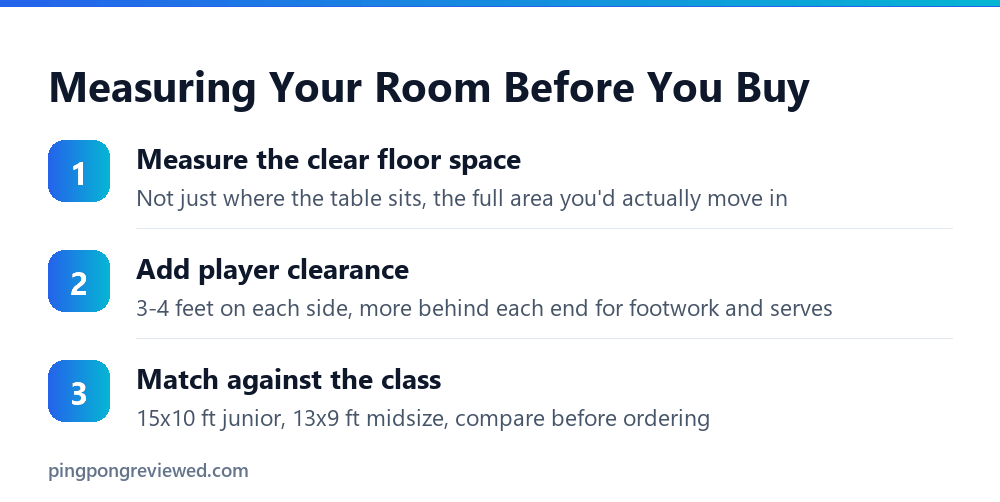
Measure your available room before picking a class, not the other way around. A junior table needs about 15×10 feet of clear space to allow real footwork and swing room, a midsize table needs about 13×9 feet. If your room is tighter than that, a mini or tabletop option is honestly more of a novelty than a genuine training tool, and it’s worth being honest with yourself about that trade-off before buying.
If you’re buying for a child specifically rather than for space reasons alone, age matters more than room size within the junior-versus-midsize decision. A junior table’s slightly larger surface gives a growing child more room to develop real footwork before eventually moving to a full-size table, while a midsize table is more about fitting the sport into a small home than about matching a specific age.
Whichever class you ultimately land on, the height rule from earlier in this guide still applies as the non-negotiable check, confirm 30 inches specifically before ordering, regardless of how convincing the rest of a listing’s marketing language sounds.
What are the exact dimensions of a smaller ping pong table?
It depends on the class. Junior (3/4 scale) tables run about 7×4 feet, midsize (2/3 scale) tables run about 6×3 feet, and mini/tabletop tables run 3-5 feet with no standardized height across brands.
Does the net height change on a smaller table?
No, the net stays 6 inches high on genuine junior and midsize tables, proportional to the full regulation table’s net height relative to a smaller playing surface.
Is a smaller table still good for real practice?
Junior and midsize tables both keep the full 30-inch regulation height, which is what makes them genuine training tools rather than toys. Mini and tabletop tables are the exception, built for casual or travel use rather than serious practice.
Should I buy a smaller table or a full-size table?
Buy full-size if your room fits one (about 17×11 feet), since it’s the long-term option a child or beginner won’t outgrow. Buy a smaller class specifically when room size, not preference, is the real constraint.
Do smaller tables fold down for storage?
Most junior and midsize tables sold today fold in half on wheeled legs, the same design as full-size tables. Check the folded footprint, not just the playing dimensions, since a folded junior table still needs roughly 4×4 feet of storage space.
Will a regulation net fit a smaller table?
No, a 72-inch regulation net will overhang a narrower midsize or junior table significantly. Genuine smaller tables typically ship with a correctly sized net, or you’ll need to buy one matched to the table’s actual width.
Can adults play seriously on a junior or midsize table?
Adults can, and it’s a reasonable option if space is genuinely the constraint, but the shorter table length changes shot timing and depth judgment noticeably compared to a full-size table, so expect a real adjustment period if you later move to a full-size table.
Do outdoor smaller tables exist?
Yes, some junior and midsize tables come in weatherproof outdoor versions similar to full-size outdoor tables, check the specific listing for weatherproofing claims rather than assuming a smaller table is automatically indoor-only, since indoor-only construction is still more common at these sizes.

Ping Pong Reviewed is an equipment review site covering table tennis and baseball gear. Specifications are checked against manufacturer listings, and prices against live retail pages, before publication.