Best Type of Shoes for Table Tennis (By Category)
The best type of shoes for table tennis is a dedicated table tennis shoe — low sole profile, non-marking rubber, and lateral support built for constant footwork resets. Butterfly’s dedicated table tennis shoes are the clearest example. A crossover badminton or squash shoe is the reasonable second choice. A general running or basketball shoe is the type to avoid.
- →Dedicated table tennis shoes, mainly from Butterfly and Mizuno, are built specifically around the sport’s constant lateral footwork.
- →Crossover shoes from badminton, squash, or general indoor court lines work reasonably well since those sports share similar footwork demands.
- →General running or basketball shoes are the type to actively avoid — higher heel drop and less lateral support work against you specifically in table tennis.
- →Fit matters as much as type: dedicated table tennis brands often run narrower than general athletic shoes, so check sizing charts specifically.
“Best shoes for table tennis” usually gets answered with a product list. That skips the more useful question: what type of shoe are you even comparing? Table tennis footwork is short, explosive, and constantly resetting laterally. That specific demand rewards a specific kind of shoe design. Understanding the categories first makes any individual product choice much easier.
Table of Contents
Type 1: Dedicated Table Tennis Shoes

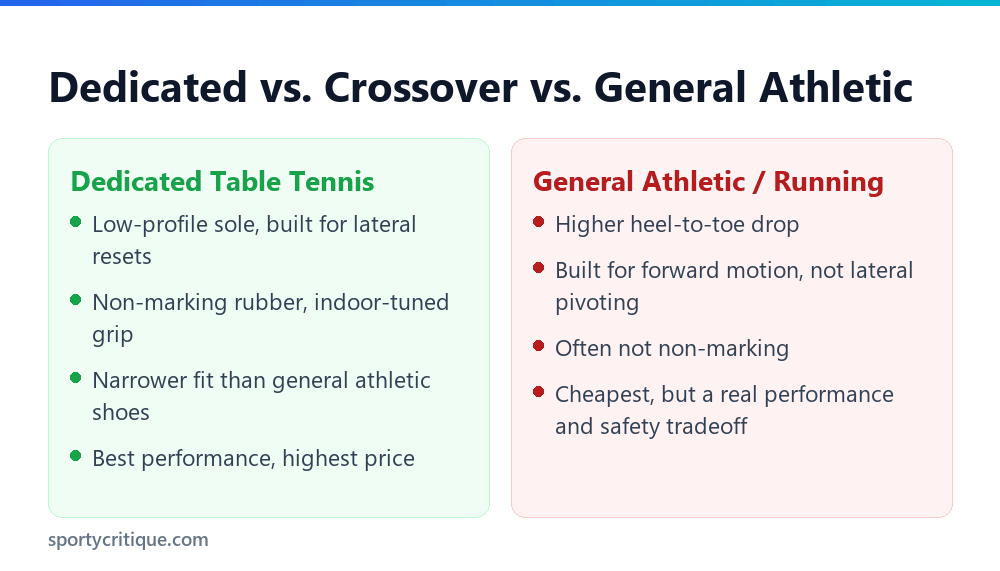
Brands like Butterfly build shoes specifically around table tennis footwork. That means a low sole profile, reinforced lateral support, and non-marking rubber tuned for indoor courts. The Butterfly Athletic line is a solid representative example, purpose-built rather than adapted from another sport. This category delivers the best performance. It usually costs more, though, and runs narrower than general athletic shoes.
Type 2: Crossover Indoor Court Shoes

Shoes built for badminton, squash, or general indoor court sports share enough footwork DNA with table tennis to work reasonably well as a crossover pick. They won’t be quite as fine-tuned as a dedicated table tennis shoe, but for players who split time across multiple indoor racket sports, one crossover pair covering several activities is a genuinely practical tradeoff.
Type 3: Badminton-Specific Shoes

Badminton shoes deserve their own mention within the crossover category. Badminton’s footwork involves explosive lateral and forward lunges. That overlaps closely with table tennis specifically, more than most other crossover sports do. A dedicated badminton shoe often performs closer to a true table tennis shoe than a generic “indoor court” shoe does. That makes it a strong second choice if a table tennis-specific model isn’t available in your size or budget right now.
💡 Pro tip: If you’re choosing between a badminton shoe and a generic cross-trainer for table tennis, pick the badminton shoe every time — the footwork overlap is real, not just marketing language.
Type Comparison at a Glance
Four real categories cover almost every option a player will actually encounter: dedicated table tennis shoes, badminton or squash crossovers, hybrid multi-sport shoes, and general athletic shoes. Each moves along the same basic tradeoff. More sport-specific tuning means better performance and a higher price. Less tuning means broader everyday usefulness and, usually, a lower one. Knowing where you sit on that tradeoff before shopping saves time comparing individual products later.
What to Avoid: General Running and Basketball Shoes
- ✓A dedicated table tennis shoe if budget allows
- ✓A badminton or squash shoe as a strong second choice
- ✓Any shoe explicitly rated non-marking for indoor courts
- ✕A running shoe — elevated heel raises ankle-roll risk
- ✕A basketball shoe — built for vertical jumping, not lateral resets
- ✕Any shoe without a non-marking sole for indoor play
Running shoes are built for forward motion in a straight line, with an elevated heel that actually increases ankle-roll risk during table tennis’s constant lateral movement. Basketball shoes go the opposite direction — heavier, higher-cut for ankle support during vertical jumps, neither of which table tennis footwork rewards. Both technically work in a pinch, but both work against the specific movement pattern the sport actually demands.
How Fit Differs Across These Types
Dedicated and badminton-specific shoes from Asian manufacturers, including Butterfly and Mizuno, commonly run narrower than general Western athletic shoe sizing. Check the brand’s specific size chart. Don’t just order your usual running shoe size. This is the single most common fit mistake players make when switching from a general athletic shoe to a dedicated or crossover table tennis type for the first time.
Upper Material Differences
Dedicated and badminton shoes commonly use synthetic mesh uppers, light and breathable but less durable against outdoor abrasion than leather. That’s a fine tradeoff, since these shoes are built for indoor use anyway. General athletic shoes vary more, some using leather or heavier synthetics for outdoor durability that simply isn’t needed indoors. If you’ll only ever wear the shoe on an indoor court, the lighter mesh construction is the better fit, not a compromise you’re settling for.
Price Range by Type
Dedicated table tennis shoes typically cost the most, reflecting the specific engineering that goes into sole profile and weight. Crossover badminton and squash shoes usually sit in a similar range, sometimes slightly less. General athletic shoes span a much wider range, from cheap basics to premium running shoes, but even a premium running shoe doesn’t solve the underlying mismatch between its design and table tennis footwork. Paying more for the wrong type doesn’t fix the wrong type — it just gets you a more expensive version of the same underlying problem.
Durability Differences by Type
Dedicated table tennis shoes wear at the outer sole edge first, since that’s where lateral pivoting concentrates stress. Crossover badminton and squash shoes wear similarly, just slightly slower since the demands aren’t quite as extreme. General athletic shoes wear more evenly across the sole but often show upper damage sooner under lateral stress they weren’t built to handle. None of the three types last forever. Expect 6-12 months of regular use from any of them before real replacement becomes necessary, faster for players training several times a week.
Breathability by Type
Dedicated and crossover shoes generally use more breathable mesh uppers than general athletic shoes, since less bulky material also means better airflow. That’s a real side benefit during long sessions, not just a marketing detail. A hot gym without strong air conditioning makes this difference noticeable within the first half hour of play, especially compared to a heavier basketball or running shoe design.
What Serious Players Actually Wear
Watch any club-level or competitive table tennis match, and dedicated shoes dominate the floor. That’s not brand loyalty. It’s a practical response to how much footwork the sport actually demands at a serious level. Casual and recreational players can get away with a crossover or even a decent general athletic shoe without much real downside. Once training volume increases, the type of shoe starts to matter more, not less, since repeated wrong-type stress adds up over hundreds of sessions across a full competitive season.
Signs You’ve Outgrown a General Athletic Shoe
A few warning signs suggest it’s time to move up from a general athletic shoe to a dedicated or crossover type. Feeling sluggish resetting between shots, noticing the shoe scuffing or marking the floor, or dealing with sore ankles after regular sessions all point toward a shoe that’s actively working against your footwork rather than supporting it. None of these are dramatic on their own, but together they’re a clear signal the general athletic category has reached its limit for your level of play.
Type 4: Hybrid Multi-Sport Shoes

A fourth category sits between dedicated and general athletic: hybrid shoes marketed for multiple indoor sports at once. These trade some table tennis-specific tuning for broader usefulness. They’re a reasonable pick if your budget only stretches to one pair of shoes covering several activities. Just don’t expect them to match a dedicated table tennis shoe stride for stride during fast footwork.
Sole Type: The Detail That Separates Every Category
Every type discussed here really comes down to the sole. Dedicated shoes use a thin, flat, non-marking rubber tuned for quick pivots. Crossover shoes use a similar rubber but slightly less optimized for table tennis specifically. Running and basketball shoes use thick, cushioned soles built for a completely different kind of impact. If you only check one spec when comparing shoe types, check the sole. It tells you more about real performance than the brand name or the marketing copy ever will.
Grip and Traction: How the Types Differ
Table tennis courts and general indoor gyms have different flooring, and traction needs shift accordingly. Dedicated shoes use rubber compounds tuned specifically for table tennis court surfaces, gripping firmly during a lateral cut without over-sticking during a pivot. General athletic shoes, especially basketball models, use grippier rubber built for a different kind of stop-and-go movement. That extra grip can actually work against you in table tennis, catching at the wrong moment during a fast reset instead of releasing smoothly.
Weight Differences Across the Three Types
Dedicated table tennis shoes are usually the lightest of the three categories, since every gram works against fast lateral resets. Crossover badminton and squash shoes come close, sharing similar priorities. General athletic shoes, especially basketball models, add real weight for ankle support and cushioning. That weight doesn’t help you in table tennis. It actively works against the quick, repeated resets the sport demands, shot after shot.
Caring for Each Shoe Type
Dedicated and crossover shoes with mesh uppers should air-dry away from direct heat after sweaty sessions, since heat can warp the lightweight materials that make them breathable in the first place. Wipe the sole clean of dust between sessions, since a dusty indoor court surface gradually reduces the very grip you bought a non-marking sole for. General athletic shoes tolerate rougher handling, but that durability comes from the same heavier construction that makes them the wrong type for table tennis footwork in the first place — a reminder that no amount of careful maintenance turns the wrong type of shoe into the right one.
What type of shoe is best for table tennis?
A dedicated table tennis shoe from a brand like Butterfly or Mizuno performs best overall, built specifically around the sport’s constant lateral footwork demands.
Can I use a badminton shoe for table tennis?
Yes — badminton’s footwork overlaps closely with table tennis, making a dedicated badminton shoe a strong second choice when a table tennis-specific model isn’t available in your size.
Why shouldn’t I use running shoes for table tennis?
Running shoes have an elevated heel built for forward motion, which increases ankle-roll risk during table tennis’s constant lateral direction changes throughout play.
Do table tennis shoes run true to size?
Often not — dedicated and crossover shoes from Asian manufacturers commonly run narrower than general athletic shoe sizing, so always check the brand’s specific chart first.
Are hybrid multi-sport shoes worth it for table tennis?
They’re a reasonable budget compromise if you play multiple indoor sports, but they won’t match a dedicated table tennis shoe’s performance for fast, sport-specific footwork resets.
As an Amazon Associate, we earn from qualifying purchases through links on this page.

Ping Pong Reviewed is an equipment review site covering table tennis and baseball gear. Specifications are checked against manufacturer listings, and prices against live retail pages, before publication.