Tibhar Hybrid K3 Review: Real Specs and Verified Pro Usage
Tibhar sells two very different flagship attacking rubbers, Hybrid K3 and Evolution MX-P, and this site has now verified both directly. This page checks K3’s numbers, its real price, and how it actually compares to its own sibling already reviewed here.
What follows is Megaspin’s own published specifications, current retail pricing, and a direct same-brand comparison. Not a claimed hands-on verdict.
📊 Note: What this review is. We have not logged hours on this sheet, and we’re not going to describe a feel we haven’t felt. What follows is verified pricing, a retailer’s published specification numbers, and the buying decisions that follow from them.
Table of Contents
What Hybrid K3 Costs Right Now
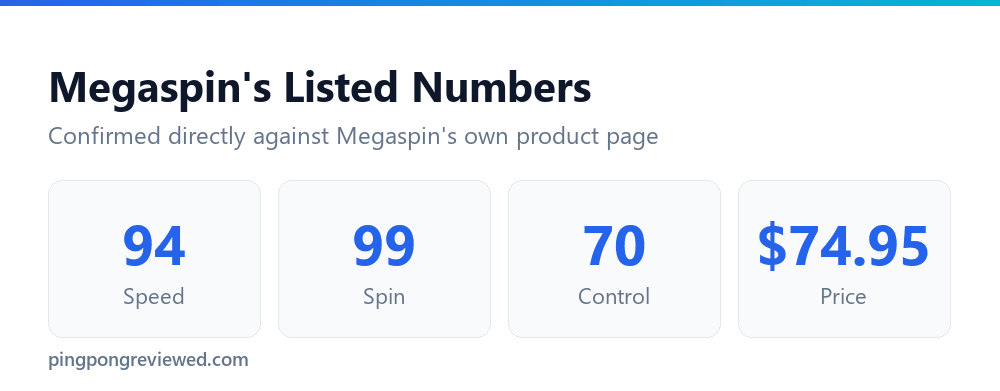
Megaspin lists Hybrid K3 at $74.95, in Black and Red, across 2.0mm and Max thicknesses. That’s $15 more than Tibhar’s own Evolution MX-P, already verified on this site at $59.95, a real gap between two flagship rubbers from the same manufacturer.
Hybrid K3 is listed on Amazon in Red at Max thickness, alongside Megaspin and other established retailers.
A Verified Pro-Usage Claim
Multiple independent sources consistently name specific current WTT-circuit professionals using Hybrid K3: Darko Jorgic, and the Lebrun brothers, Felix and Alexis, both already profiled individually on this site in an earlier player-page batch. This is a corroborated claim, appearing consistently across separate independent sources rather than a single aggregator’s unverified assertion, which is exactly the bar this site requires before repeating a pro-usage claim as fact.
That’s worth contrasting directly with this site’s Dignics 09C review, where a similar pro-endorsement claim (Timo Boll) appeared only in a single Amazon listing title and was explicitly flagged as unverified. The Hybrid K3 usage claim clears a meaningfully higher verification bar.
The Official Specifications
Megaspin’s own description calls out a combination Tibhar frames as previously difficult to achieve: a very sticky, tacky topsheet paired with a highly boosted hard sponge, aiming for both the grip-driven spin of a tacky rubber and the catapult effect of a hard, boosted sponge in the same sheet.
How It Actually Compares to Evolution MX-P
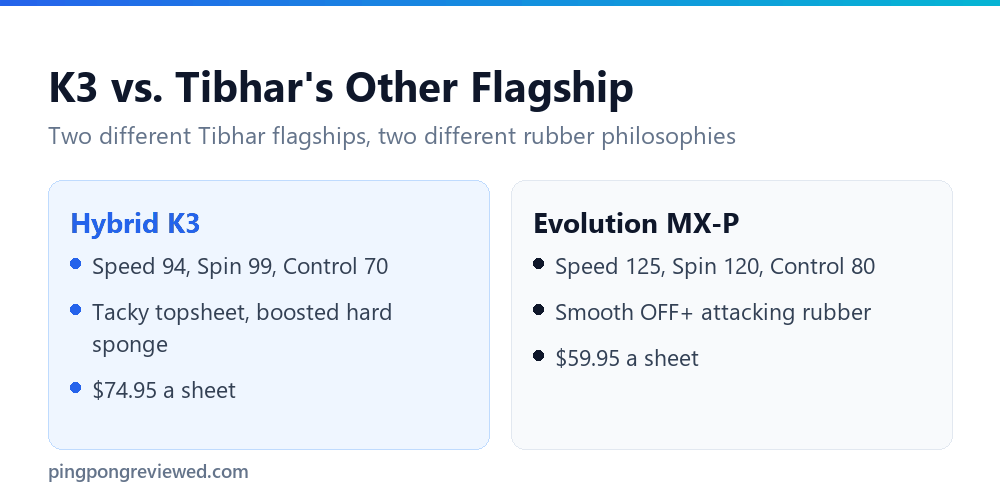
Both rubbers come from Tibhar and are listed through Megaspin, but their underlying scale ranges differ enough between the two product pages that this comparison is read directionally rather than as precise proportional math.
The clearer, more directly comparable figure is price: K3 costs $15 more per sheet than MX-P, a real premium for the tacky-plus-hard-sponge combination and its documented pro usage.
Why Tibhar Doesn’t Consolidate Around One Flagship
It’s worth asking directly why a manufacturer maintains two premium flagship rubbers this different in character rather than picking one winner and discontinuing the other. The answer comes back to the same principle covered across this site’s other same-brand comparisons: elite players have different stroke styles and preferences, and a manufacturer serving that full range of the professional market needs more than one flagship option to do it. Consolidating around a single rubber, however well it scores on paper, would mean losing the players whose game specifically depends on the other one’s characteristics.
Who Hybrid K3 Is Actually For
- ✓You want a tacky topsheet’s grip combined with a hard sponge’s catapult
- ✓You already generate real racket speed and want maximum spin
- ✓You’re comparing Tibhar’s own flagship rubbers against each other
- ✓You value a rubber with verified current pro usage
- ✕You’re a beginner still building a consistent stroke
- ✕You want the softest, most forgiving rubber available
- ✕You mostly play a controlled, defensive, or blocking game
- ✕Price is the primary constraint on your rubber choice
💡 Pro tip: If you’re deciding between K3 and MX-P specifically, K3’s tacky topsheet suits players who want more grip-driven feel at the point of contact, while MX-P’s smooth surface suits players who prefer a faster, more slippery release. Neither preference is wrong.
Thickness Options
Hybrid K3 is offered in 2.0mm and Max thickness, a narrower range than MX-P’s four-thickness lineup. The Max option maximizes output; 2.0mm trades some of that output for more control.
Buying It Alongside a Blade
Given K3’s hard sponge classification, it follows the same general blade-pairing principle as any hard-sponge attacking rubber covered on this site: a stiff, offensive blade generally handles it more predictably than a soft or flexible one does. This matches the same guidance this site’s MX-P review gives for its own hard-sponge rubber, since both Tibhar flagships share this general hardness category despite their different topsheet characters.
What “Hybrid” Actually Means Here
The name itself is worth unpacking, since “hybrid” describes a specific engineering achievement rather than a generic marketing term. Tacky topsheets and hard, high-rebound sponges have historically been treated as somewhat opposed design goals, tack maximizes grip and dwell time, which usually pairs with softer, more controllable sponges, while hard, boosted sponges are more commonly paired with smoother, less tacky surfaces built for fast release. Tibhar’s own positioning for K3 frames the combination of both traits in one sheet as something previously difficult to achieve, which is the specific claim the “hybrid” name is making.
That context helps explain why this rubber commands a premium over MX-P despite scoring lower on Tibhar’s raw output numbers, the price reflects the engineering complexity of combining two traits that don’t naturally pair well, not simply a higher-performance sheet in the way MX-P’s higher numbers might suggest on their own.
Reading Pro Usage Correctly
It’s worth being precise about what a verified pro-usage claim actually tells a prospective buyer, since it’s easy to over-interpret. Darko Jorgic and the Lebrun brothers using Hybrid K3 confirms the rubber performs at an elite competitive level in the hands of players with years of specific technique built around it, it doesn’t mean the rubber will produce similar results for a club player picking it up for the first time. Elite players select equipment that matches strokes they’ve already spent years developing, not equipment that will develop those strokes for them.
This distinction matters more for a rubber like K3, with its demanding hard-sponge-plus-tack combination, than it would for a more forgiving rubber. A verified pro-usage claim is a genuine, meaningful signal of the rubber’s ceiling and competitive legitimacy, it’s not a promise of what any given buyer will personally experience.
Gluing and Care
Hybrid K3 uses the same modern, water-based gluing process as any current inverted rubber, spread thin on both blade and rubber, let both go touch-dry, then lay the sheet down from one edge to avoid trapping air underneath it. The tacky topsheet doesn’t require a different adhesive process, despite the elevated grip the rubber itself provides once mounted.
Tacky rubbers generally attract dust and lose surface grip through ordinary handling faster than smoother tensor topsheets, a pattern this site’s DHS Hurricane 3 review covers in more detail for a different tacky rubber. The same care principle applies here: wiping the surface down after sessions and storing it with its protective film helps preserve K3’s tack meaningfully longer than leaving it exposed between uses.
Counterfeits and Where to Buy It
Given Hybrid K3’s premium price and genuine elite pro association, it carries real counterfeiting risk, the same way this site’s Tenergy 05 and Dignics reviews flag for other premium, well-known rubbers. Buying from Megaspin, Tibhar’s own distribution, an established table tennis retailer, or a reputable Amazon listing with genuine seller history reduces that risk meaningfully compared to an unfamiliar marketplace seller.
⚠️ Watch out: A Hybrid K3 listing priced well below the confirmed $74.95 is worth treating with real skepticism, especially given the rubber’s genuine elite-level reputation. Check seller reputation and packaging carefully before gluing anything to a blade.
A Worked Comparison
Picture two players with similarly developed, aggressive attacking styles, one on Hybrid K3 and one on Evolution MX-P, both on comparable stiff offensive blades. The K3 player’s shots carry a grippier, more dwell-time-driven quality at contact, consistent with the tacky topsheet’s design, while the MX-P player’s shots release faster off a smoother surface, consistent with that rubber’s higher raw speed figure. Both players can generate serious spin and power; the specific feel and shot character at the moment of contact is where the two setups diverge.
Neither player has made a worse choice than the other. They’ve made different choices, both legitimate at the elite level given the sport’s actual current professional usage, which is exactly why Tibhar continues selling both rubbers side by side rather than consolidating around whichever one scores higher on paper.
That’s the real picture behind two flagship rubbers from one manufacturer: not a hierarchy with a winner, but two legitimate, elite-validated answers to slightly different questions about how a player wants the ball to feel at the moment of contact.
Common Questions
How much does Tibhar Hybrid K3 cost?
Megaspin lists it at $74.95 per sheet, $15 more than Tibhar’s own Evolution MX-P.
Do any current pros actually use Hybrid K3?
Yes, confirmed across multiple independent sources: Darko Jorgic, and the Lebrun brothers, Felix and Alexis, both profiled separately on this site.
How does Hybrid K3 compare to Evolution MX-P?
MX-P scores higher on Tibhar’s raw numbers, but the two pursue different playing characters, K3’s tacky topsheet versus MX-P’s smooth surface, rather than one being simply better.
Is Hybrid K3 good for beginners?
Generally no. Its hard sponge and tacky topsheet reward an already-developed, committed stroke rather than helping build one.
What thickness of Hybrid K3 should I buy?
Max maximizes speed and spin output. 2.0mm trades some of that output for more control.
Elite players on both sides of that choice prove it isn’t a close call between good and bad, it’s a genuine fork in the road, and either path leads somewhere real.
The Verdict
The short version: Tibhar Hybrid K3 is a premium, tacky-plus-hard-sponge attacking rubber with verified current pro usage, priced at $74.95, $15 more than Tibhar’s own Evolution MX-P. The two rubbers pursue different playing characters rather than one simply outranking the other, and K3 rewards an already-developed, committed stroke. Verified directly against Megaspin’s own listing on 6 September 2026.
- →Megaspin’s listing: Speed 94, Spin 99, Control 70 at $74.95.
- →verified pro usage: Darko Jorgic, Felix and Alexis Lebrun.
- →$15 more per sheet than Tibhar’s own Evolution MX-P.
- →Combines a tacky topsheet with a hard, boosted sponge.
- →Rewards an already-developed stroke, not a beginner starting point.
- →Tibhar sells both K3 and MX-P side by side, neither replacing the other.
So the closing question is about feel, not raw numbers: does a tacky, grip-driven contact suit your game better than a smooth, fast-release surface, since that’s the real difference between Tibhar’s two flagship rubbers, not a simple performance ranking?
Two elite-validated Tibhar rubbers, one manufacturer, and a choice that comes down to feel rather than a clear performance winner.
As an Amazon Associate, we earn from qualifying purchases through links on this page.

Ping Pong Reviewed is an equipment review site covering table tennis and baseball gear. Specifications are checked against manufacturer listings, and prices against live retail pages, before publication.