STIGA Evolution Review: Verified Specs, Price and Skill Class

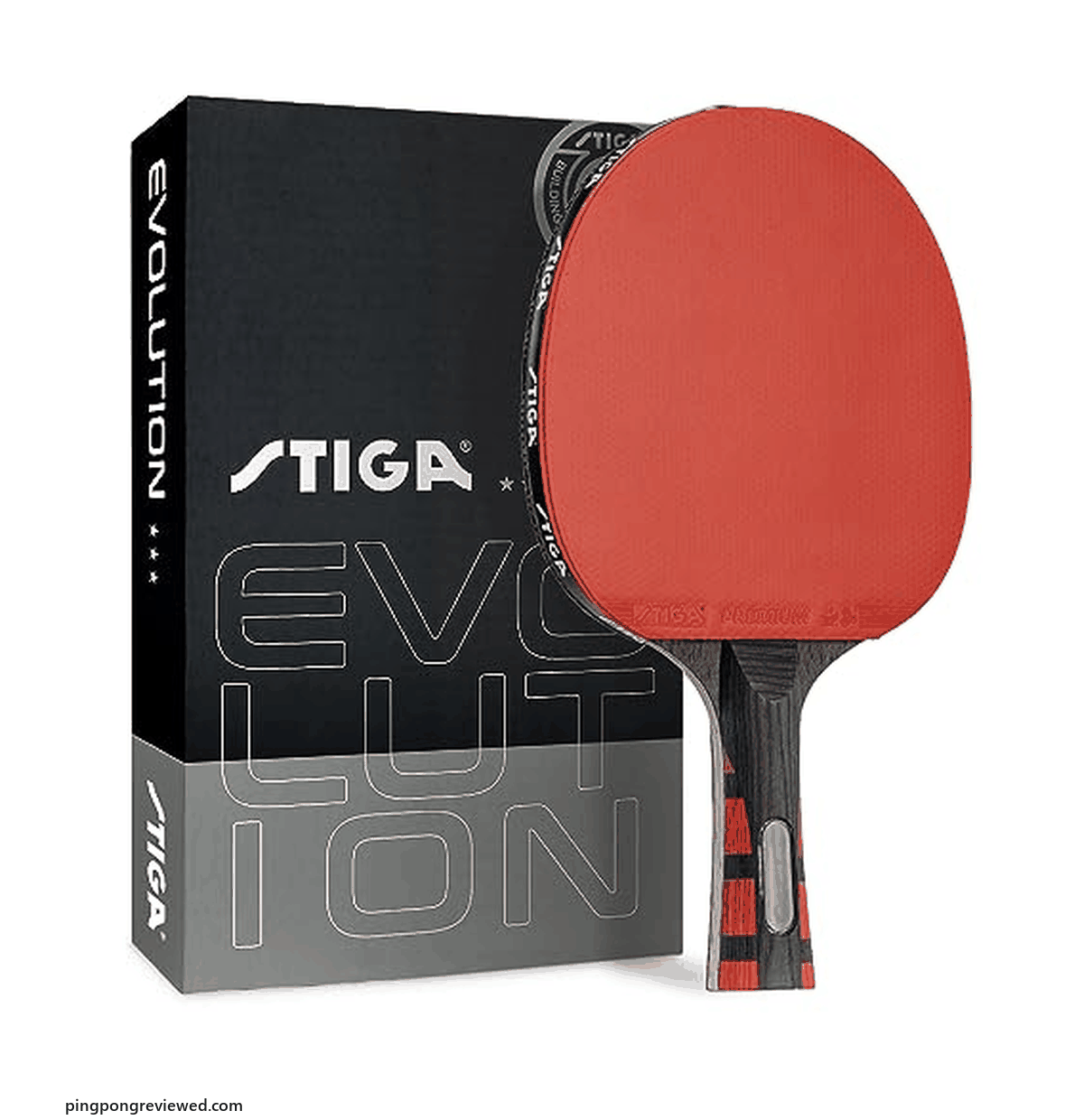
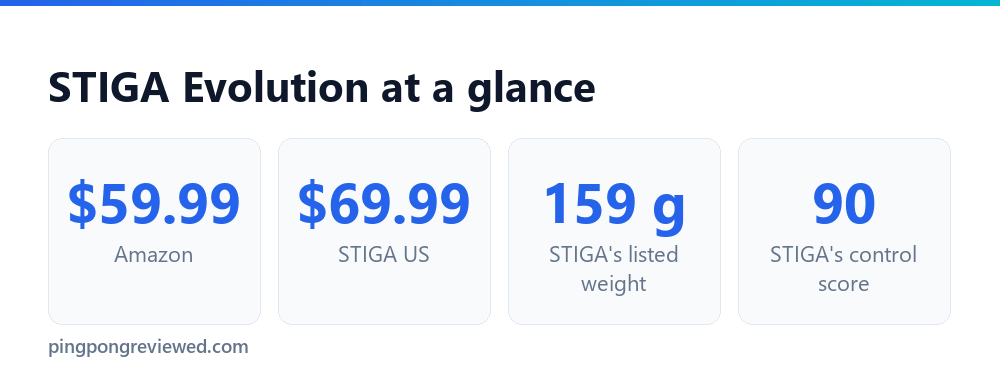
This STIGA Evolution review sticks to what STIGA’s own pages and Amazon’s data say. The Evolution is a 6-ply performance racket with a 2 mm sponge, listed at 159 g and rated 96, 94 and 90 by STIGA. On October 1, 2026 it was $69.99 on STIGA’s US site and $59.99 on Amazon. STIGA’s copy calls it tournament-level and credits a Shock Dispersion Tube technology that it says moves vibrations and energy out of the handle. We haven’t played with it, so this is a verification of specs and prices, not a verdict on feel.
We read STIGA’s product page, STIGA’s help pages and Amazon’s live data on October 1, 2026, and we report what each says and where they disagree.
We haven’t tested the racket, so you won’t find claims about how it feels. You’ll find specs, prices, what STIGA says its technology does, and the gaps in what STIGA tells you. For the Evolution’s carbon-bladed sibling, see our STIGA Pro Carbon review, and for starter options see our beginner paddle guide.
- →Price on October 1, 2026: $69.99 on STIGA’s US site and $59.99 on Amazon.
- →STIGA lists a 6-ply blade of Ayous, Awan and Kiri woods, a 2 mm sponge, ITTF approved rubber and 159 g.
- →STIGA’s ratings are Speed 96, Spin 94 and Control 90, with no scale stated.
- →STIGA classes it as a performance racket and calls it tournament-level.
- →STIGA’s pages don’t say whether the rubber can be replaced.
Table of Contents
STIGA Evolution specifications
The Evolution’s compare table lists dimensions as 6x10x0.25 with no units, and the page gives no handle length, so we don’t quote them.
STIGA’s technology names, in STIGA’s words
Of the Pro Carbon, Raptor, Carbon+ and Nitro pages we read, none describes an SDT, while STIGA’s Talon page carries the same SDT copy as the Evolution’s. Beyond that, these are STIGA’s names for its own processes, and we have no test to confirm any of them.
The Evolution next to four other STIGA rackets
Within these five, the Evolution lists the highest control at 90, with the Nitro at 89. The Pro Carbon and Raptor list the highest spin at 100. STIGA’s pages don’t explain how the scores are produced, and we haven’t measured any of these rackets, so the table describes what STIGA publishes and nothing more. Our Pro Carbon review covers the carbon-bladed models in the same way.
STIGA Evolution versus the Nitro, on STIGA’s pages
The Nitro is the lowest-priced racket in the table above, so it is the natural comparison for a buyer watching cost. The Nitro page describes a 6-ply blade of the same three woods, Ayous, Awan and Kiri, a 2 mm sponge and ITTF approved smooth inverted rubber. Where the Evolution credits a Shock Dispersion Tube, the Nitro credits what STIGA calls Tube Technology: milled micro channels in the middle ply, filled with different materials depending on the desired characteristics of the blade.
STIGA lists the Nitro at Speed 90, Spin 92 and Control 89, a weight of 145 g and $59.99. That puts it $10.00 below the Evolution on STIGA’s site and 14 g lighter. The two list control within one point of each other, and the Evolution lists higher speed and spin.
One quirk is worth knowing before you compare listings. The Nitro page uses different wording in two places: the title says an anatomic Italian composite handle and the spec table says flared. When a maker’s own page words a feature two ways, check the spec table and ask before you buy if the handle shape matters to you.
STIGA Evolution versus the Pro Carbon
STIGA lists the Pro Carbon $10.00 above the Evolution. Its page describes a 7-ply blade, five layers of balsa and two of carbon, with a 2 mm sponge and ITTF approved S5 rubber. The Evolution is a 6-ply wood blade with a 2 mm sponge. Both are listed at 159 g.
STIGA’s ratings put the Pro Carbon at 99, 100 and 80 and the Evolution at 96, 94 and 90, so the Pro Carbon lists higher speed and spin and the Evolution lists higher control. STIGA’s US site lists the Pro Carbon at $79.99 and the Evolution at $69.99. On Amazon the Evolution was $59.99, the Blue Pro Carbon $69.99 and the Red $79.99.
We don’t claim either is better, because we haven’t tested either and STIGA states no scale for the scores. Our Pro Carbon review has the same treatment for that racket.
How STIGA presents its ratings
It is easy to over-read STIGA’s three scores, so here is what the pages actually show. On STIGA’s US product pages the speed, spin and control scores appear as bar graphs, and the same numbers are repeated in the bullet text. No page we read states a scale. Amazon’s listing for the Evolution repeats the same three numbers, 96, 94 and 90, in its bullets.
STIGA’s European site uses a different system for some rackets, a 1 to 5 star grading described in its star-system guide, and says more stars means a more advanced and faster racket with less control. We cannot confirm that the Evolution has a star grade, so we don’t apply that rule here.
The safe way to use the numbers is the narrow one. Compare the Evolution with other STIGA rackets on STIGA’s own pages, and treat anything beyond that as a guess.
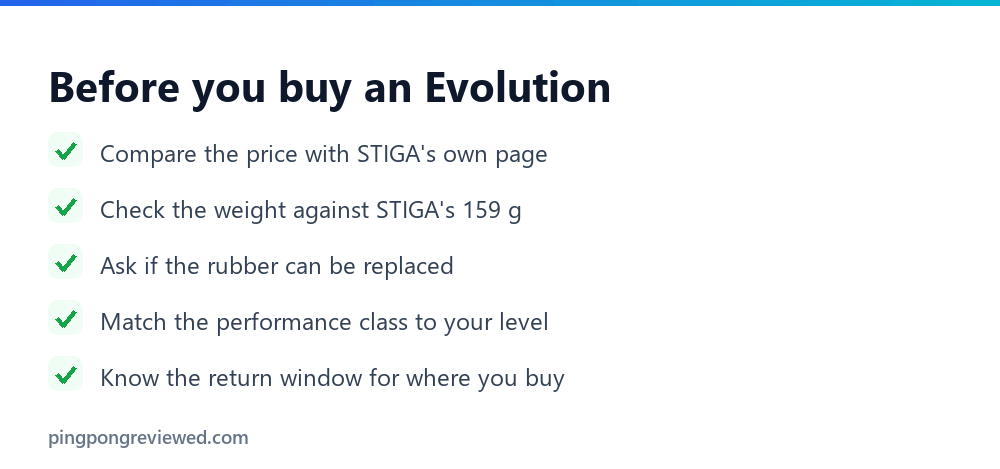
Questions to settle before you order
None of these questions needs a test. They are the gaps between what the listings say, and they are cheaper to close before you order than after.
What the Amazon listing adds, and what it repeats
Amazon’s listing for the STIGA Evolution is titled as a 6-ply light blade performance paddle, and it was sold by Amazon.com and in stock on October 1, 2026. Its bullets repeat STIGA’s own copy: Nano Composite and ACS technologies, the Shock Dispersion Tube, Crystal and WRB, a 6-ply blade of Ayous, Awan and Kiri with a 2 mm sponge, and ratings of 96, 94 and 90. Its bullets add nothing on materials or ratings that STIGA’s page lacks. Amazon’s data also lists a 90-day warranty and item dimensions that STIGA’s page does not, and Amazon shows $69.99 as the list price beside the $59.99 price.
STIGA’s page title also calls the sponge tournament-approved. We read that as the maker’s shorthand for the ITTF approved rubber it describes in the body.
If the Evolution’s class is more than you need
The Evolution is a performance racket, and it is priced like one. If you’re newer to the sport, the maker-stated beginner options we checked on October 1, 2026 cost less. These come from our beginner guide.
Those figures are a snapshot, and none of these is a recommendation based on testing. They are the maker-stated options at lower prices, listed so you can see what the Evolution’s cost buys on paper. Our beginner paddle guide has the details for each.
Price, returns and where to buy
On October 1, 2026 the Evolution was $59.99 on Amazon, sold by Amazon.com and in stock. STIGA’s own US page lists $69.99, a $10.00 difference. We don’t know why, so we don’t call it a discount. Prices move, so check before you buy.
STIGA’s US FAQ says you may return an item within 30 days of the purchase date, for a refund or an exchange of the same item, and says to submit warranty claims through its Contact Us form. See STIGA’s FAQ. That applies to STIGA’s own store, and Amazon has its own terms.
Who the STIGA Evolution is for, according to STIGA
STIGA’s US performance rackets page says performance rackets are generally designed for players who have developed their technique. See STIGA’s performance rackets page. STIGA’s own copy for the Evolution describes a tournament-level racket built for stellar performance and exceptional control. STIGA never uses the word beginner for it.
That is a statement about STIGA’s positioning, not about how the racket plays. We haven’t tested it. If you’re choosing a first paddle, our beginner guide lays out six picks by use with prices and contents, and our main paddle guide compares eight paddles by skill level.
What STIGA’s pages do not say
Looking after the racket
STIGA’s rubber guide says to clean the rubber after each use, to avoid exposing a racket to extreme temperatures for extended periods, and that a rubber generally needs replacing after about two years. See STIGA’s rubber guide. Our paddle cleaning guide covers the how-to.
How we checked this review
We read STIGA’s US product pages for the Evolution, Pro Carbon, Raptor, Carbon+ and Nitro, STIGA’s performance rackets and FAQ pages, STIGA’s rubber guide and Amazon’s product data, all on October 1, 2026. We did not play with the racket, so we don’t say how it feels. We don’t quote star ratings or review counts. Prices and stock change, so treat the numbers as a snapshot.
Frequently asked questions
How much does the STIGA Evolution cost?
On October 1, 2026 STIGA’s US site listed the Evolution at $69.99. Amazon showed it at $59.99, sold by Amazon.com and in stock. We don’t know why Amazon’s price was lower, so we don’t call it a discount.
How much does the STIGA Evolution weigh?
STIGA’s compare table lists 159 g. Amazon’s data works out to about 158.8 g, which agrees.
What does the Shock Dispersion Tube do?
STIGA says its Shock Dispersion Tube technology absorbs vibrations and transfers energy out of the handle, resulting in improved speed, control and feel. That is STIGA’s claim, and we haven’t tested it.
What are the STIGA Evolution’s ratings?
STIGA lists Speed 96, Spin 94 and Control 90. STIGA shows them as bar graphs and states no scale, so compare them with other STIGA rackets only.
Is the STIGA Evolution good for beginners?
STIGA calls it a performance racket, and its US site says performance rackets are generally designed for players who have developed their technique. STIGA’s own copy describes it as tournament-level. We haven’t tested it, so we can’t say how it plays.
Is the rubber ITTF approved?
STIGA’s page says ITTF approved rubber and that the racket is approved for tournament play. STIGA’s wording is a maker statement, and its page ties the approval to the rubber, so don’t read it as an approval of the whole racket.
Can you replace the rubber on the STIGA Evolution?
STIGA’s US pages don’t say. Don’t assume you can swap it, and ask STIGA before you buy if it matters.
What is the difference between the Evolution and the Pro Carbon?
On STIGA’s pages the Evolution is a 6-ply wood blade rated 96, 94 and 90, and the Pro Carbon is a 7-ply blade with two carbon layers rated 99, 100 and 80. Both are listed at 159 g. STIGA’s US site lists the Evolution at $69.99 and the Pro Carbon at $79.99.
What is STIGA’s return policy?
STIGA’s US FAQ says you may return an item within 30 days of purchase for a refund or an exchange of the same item. That applies to STIGA’s own store, and Amazon has its own terms.
Sources
Specs come from STIGA’s US pages for the Evolution, Pro Carbon, Raptor, Carbon+ and Nitro. Positioning comes from STIGA’s performance rackets page, returns from its FAQ and care guidance from its rubber guide. Prices and stock come from Amazon’s product data.
As an Amazon Associate, we earn from qualifying purchases through links on this page.

Ping Pong Reviewed is an equipment review site covering table tennis and baseball gear. Specifications are checked against manufacturer listings, and prices against live retail pages, before publication.