How Long Do Table Tennis Rubbers Last? The Real Numbers
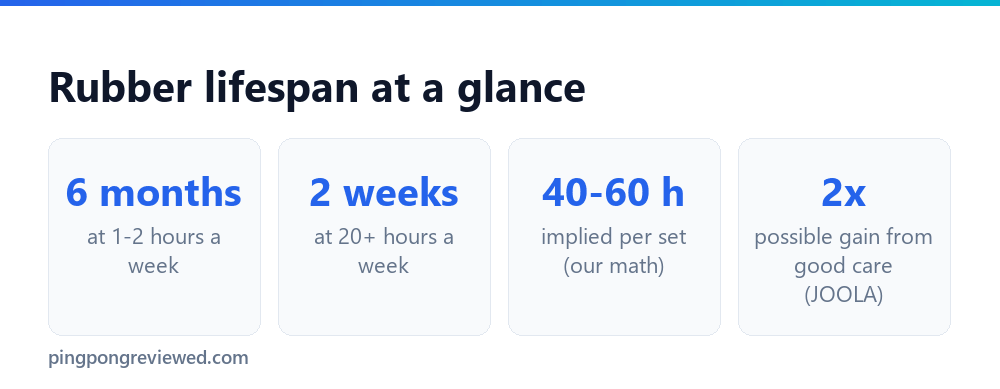
How long do table tennis rubbers last? Nobody publishes a hard number. Butterfly says the lifespan depends on play time and training intensity and gives wear signs instead of hours. The schedule most guides copy comes from a 2022 JOOLA estimate: about six months at 1 to 2 hours a week, dropping to about two weeks above 20. Working backwards from those ranges, that is roughly 40 to 60 hours of play per set. Replace a rubber when the grip fades, the surface goes whitish and the ball starts to slip.
Ask this question at any club and you’ll get a confident answer. Every six months. Every two months. Whenever it feels dead. The answers don’t agree, and that’s the first clue that nobody is quoting hard data. So how long do table tennis rubbers last, really?
So we went to the source. We read what Butterfly itself says on its care pages, then compared the two most-copied schedules: JOOLA’s 2022 estimate and Racket Insight’s 2021 guide. Then we did the part most guides skip. We turned the schedules into hours of play and into dollars, using the rubber prices from our own reviews.
One caution up front. We haven’t worn out a rubber on a table for this article, and we don’t claim to. This is a comparison of published guidance plus arithmetic, and we mark our own math as ours.
- →Butterfly gives no hours figure. It gives signs of wear.
- →The popular schedule is an estimate from JOOLA (2022): six months at 1 to 2 hours a week, two weeks at 20 or more.
- →Those ranges imply roughly 40 to 60 hours of play per set. That is our calculation, not a JOOLA claim.
- →Cost per hour runs about $1.33 to $2.00 for a $40 rubber and $2.67 to $4.00 for a $80 one, per full setup of two sheets.
- →Care can matter as much as hours. JOOLA says it can double the life of a recreational player’s rubber.
Table of Contents
How long do table tennis rubbers last? What the manufacturer says
Butterfly is the most useful source here because it makes the fewest promises. Its care page says the lifespan of a rubber depends on many factors, such as play time or the intensity of training. There’s no table and no hours figure.
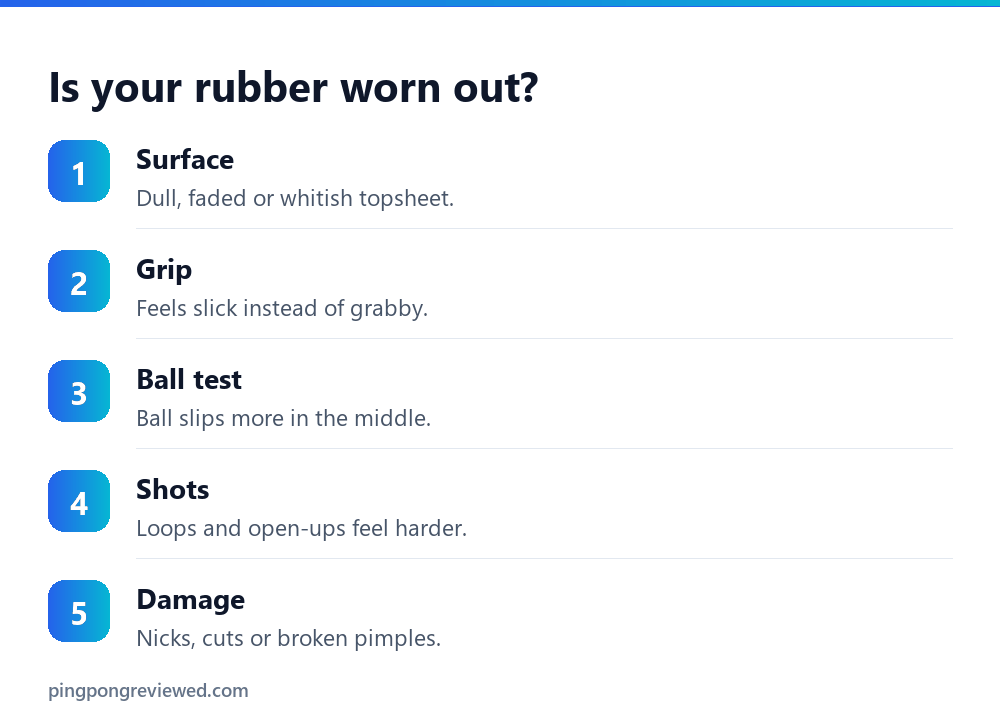
What it does give is a list of signs. For pimples-in rubber, replace it when the surface loses its grip, or when it loses its sheen and turns whitish. For pimples-out and long-pimple rubber, replace it when the pimples start to break, when the surface is discolored, or when the bounce and rotation get smaller. Butterfly also notes that a rubber left unused for a longer period can lose elasticity.
📊 Note: Butterfly says to replace a rubber regularly depending on use, and it stops there. If a guide gives you a precise number of hours and credits Butterfly, treat that with suspicion.
The estimate everyone copies
With no official figure, most guides fall back on estimates by playing time. The one we found repeated most is from JOOLA, published on October 13, 2022 by Matthew Hetherington. Here are its ranges.
Notice the gap between 12 and 15 hours. The guide doesn’t cover it, so you have to interpolate. That’s a reminder these are rules of thumb, not measurements.
The guide adds one more line worth remembering. For recreational players, it says proper care can double the potential lifespan of a rubber, because care can be a bigger factor than heavy wear and tear.
What the ranges imply in hours
Here’s the math nobody prints. Take the middle of each range and multiply it by the time the rubber is supposed to last.
The pattern is striking. Move from casual to heavy play, and the implied life settles at about 40 to 60 hours of use. In other words, the schedule is really a single hours budget spread across different weekly schedules. That’s a useful way to think about it, because it turns the vague question into a simple one: how many hours have you put on this sheet?
A second opinion: Racket Insight’s rule of thumb
Racket Insight’s guide, dated November 21, 2021, uses sessions instead of hours. Its rule of thumb is that the number of times you play per week roughly equals the number of times you change rubbers per year. So three sessions a week means three changes a year.
It also gives ranges. Recreational players playing an hour or two a few days a week can keep a rubber for up to a year. Advanced players training five days a week change about every two months. It also says paddles from sports shops tend to last around six months to a year, though wear is less noticeable on them.
Now compare. At three sessions a week, Racket Insight says three changes a year. JOOLA, for 3 to 6 hours a week, says four. Those two land in the same neighborhood, which is reassuring. But both are estimates from one author each. Neither is a lab test.
Forehand and backhand don’t wear the same
The Racket Insight author also shares personal patterns. They describe changing a forehand rubber about every four months and a backhand every eight to ten. That fits common sense. The forehand usually takes more of the aggressive, spin-heavy strokes, so it wears faster.
The same author says a DHS Hurricane 3 lasted two years for them. The guide also calls Tibhar Evolution MX-P one of the shorter-lasting rubbers, with some players switching every month or two. Treat both as anecdotes. Playing style, intensity and grade all differ. We couldn’t find any hard data comparing tacky, tensor and hybrid rubbers.
How to tell it’s time: a five-step check
Since dates are guesses, wear signs are the better guide. Here’s a simple check that combines Butterfly’s signs with the tests Racket Insight describes.
Count hours, not months
The hours math points to a habit that most players never build. Two people can own a rubber for exactly six months, and one of them has played 40 hours while the other has played 400. The calendar tells you nothing. Hours tell you a lot.
So keep a tally. After each session, note how long you played. Once a set passes roughly 40 hours, start doing the wear check above every time you pick up the racket. This is our suggestion, built on the implied range from JOOLA’s estimate. It isn’t an official rule, and your own wear signs always override it.
There’s a second benefit. A tally tells you what a rubber really cost you per hour, which makes the next purchase easier. You may find that a rubber you thought was too expensive was cheaper to play than a budget one you replaced twice as often.
What extends a rubber’s life
JOOLA’s claim that care can double a recreational player’s rubber life is worth taking seriously. The guide mentions wiping the surface with breath condensation and using a proper rubber cleaner. Our own cleaning guides cover the how and the rules. Read how to clean a paddle, check whether cleaners are legal in matches, and see our cleaner picks.
Also remember Butterfly’s point about long periods of non-use. A racket that sits in a drawer for months can lose elasticity, so a spare racket isn’t a free backup.
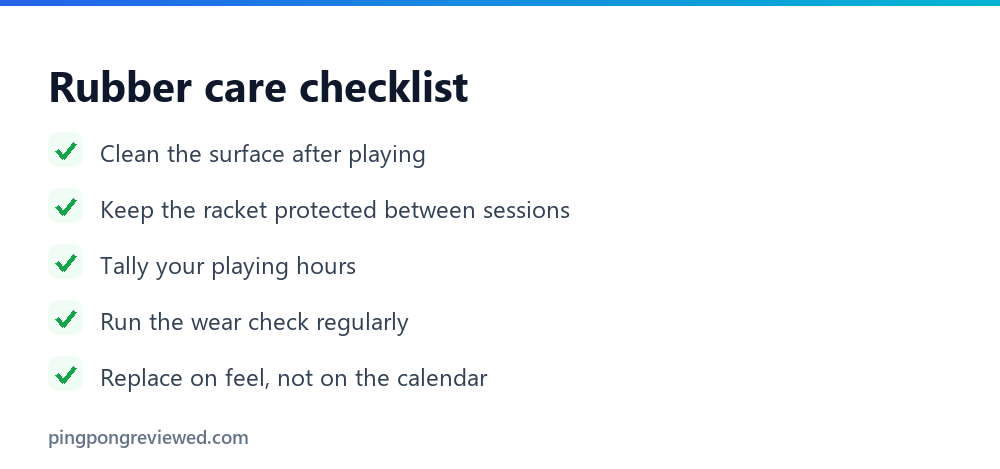
- ✓Clean the surface after playing
- ✓Keep the racket protected between sessions
- ✓Change a worn sheet before your strokes adapt to it
- ✓Judge by wear signs, not by the calendar
- ✕Assume a rubber is fine because it looks fine
- ✕Leave a racket unused for months and expect it to play like new
- ✕Trust an hours figure attributed to Butterfly
- ✕Use anything to boost the rubber. It is banned.
What each schedule costs
Here’s the part most guides skip. We used the per-sheet prices from our reviews, doubled them for a full two-sided setup, and ran them through JOOLA’s schedule. Prices change, so treat these as an illustration of the pattern.
The numbers climb fast. That’s the reason many players don’t follow the schedule for both sides. If you replace only the forehand at each interval, the bill roughly halves. It’s also why price per hour matters more than price per sheet.
So Tenergy 05 costs roughly twice as much per hour as Rozena. Whether that’s worth it depends on what you gain, and we cover that in our reviews of Tenergy 05 and Rozena. For a game with hours this short, cost per hour is a fair way to compare.
When the paddle is the consumable
If you play casually with a cheap pre-made paddle, the math flips. Racket Insight says paddles from sports shops tend to last around six months to a year. But a single-racket Palio Expert 3.0 was $39.99 when we checked on September 29, 2026. Two sheets of Rozena cost $79.98, or twice as much.
So for a beginner on a $40 paddle, replacing the whole paddle can be cheaper than re-covering it. That changes when you should move to a custom setup. Our paddle guide and replacement guide can help you decide.
Three hypothetical players, worked through
Numbers are easier to trust when you can see them applied. These three players are made up for illustration. The schedules come from JOOLA and Racket Insight, and the prices come from our reviews and our paddle guide.
Sam plays two hours a week on a pre-made paddle
Sam falls in JOOLA’s first tier, so the estimate is about six months per set. Racket Insight says paddles from sports shops tend to last around six months to a year. Re-covering with two Rozena sheets would cost $79.98 each time. A new Palio Expert 3.0 costs $39.99. Over a year, replacing the whole paddle twice costs about $80, while re-covering twice costs about $160.
For Sam, the paddle is the consumable. The better upgrade is a proper blade later, once the game justifies it.
Priya plays five hours a week with Rozena on both sides
Priya sits in the 3-to-6-hour tier, so JOOLA suggests roughly three months per set, or four sets a year. At $79.98 a setup, that’s about $320 a year if she replaces both sides each time. If her five hours are spread over three sessions, Racket Insight’s rule of thumb says three changes a year, or about $240. So her likely cost sits somewhere between $240 and $320.
If she replaces the forehand at every interval and the backhand every second interval, JOOLA’s schedule gives about $240 a year. That’s our arithmetic, and it relies on the forehand wearing faster.
Leo plays twelve hours a week with Tenergy 05 on the forehand and Rozena on the backhand
Leo sits at the top of JOOLA’s third tier, where the estimate is one to two months. Because he is at the heavy end, call it about one month. That’s roughly 12 forehand sheets a year at $79.99, or about $960. If the backhand lasts twice as long, as the Racket Insight pattern suggests, that’s about 6 Rozena sheets at $39.99, or about $240.
Add them and Leo spends about $1,200 a year on rubber. That’s a serious hobby budget, not a beginner’s one. It also explains why heavy players watch cost per hour so closely.
Common mistakes
Frequently asked questions
Is there an official number of hours a rubber lasts?
No. Butterfly says the lifespan depends on many factors such as play time and training intensity, and it gives signs of wear instead of an hours figure. The schedules you see online are estimates.
How often should a beginner change rubber?
JOOLA’s 2022 estimate for 1 to 2 hours a week is about six months, and Racket Insight says recreational players can go up to a year. Change it when the grip fades, not on a date.
Does a rubber wear out if I don’t use it?
It can lose elasticity. Butterfly notes that a rubber not used for a longer period can lose elasticity.
Should I replace both sides at the same time?
You don’t have to. Racket Insight’s author describes changing a forehand rubber about every four months and a backhand every eight to ten. The forehand usually does more of the work.
Can cleaning make a rubber last longer?
JOOLA says proper care can double a recreational player’s rubber lifespan. Cleaning and keeping the racket protected are the two habits it mentions.
What are the signs of a worn pimpled-out rubber?
Butterfly lists pimples that start to break, a discolored surface, and smaller bounce and rotation.
Is it cheaper to replace the rubber or the whole racket?
For a cheap pre-made paddle, the whole paddle can be cheaper. A single-racket Palio Expert 3.0 was $39.99 when we checked, which is half the price of two sheets of Rozena at $79.98.
Sources
Manufacturer guidance comes from Butterfly’s rubber replacement page and FAQ. The estimate table is from JOOLA (October 13, 2022), and the rule of thumb is from Racket Insight (November 21, 2021). The implied hours, annual costs and cost per hour are our own arithmetic on those ranges and on the prices in our rubber reviews.

Benjamin Fink is the Lead Equipment Analyst and Senior Contributor at Ping Pong Reviewed. A competitive USATT tournament player and table tennis technician with over 12 years of testing experience, Benjamin specializes in blade carbon composite physics, rubber sponge durometer hardness testing, ITTF equipment compliance, and table tennis robotics mechanics.