How to Play Against Anti-Spin: 5 Tactical Adjustments
Anti-spin is the one common rubber type where playing your normal game actively works against you. Every instinct built from years of playing against inverted rubber, read the stroke, expect the matching spin back, gets inverted along with the ball, which is exactly why so many players find it disorienting the first several times they face it.
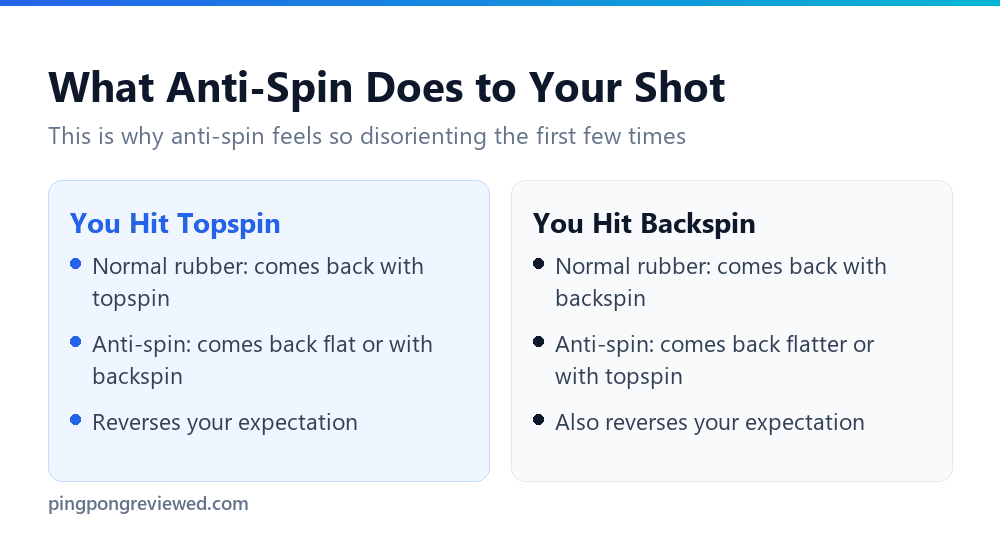
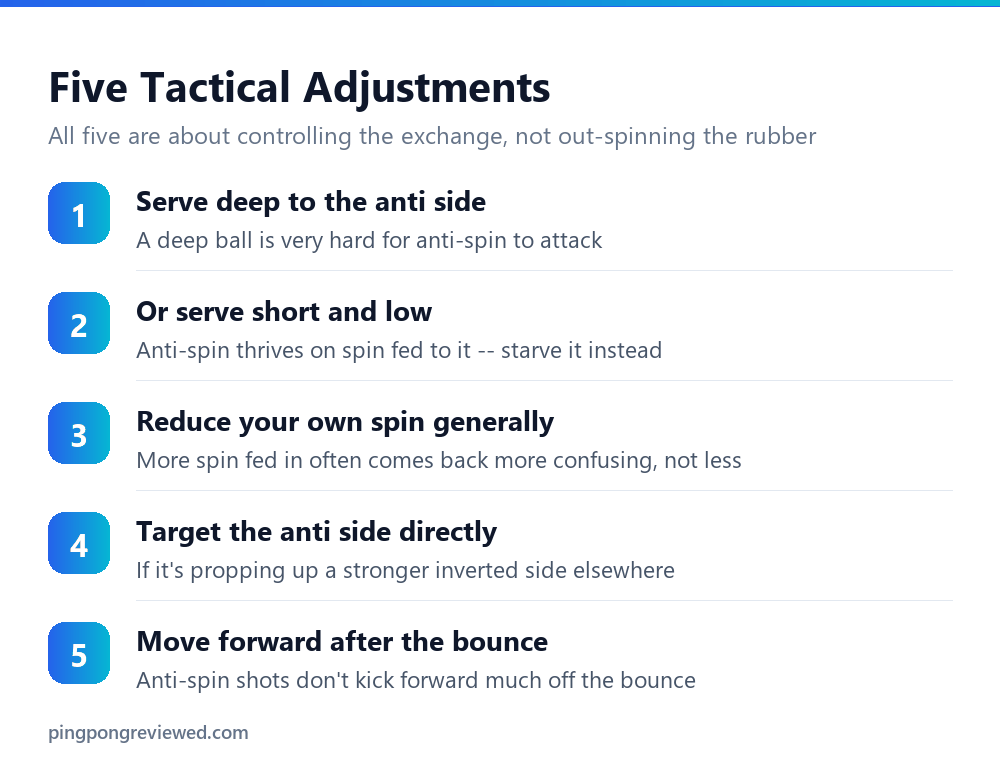
Short answer: Anti-spin rubber largely reverses the spin you feed it, topspin tends to come back flat or with backspin, and backspin tends to come back flatter or with topspin. The main tactical adjustments are serving deep (hard for anti to attack) or short and low (starving it of spin to work with), generally reducing your own spin rather than overpowering it, targeting the anti-spin side directly if it’s propping up a stronger side elsewhere, and moving forward after the bounce since anti-spin shots don’t kick forward the way topspin does. Verified against independent coaching sources on 5 September 2026.
Table of Contents
Why Anti-Spin Breaks Normal Instincts
Anti-spin rubber is smooth and deliberately very low-friction, which means it doesn’t grip the ball the way a normal inverted rubber does. That lack of grip is the entire mechanism: instead of amplifying and redirecting incoming spin the way a grippy surface does, an anti-spin surface lets the ball skid across it with minimal interaction, which tends to flatten or reverse the spin the ball comes back with relative to what was sent in.
That’s the opposite of what years of playing against normal rubber trains a player to expect, which is exactly why the first few points against anti-spin so often go badly even for otherwise strong players. The fix isn’t a single trick, it’s a set of adjustments to how the whole point gets constructed.
Serve Selection: Two Opposite Approaches That Both Work
Coaching sources converge on two serving strategies against anti-spin, and they pull in opposite directions on purpose. The first is serving deep to the anti-spin side specifically, because a deep ball is difficult for an anti surface to attack, the returning shot tends to be passive and predictable, which hands the server time to set up the next attack comfortably.
The second approach is serving short and with very little spin. Anti-spin play depends on having spin to redirect in the first place; a low-spin, short serve gives the anti surface little to work with, which can be just as disruptive as a deep serve, for the opposite reason. Either approach can work well, what doesn’t work is serving with heavy spin at a medium depth, which is exactly the ball an anti-spin surface handles most comfortably.
Play With Less Spin, Not More
The single most counterintuitive adjustment against anti-spin is reducing your own spin generally, rather than trying to beat the surface with even more of it. An anti-spin player specifically relies on incoming spin to generate their own confusing returns; feed them heavy spin and you’re supplying the raw material their whole game depends on. Feed them flat, low-spin balls instead, and they have far less to redirect, which is often the more effective adjustment even though it feels passive compared to normal play.
💡 Pro tip: If you notice your attacking shots keep coming back strangely off an anti-spin surface, don’t respond by hitting harder or spinning more. Try the opposite: flatten your own shots and see if the anti surface has less to work with.
Target Selection: Attack the Weaker Side
Many anti-spin players pair the anti rubber with a stronger inverted rubber on the other side, using the anti side defensively to set up an easier ball for their real attacking weapon. If that’s the pattern you’re facing, coaching sources recommend attacking the anti-spin side directly rather than avoiding it, forcing the player to actually use their weaker surface rather than letting them dictate which side the point gets played on.
This requires actually watching for the pattern across a few points rather than assuming it from the first rally. Not every anti-spin player is using it as a purely defensive prop; some build a balanced game around it, in which case the target-selection advice matters less than the serve and spin adjustments above.
- ✓Serve deep to the anti-spin side to limit its attacking options
- ✓Or serve short and low to starve it of spin to redirect
- ✓Flatten your own shots rather than adding more spin
- ✓Move forward after the bounce since the ball won’t kick out
- ✕Feed heavy spin expecting to overpower the surface
- ✕Assume the return will carry the spin you expect
- ✕Stand back waiting for a kick that anti-spin shots don’t produce
- ✕Ignore a pattern of the anti side setting up their stronger side
Positioning: Move Forward, Not Back
One of the more subtle adjustments is footwork rather than stroke selection. Normal topspin shots kick forward noticeably after the bounce, which trains players to stand slightly back, giving the ball room to arrive. Anti-spin shots don’t kick forward the same way, since the surface isn’t generating the same spin-driven trajectory. A player who stands at their normal depth against anti-spin often finds the ball dying shorter than expected, out of comfortable striking range.
Moving slightly forward compensates for this directly, and it’s one of the adjustments coaching sources mention most consistently as something players simply forget to do the first several times they face anti-spin, purely out of habit built from every other matchup.
⚠️ Watch out: Anti-spin rubber is legal and ITTF-approved as a rubber category, it’s a legitimate equipment choice, not a rules violation or a gimmick. Treat facing it as a tactical adjustment, not a complaint about the opponent’s gear.
Why Anti-Spin Persists Despite Being Rare
Anti-spin is a genuine minority equipment choice at every level of the sport, most players, including most advanced ones, never use it themselves. That rarity is actually part of why it’s so effective for the players who do commit to it: opponents get far less practice reading and adjusting to it than they get against normal inverted rubber, simply because they run into it so much less often. A player who has spent years developing anti-spin tactics faces opponents who are, on average, seeing the surface for one of the first times.
This is worth knowing because it reframes the difficulty: it’s not that anti-spin is objectively harder to solve than other matchups, it’s that most players simply haven’t built the specific reps against it that they’ve built against far more common rubber types. The tactics above compress a lot of that missing experience into something usable the first time you face it, rather than requiring years of exposure to work out independently.
What Anti-Spin Players Struggle With Themselves
It’s worth understanding the other side of this matchup too, since it clarifies why some of the tactics above work as well as they do. Anti-spin surfaces generally can’t generate much power or spin of their own, the same low-friction property that disrupts an opponent’s spin also limits what the anti-spin player can actively produce on offense. Most anti-spin games are built around using the surface defensively or as a change-of-pace tool alongside a stronger inverted side, not as a primary attacking weapon on its own.
That’s exactly why the deep-serve tactic works as well as it does, a deep ball demands an attacking response, and attacking is specifically what the anti-spin surface struggles to do well. Recognizing this limitation is part of what makes the serve selection advice more than just a rule of thumb; it targets a genuine, structural weakness in what the surface can accomplish.
Adjusting Mid-Match as You Learn the Specific Opponent
The tactics above are a strong starting framework, not a fixed script to run unchanged for an entire match. Individual anti-spin players vary in exactly how they use the surface, some lean almost entirely defensive, others mix in more active blocking or even occasional attacking shots off it. Paying attention during the first several points to which specific version of anti-spin play you’re actually facing lets you weight the tactics above differently rather than applying all of them with equal emphasis from the first point.
A player who’s clearly using anti purely to block and reset points rewards patience and depth more than an aggressive spin reduction strategy. A player using it more actively to disrupt and counter-attack rewards the flatter, lower-spin approach more directly. Neither observation changes the underlying five adjustments, it just changes how heavily to lean on each one.
A Worked Example
Picture a rally where you loop a heavy topspin shot to an opponent’s anti-spin side, expecting a hard-to-handle return. Instead, the ball comes back dead and flat, landing shorter than you anticipated because you were standing at your normal loop-rally depth. You’re forced to reach forward awkwardly, and the weak return you send back gets attacked easily.
Now replay the same rally with the adjustments above: a flatter shot to begin with, since heavy spin was the thing that made the anti return so confusing, and a position a half-step closer to the table to account for the ball dying short. The same anti-spin surface produces a far more manageable exchange, not because the rubber changed, but because the tactics matched what it actually does.
📊 Note: Long pimples are a related but distinct rubber category that also disrupts normal spin exchanges, often even more dramatically than anti-spin. The tactical adjustments overlap but aren’t identical, since long pimples interact with incoming spin differently than a smooth anti surface does.
The Short Version, Restated
Anti-spin rubber reverses the spin relationship most players spend years building instincts around, which is why it feels so disorienting rather than simply difficult. The fix isn’t more spin or more power, it’s serve selection, reduced spin, target awareness, and a half-step forward in positioning, all aimed at controlling the shape of the point rather than out-muscling the surface.
None of these adjustments require new strokes to learn. They’re the same shots most players already have, redeployed with a different plan behind them.
Anti-Spin Questions, Answered
Why does anti-spin rubber feel so confusing to play against?
It reverses the normal spin relationship: topspin fed into it tends to come back flat or with backspin, and backspin tends to come back flatter or with topspin, which is the opposite of what most players’ instincts expect.
Should I serve short or long against anti-spin?
Both work for different reasons. A deep serve is hard for anti-spin to attack; a short, low-spin serve starves it of spin to redirect. What doesn’t work well is a medium-depth, heavily spun serve.
Should I hit harder or spin more against anti-spin?
No. Reducing your own spin and pace is generally more effective than adding more, since anti-spin relies on incoming spin to generate its confusing returns.
Why does the ball die short against anti-spin?
Anti-spin shots don’t kick forward off the bounce the way normal topspin does, which is why moving slightly forward in positioning helps against it.
Is anti-spin rubber legal to use in competition?
Yes. It’s a legitimate, ITTF-recognized rubber category, not a rules violation, facing it calls for a tactical adjustment, not a rules complaint.
The Short Version
- →Anti-spin rubber largely reverses the spin fed into it.
- →Serve deep or short-and-low, avoiding medium-depth spin serves.
- →Reduce your own spin rather than trying to overpower the surface.
- →Target the anti-spin side directly if it’s propping up a stronger side.
- →Move slightly forward, since anti-spin shots don’t kick off the bounce.

Ping Pong Reviewed is an equipment review site covering table tennis and baseball gear. Specifications are checked against manufacturer listings, and prices against live retail pages, before publication.