Can You Lose on a Serve in Ping Pong? The Real Rules (2026)
Can you lose on a serve in ping pong? Yes, in two genuinely different ways worth telling apart: your serve can be called illegal and cost you the point directly, or your serve can be perfectly legal and you simply lose the rally that follows. One thing to settle immediately, because it is stated wrongly almost everywhere: a serve that clips the net and still lands legally in the opponent’s court is not a fault. It is a let, replayed with no penalty to anyone. Getting that distinction right is most of what separates knowing the serve rules from half-knowing them.
This confusion is common enough that it’s worth walking through carefully rather than assuming the difference is obvious. A fault ends the point instantly, in your opponent’s favor, the moment it’s called, regardless of how good your placement or spin was. A let doesn’t end anything — it’s simply a do-over, as if the serve never happened. Mixing these two up leads to real confusion during actual play, especially for newer players unsure whether to keep playing a rally after their serve grazes the net.
Table of Contents
The Two Genuinely Different Ways to Lose on Your Serve
- Your serve is called illegal (a fault) — the point goes directly to your opponent, regardless of what would have happened next.
- Your serve is legal, but you lose the rally — the opponent returns it well, or you win the point yourself; either way, serving doesn’t guarantee anything beyond starting the point fairly.
What Actually Makes a Serve Illegal
Under current ITTF rules, a legal serve has to follow all of these requirements. Missing any one of them is a fault, and the point goes to your opponent immediately.
- The ball must rest on an open, flat palm, above the table and behind the end line before you toss it.
- You must toss the ball nearly straight up, at least 16cm, without imparting spin with your fingers.
- You strike the ball as it falls, and it must bounce once on your own side before crossing to your opponent’s side.
- The ball has to stay above table level and behind the end line throughout the toss and strike.
- The ball must be visible to your opponent at all times — you can’t hide it behind your body, arm, or free hand.
Most illegal serves called in casual or club play come down to one of two things: an insufficient toss height, tossing the ball just a few inches instead of the required 16cm, or hiding the serve with the free arm or body, both far more common than people expect once they actually know to look for them.
The toss-height rule specifically gets overlooked constantly in casual and even semi-competitive play, since a low, quick toss is genuinely harder for an opponent or umpire to call out in the moment than a more obvious violation like hiding the ball behind your body. That doesn’t make it any less of a real rule, just a less consistently enforced one outside formal officiated matches. If you’re serious about playing by the actual rules rather than a loosely enforced version of them, it’s worth deliberately practicing a full 16cm toss until it becomes an automatic part of your motion rather than something you have to consciously think about mid-match.
The Let Rule Almost Everyone Gets Wrong
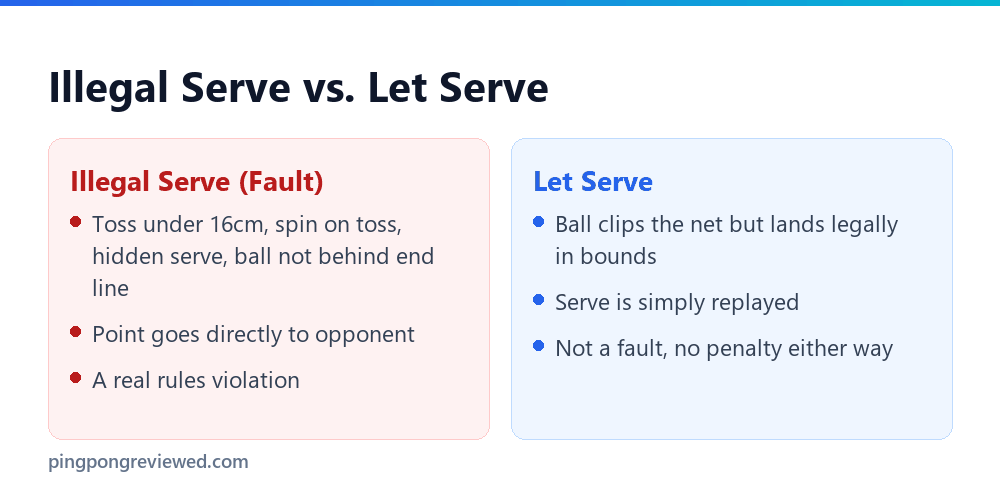
A serve that touches the net on its way over, and then still lands legally within the correct service box, is called a let. It is simply replayed with no penalty to either player — not a fault, and not a point for anyone. This is one of the most commonly misunderstood rules in the sport, and the usual error runs in one direction: people assume a net-touch makes the serve illegal. It does not. The serve only becomes a fault if it clips the net and then fails to land legally.
If the ball clips the net and then fails to land legally, goes off the side, doesn’t clear to the opponent’s side, lands short of the correct service box in doubles, that’s a different situation and is scored as a normal fault or point the same as any other failed serve, independent of the net touch itself.
There’s no limit on how many times a let can be called in a row during a single point’s serve attempts — if a player serves three consecutive let serves, all three are simply replayed with no penalty accumulating. This surprises some newer players who assume repeated lets should eventually count against the server somehow, but the rule genuinely treats each let as a clean, independent do-over regardless of how many precede it.
Can You Score Directly on Your Own Serve?
Yes — if your legal serve is fast, well-placed, or spun in a way your opponent can’t return, you win the point outright, the same as any other rally-ending shot. Serving isn’t purely defensive; a strong, well-placed serve is a genuine offensive weapon at every level of play, from casual games to professional competition.
This is part of why serve strategy gets real attention at higher levels of play, varying placement, spin type, and speed unpredictably enough that an opponent can’t settle into a rhythm reading your toss. A serve that’s legal but predictable still loses its offensive value over the course of a match, since a good opponent adapts to a repeated pattern quickly even when every individual serve is technically within the rules.
How We Verified This
The serve rules on this page — toss height, palm requirement, visibility rule and specifically the let-serve distinction — are checked against current ITTF serve regulations rather than against the summaries that circulate on rules sites, several of which state the net-touch rule incorrectly.
We’d rather a reader come away from this page knowing exactly two accurate rules than five vaguely stated ones.
Frequently Asked Questions
Can you lose on a bad serve in ping pong?
Yes — an illegal serve, meaning one that violates the toss, visibility, or positioning rules, is a fault, and the point goes straight to your opponent immediately.
Is there a let in ping pong?
Yes — a serve that clips the net but still lands legally in the correct service box is simply replayed with no penalty. This is different from a fault and doesn’t cost either player a point.
Does a ping pong serve have to go off the end of the table?
The ball has to clear the net and land legally within the correct service box on the opponent’s side, but there’s no rule requiring it to go past the end of the table beyond landing legally in bounds.
What happens if you fail a serve in table tennis?
If it’s called an illegal serve, meaning a genuine fault, the point goes directly to your opponent. If it’s just a let, the serve is simply replayed with no point awarded to anyone at all.
What is the actual serve rule in table tennis?
The ball must rest on an open palm behind the end line, be tossed at least 16cm without spin, struck as it falls, and stay visible to the opponent throughout, with a bounce on your side before crossing to theirs.
Is table tennis harder than tennis?
They demand different skills rather than one being objectively harder — table tennis rewards faster reflexes and spin reading at close range, while tennis demands more raw power and court coverage. Comparing difficulty across genuinely different sports is inherently subjective.
Can the free hand touch the table during a serve?
The rule specifically concerns keeping the ball visible and the toss legal, not a blanket ban on any body contact with the table. That said, leaning on the table during a serve is unusual and can draw scrutiny for potentially obstructing the required visibility of the toss, so most players avoid it as a habit.
Does the receiver get to call a let themselves?
In officiated matches, an umpire typically makes the let call. In casual or unofficiated play, either player commonly calls it, and the honor-system norm is to call lets honestly rather than disputing an obvious net touch that clearly still landed in.
What’s the penalty for repeated illegal serves?
Each individual illegal serve is simply a fault, costing that one point, there’s no escalating penalty for repeat violations within ITTF’s core serve rules themselves. Some tournament-level officiating may apply separate conduct penalties for deliberate, repeated rule-breaking, but that’s a different matter from the serve fault itself.
As an Amazon Associate, we earn from qualifying purchases through links on this page.

Ping Pong Reviewed is an equipment review site covering table tennis and baseball gear. Specifications are checked against manufacturer listings, and prices against live retail pages, before publication.