A Ball From Another Table Interrupts Your Rally: What’s the Rule?
A ball rolling in from a neighboring table mid-rally is a common occurrence at any busy club or tournament venue with multiple tables running simultaneously, and it’s governed by a specific rule most casual players have never had explained to them, including one procedural detail that catches people out the very first time it actually happens to them.
Short answer: When an external event beyond either player’s control, a ball from another table, an unexpected environmental disruption, interferes with a rally, it’s a let: replayed with no points scored and no change to serving order. Critically, this only applies if a player calls it immediately when it happens, it isn’t automatic or retroactive.
Table of Contents
What Counts as External Interference
The rule covers interruptions from circumstances beyond either player’s control, a ball rolling in from a neighboring table is the single most common real-world example at any venue running multiple tables simultaneously, but the rule’s actual scope is broader than just that one specific scenario. Any similarly external, unpredictable disruption that affects a player’s ability to see, track, or respond to the ball during an active rally falls under the same general provision.
The Detail That Catches People Out: You Have to Call It
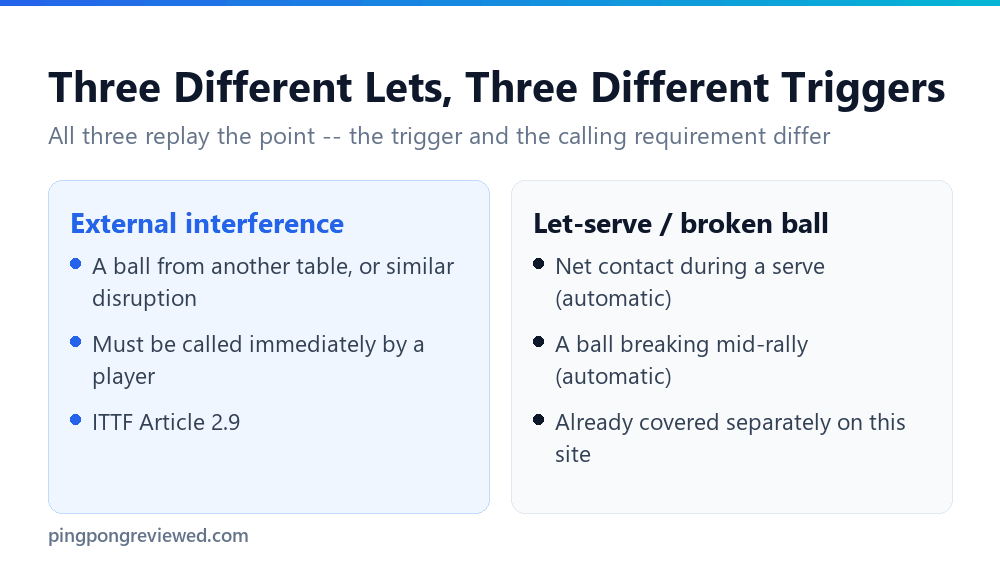
This is the single most important procedural detail, and it’s easy to miss: external interference only becomes an official let if a player calls it immediately, at the moment it happens. This is NOT automatic, and it’s NOT something that can be raised after the fact once the point has already concluded and been scored. If a stray ball rolls across the court mid-rally and neither player stops play to call a let in that moment, the point stands exactly as it was actually played, regardless of the interference.
⚠️ Watch out: If you notice a stray ball or similar external interference during a rally, call it immediately, don’t wait to see how the point plays out first. Once the point ends and is scored, it’s too late to retroactively claim a let based on interference that wasn’t called at the time.
Why the Immediate-Call Requirement Makes Sense
This procedural requirement isn’t an arbitrary technicality, it closes off a real, obvious potential for abuse. Without an immediate-call requirement, a player who lost a point could retroactively claim some minor, unverifiable external distraction affected that specific point, well after the fact, with no way for anyone to confirm or deny the claim at that point. Requiring the call to happen in the moment, while both players and any umpire can actually observe and verify the interference directly, keeps the let mechanism honest and prevents it from becoming a retroactive excuse for a lost point.
A Third Kind of Let, Distinct From the Other Two
This site has already covered two other let situations, and it’s worth being explicit that external interference is a third, separate category rather than a variation on either of them. A let-serve happens automatically when a served ball touches the net and still lands legally, no player call is needed, since the umpire or the physical outcome itself triggers it. A broken ball mid-rally is also automatically a let, again with no calling requirement, since a physically broken ball is an objectively verifiable event. External interference is the one let category that specifically REQUIRES an active call from a player, it doesn’t trigger itself.
What Happens After a Valid Let Call
Once external interference is validly called, the outcome matches how any let is handled generally: the point is replayed from the same server, with no points awarded to either player for the interrupted rally and no change to the serving order or rotation. This consistency across let types is worth knowing, regardless of which of the three let categories actually triggered the replay, the practical resumption procedure is the same.
Handling This in Casual, Multi-Table Venues
This rule matters most practically in exactly the setting where it comes up most often: a busy recreational venue or club running several tables close together, where a stray ball crossing between tables is a routine, near-daily occurrence rather than a rare event. Without a formal umpire present, both players sharing an understanding that either can call an immediate stop for genuine interference, and that doing so isn’t itself a breach of etiquette or a sign of poor sportsmanship, keeps disputes from developing over what would otherwise be a routine, unavoidable venue hazard.
💡 Pro tip: In a busy multi-table venue, agreeing with your opponent before play starts that either of you can call an immediate stop for a stray ball or similar disruption, without it being treated as gamesmanship, avoids exactly the kind of dispute that can arise when one player feels a genuine interference call was actually a delay tactic.
- ✓Call external interference immediately, the moment it actually happens
- ✓Understand this as a separate rule from let-serves and broken balls
- ✓Agree with your opponent beforehand on how you’ll handle multi-table interference
- ✓Replay from the same server with no score change once a let is validly called
- ✕Wait to see how a point plays out before deciding whether to call interference
- ✕Try to claim a let retroactively after a point has already been scored
- ✕Assume external interference triggers automatically like a broken ball does
- ✕Treat a genuine, immediate interference call as bad sportsmanship
A Difficult Judgment Call: Marginal Interference
The clearest cases, a ball rolling directly across the table mid-rally, are easy to identify and call confidently. Harder cases exist too: a ball rolling near but not directly through the playing area, a brief and minor equipment noise elsewhere in the venue, a distraction that plausibly affected play but isn’t unambiguous. There’s no precise, universal threshold the rule itself specifies for exactly how significant an interference has to be before it qualifies, this is left to the judgment of whoever is calling it, and in officiated matches, ultimately to the umpire’s discretion if the players themselves disagree about whether a specific incident actually qualified.
In casual play without an umpire to make that judgment call, the practical approach is generally to err toward accepting a borderline call in good faith rather than disputing it, since the alternative (relitigating every marginal case) causes far more disruption to the match than simply replaying an occasional point that might not have strictly needed it.
The Short Version, Restated
A stray ball or similar genuine external disruption during a rally is a let, replayed with no score change, but only if a player actually calls it immediately when it happens. Unlike a let-serve or a broken ball, which trigger automatically, this specific let category depends entirely on someone speaking up in the moment, which is exactly the detail most casual players haven’t had explained to them until they’ve been caught out by it once.
Speak up the instant it happens, extend good faith on borderline calls, and you’ll rarely see this specific rule cause any real, lasting friction even at the busiest multi-table venue running dozens of matches side by side.
Who Has the Authority to Call It
Either player, not just the one directly affected by the interference, can call an immediate stop for external interference. This matters in a scenario worth spelling out directly: if a stray ball rolls near the player who’s about to win the point comfortably regardless, that player has no obvious incentive to stop play and call a let themselves. The rule doesn’t restrict the call to only the disadvantaged player specifically because doing so would create exactly that kind of perverse incentive, both players sharing the ability to call it keeps the mechanism fair regardless of who the interference happens to favor in that specific moment.
In officiated matches, the umpire also has independent authority to stop play and call a let for external interference, independent of whether either player does so first, an additional safeguard specifically for situations where both players might be too focused on the rally itself to notice or react to the interference in time.
What Doesn’t Qualify as External Interference
It’s worth being clear about the boundary of this rule, since “external interference” could otherwise be stretched to cover almost any distraction a player experiences. The rule is specifically about circumstances beyond either player’s own control, a stray ball, an unexpected equipment failure elsewhere in the venue, similar external events. It does NOT cover ordinary in-venue noise, spectator reactions, or general environmental conditions a player simply finds distracting but which don’t constitute a genuine, objective interruption to play itself. The distinction matters because treating ordinary background distraction as grounds for a let call would make the rule far too broad and disruptive to normal match flow.
Common Questions
What happens if a ball from another table rolls into my rally?
It’s a let, the point is replayed with no score change, but only if a player calls it immediately when it happens.
Is external interference automatically a let, like a broken ball?
No, unlike a broken ball or a let-serve, external interference specifically requires an immediate call from a player to become an official let.
Can I claim a let after the point has already ended?
No, the call has to happen immediately, while the interference is actually occurring. It cannot be claimed retroactively after the point has been scored.
What’s the difference between this and a let-serve?
A let-serve (net contact during a serve) is automatic and requires no player call. External interference is a separate category that specifically does require an immediate call.
How should I handle stray balls at a busy multi-table venue?
Agree with your opponent beforehand that either player can call an immediate stop for genuine interference without it being seen as a delay tactic or poor sportsmanship.
Can the player who’s winning the point call a let too?
Yes, either player can call it, not just the one disadvantaged by the interference, which prevents a perverse incentive to stay silent when interference happens to favor you.
Does ordinary venue noise or spectator reaction count as external interference?
No, the rule covers genuine, objective interruptions like a stray ball, not general background distraction a player simply finds unhelpful.
The Short Version
The only let category in the sport that depends entirely on someone actually speaking up in the moment.
- →External interference (a stray ball, etc.) is a let if called immediately.
- →Unlike other lets, this one requires an active player call, it’s not automatic.
- →A let cannot be claimed retroactively after a point has already been scored.
- →This is a separate rule from let-serves and broken balls, both automatic.
- →A valid let replays the point with no score change and no serving-order change.
- →Agree on interference etiquette beforehand at busy, multi-table venues.

Benjamin Fink is the Lead Equipment Analyst and Senior Contributor at Ping Pong Reviewed. A competitive USATT tournament player and table tennis technician with over 12 years of testing experience, Benjamin specializes in blade carbon composite physics, rubber sponge durometer hardness testing, ITTF equipment compliance, and table tennis robotics mechanics.