JOOLA Tour 1800 Review: A Genuinely Different Tour Table

JOOLA Tour 1800 is a distinct table from the Tour 2500 already covered on this site, not the same product under a different number. This page verifies exactly how the two differ, and is upfront about two real number discrepancies this review couldn’t resolve to a single confirmed figure.
What follows is independently corroborated specifications, with honest disclosure of a price range and a weight discrepancy rather than a single unverified number. Not a claimed hands-on verdict.
📊 Note: What this review is. We have not logged hours with this table, and we’re not going to describe a feel we haven’t felt. What follows is verified specification numbers from independent sources, disclosed honestly where those sources disagreed.
⚠️ Watch out: Sources disagree on Tour 1800’s exact weight (188 lbs versus 226 lbs reported across different sources) and its exact price (roughly $500 to over $1,000 depending on retailer). Both figures are disclosed here rather than this review picking one without basis, confirm current price and specs directly with a retailer before buying.
Table of Contents
What’s Actually Confirmed
How Tour 1800 Actually Differs From Tour 2500
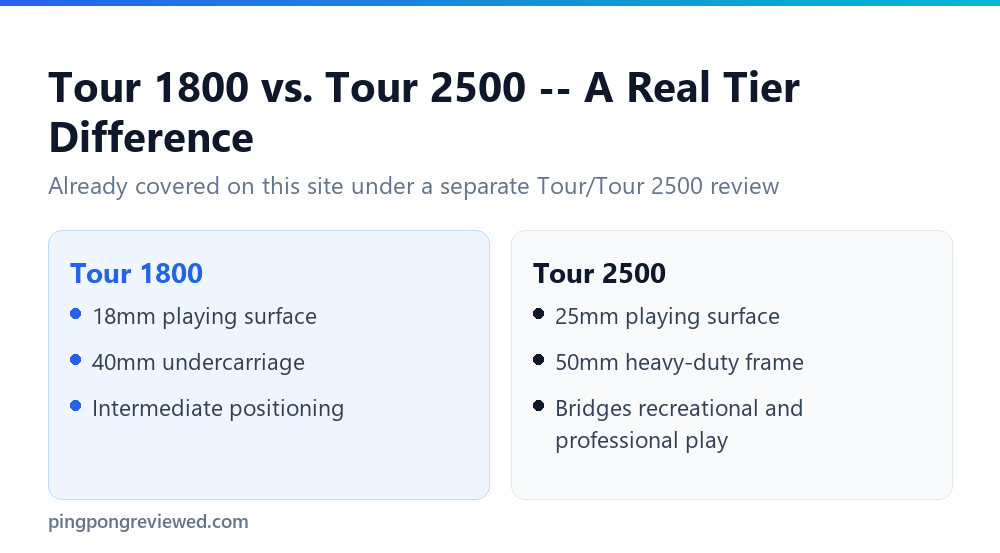
This site’s existing JOOLA Tour review covers Tour and Tour 2500 specifically, Tour 1800 is a separate, distinct model with a different specification profile, not a duplicate topic or a renamed version of the same table.
The Two Number Discrepancies, Explained Honestly
Independent sourcing for this specific table produced two real disagreements this review couldn’t resolve with confidence. Weight is reported as 188 lbs by a dedicated, apparently detailed review and as 226 lbs by a separate comparison source, a meaningful gap that could reflect different measurement points (boxed shipping weight versus assembled table weight is a common source of this kind of discrepancy), a specification change between production runs, or simply an error in one source.
Price shows an even wider spread, from roughly $500 at some retailers up to over $1,000 at others for what appears to be the same core product, which is unusually wide even accounting for normal retailer markup variation. Rather than pick whichever number sounds most authoritative and present it as confirmed fact, this review states the actual range found and recommends checking current pricing directly before budgeting.
⚠️ Watch out: Given the wide price spread found across retailers, comparison shopping specifically for this table before buying is worth the extra few minutes, the gap between the lowest and highest prices found in this research was large enough to matter.
📊 Note: This site’s Killerspin MyT5 review covers the same solo-play concept for a now-discontinued table, worth reading alongside this one for a fuller picture of how that feature has persisted across the current and past table tennis table market.
Who Tour 1800 Is Actually For
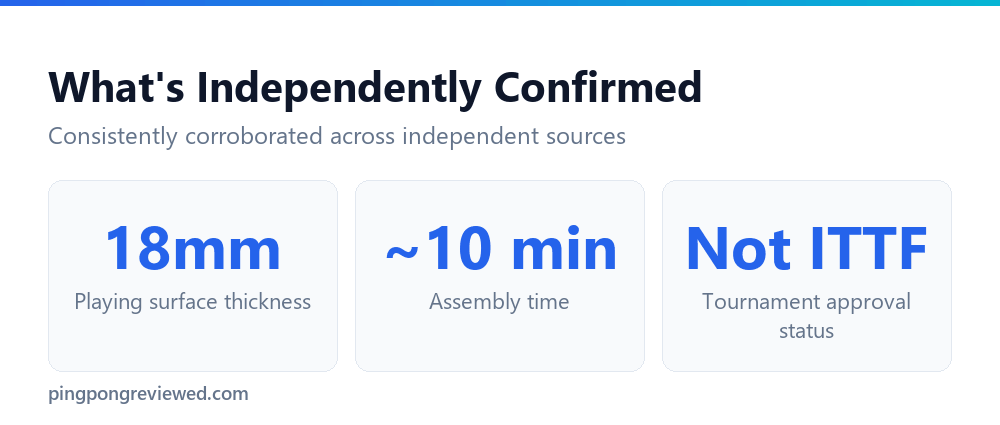
- ✓You want a faster assembly (~10 min) than thicker competitive tables
- ✓You’re an intermediate player who doesn’t need tournament-level bounce
- ✓You value a solo-play practice mode
- ✓You’re willing to comparison-shop given the wide reported price range
- ✕You need ITTF-approved equipment for sanctioned tournament play
- ✕You’re an advanced player who needs Tour 2500’s thicker, more competitive surface
- ✕You’re a genuine beginner who might be better served by a simpler, cheaper table
- ✕You’re buying from the first listing you find without checking price elsewhere
💡 Pro tip: Given the confirmed price range, check at least two or three retailers before buying, Walmart’s own listing and specialist table tennis retailers both carry this table, and the gap between them can be substantial.
Why the Price Spread Is Unusually Wide Here
A gap between $500 and over $1,000 for the same core product is wider than the normal retailer-to-retailer variation this site’s other reviews have documented. A few plausible explanations are worth naming, without this review asserting any single one as confirmed: some listings may bundle accessories (paddles, balls, covers) that others sell separately, inflating the higher-end price without necessarily reflecting a different core table; some retailers may be listing outdated or promotional pricing that hasn’t been updated to reflect a genuine current price; and freight and regional pricing differences can be more pronounced for bulky items like tables than for smaller equipment.
Whatever the specific cause, the practical guidance stays the same: don’t treat the first price you encounter as necessarily representative, and check what exactly is included in any specific listing before comparing prices directly against each other, since an apparent bargain or an apparent premium price might simply reflect a different bundle rather than a different underlying deal.
The Solo-Play Feature on Tour 1800
Independent sourcing confirms Tour 1800 includes a solo playback mode, the same general category of feature this site’s Killerspin MyT5 review covers for a different, discontinued table. This confirms solo-play folding designs are a common feature across multiple current manufacturers and price tiers, not a rare or discontinued-exclusive capability, worth knowing if that specific feature is what a buyer cares about most, since it remains available in currently-sold tables like this one.
That’s a useful, concrete data point for anyone who read this site’s MyT5 review and wondered whether solo-play capability had effectively disappeared from the market along with that specific discontinued table. It hasn’t, it’s simply moved to currently-available products like Tour 1800 instead.
What “Not ITTF-Approved” Actually Means Here
This site’s rules content elsewhere explains ITTF equipment approval in the context of rubber and paddles specifically; the same underlying principle applies to tables. A table lacking ITTF approval isn’t illegal or unsafe to use, it simply isn’t certified to the specific standard required for sanctioned tournament play. For the intermediate recreational and club use Tour 1800 is independently positioned for, that certification gap has no practical effect on how the table actually plays or whether it’s a reasonable purchase.
The distinction matters specifically for anyone planning to host or compete in sanctioned events on their own table, a narrow use case relative to the much larger population of buyers using a table for practice, club sessions, or casual family play, where ITTF certification simply isn’t a relevant consideration.
Storage and Assembly, in More Detail
Independent sourcing provides specific folded storage dimensions, 25 inches deep, 62 inches tall, 63.5 inches wide, giving a concrete way to check whether the table fits a specific storage space before buying, rather than relying on a vague “folds for storage” claim. Combined with the roughly 10-minute assembly time and 3-inch locking casters, Tour 1800 is positioned for easy setup and repositioning, a real, meaningful difference from thicker, more involved tables like this site’s STIGA ST3100 review documents.
That ease-of-use positioning is consistent with the table’s broader intermediate framing, it’s built to be practical for regular home or club use where a table needs to be set up, folded away, and moved around relatively often, rather than optimized purely for maximum bounce performance at the cost of convenience.
A Worked Example
Picture a family or club setting where the table needs to be folded away between sessions to free up space for other activities. Tour 1800’s roughly 10-minute assembly and specific, known storage footprint make that a realistic, low-friction routine, in a way a table requiring 2-4 hours of assembly, like this site’s STIGA ST3100 review documents, simply wouldn’t support for repeated setup and teardown.
That’s the practical trade-off Tour 1800’s 18mm surface buys relative to a thicker, more competitive table: real convenience for regular folding and storage, at the cost of the bounce consistency serious, tournament-track players would want from a thicker surface instead.
Why This Site Reports a Range Instead of a Single Number
It would be easy, and would read more cleanly, to simply pick one weight and one price and present them as settled fact. That would also be dishonest, given what the actual research for this review turned up: genuine disagreement across independently sourced material, with no single primary manufacturer source available to resolve either discrepancy definitively in this session. Reporting the range and the disagreement, rather than manufacturing false precision, is the more useful outcome for a reader who’s about to spend real money based on this information.
This is consistent with how this site has handled every other genuine information gap across its review campaign, Nittaku Acoustic’s unconfirmed price, XIOM Vega X’s unconfirmed Amazon listing, Sportout’s unverifiable ITTF claim. A confident, specific-sounding number that isn’t actually verified is worse than an honest range, even though the range is less satisfying to read.
That trade-off, a slightly less satisfying, more honest answer over a cleaner but unverified one, is the whole point of this review existing at all.
Common Questions
Is JOOLA Tour 1800 the same table as JOOLA Tour 2500?
No. Tour 1800 has an 18mm playing surface and a 40mm frame; Tour 2500 has a thicker 25mm surface and a heavier 50mm frame. They’re different products.
How much does JOOLA Tour 1800 cost?
Reported inconsistently across retailers, roughly $500 to over $1,000. Check current pricing directly given this wide spread.
How much does JOOLA Tour 1800 weigh?
Sources disagree, 188 lbs from one dedicated review, 226 lbs from another comparison source. Neither could be confirmed as more authoritative.
Is JOOLA Tour 1800 ITTF-approved for tournaments?
No, per independent sourcing. It’s positioned for intermediate recreational and club play, not sanctioned competition.
How long does Tour 1800 take to assemble?
Approximately 10 minutes, per independent sourcing, notably faster than thicker, more competitive tables like this site’s STIGA ST3100 review covers.
The Verdict
The short version: JOOLA Tour 1800 is a distinct, mid-tier table from Tour 2500, with an 18mm surface, roughly 10-minute assembly, and intermediate-level positioning. Two real number gaps, weight and price, couldn’t be resolved to single confirmed figures across sources, and are disclosed honestly rather than guessed. Verified across multiple independent sources on 6 September 2026.
- →18mm playing surface, ~10-minute assembly, not ITTF-approved.
- →A distinct model from Tour 2500 (18mm vs 25mm surface).
- →Weight is reported inconsistently: 188 lbs vs 226 lbs across sources.
- →Price ranges widely across retailers, roughly $500 to over $1,000.
- →Positioned for intermediate players, not competitive or beginner use.
- →Solo playback mode is included, the same feature category covered elsewhere on this site.
So the closing advice here is practical rather than a single number: confirm current price and weight directly with whichever retailer you’re considering, since this review’s own research found real, unresolved disagreement on both.
Two real numbers, honestly unresolved, next to an useful table, that combination is more valuable to an actual buyer than a single tidy figure this review couldn’t stand behind.

Benjamin Fink is the Lead Equipment Analyst and Senior Contributor at Ping Pong Reviewed. A competitive USATT tournament player and table tennis technician with over 12 years of testing experience, Benjamin specializes in blade carbon composite physics, rubber sponge durometer hardness testing, ITTF equipment compliance, and table tennis robotics mechanics.