
Truls Moregard: He Beat the World Number One at the Olympics

Truls Moregard’s run to the Paris 2024 Olympic final connects four other players covered on this site, one match at a time. He beat the world number one to get started, then beat a player who would go on to make history of his own.
Reading his profile alongside the others fills in a bracket that no single bio tells on its own.
Short answer: Truls Moregard was born on 16 February 2002 in Lessebo, Sweden, and plays a right-handed shakehand grip. At Paris 2024, he beat world number one Wang Chuqin and then Hugo Calderano before losing the final to Fan Zhendong, taking silver in singles and again in the team event. In 2025 he became the first non-Chinese player to win a WTT Grand Smash singles title, at WTT Europe Smash. He reached a career-high world ranking of number 2 in March 2026 and was ranked number 5 as of September 2026. Verified across his own match and ranking record on 4 September 2026.
Table of Contents
The Bracket That Connects Five Players

So this is worth laying out as one connected sequence, since no single profile tells the whole story. Moregard’s first notable win was over Wang Chuqin, the reigning world number one.
That match is the same one covered on this site’s Wang Chuqin profile: a photographer broke Wang Chuqin’s racket before the match, and Wang Chuqin went on to lose it, exiting the tournament early. Moregard was the opponent on the other side of the net.
So the same tournament that gave Moregard his silver medal also produced the exact chain of results behind three other profiles on this site. Beating Calderano in the semifinal sent Calderano into the bronze medal match, where he lost to Felix Lebrun, also covered here.
📊 Note: Reading the Wang Chuqin, Hugo Calderano, and Felix Lebrun profiles on this site alongside this one fills in the full picture of a single Olympic bracket from four different angles.
His Own Record
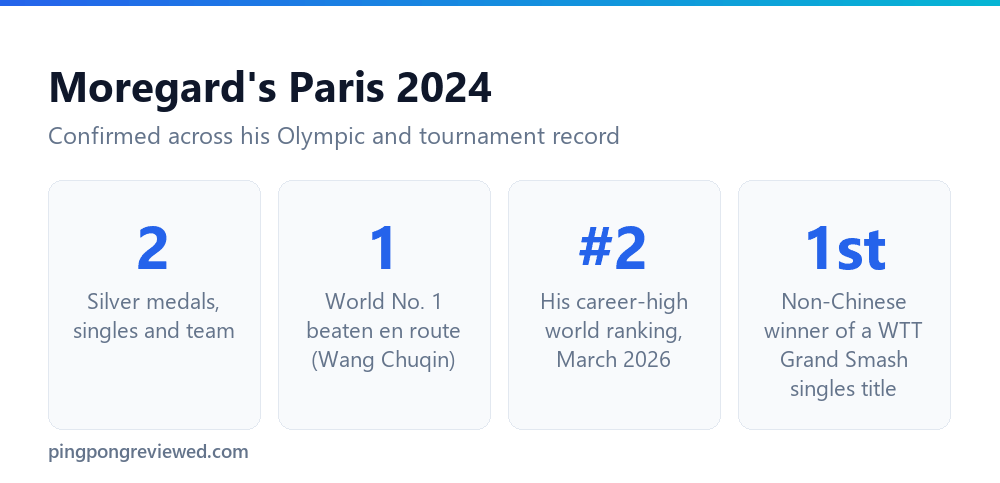
The 2025 WTT Europe Smash win carries specific historical weight. WTT Grand Smash events, the sport’s biggest tier outside the Olympics and World Championships, had been swept by Chinese players until Moregard broke that run.
The Waldner Comparison
So Moregard is frequently compared to Jan-Ove Waldner, the Swedish player also profiled on this site, specifically for his unconventional backhand technique and willingness to play shots that depart from standard textbook technique.
That comparison carries real weight in Swedish table tennis specifically, since Waldner remains the standard against which Swedish players get measured. A silver medalist at both an Olympics and a World Championships is a legitimate case for that comparison, not just a media narrative attached to any promising young Swede.
💡 Pro tip: Watching for unconventional backhand angles and shot selection is the specific technical detail behind the Waldner comparison, not just a vague sense of similar success.
Equipment
Moregard plays a Stiga Cybershape Carbon CWT Truls Edition blade, his own signature model, with Stiga DNA Platinum XH rubber on both forehand and backhand, a matched setup rather than a split one.
The Win Over Wang Chuqin, in Detail
So the Wang Chuqin match deserves more than a passing mention, since beating a reigning world number one at the Olympics is a rare result on its own, independent of the racket-breaking incident that preceded it.
The scoreline, 12-10, 11-7, 5-11, 7-11, 11-9, 11-6, went to six games. Moregard didn’t win comfortably or via an obvious upset margin; he won a close, competitive match against the best-ranked player in the sport at the time.
So whatever role the equipment disruption played, and this site’s own Wang Chuqin profile is careful not to overstate that connection, the final scoreline was a close, real contest rather than a walkover against a compromised opponent.
⚠️ Watch out: It’s tempting to read Wang Chuqin’s loss as purely a consequence of the broken racket. The six-game scoreline argues against that being the whole story: Moregard was competitive throughout, not just benefiting from a one-sided disruption.
From Junior Prospect to Two Silver Medals
So Moregard’s path to Paris 2024 wasn’t sudden. He’d already won a World Championships singles silver in 2021 and a World Team Championships bronze in 2018, well before his Olympic breakthrough.
Two Swedish Championships titles, in 2019 and 2021, mark him as the dominant domestic player in Sweden across that same stretch. So the Paris 2024 run was the continuation of an already-established trajectory, not an unexpected leap from nowhere.
The 2023 European Championships team gold added a continental title to the resume the year before his Olympic silver, rounding out a rise that looks, in hindsight, like a consistent upward climb rather than a single breakout tournament.
What the WTT Europe Smash Win Actually Broke
So the significance of the 2025 WTT Europe Smash win is worth explaining structurally, not just noting as a first. WTT Grand Smash events sit at the top tier of the WTT tour system, below only the Olympics and World Championships in prestige.
Chinese players’ depth at the top of men’s and women’s singles has meant these events, in practice, functioned close to a Chinese-only winners’ circle at the singles level. A non-Chinese winner breaking that pattern is a structural result, not just an individual highlight reel moment.
📊 Note: This context matters for judging how significant the win actually was. Beating the field at a Grand Smash is impressive on its own. Being the first non-Chinese player to do it adds a second, separate layer of significance.
2025: The WTT Finals Runner-Up Result
So the WTT Finals runner-up finish the same year rounds out a 2025 season that was, on balance, his strongest since the Paris Olympics: a Grand Smash title, a WTT Champions title in Montpellier, and a WTT Finals final appearance.
Losing that final still meant beating the field to get there in the first place, against a WTT Finals draw that typically includes only the season’s top-performing players. So even the runner-up finish reflects a season of sustained, not sporadic, top-level results.
Taken together, three finals or title matches at the sport’s top tiers in a single calendar year, a Grand Smash, a Champions event, and the season-ending Finals, is a workload most players never reach even once in a career, let alone across one season.
Sweden’s Table Tennis Lineage
So Moregard’s rise matters specifically inside Swedish table tennis history, a country with a strong past in the sport that had faded at the very top level for years before his breakthrough.
Jan-Ove Waldner’s era defined Swedish table tennis at its peak, producing multiple World Championship and Olympic-level results through the 1990s. The gap between that era and a Swedish player reaching an Olympic singles final again is the specific context that makes Moregard’s Paris 2024 silver land as more than an individual achievement.
So a new Swedish player reaching that level again, and doing it with a similarly unconventional, hard-to-categorize style, is exactly the kind of continuity that makes the Waldner comparison stick rather than fade as empty hype.
💡 Pro tip: For the fuller picture of what that comparison is actually measured against, this site’s Jan-Ove Waldner profile covers the era and the specific results Moregard is now being compared to.
A Career Still Being Written
So at 24 in 2026, with a career-high ranking of number 2 already reached, Moregard’s Paris 2024 silver reads as a marker on an ongoing rise rather than a peak already passed.
The specific gap left on his record, an Olympic or World Championships singles gold rather than silver, is the same kind of checkable, nameable target that shows up across several of the other profiles on this site. Unlike some of them, his has already come within one match of closing, twice.
So the next major final he reaches is the one worth watching most closely, since the results so far show a player who reliably gets to the final match, not one who simply hasn’t broken through yet.
That reliability, showing up in the biggest matches again and again rather than producing one isolated highlight, is usually the more telling signal of a player’s real level than any single result taken on its own, gold medal or otherwise.
Two silver medals at the sport’s two biggest individual events, reached before turning 23, is a foundation most careers never match. What happens with the years still ahead of him is the open question this profile will keep tracking, alongside the connected profiles of everyone he beat and lost to along the way through that single, historic Paris bracket.
So read as one connected story rather than four separate biographies, that single tournament bracket, Wang Chuqin, Moregard, Calderano, and Felix Lebrun, says more about the current state of men’s table tennis than any one player’s page could say alone.
Four players, four different countries, one bracket. That’s as good a snapshot of how globally competitive the men’s game has become as any single result in the sport right now, and it’s worth remembering the next time any one of their names comes up on its own.
Truls Moregard Questions, Answered
Did Truls Moregard beat Wang Chuqin at the Olympics?
Yes, at Paris 2024, in the same match where Wang Chuqin’s racket was broken by a photographer beforehand. Moregard won and advanced further in the tournament.
What was Truls Moregard’s result at Paris 2024?
Silver medal in both singles and the team event. He lost the singles final to Fan Zhendong after beating Wang Chuqin and Hugo Calderano earlier in the tournament.
Is Truls Moregard the first non-Chinese WTT Grand Smash champion?
Yes, winning the 2025 WTT Europe Smash singles title, breaking a run of Chinese wins at that event tier.
What is Truls Moregard’s world ranking?
He reached a career-high of world number 2 in March 2026 and was ranked world number 5 as of September 2026.
Why is Truls Moregard compared to Jan-Ove Waldner?
Both are Swedish players known for unconventional, non-textbook backhand technique. Waldner remains the benchmark for Swedish table tennis, and Moregard’s Olympic and World Championship silver medals make the comparison a serious one rather than just hype.
What equipment does Truls Moregard use?
A Stiga Cybershape Carbon CWT Truls Edition blade, his own signature model, with Stiga DNA Platinum XH rubber on both wings.
The Short Version
- →Born 16 February 2002 in Lessebo, Sweden; right-handed shakehand grip.
- →Beat world number one Wang Chuqin, then Hugo Calderano, en route to the Paris 2024 final.
- →Won silver in both singles and team at Paris 2024, losing the singles final to Fan Zhendong.
- →First non-Chinese player to win a WTT Grand Smash singles title, 2025 WTT Europe Smash.
- →Reached a career-high world ranking of number 2 in March 2026.
- →Frequently compared to Swedish legend Jan-Ove Waldner for his unconventional style.

Ping Pong Reviewed is an equipment review site covering table tennis and baseball gear. Specifications are checked against manufacturer listings, and prices against live retail pages, before publication.