How to Clean a Ping Pong Paddle (And Why Your Spin Really Disappeared)
Quick Answer: Wipe the rubber after every session — breath and a clean palm is enough. Once a week, use a barely damp sponge with water, wiping in one direction only. Monthly, use a proper table tennis rubber cleaner. Never use household cleaners, washing-up liquid or alcohol. Air dry 30–60 seconds, then case it.
If your loops have started slipping and your spin has quietly vanished, your rubber probably isn’t worn out. It’s dirty — and the difference matters, because one costs $60 to fix and the other costs ninety seconds.
Dust, sweat and skin oil build an invisible film on the topsheet. You can’t see it. You can absolutely feel its absence once it’s gone.
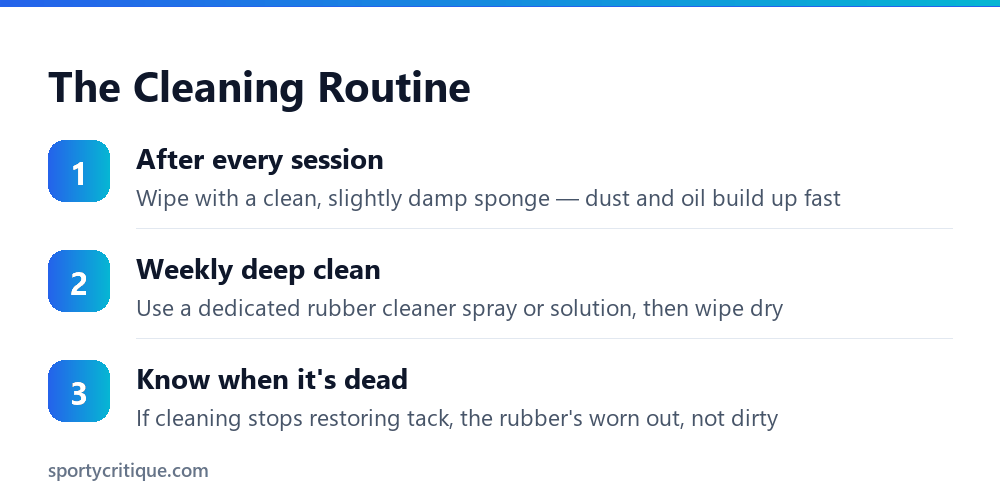
Table of Contents
Why a dirty rubber stops working
Understanding this makes the whole routine make sense, and it takes one paragraph.
Spin in table tennis is friction. That’s the entire mechanism — your rubber’s topsheet grips the ball for a few milliseconds, holds it while the racket keeps moving, and flings it off rotating. Every bit of spin you generate comes from that grip. The loop is nothing but a stroke designed to maximise it.
Now coat that topsheet in a microscopic layer of dust and skin oil. The ball no longer touches rubber — it touches film. It slides instead of gripping, and your brushing stroke produces a slow, spinless ball that goes exactly nowhere. You haven’t lost technique. You’ve lost contact.
This is why the effect is so disproportionate to the cause. A film you cannot see costs you the single physical property your whole attacking game depends on. And because it accumulates gradually, you never notice a day when it happened — you just slowly conclude your rubber is old, or your form has gone.
The routine, by frequency
| When | What | Takes |
|---|---|---|
| After every session | Breathe on the rubber, wipe with a clean palm or lint-free cloth | 10 seconds |
| Weekly (or every 3–4 sessions) | Barely damp sponge with plain water, one direction, air dry flat | 60 seconds |
| Monthly | Dedicated table tennis rubber cleaner + soft sponge | 90 seconds |
| Every session, always | Case it. Room temperature. Away from sun | 5 seconds |
The weekly clean, done properly
- Dampen the sponge — barely. If you can squeeze water out of it, it’s far too wet. Water soaking into the sponge layer beneath the topsheet is a genuine problem, and it’s the most common way people damage a rubber while trying to help it.
- Wipe in ONE direction. Not circles, not back and forth. Repeated multi-directional scrubbing stretches the topsheet, and a stretched topsheet never fully recovers.
- Barely any pressure. You’re lifting a film, not scouring a pan. Guide the sponge across; let it do the work.
- Air dry flat for 30–60 seconds before casing. Sealing a damp rubber into a case is how you get a rubber that smells and degrades.
💡 Clean your cleaning sponge, too. It picks up everything it removes and then you rub that back on. Rinse it in warm water only — no soap, no detergent, ever, because whatever’s in it goes onto your rubber next time. Squeeze gently, let it dry. Nobody does this and everyone should.
Your rubber type changes the routine
Here’s what the generic guides miss entirely: tacky and tensor rubbers have different cleaning needs, because they’re generating spin by different mechanisms.
| Tacky (Chinese — DHS Hurricane, Palio) | Tensor (Butterfly, Xiom, Tibhar, Donic) | |
|---|---|---|
| Spin comes from | The sticky topsheet gripping the ball | The sponge’s catapult |
| Attracts dust | Constantly — stickiness is a dust magnet | Normally |
| Cleaning frequency | After every session, seriously | Weekly is fine |
| When dirty | Catastrophic — the tack is the whole product | Noticeable but tolerable |
| Restoring tack | Cleaning genuinely restores it — dramatically | Nothing to restore |
| Protective film | Strongly recommended — preserves tack between sessions | Optional |
If you play with tacky Chinese rubber and you’re not cleaning it after every single session, you’re playing with a fraction of the rubber you bought. The stickiness that makes Hurricane devastating is also what makes it grab every particle of dust in the hall — it’s a self-defeating property and the only answer is discipline. (The full tacky-vs-tensor picture is in our brands guide.)
Tensor players get an easier life. Your spin comes mostly from the sponge underneath, which dust can’t reach, so a dirty topsheet costs you touch and short-game feel rather than your entire attacking game. Weekly is genuinely fine.
What never touches your rubber
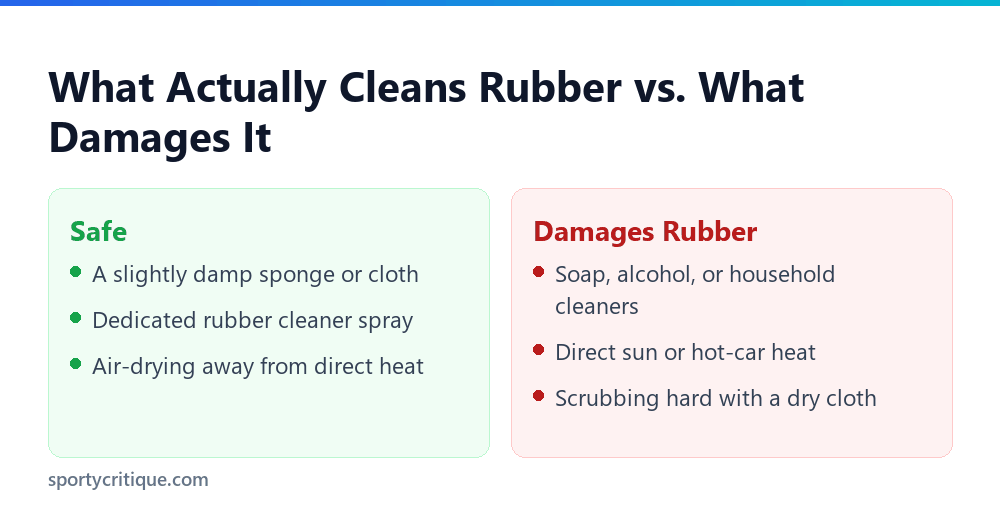
⚠️ No household cleaners. No washing-up liquid. No alcohol. No solvents. These break down the rubber compound itself — not the dirt on it, the product you paid for. They’ll clean it beautifully once and shorten its life by months. This is the single most common way people destroy a rubber with good intentions.
| Never | Why |
|---|---|
| Alcohol / solvents | Dries the topsheet, crazes the surface, kills tack permanently |
| Washing-up liquid | Leaves residue that attracts more dirt than it removed |
| Paper towels | Mildly abrasive and they shed lint into the surface |
| Lots of water | Soaks into the sponge layer — swollen sponge is unfixable |
| Direct sunlight for drying | UV ages rubber faster than a year of play |
| Hard scrubbing | Stretches the topsheet; it doesn’t spring back |
| Water on the blade edge | Swollen wood and lifting glue |
Storage: where rubbers actually die
More rubber lifespan is lost in bags and car boots than on tables. This is worth internalising, because it’s the cheapest performance you’ll ever buy.
Always case it. A paddle loose in a bag with balls, a water bottle and a towel is being sanded down between sessions. A basic case costs less than a single rubber sheet.
Room temperature, always. Not the car boot in summer, not the garage in winter, not a windowsill. Heat accelerates the chemical aging of both rubber and the glue holding it on. A racket that lives in a hot car ages months in weeks — and you’ll blame the rubber.
Away from humidity. Damp gets into the sponge and the blade, and neither recovers well.
Protective films: the honest verdict
The adhesive sheets you stick onto the rubber between sessions genuinely work — they keep dust and air off the topsheet, and for tacky rubber they’re close to essential, because preserving tack between sessions is most of the battle.
For tensor rubber the case is weaker but real: they slow oxidation of the topsheet a little and stop your rubber collecting whatever’s in your bag. They cost a few dollars and last months. The one caveat: peel them off gently and replace them when the adhesive goes gummy, because a film that’s fighting you on removal is worse than no film.
When cleaning won’t help: knowing a dead rubber
Rubber is a consumable, and eventually cleaning stops being the answer. The signs it’s genuinely finished:
- It stays slick after a proper clean. If a fresh clean doesn’t restore grip, the topsheet is worn — that’s not dirt, that’s the surface itself.
- The sponge feels dead. No catapult, no spring. The ball thuds rather than jumps.
- A matte patch where your forehand contacts. That’s several thousand brushing strokes’ worth of wear and it doesn’t come back.
- Edges lifting or the topsheet visibly separating from the sponge.
Rough lifespans: casual players 1–2 years, club players 6–12 months, serious trainers 2–3 months. Professionals change rubbers weekly or more — for them it’s a consumable in the same category as tennis strings, which is part of why elite equipment costs what it does (see our expensive paddles breakdown).
When it’s time, our rubber guide covers replacements by playing style. And if you’re on a $15 pre-made paddle, replacing the rubber costs more than the paddle is worth — upgrade the whole thing instead via our paddle roundup.
The cleaning myths that circulate
Table tennis forums have been arguing about rubber care for twenty years, and several bad ideas have achieved folk-wisdom status. Worth naming them.
‘Spit works fine.’ Breath and a palm wipe is a legitimate between-points habit — the moisture in your breath lifts loose dust and it’s what you’ll see professionals do at the table. Actual saliva is a different thing: it’s got enzymes and sugars in it, and it leaves a residue that attracts more dust than it removed. Breathe on it; don’t spit on it.
‘Baby wipes are cheap rubber cleaner.’ They aren’t. They contain surfactants, fragrances and often alcohol — three things you specifically don’t want on a topsheet. They’ll clean the rubber visibly and degrade it invisibly. A dedicated cleaner costs about the same per use.
‘Cleaning too often wears the rubber out.’ Backwards. Gentle, correct cleaning removes the abrasive dust that grinds the topsheet with every shot. The rubber that gets wiped after each session lasts longer, not shorter. What wears rubber out is scrubbing hard, using solvents, and playing on grit.
‘You need the expensive branded cleaner.’ Plain water on a barely damp sponge does 80% of the job, and it’s what most club players should use weekly. The dedicated cleaner earns its monthly pass by lifting oil that water leaves behind — but if the choice is between an expensive cleaner you never buy and water you have right now, use the water.
‘A dirty rubber just needs more effort in the stroke.’ This is the one that costs people months. You cannot out-swing a friction problem — if the surface isn’t gripping, a harder swing produces a faster spinless ball. Players who believe this end up rebuilding a technique that was never broken.
Don’t forget the blade
The wooden part needs almost nothing, which is why people give it nothing and then wonder why the handle is grimy and the edges are chipped.
Wipe the handle occasionally with a barely damp cloth — hand oil builds up and a slick handle makes you grip harder, which costs you touch. Keep water off the edges, where it soaks into the plies. Edge tape is worth the three dollars: it protects the blade from the inevitable table-edge collision, and a chipped blade edge is where delamination starts.
If you ever change rubbers yourself, a sealed blade survives the peel far better than a bare one — that’s a separate job covered properly in our blade sealing guide.
Frequently asked questions
How often should I clean my ping pong paddle?
A quick wipe after every session; a proper water clean weekly; a dedicated cleaner monthly. If you play tacky Chinese rubber, make the proper clean an after-every-session habit — the tack depends on it.
Can I use water to clean table tennis rubber?
Yes — a barely damp sponge, wiped in one direction. Water is the standard weekly method. What you can’t do is soak it; water in the sponge layer is a real problem.
Can I use soap or washing-up liquid?
No. It leaves residue that attracts dirt, and detergents break down the rubber compound over time. Water or a dedicated table tennis cleaner, nothing else.
Do rubber cleaners actually work?
Yes — they lift the oil that plain water leaves behind, which is why they’re worth a monthly pass even if water is your weekly routine. Foam cleaners with a soft sponge are the safest combination.
Why has my rubber lost its grip?
Clean it first. If it’s still slick afterward, the topsheet is worn and it’s replacement time — but the majority of ‘my rubber died’ cases are film, not wear.
Are protective films worth it?
For tacky rubber, close to essential. For tensor, a cheap and mild benefit. Either way, replace them when the adhesive goes gummy.
Does cleaning restore tack on Chinese rubber?
Dramatically, yes — often to the point where players think they’ve been given a new sheet. That’s how much tack a dust film costs you.
Should I clean both sides equally?
Yes, though your forehand side will always need it more — it takes the majority of your brushing contacts and lives closer to the table. If you play pips or anti-spin on the backhand, be gentler still: those surfaces are more fragile and the dirt sits in the pips rather than on a flat sheet, so a light touch and patience beat pressure.
Can I clean a paddle that has never been cleaned?
Absolutely, and the result is often startling — a rubber that’s been quietly accumulating film for a year can regain a genuine amount of grip from one careful clean. It won’t reverse actual wear, and if the topsheet is worn smooth nothing will. But before you write off a rubber that ‘died’, give it one proper clean. It’s ninety seconds and it’s free.

Ping Pong Reviewed is an equipment review site covering table tennis and baseball gear. Specifications are checked against manufacturer listings, and prices against live retail pages, before publication.