
History of Table Tennis: From Cigar-Box Lids to Gold
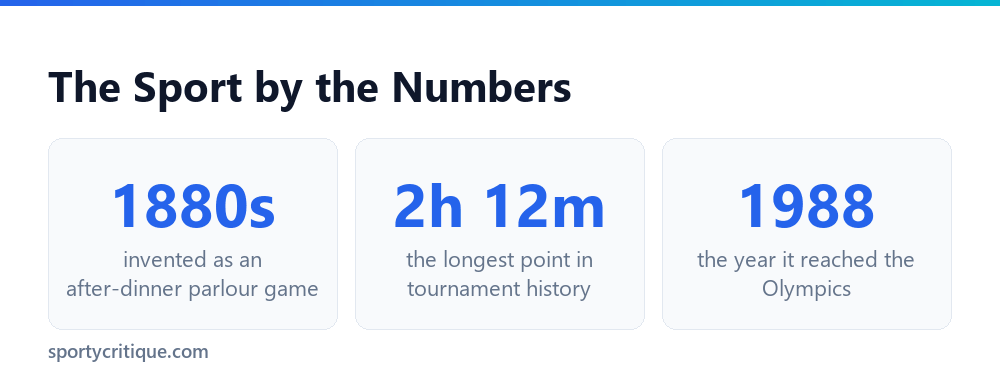
Quick Answer: Table tennis began in 1880s England as an after-dinner parlour game played with books for a net and cigar-box lids for paddles. ‘Ping-Pong’ was trademarked in 1901, the ITTF formed in 1926, sponge rubber transformed the sport in 1952, and it reached the Olympics in 1988. Along the way it helped thaw the Cold War.
Few Olympic sports began as a joke at a dinner party. This one did — and the century between the joke and the Olympic podium contains a two-hour single point, a trademark dispute that renamed the entire sport, a piece of sponge that made everything before it obsolete, and a diplomatic incident that helped reopen China to the West.
Table of Contents

The point that lasted two hours and twelve minutes
Start here, because it explains more about table tennis’s early identity than any date.
At the 1936 World Championships in Prague, Poland’s Alex Ehrlich faced Romania’s Paneth Farcas. Ehrlich was known as the King of the Chiselers — a defensive specialist who simply refused to attack, waiting for the opponent’s patience to break first. Farcas had the same idea.
The opening point lasted two hours and twelve minutes. The ball crossed the net more than 12,000 times. After 70 minutes, Ehrlich switched his bat to his left hand to rest his arm — mid-point. After 85 minutes the umpire had to be replaced, because his neck had seized up from watching the ball go back and forth.
This was the sport in the hard-bat era: a war of attrition where equipment couldn’t generate enough spin to end a rally, so the only strategy was to outlast your opponent’s sanity. Something had to change — and the ITTF’s answer, the expedite rule (which hands the point to the receiver after 13 consecutive returns), still exists in the rulebook today. You’ll find it in our rules guide, a fossil of the day two men nearly played a single point into the next morning.
1880s: the parlour era
Lawn tennis exploded across Victorian England in the 1870s, and — as with everything the English enjoyed outdoors — someone immediately tried to do it indoors. Upper-class dinner parties improvised: a row of books down the middle of the dining table for a net, cigar-box lids or rounded rackets for bats, and a ball made of rounded champagne corks or India rubber.
It was genuinely a novelty, sold under a small avalanche of onomatopoeic names. Gossima. Whiff-Waff. Flim-Flam. Manufacturers were selling boxed sets by the 1890s, and none of the names stuck — because the game had a fundamental problem. Cork balls were unpredictable and rubber balls were too lively. There was no ball worth building a sport around.
1901: the year everything was decided
Two things happened in 1901 that shaped the next 125 years.
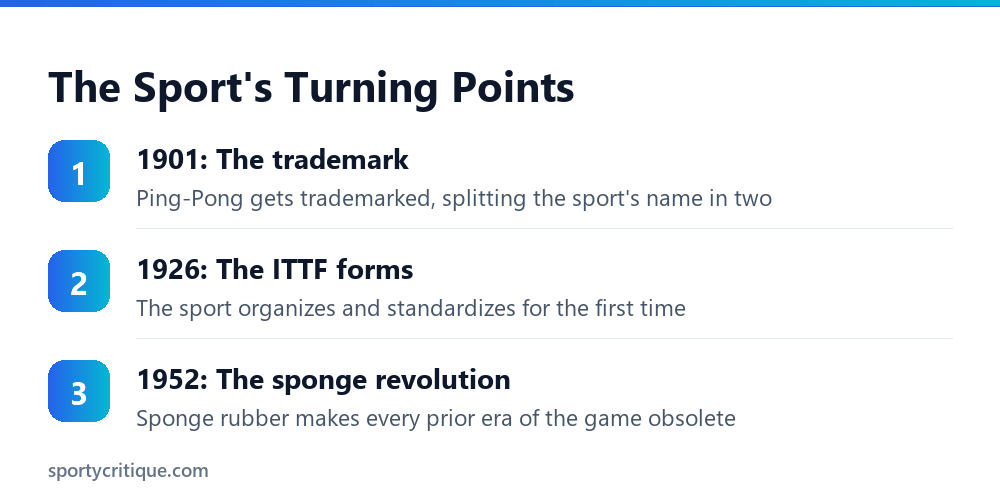
First, the English games manufacturer J. Jaques & Son trademarked the name ‘Ping-Pong’ — an imitation of the sound the ball made — and licensed it to Parker Brothers in the United States. The name was catchy, it spread instantly, and it was owned. That single commercial fact is why the sport is officially called table tennis today: when players and clubs began organising, they couldn’t legally use the popular name, so they standardised on the generic one. (The full naming saga, including where the two words still mean different things, is in our table tennis vs ping pong guide.)
Second — and more importantly for the game itself — the English enthusiast James Gibb brought back celluloid balls from a trip to America. They were light, they bounced true, and they were cheap. The sport suddenly had a projectile worth designing rules around, and the modern game’s DNA was set. Those celluloid balls, remarkably, would survive for 113 years.
1926: the sport organises
The International Table Tennis Federation formed in 1926, and held its first World Championships in London that same year — 62 years before the sport would reach the Olympics.
The interwar decades belonged to Central Europe, and to Hungary above all, whose players collected world titles by the armful. This was the hard-bat era: pimpled rubber over bare wood, very little spin, and — as Ehrlich and Farcas demonstrated — an inherent bias toward defence. The rules were still being invented in response to problems nobody had anticipated. Net heights changed. Time limits arrived. The sport was figuring out what it wanted to be.
1952: the sponge revolution
Then came the single most disruptive moment in the sport’s history, and it arrived unannounced in the hands of a Japanese player nobody had heard of.
At the 1952 World Championships, Hiroji Satoh showed up with a paddle backed with a thick layer of sponge. Nobody had seen anything like it. The sponge held the ball on the racket for a fraction longer — dwell time — and that fraction was everything: it let a player brush the ball rather than strike it, generating spin at levels the hard bat physically could not produce.
Satoh won the championship. And within a decade, the sport reorganised itself around what sponge made possible: the loop, a brushing topspin attack developed by Japanese players through the late 1950s and 60s. The chiseling defensive game that had dominated for thirty years became a specialist curiosity almost overnight. The whole of modern table tennis — the arcs, the kick off the bounce, the 100-plus revolutions per second — descends from that piece of sponge. Our forehand loop guide covers the stroke it created.
⚠️ The sport’s centre of gravity moved with it. Hard-bat table tennis suited European patience. Sponge table tennis rewarded aggression, wrist speed and endless repetition — and the nations that built training systems around those qualities took over. Europe never really got it back.
1959 onward: how China took the sport
Rong Guotuan won China’s first world title in 1959 — the country’s first world championship in any sport. The timing mattered enormously: a young People’s Republic looking for international standing found it in a game requiring no expensive facilities, no imported equipment, and no physical size advantage. Table tennis was cheap, it was winnable, and it became national policy.
What followed is the most complete national dominance in Olympic sport. China embedded the game in schools, built a state training pipeline, and industrialised the production of champions. The result: 37 of the 42 Olympic gold medals ever awarded in table tennis (through Paris 2024) have gone to China. Only three other nations have ever won one — South Korea, Sweden, and Japan. The numbers are in our statistics page, and they’re genuinely difficult to overstate.
There’s a strange counter-story on the other side of the Iron Curtain: the Soviet Union reportedly discouraged the sport for years, on the belief it was harmful to players’ eyesight. Whatever the truth of the reasoning, the USSR sat out the sport’s formative decades — a small piece of Cold War oddity that helps explain why Soviet table tennis never matched its other Olympic programs.
1971: ping-pong diplomacy
The strangest chapter in any sport’s history, and it started with a missed bus.
At the 1971 World Championships in Nagoya, Japan, American player Glenn Cowan missed his team’s transport and — by accounts — boarded the Chinese team’s bus instead. Chinese star Zhuang Zedong approached him and gave him a gift. Photographs of the exchange went around the world at a moment when the US and China had essentially no diplomatic contact.
Within days, China invited the American team to Beijing — the first official American delegation in the country in over two decades. The visit went ahead in April 1971. President Nixon’s own visit followed in February 1972. Historians argue about how much the table tennis exchange caused versus catalysed, but nobody disputes that it happened first, and that it made the impossible suddenly look ordinary.
📊 Worth sitting with: a sport invented as an after-dinner amusement, named after a noise, played the entire twentieth century in basements and church halls — and it has a supporting credit in the reopening of US–China relations. No other game can claim anything like it.
1988 onward: the modern rulebook
Table tennis debuted at the Seoul 1988 Olympics, 62 years after its first World Championships. What followed was two decades of rule changes designed almost entirely for one purpose: making the sport watchable on television.
| Year | Change | Why |
|---|---|---|
| 2000 | Ball enlarged 38 mm → 40 mm | A bigger ball flies slower — rallies became visible to broadcast cameras and viewers |
| 2001 | Games shortened from 21 points to 11 | More frequent climaxes; every point now matters from the start |
| 2002 | Hidden serves banned — the ball must stay visible | Ended a generation of serves opponents literally could not read |
| 2014 | Celluloid replaced with plastic | Celluloid is flammable — the same material as early film stock. 113 years ended |
| 2021 | Rubber colours expanded beyond red/black | Pink, purple, green and blue allowed; one side must stay black for colour-blind players |
The 2001 change is the one that reshaped how the game is played. Under 21-point scoring you could afford a slow start and settle into a match; at 11 points, losing the first three means you’re a third of the way to losing the game. Modern table tennis is front-loaded — serves and third-ball attacks decide games before they develop — and that’s a direct consequence of a rule written for television.
And the 2002 hidden-serve ban forced an entire generation of professionals to rebuild their serves around spin rather than concealment. It’s arguably the most skill-altering rule change the sport has made. Details of what’s legal now are in our serving rules guide.
The complete timeline
| Year | Milestone |
|---|---|
| 1880s | Emerges as an English after-dinner game — books for nets, cigar-box lids for bats |
| 1890s | Sold commercially as Gossima, Whiff-Waff, Flim-Flam |
| 1901 | ‘Ping-Pong’ trademarked by J. Jaques & Son; James Gibb introduces celluloid balls |
| 1926 | ITTF founded; first World Championships, London |
| 1936 | The Ehrlich–Farcas 2h12m point in Prague |
| 1937 | Expedite rule introduced in response |
| 1952 | Hiroji Satoh wins Worlds with sponge — the sport changes forever |
| 1950s–60s | Japanese players develop the loop |
| 1959 | Rong Guotuan wins China’s first world title in any sport |
| 1971 | Ping-pong diplomacy at Nagoya; US team visits Beijing |
| 1972 | Nixon visits China |
| 1988 | Olympic debut, Seoul |
| 2000 | 38 mm → 40 mm ball |
| 2001 | 21 points → 11 points |
| 2002 | Hidden serves banned |
| 2014 | Celluloid → plastic balls |
| 2021 | Rubber colour rules expanded |
| 2024 | Fan Zhendong completes the career Grand Slam in Paris |
Frequently asked questions
Who invented table tennis?
No single person. It emerged organically among British upper-class households in the 1880s as an indoor imitation of lawn tennis. The closest thing to founding figures are James Gibb (who brought celluloid balls to the game in 1901) and the Jaques company (who named it).
Why is it called table tennis and not ping pong?
Because ‘Ping-Pong’ was a trademark. When the sport organised in the 1920s it couldn’t legally use the popular name, so the ITTF standardised on the generic ‘table tennis’. The trademark won the public and lost the paperwork.
What was the sponge revolution?
Hiroji Satoh’s 1952 World Championship win using a thick sponge-backed paddle. Sponge gave dwell time, dwell time gave spin, and spin turned a patient defensive game into the fastest racket sport in the world within a decade.
Did ping pong really affect US-China relations?
It genuinely preceded and helped catalyse the thaw. The 1971 American team visit to Beijing was the first official US delegation in over two decades, and Nixon’s visit followed within a year.
What was the longest point in table tennis history?
Ehrlich vs Farcas at the 1936 World Championships in Prague — 2 hours 12 minutes, over 12,000 shots, on the opening point of the match. It’s why the expedite rule exists.
When did table tennis become an Olympic sport?
Seoul 1988 — 62 years after its first World Championships. China has won 37 of the 42 golds awarded since.

Ping Pong Reviewed is an equipment review site covering table tennis and baseball gear. Specifications are checked against manufacturer listings, and prices against live retail pages, before publication.