
Table Tennis Statistics & Facts (2026): Players, Records & Market Data

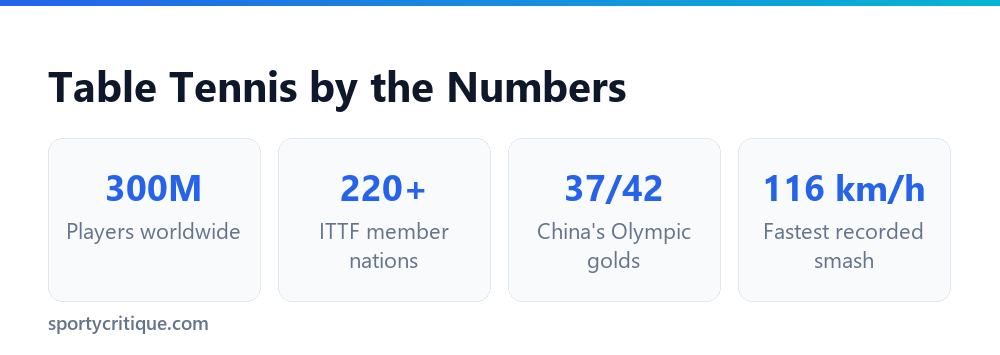
Quick Answer: An estimated 300 million people play table tennis worldwide, making it one of the most-played sports on earth. The ITTF has 220+ member associations, China has won 37 of the 42 Olympic gold medals ever awarded in the sport, and the global equipment market sits somewhere between $0.9 and $1.8 billion a year depending on whose research you read. Every figure below is sourced, dated, and flagged when it’s an estimate.
This page exists because table tennis statistics are scattered across federation PDFs, market research paywalls, and blog posts that copy each other’s numbers without checking them. We pulled the figures together, noted where sources disagree (they disagree more than you’d expect), and marked what’s a hard count versus an educated guess. It’s maintained — see the review date at the bottom — and you’re welcome to cite it.
📊 Using these figures? Please link back to this page rather than copying the table. We update numbers when federations publish new data, and a link means your readers get the current figure rather than a stale one.
Table of Contents
Participation: how many people actually play?
The headline number you’ll see everywhere is 300 million players worldwide. It’s the figure the ITTF and most sports media use, and it puts table tennis in the same conversation as basketball and volleyball for global participation. It’s also — and this matters if you’re citing it — an estimate rather than a census. Nobody counts recreational players in 220+ countries; the number is modelled from federation memberships, equipment sales, and national survey data.
Where the data is hard, it’s national. Here’s what the reliable surveys say:
| Country/Region | Participants | Basis | Source |
|---|---|---|---|
| Worldwide | ~300 million (est.) | Modelled estimate, all play levels | ITTF / widely cited |
| United States | 15–16 million | Played at least once in the year, age 6+ | SFIA annual survey |
| United States (2017 peak) | 16.04 million | Same basis — the highest recorded | Statista / SFIA |
| England (adults) | 388,700 | Played 2+ times in the last 28 days, age 16+ (Nov 2023–Nov 2024) | Sport England Active Lives |
| England (children) | ~288,000 | Any given week, school years 1–11 (≈3.9%) | Sport England Active Lives |
| China | Tens of millions (est.) | No comparable public survey; the sport is national infrastructure | — |
Two things stand out. First, US participation is remarkably stable — it has ping-ponged (sorry) between 15 and 16 million for years, neither growing nor collapsing, which is unusual for a recreational sport. Second, the England figures show why methodology matters more than the number: 388,700 adults sounds tiny next to America’s 16 million, but England counts people who played twice in the last four weeks while the US counts people who played once in the last year. They are not the same measurement, and anyone comparing them directly is producing nonsense.
⚠️ The comparison trap: you’ll see articles claiming table tennis is ‘declining in Britain’ or ‘booming in America’ by comparing these two numbers. They measure different things over different windows with different age floors. Only compare a country to its own previous years.
Why China is a different category
China’s participation isn’t really measurable the way other countries’ is, because table tennis there isn’t a hobby — it’s infrastructure. The sport is embedded in the school system, professional leagues, and a state training pipeline that has produced most of the sport’s champions for six decades. Table tennis has held official prominence in China since the 1950s, and the country’s dominance in results (below) is downstream of a talent pool no other nation approaches.
Olympic statistics and China’s dominance
Table tennis debuted at the Seoul 1988 Olympics and has appeared at every Games since. Through Paris 2024, that’s 10 Olympic tournaments before the most recent, with 909 individual players having represented their nations across the sport’s Olympic history.
Then there’s the statistic that defines the sport:
| Metric | Figure |
|---|---|
| Olympic golds awarded (all events, through Paris 2024) | 42 |
| Won by China | 37 |
| Won by everyone else combined | 5 |
| Nations other than China to win any gold | 3 — South Korea, Sweden, Japan |
| First Olympic appearance | Seoul 1988 |
| Total individual Olympians in the sport | 909 |
37 of 42. That’s an 88% gold-medal share across nearly four decades, and it may be the most lopsided national record in any Olympic sport — more dominant than the USA in basketball, more dominant than Kenya in distance running. The three nations that broke through did it in specific, memorable circumstances: Sweden through the generational talent of Jan-Ove Waldner, South Korea in the early Games and again in 2004 through Ryu Seung-min, and Japan via mixed doubles at Tokyo 2020 — a event added in part because it gave non-Chinese nations a realistic path to gold.
What this means if you’re citing it
The ’37 of 42′ figure is the single most-quoted table tennis statistic and it’s frequently mangled. Common errors: quoting it as ’32 of 37′ (an older count from before recent Games), attributing it to singles only (it’s all events), or using it to claim China has ‘never lost’ an Olympic gold (they’ve lost five). If you cite it, cite it as all-events through Paris 2024.
World Championships and professional records
The World Table Tennis Championships predate the Olympics in this sport by 62 years — the ITTF held the first in London in 1926, the same year the federation formed. The modern era is again Chinese-dominated, though European players held the sport’s center of gravity through the 1930s (Hungary above all) and again briefly in the Swedish golden generation of the late 1980s and early 90s.
Some benchmark figures from the current era, using Fan Zhendong as the reference point for what a career at the top looks like:
| Achievement | Fan Zhendong’s record |
|---|---|
| World Championship titles (all events) | 9 — including 5 team, 2 singles (2021, 2023), 2 doubles |
| World Cup singles titles | 4 |
| Olympic singles gold | 1 (Paris 2024 — completing a career Grand Slam) |
| Titles won per year since 2013 debut | At least one, every year |
For context on how hard the Grand Slam is: winning Olympic, World Championship, and World Cup singles titles has been achieved by a single-digit number of players in the sport’s history. The bar for ‘greatest of all time’ arguments in table tennis is a career like that — and in Fan’s own era, Ma Long’s résumé is arguably larger still.
Speed, spin, and physics records
Table tennis produces the most extreme rotation numbers in ball sports, and modest speed numbers that are wildly misunderstood because of the distances involved.
| Record / measure | Figure | Context |
|---|---|---|
| Fastest recorded smash | ~116 km/h (72 mph) | Sounds slow next to a 250 km/h tennis serve — but crosses a 2.74 m table in a fraction of a second |
| Maximum spin on a looped ball | 100+ revolutions per second | The highest rotation rate of any ball sport |
| Longest continuous rally (Guinness) | 11 hours 50 minutes+ | Daniel and Peter Ives (UK), 2021 |
| Ball weight | 2.7 g | Roughly the weight of half a sheet of paper |
| Ball diameter | 40 mm+ | Enlarged from 38 mm in 2000 to slow the game for television |
| Standard bounce test | ~23 cm from a 30 cm drop | The ITTF surface uniformity standard |
Why 72 mph is faster than it sounds
Reaction time is the real measure. A tennis serve at 200 km/h travels roughly 18 metres to the returner — around 400 milliseconds of flight. A table tennis smash at 116 km/h travels perhaps 2 metres from contact to your paddle: roughly 60–80 milliseconds. Human visual reaction time alone is around 200 ms. This is why elite players don’t ‘see’ the ball and react — they read the opponent’s body and paddle angle before contact and are already moving. The speed statistic is meaningless without the distance statistic, which is exactly the nuance most ‘fastest sports’ listicles drop.
The spin figure carries the same problem. 100+ revolutions per second means the ball completes a full rotation roughly every 10 milliseconds — the physics reason a heavy topspin loop dives onto the table and kicks forward off the bounce. If you want the practical side of that number, our guide to putting spin on the ball covers how it’s actually generated.

The equipment market: why the numbers don’t agree
To see how premium brand pricing breaks down across tiers, see our market analyses on Table Tennis Brands & Specialties and The Most Expensive Ping Pong Paddles.
This is where citing sources honestly matters, because published market research on table tennis equipment disagrees by a factor of two or more. Here’s the actual spread:
| Source / basis | 2025 market size | Forecast |
|---|---|---|
| IMARC Group | $905.6 million | $1,152.7 million by 2034 (2.64% CAGR) |
| Alternative industry estimate | $1.8 billion | $3.1 billion by 2034 (6.2% CAGR) |
| Asia-Pacific regional (one report) | $2.35 billion | — (exceeds another report’s global figure) |
⚠️ Read that last row again. One research firm’s Asia-Pacific regional figure ($2.35B) is larger than another firm’s entire global market ($905.6M). They cannot both be measuring the same thing. The likeliest explanation is scope: narrow definitions count blades, rubbers, balls, and tables; broad ones fold in apparel, shoes, robots, club revenue, and recreational ‘game room’ products. If you’re citing a market size, cite the firm and the year — and treat any single figure as one methodology’s answer, not the truth.
What the research does agree on: Asia-Pacific dominates (roughly a third of the global market in most estimates), driven by China’s manufacturing base and player population; growth is modest but positive; and the growth drivers are fitness awareness, organized competition, and cheap equipment getting genuinely good.
What individual players actually spend
Market totals are abstract. Per-player, the sport splits into two economies:
| Tier | Typical spend | What you get |
|---|---|---|
| Recreational | $20–60 once | Pre-made paddle, a few 1-star balls, occasional table access |
| Club player | $150–250/year | Custom blade amortized, 2–4 rubber changes, 3-star balls, club fees |
| Serious competitor | $500–1,500/year | Premium blade, frequent rubber replacement, shoes, travel |
| Professional | Thousands/year | Rubbers changed weekly or more; equipment is a consumable |
The gap between a $30 paddle and a $500 setup is real but non-linear — we break down exactly what the money buys in our guide to the most expensive ping pong paddles, and the practical middle ground in our paddle reviews.

Health and fitness data
Table tennis has a reputation as a low-effort basement game. The calorie data says otherwise once intensity rises:
| Intensity | Calories/hour | Notes |
|---|---|---|
| Casual friendly play | 200–300 | The barbecue game |
| Average across play styles | 275–400 | The commonly cited range |
| 150 lb (68 kg) player, moderate | ~280 | Bodyweight drives the number |
| 200 lb (91 kg) player, moderate | ~360 | Same effort, more mass to move |
| Competitive rallies / match play | 350–500 | Comparable to a brisk cycling session |
| High-intensity drills / multi-ball | 500+ | Robot training at pace is genuinely brutal |
The more interesting health data isn’t caloric. Table tennis is repeatedly singled out for cognitive benefit — it demands hand-eye coordination, sub-second decision-making, and continuous spatial prediction, and it’s one of the few sports where an 80-year-old and a 20-year-old can genuinely compete. That combination (low joint impact, high cognitive load, cross-generational play) is why the sport shows up in research on aging, coordination, and social health. We cover the specifics in our health benefits guide and the flip side — the injuries the sport actually causes — in the injuries guide.
Historical milestones by the numbers
| Year | Milestone |
|---|---|
| 1880s | The game emerges as an English after-dinner amusement — books for nets, cigar-box lids for paddles |
| 1901 | ‘Ping-Pong’ trademarked by J. Jaques & Son; celluloid balls introduced by James Gibb |
| 1926 | ITTF founded; first World Championships held in London |
| 1952 | Hiroji Satoh wins Worlds with a sponge-covered paddle — the sport’s biggest technical rupture |
| 1959 | Rong Guotuan wins China’s first world title |
| 1971 | Ping-pong diplomacy: US and Chinese players’ exchange helps reopen relations |
| 1988 | Olympic debut at Seoul |
| 2000 | Ball enlarged 38 mm → 40 mm |
| 2001 | Games shortened from 21 points to 11 |
| 2002 | Hidden serves banned — the ball must stay visible to the receiver |
| 2014 | Celluloid balls replaced by plastic after 113 years |
| 2024 | Fan Zhendong completes the career Grand Slam in Paris |
Two of those changed how the sport is played more than any equipment innovation since: the 11-point game made every point matter (a 21-point game let you ‘settle in’; an 11-point game punishes a slow start immediately), and the hidden-serve ban forced a generation of players to rebuild serves that had relied on concealment. The full story is in our history of table tennis.
Statistics that win bar arguments
- The sport’s name is a trademark. ‘Ping-Pong’ was owned by a games manufacturer; ‘table tennis’ exists as the official name because federations couldn’t use the trademarked one. (The full naming story.)
- There is no maximum paddle size. The rules specify the blade must be flat, rigid, and at least 85% natural wood by thickness — but no dimension limit. You could legally play with a paddle the size of a dinner plate.
- Balls were flammable until 2014. Celluloid is the same material as early film stock. The switch to plastic was a safety and supply decision as much as a sporting one.
- The USSR reportedly discouraged the sport for years over a belief it was harmful to players’ eyes — one reason Soviet table tennis never matched its other Olympic programs.
- The net is 15.25 cm high — and the table is 76 cm. The net is one-fifth the height of the table it sits on. (All official dimensions.)
- An 11-hour 50-minute rally exists. Two brothers, one ball, no winner — the Guinness record for continuous rallying, set in 2021.
- Table tennis reached the Olympics 62 years after its World Championships. The sport had a world champion in 1926 and an Olympic champion in 1988.
Methodology and sourcing
Because this page exists to be cited, here’s how it’s built:
- Federation data (ITTF, Sport England Active Lives, SFIA) is used where available and quoted with its measurement basis, because participation surveys are not comparable across countries.
- Olympic and championship records are counts, not estimates — they’re the hardest figures on this page.
- Market research figures are reported as a range with the firms named, because published estimates disagree by more than 2x and no single number is authoritative.
- The 300 million worldwide figure is an estimate, widely cited, not a census. We flag it as such every time it appears rather than laundering it into a fact.
- Speed and spin records are the best-recorded public figures; table tennis lacks the systematic radar tracking tennis and baseball enjoy, so treat them as documented instances rather than physical maximums.
📊 Last reviewed: July 2026. Figures are re-checked against federation and market publications periodically. Found a number that’s out of date, or a source we should be using? Tell us — corrections are made publicly and quickly. Our full editorial process is documented in How We Test.
The Olympic Event Programme, Event by Event
Olympic table tennis is frequently discussed as a single category, but the event programme has changed twice since the sport’s debut, and knowing the structure makes the medal statistics elsewhere on this page far easier to interpret.
- 1988 Seoul (debut): four events, men’s and women’s singles and doubles. Table tennis entered as a full medal sport rather than a demonstration event.
- 1988 to 2004: that same four-event programme ran unchanged across five Games.
- 2008 Beijing: men’s and women’s doubles were replaced by men’s and women’s team events, a change widely attributed to one nation’s near-total dominance of the doubles medals under the previous format.
- 2020 Tokyo: mixed doubles was added as a new event without removing anything, taking the programme to five events.
- 2028 Los Angeles: a mixed team event has been approved for addition.
This matters for reading medal tables because the total number of medals available per Games has changed, and because the doubles medals awarded up to 2004 are not directly comparable with the team medals awarded from 2008 onward. Any statistic comparing medal counts across eras is comparing partly different programmes.
It is also why per-Games medal totals rose at Tokyo relative to earlier Games, and will rise again in 2028. Growth in a country’s medal count across those boundaries partly reflects more events existing, not only improved performance.
Reading the Dominance Figures in Context
Any table tennis statistics page ends up quoting figures on Chinese dominance, and those numbers are accurate but frequently presented without the structural context that explains them.
Three factors are worth holding alongside the medal counts. Entry caps limit how many singles players any one country may enter regardless of how many would otherwise qualify by ranking, which means the dominance figures understate rather than overstate the depth involved. The 2008 switch from doubles to team events was itself partly a response to that dominance. And national programme investment differs enormously between countries, so the figures reflect systems as much as individual talent.
None of that diminishes the achievement. It does mean that “country X has won N of the last M golds” is a statement about sporting infrastructure and selection depth, not simply about who produced the best individual players in a given year.
How to Read Table Tennis Statistics Critically
Statistics in this sport are quoted widely and sourced inconsistently, and a few habits make the difference between using them well and repeating something that was never solid.
- Check whether participation figures count players or registered members. These differ by orders of magnitude, and headline participation numbers frequently blur the two.
- Check the date. Equipment market figures in particular are often years old by the time they circulate widely, and are quoted as current.
- Check whether speed and spin records are measured or estimated. Many widely-repeated figures originate from demonstrations rather than controlled measurement.
- Prefer governing-body sources for competition records, since they maintain the authoritative results.
The general principle is that a statistic without a traceable source and a date is an anecdote wearing a number. That applies to figures on this page as much as anywhere else, which is why the methodology section sets out where these came from and how confident each category is.
A Note on Figures Quoted Elsewhere
Table tennis statistics circulate widely and are re-quoted far more often than they are checked, which means a figure appearing on many sites is evidence of copying rather than of accuracy.
The categories most affected are participation totals, where definitions vary enormously, equipment market sizes, where projections get quoted as measurements, and physical records for ball speed and spin rate, where widely-repeated numbers frequently trace back to a single demonstration rather than systematic measurement. Competition results and Olympic records are the most reliable category, because governing bodies maintain them authoritatively.
Where this page gives a figure, the methodology section sets out where it came from and how confident it is. Where a commonly-quoted figure could not be traced to a credible source, it has been left out rather than repeated, which is why some numbers you may have seen elsewhere do not appear here.
Frequently asked questions
How many people play table tennis worldwide?
An estimated 300 million, which places it among the most-played sports globally. Treat it as a modelled estimate rather than a count — no organization surveys recreational play across 220+ member associations.
Is table tennis the most popular sport in China?
It’s the sport most identified with China and is embedded in schools and state programs, competing with basketball and football for actual popular attention. Its status is closer to ‘national sport’ than ‘most watched’ — and China’s 37 Olympic golds are the clearest evidence of the infrastructure behind it.
How fast is a table tennis smash?
The fastest recorded is around 116 km/h (72 mph). Because the ball travels roughly 2 metres, that leaves an opponent 60–80 milliseconds — less than human visual reaction time, which is why elite defense is anticipation, not reflex.
How big is the table tennis industry?
Published estimates range from about $905 million to $1.8 billion globally for 2025, depending on scope. Asia-Pacific is consistently the largest region at roughly a third of the market.
How many calories does table tennis burn?
Roughly 275–400 per hour on average — 200–300 for casual play, 350–500 for competitive rallies, and 500+ for high-intensity multi-ball drills. Bodyweight matters: a 200 lb player burns roughly 30% more than a 150 lb player at the same effort.
Can I use these statistics on my site?
Yes — please cite this page as your source with a link. We maintain the figures and note their sourcing basis, so a link keeps your readers on current numbers rather than a snapshot that ages badly.
🏓 Finding the Right Equipment in a 300+ Million Player Sport
With hundreds of millions of active players and thousands of blade/rubber pairings, picking the right setup shouldn’t require guessing. Take our 2-question selector to find your ideal racket:

Ping Pong Reviewed is an equipment review site covering table tennis and baseball gear. Specifications are checked against manufacturer listings, and prices against live retail pages, before publication.