
Ping Pong Rules 21 Points: What Changed and Why (2026)

If you are searching for ping pong rules 21 points, here is the direct answer: 21-point scoring is not the current rule, and has not been since 2001. Official table tennis is played to 11. You will find plenty of sources presenting 21 as a currently played “variant” while simultaneously asking what year it was changed, which is contradictory and leaves the actual answer unclear. It is history, and what follows is how the old format worked, why it changed, and what replaced it.
This kind of confusion is common enough that it’s worth addressing directly rather than assuming everyone already knows the current rule. Plenty of casual players learned the game from someone who grew up with 21-point scoring, and that habit gets passed down informally at family gatherings and backyard games long after the official rule changed. There’s nothing wrong with that for casual play, but it’s worth knowing which system you’re actually using and why, especially if you ever end up playing someone used to the current official rules.
Table of Contents
What the 21-Point System Actually Was
Before 2001, official table tennis games were played to 21 points, win by 2, meaning a game couldn’t end 21-20 and had to continue until one player led by 2. Serve rotated every 5 points rather than every 2 the way it does now, and matches were typically decided over a best-of-3 or best-of-5 games format depending on the level of competition, the same general match-format logic used today, just with longer individual games.
That every-5-points serve rotation is actually the detail that mattered most for how the game felt to play, more than the raw point target. Longer serve stretches meant a strong server could build real momentum across 5 straight points before an opponent got a chance to serve back, which shaped strategy differently than the current every-2-points system does. Under the current rules, momentum shifts back and forth far more rapidly, which is part of why matches feel more back-and-forth and less dominated by extended serving runs than they did under the older format.
Why and When It Actually Changed
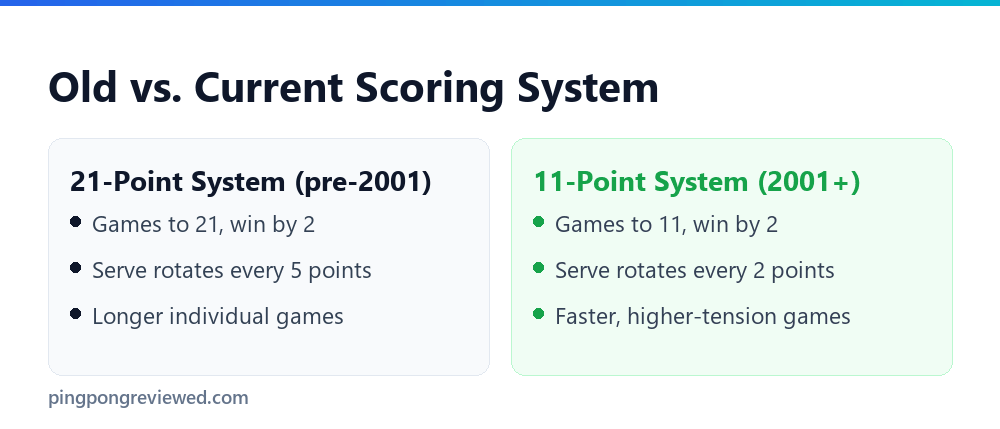
The International Table Tennis Federation switched official scoring from 21 points to 11 points on September 1, 2001, following a vote at that year’s World Championships. The stated goal was making matches faster-paced and more television-friendly — a 21-point game could run considerably longer than an 11-point one, and shorter games concentrate tension into fewer, higher-stakes points rather than spreading it across a longer game. The change happened around the same era as the ball size increasing from 38mm to 40mm, another rule change aimed partly at making the sport easier to follow for television audiences by slightly slowing down ball speed.
Both changes reflect the same underlying pressure the sport faced going into the 2000s: table tennis had struggled with television viewership internationally, partly because the ball moved fast enough on a small screen that casual viewers found it genuinely hard to follow the action, and partly because 21-point games could stretch out matches to a length that didn’t suit broadcast scheduling. Slowing the ball down slightly with the larger 40mm size and shortening games with the 11-point switch were both aimed at the same broader goal: making the sport more watchable for people who weren’t already dedicated fans, rather than changing anything about the core skills the sport rewards.
How Scoring Actually Works Now
- Games are played to 11 points, win by 2 — a game can’t end 11-10.
- Serve rotates every 2 points, not every 5 like the old system, which keeps possession changing hands more often throughout a game.
- At 10-10 (deuce), serve alternates every single point until one player establishes a 2-point lead.
- Matches are decided over a set number of games, commonly best-of-5 for most competitive play and best-of-7 at the highest levels, the same general match structure the old system used.
The switch to more frequent serve rotation also changed how much a strong serve actually matters strategically. Under the old 5-point rotation, a genuinely dominant server could lean heavily on that single skill to build a big lead before the opponent got a real chance to respond. Under the current 2-point rotation, no single skill carries a match to the same degree, which rewards more balanced, well-rounded players over serve specialists in a way the old system didn’t as strongly.
Does Anyone Still Play to 21?
Not in sanctioned competitive play, but the old 21-point format still shows up occasionally in casual or informal settings, sometimes simply because a player learned the game decades ago and never updated their habit, and sometimes as a deliberate choice for longer, more relaxed recreational games among friends who aren’t concerned with matching official rules. There’s nothing wrong with playing to 21 casually if that’s what your group prefers — it’s simply not the format used in official tournaments, clubs, or ranked play today.
If you’re joining a club for the first time after only having played casually to 21, expect a genuine adjustment period rather than assuming the switch to 11-point scoring and 2-point serve rotation is a trivial change. The faster pace of possession changes hands under the current system means you need to adapt to your opponent’s serve more quickly and more often within a single game, which some players used to longer serve stretches find genuinely disorienting the first few times they play under official rules.
How We Verified This
The 2001 rule-change date, the reasoning behind it and the current scoring mechanics were each checked against multiple independent sources. That is worth stating because a good deal of writing on this topic never clearly commits to whether 21-point scoring is current or historical, which is the single thing a reader searching for it needs to know.
This is a genuinely easy category of error to fall into with sports rules content specifically, since a rule change from years ago can keep circulating in older articles that never get corrected, especially when a topic doesn’t get refreshed often. We treat any specific date, numeric rule, or historical claim on this site the same way going forward: check it against a real source before publishing rather than assuming an older draft got it right.
Why the ITTF Actually Made the Change
The switch from 21 points to 11 in 2001 wasn’t a tweak for its own sake. It was part of a deliberate package of changes aimed at making the sport work on television, and understanding that motive explains the other rule changes that arrived around the same period.
Under 21-point scoring, a single game could run long and, worse for broadcast, run unpredictably long. Shorter games to 11 produce more games per match and more frequent decisive moments, which gives a broadcaster natural breaks and a viewer more visible tension. The serve change from five serves each to two follows the same logic: service alternates more often, so a single dominant server has less opportunity to build an unanswerable lead in one stretch.
It’s worth noting what the change did to the competitive character of the sport, since this is genuinely debated rather than settled. Shorter games compress the margin for a slow start, a player who drops the first four points in an 11-point game is in real trouble in a way they wouldn’t be at 21. That arguably rewards fast starters and increases variance, which is exactly what makes matches more watchable and, to some traditional players, less reliably reflective of who is actually stronger.
The Other Rule Changes From the Same Era
The scoring change gets remembered because it’s the most visible, but several other modernisations landed in the same broad period and are often mistakenly attributed to a single rule revision.
- Ball size: 38mm to 40mm (2000). A larger ball travels slightly slower and carries marginally less spin, lengthening rallies and making play easier to follow on camera.
- Scoring: 21 to 11, serves five to two (2001). The change this page is about.
- Service visibility rules. The server must toss the ball at least 16cm vertically from an open, flat palm, and may not hide the ball from the receiver at any point. This closed off hidden serves that were extremely difficult to read.
- Ball material: celluloid to plastic (2014). Sanctioned play moved to plastic 40+ balls, largely because celluloid’s raw materials are hazardous and increasingly restricted.
Taken together these describe a sport being deliberately restructured over about fifteen years for spectators and for manufacturing safety, not a series of unrelated adjustments. That framing makes the individual changes much easier to remember.
Where 21-Point Games Still Turn Up
The old format hasn’t vanished from casual play, and there’s nothing improper about that, house rules are house rules. Plenty of recreational players who learned before 2001 still default to 21, and some social clubs keep it deliberately because longer games suit a relaxed session better than a rapid succession of short ones.
The practical thing to establish before a casual game is simply which format you’re playing and how serve rotation works under it, since the two are linked: 21-point games traditionally use five serves each, 11-point games use two. Mixing them, playing to 21 with two-serve rotation, isn’t wrong exactly, but it’s worth agreeing rather than discovering mid-game that you each assumed something different.
If you’re practising with any intention of playing in a club or tournament, though, practise at 11. The formats reward genuinely different things, and habits built over long games transfer imperfectly to short ones.
The most transferable habit to build is treating the opening points as genuinely consequential rather than as a warm-up phase. In a 21-point game a player could feel their way into a match over the first several points and lose very little for it. At 11 that same unhurried start can put the game beyond reach before the player has settled, which is why serve and receive quality from the very first point matters far more in the modern format than in the one it replaced.
Frequently Asked Questions
Does table tennis still play to 21 points?
No, not in official or sanctioned play — that changed to 11 points in 2001. Some casual or informal games still use 21 points by preference, but it isn’t the current standard.
Why was scoring changed from 21 to 11 points?
Primarily to make matches faster-paced and more television-friendly, concentrating tension into fewer, higher-stakes points rather than spreading it across a longer game.
What year did table tennis change from 21 to 11 points?
2001, specifically effective September 1 of that year, following a formal vote at that year’s World Championships event.
Are there different rules for amateurs and professionals?
The core scoring rules, games to 11, win by 2, are the same across skill levels in genuinely sanctioned play. What varies more is match format, best-of-3 versus best-of-5 or best-of-7 games, depending on the specific competition’s own rules.
Is there a time limit in ping pong?
Not for standard scoring, but ITTF rules include an expedite system that can activate after a set time limit in a game to speed up an unusually slow, defensive match, changing serve rules temporarily rather than ending the game outright.
How does serving work under the current 11-point system?
Each player serves 2 consecutive points, then serve passes to the opponent, continuing in that pattern until 10-10, at which point serve alternates every single point until the game ends.
Was the 40mm ball change related to the scoring change?
Yes, both happened around the same era and shared a similar goal — the ball grew from 38mm to 40mm partly to slow the game down slightly for viewers, alongside the switch to 11-point scoring to shorten match length, both aimed at making the sport more watchable for a broader television audience.
Do doubles matches use the same 11-point scoring as singles?
Yes, the core scoring rules are the same for both formats under current ITTF rules — games to 11, win by 2, with serve rotation rules adjusted for the alternating-player serve order doubles requires.
Where can I find the official current table tennis rules?
The International Table Tennis Federation publishes its full official rulebook, including scoring, serve, and equipment regulations, on its own site, the most reliable source for exact current rule wording rather than a secondhand summary.
Did the 11-point change affect how players train differently?
To some degree, yes — coaches generally place more emphasis on consistency across shorter point sequences under the current system, since a single bad service game costs relatively more of an 11-point game than it would have cost of a longer 21-point one, where there was more room to recover across a longer game.
As an Amazon Associate, we earn from qualifying purchases through links on this page.

Ping Pong Reviewed is an equipment review site covering table tennis and baseball gear. Specifications are checked against manufacturer listings, and prices against live retail pages, before publication.