
Which Table Tennis Strokes to Learn First: The Coached Order
There’s a specific, sourced order coaches actually use for this, and it’s more deliberate than “just start hitting the ball.” It starts before any stroke at all, and the stroke order itself follows a psychological principle most beginners never hear explained.
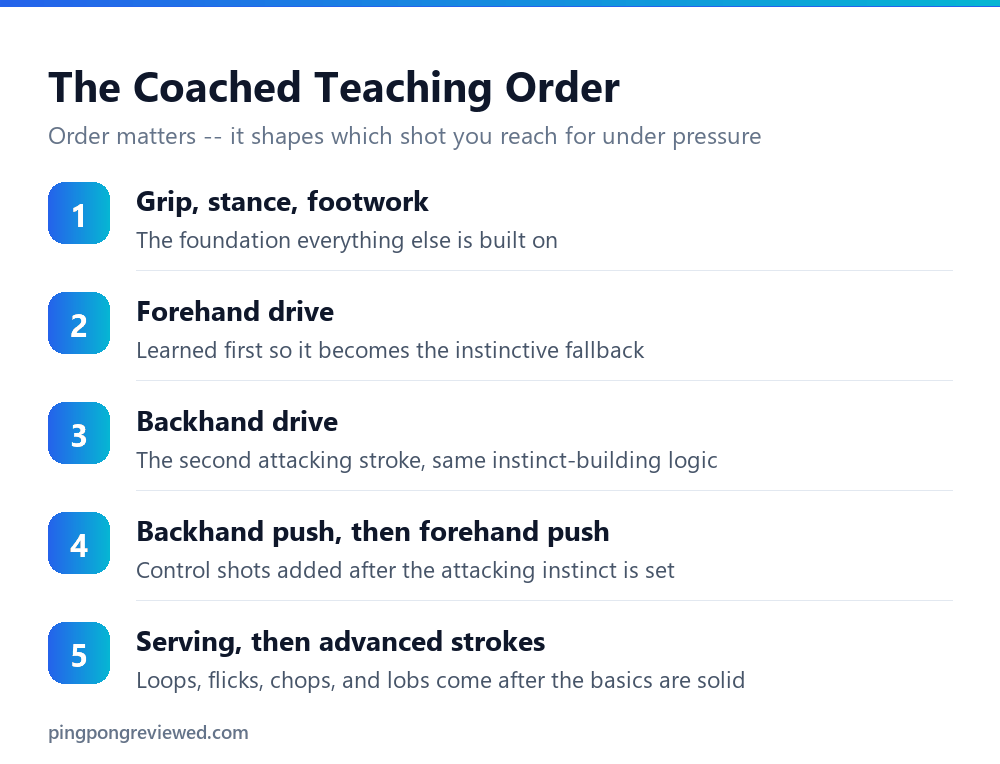
Short answer: Grip, stance, and footwork come first, before any stroke. Among the basic strokes themselves, coaching sources recommend forehand drive, then backhand drive, then backhand push, then forehand push, deliberately teaching the attacking drives before the defensive pushes, since whatever a player learns first tends to become their instinctive fallback under pressure. Footwork, serving, and more advanced strokes like the loop, flick, chop, and lob are layered in after these basics are reasonably consistent. Verified against independent coaching sources on 5 September 2026.
Table of Contents
Before Any Stroke: Grip, Stance, Footwork
Coaching sources are direct about a common mistake: skipping straight to hitting balls without first establishing grip, stance, and footwork. These aren’t strokes themselves, but they’re the physical foundation every stroke gets built on top of, and getting them wrong early creates habits that are considerably harder to unlearn later than they would have been to build correctly from the very first sessions.
This foundation stage doesn’t need to be lengthy or overly formal, but skipping it entirely in favor of jumping straight into stroke practice is exactly the shortcut coaching sources warn produces compounding problems down the line, as flawed grip or stance habits get reinforced through repetition before anyone notices they’re the actual root cause of later technical struggles.
The Stroke Order: Drive, Drive, Push, Push
Once the foundation is in place, one specific, sourced teaching sequence for the basic strokes is: forehand drive first, then backhand drive, then backhand push, and finally forehand push. That’s a deliberate ordering choice, not an arbitrary one, drives (attacking, hitting strokes) are taught before pushes (control-focused, more defensive strokes), even though a push is often considered technically simpler to execute safely.
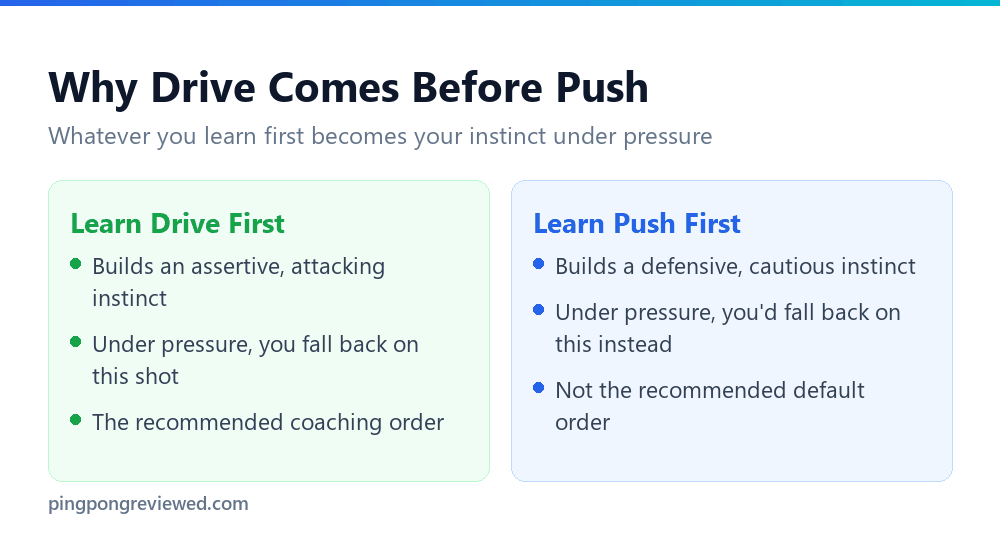
The reasoning behind this sequence is interesting: coaching sources point to a psychological principle where whatever a player learns first tends to become their instinctive fallback under real match pressure. A player who learned to drive (attack) first is more likely to stay positive and assertive when a close match gets tense, reaching instinctively for an attacking response. A player who learned to push first risks falling back on a purely defensive, passive instinct at exactly the moments that call for confidence instead.
💡 Pro tip: If you’re coaching yourself or a beginner without formal lessons, resist the common instinct to start with the push because it feels ‘safer’ or easier to control. The coached order deliberately puts the drive first for a reason that only shows up later, under pressure.
- ✓Establish grip, stance, and footwork before focusing on strokes
- ✓Learn the forehand and backhand drive before the pushes
- ✓Progress within each stroke from placement, to consistency, to accuracy
- ✓Add footwork and serving once the basic strokes feel reasonably solid
- ✕Jump straight into hitting balls without a grip/stance foundation
- ✕Learn the push first because it feels easier or ‘safer’
- ✕Try to perfect power and precise placement simultaneously from day one
- ✕Attempt loops, flicks, or chops before the basic drives and pushes are consistent
The Progression Within Each Stroke
Coaching sources also describe a specific progression within each individual stroke, rather than treating “learn the forehand drive” as a single, one-time milestone. The sequence generally runs from long, consistent placement first, to shorter placement, to general consistency across repetitions, to length variation (mixing long and short), and finally to precise accuracy and targeting. Trying to nail placement, power, and consistency all at once from the very first repetitions tends to slow overall progress compared to layering these elements in gradually.
This staged approach matters because it prevents a common frustration where a beginner tries to replicate an advanced player’s precise, varied placement immediately, without first building the basic consistency that actually makes precise placement possible to control reliably.
What Comes After the Four Basic Strokes
Once the forehand drive, backhand drive, backhand push, and forehand push all feel reasonably consistent, footwork gets layered directly into stroke practice, learning to move to the ball rather than only hitting from a fixed position. Serving follows a similar staged approach: starting with a simple flat serve to establish consistent toss mechanics and timing, then adding basic backspin or sidespin once that foundation is solid.
More advanced strokes, the topspin loop, flicks, chops, lobs, and blocks, are explicitly sequenced after the basic drives and pushes, not learned in parallel with them from the very beginning. Coaching sources are specific that getting grip, stance, and footwork solid first, combined with consistent basic drives and pushes, makes the jump to these more advanced strokes considerably easier than attempting them without that foundation.
⚠️ Watch out: Attempting to learn the loop or other advanced attacking strokes before the basic drive and push are consistent often means building the advanced stroke on top of an unstable foundation, which tends to produce technical problems that are harder to diagnose and fix later.
Why This Order Isn’t Just Tradition
It would be easy to assume a specific teaching order like this is mostly convention, passed down without much real justification. The drive-before-push sequencing specifically pushes back against that assumption directly, since it’s tied to a concrete, stated reason, the instinct a player falls back on under pressure, rather than simply reflecting which stroke happens to be easier to demonstrate first. That’s worth knowing because it means deviating from the order isn’t purely cosmetic; it can shape which instincts get built during the exact window when a player’s foundational habits are still forming.
What This Looks Like in a Real First Few Sessions
In practice, a beginner’s first session or two typically focuses almost entirely on grip and a basic ready stance, often without even a ball involved for part of that time, since getting the hand position and body posture right in isolation is easier than trying to correct it later while also tracking a moving ball. Footwork basics, like a simple side-to-side ready shuffle, often get introduced around this same early stage in a light, unforced way, well before any stroke practice begins in earnest.
Once the forehand drive is introduced, early repetitions typically happen against a slow, predictable feed, a coach or training partner delivering the ball to the same spot repeatedly, rather than in anything resembling live rally conditions. Only once that repetition builds real consistency does the practice start introducing variation: different placements, then eventually a partner mixing forehand and backhand feeds to simulate a more realistic rally.
Common Ways This Order Gets Skipped, and What Happens
The most common deviation from this sequence isn’t usually learning strokes in a wildly different order, it’s skipping the foundational grip/stance/footwork stage almost entirely and moving straight into hitting, often because it feels more immediately engaging or because a beginner is eager to start playing points rather than drilling fundamentals. Coaching sources are consistent that this shortcut tends to surface later as a ceiling on progress, a player plateaus at an intermediate level and traces the cause back to a grip or stance issue that’s now a deeply ingrained habit rather than a fresh correction.
The other common deviation is exactly the one the drive-before-push sequencing is designed to prevent: a beginner naturally gravitates toward the push first because it feels safer and more controllable when first learning to make consistent contact with the ball. That’s an understandable instinct in the moment, but it’s precisely the pattern coaching sources warn produces a more passive, defensive default under pressure later, which is harder to retrain once a player has spent months or years reinforcing it through repetition.
📊 Note: None of this means occasional deviation from the exact sequence ruins a player’s development. The point isn’t rigid adherence to a fixed script, it’s understanding why the order exists, so any deviation is a deliberate choice rather than an accidental one.
A Note for Adult Beginners
This progression applies regardless of the age at which someone starts, though adult beginners sometimes feel pressure to skip ahead to more advanced strokes quickly, especially if they’ve watched a lot of high-level play and want to replicate what they’ve seen. The foundational sequence isn’t a beginner-only formality that adults can bypass, the same reasoning about instinct formation and technical stability applies at any starting age, and rushing past it tends to produce the same downstream problems regardless of how old the player is when they start.
The Short Version, Restated
Grip, stance, and footwork first. Then forehand drive, backhand drive, backhand push, forehand push, in that specific order, because the attacking drives shape a more assertive instinct than learning the defensive pushes first would. Footwork, serving, and the more advanced strokes come after, once the basics are consistent rather than roughly approximate.
None of this needs to feel rigid or joyless, it’s simply the order that gives a beginner’s later, harder-won skills the most stable foundation to actually stick on.
The whole system, foundation through advanced strokes, is built to be self-reinforcing: each stage makes the next one easier and faster to learn, which is exactly the payoff for resisting the temptation to skip ahead.
Trust the order, even the parts of it that feel slower or less exciting in the moment. It’s built from watching what actually holds players back, not from an arbitrary sense of what a beginner curriculum should look like.
Stroke Learning Order Questions, Answered
What should a beginner learn before any stroke at all?
Grip, stance, and footwork. These form the physical foundation every stroke is built on, and skipping them creates habits that are harder to fix later.
What order should I learn the basic strokes in?
Forehand drive, then backhand drive, then backhand push, then forehand push, attacking strokes before defensive ones.
Why learn the drive before the push?
Whatever you learn first tends to become your instinctive fallback under match pressure. Learning to attack first builds a more assertive instinct than learning to push first would.
When should I start learning the loop or other advanced strokes?
After the basic forehand drive, backhand drive, backhand push, and forehand push are reasonably consistent, not in parallel with them from the beginning.
Does this learning order change for adult beginners?
No. The same reasoning about foundational habits and instinct formation applies regardless of the age at which someone starts.
Six stages, one underlying idea: build the parts that everything else depends on first, and let each stage earn the next one.
The Short Version
- →Grip, stance, and footwork come before any stroke.
- →Learn forehand drive, then backhand drive, then the two pushes.
- →Drives are taught first to build an attacking instinct under pressure.
- →Each stroke progresses from placement, to consistency, to accuracy.
- →Advanced strokes like the loop come after the basics are solid.
- →Skipping the foundation stage is the most common, costly shortcut.
Follow it in order, and the strokes that felt out of reach at the start end up feeling like the natural next step by the time you get there.

Ping Pong Reviewed is an equipment review site covering table tennis and baseball gear. Specifications are checked against manufacturer listings, and prices against live retail pages, before publication.