When to Use Backhand or Forehand in Table Tennis
The choice between backhand and forehand isn’t really about which side feels more natural or which shot you’d rather hit, coaching sources are consistent that it comes down to two concrete factors: how much time and room you have to move, and exactly where the ball is arriving relative to your body.
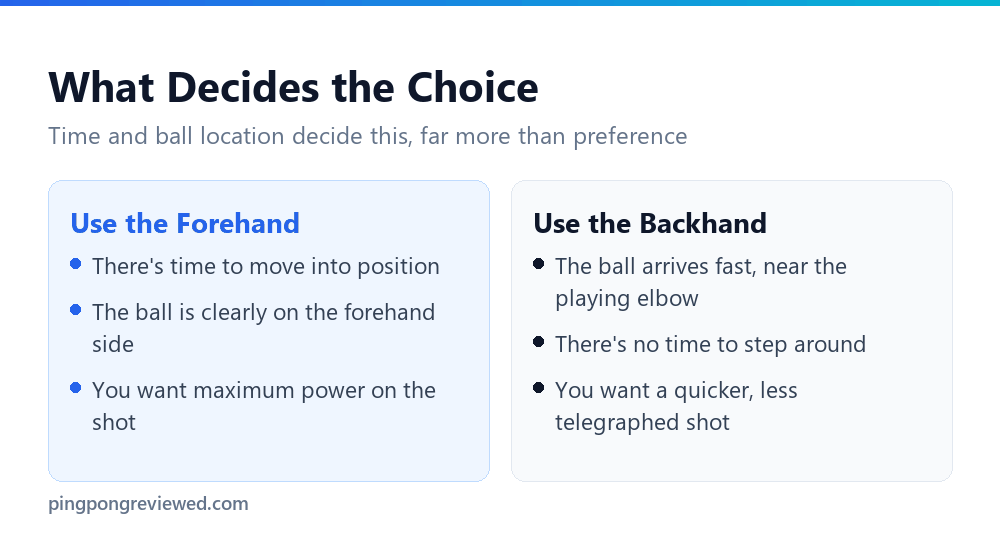
Short answer: Use the forehand when there’s time and room to move into position for it, since it generates more power through a longer stroke and bigger body rotation. Use the backhand for balls arriving quickly near the body or the “playing elbow”, the transition zone between forehand and backhand, where there isn’t time to step around. The backhand isn’t just a faster fallback either; its shorter stroke and central, opponent-facing position give it real tactical advantages of its own. Verified against independent coaching sources on 5 September 2026.
Table of Contents
The Core Rule: Time and Room
The forehand generally produces more power than the backhand, because it draws on a longer stroke and a larger rotation through the hips and shoulders. That makes it the stronger shot whenever it’s actually available, which depends on having enough time to move your feet and body into position for it. A ball with real distance and moderate pace gives a player that time, which is exactly why coaching sources default to the forehand whenever conditions allow it.
The backhand becomes the correct choice specifically when that time and room aren’t available, a fast ball arriving close to the body simply doesn’t leave enough time to step around into a forehand position without being rushed or out of balance. Using the backhand here isn’t a compromise so much as the shot the situation actually calls for.
The Playing Elbow: Where the Decision Gets Hardest
The specific zone coaching sources point to most often is the “playing elbow”, the transition area between the forehand and backhand sides of the body, roughly where the elbow sits during a ready stance. A ball aimed precisely at this zone is deliberately the hardest to answer cleanly with either shot, since it’s too close to the body for a comfortable forehand and awkwardly positioned for a backhand as well, forcing a split-second decision under real time pressure.
This is exactly why the playing elbow shows up repeatedly across different coaching contexts, not just in this backhand/forehand decision but in serve placement and rally targeting generally, it’s a difficult zone to defend well precisely because it sits at the boundary between two different shot decisions.
Why Coaches Discourage Backhanding From the Forehand Side
One piece of guidance coaching sources are specific about: don’t play a backhand shot when the ball is clearly on your forehand side with enough time to use it. Since the forehand is generally the stronger shot and there’s no time pressure forcing the backhand’s shorter stroke, choosing the backhand anyway tends to produce a weaker return than the forehand would have, for no real benefit. This isn’t a hard rule against ever backhanding a forehand-side ball, but it’s a pattern worth noticing if it’s showing up as a habit rather than a genuine tactical choice.
- ✓Default to the forehand whenever there’s time to move into it
- ✓Use the backhand for anything fast arriving near the playing elbow
- ✓Watch your elbow height during the backhand stroke for consistency
- ✓Mix in deliberate backhand attacks even when a forehand is available
- ✕Backhand a clearly forehand-side ball out of habit rather than necessity
- ✕Rush a forehand step-around when there isn’t time for it
- ✕Let your elbow drift upward noticeably during the backhand stroke
- ✕Treat the backhand purely as a fallback rather than a real weapon
The Backhand’s Real Tactical Advantages
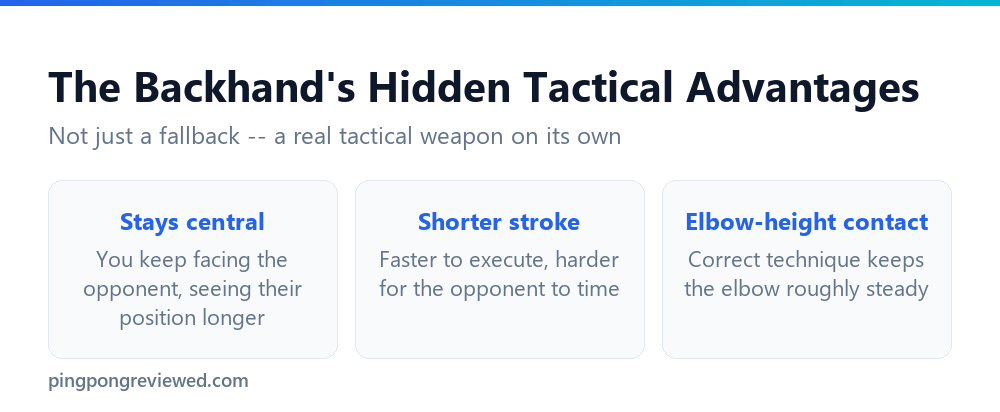
Beyond simply being faster to execute under time pressure, the backhand offers something the forehand doesn’t: because it’s played from a more central, squared-up position, a player stays facing the opponent throughout the stroke, watching their positioning and reactions right up until the shot is actually committed. That visibility supports more precise, deliberate placement, targeting the opponent’s own playing elbow, or switching to a wide open angle if the opponent has drifted out of position.
Alternating between forehand and backhand attacks also creates a genuine timing problem for an opponent independent of power or placement. The backhand’s shorter stroke changes the rhythm an opponent has to read and react to, which is exactly why some players deliberately mix in backhand attacks even from positions where a forehand would technically be available, using the backhand as an active tactical choice rather than only as a reactive necessity.
💡 Pro tip: Watch your elbow specifically during backhand practice. Correct technique keeps it at roughly the same height throughout the stroke, with contact happening in front of the body around elbow height, noticeable upward elbow movement during the shot is one of the most common backhand technical errors worth correcting early.
⚠️ Watch out: Rushing a forehand step-around when there truly isn’t time for it tends to produce a worse result than a clean, well-timed backhand would have. If you’re regularly arriving late or off-balance on forehand attempts near your body, that’s a sign to default to the backhand more often in that specific zone.
How This Changes With Footwork Quality
The time-and-room calculation isn’t fixed, it shifts directly with how good a player’s footwork actually is. A player with fast, efficient footwork can turn what would be a forced backhand for a slower-footed player into a genuine forehand opportunity, simply by covering the distance to set up in time. This is part of why footwork training is treated as foundational in most coaching progressions, it doesn’t just help players move to the ball, it directly expands how often the stronger forehand shot is actually available in the first place.
This also means the exact boundary of the playing-elbow zone, where a forehand stops being realistically available and a backhand becomes the necessary choice, isn’t identical for every player. A player with excellent footwork can push that boundary closer to their body than a player still developing their movement, which is one reason advanced players seem to use their forehand from positions that would force a backhand for a less experienced player facing the identical shot.
Modern Trends: A Stronger Backhand Than in the Past
It’s worth noting that the balance between these two shots has shifted over time at the elite level. Modern coaching and elite play generally feature a stronger, more heavily used backhand than was typical in earlier eras of the sport, with many top players developing backhand loops and attacks that rival their forehand in both power and frequency of use. That shift doesn’t overturn the core time-and-room rule, the forehand still generally out-powers the backhand when both are equally available, but it does mean the backhand is treated less as a purely defensive or reactive shot than it once was.
For a developing player, this trend is worth knowing mainly as context: investing real practice time in a strong, attacking backhand isn’t settling for a lesser shot or working around a weakness. It’s building the same tool the modern game increasingly rewards on its own terms, not merely as a stopgap for when a forehand isn’t reachable in time.
📊 Note: If you notice your own backhand feels significantly weaker than your forehand, that gap is worth addressing directly through dedicated backhand practice, rather than simply avoiding the shot and relying on footwork to manufacture forehand opportunities instead. A lopsided game is easier for opponents to exploit by targeting the weaker side deliberately.
Doubles Adds a Layer to This Same Decision
In doubles play, the backhand-versus-forehand decision gets an added layer because partners have to share table coverage and avoid colliding with each other while moving. A shot that would clearly call for a forehand step-around in singles sometimes favors a quicker backhand in doubles specifically to avoid moving into a partner’s space, even when time alone might technically allow the forehand. The core time-and-room principle still applies, but doubles adds positioning relative to a partner as a third factor alongside ball location and time available.
A Worked Example
Picture a rally where an opponent sends a moderate-pace ball wide to your forehand side, giving you a full step to set up. A forehand here is the clear, stronger choice, there’s no reason to sacrifice power for speed you don’t actually need. Now picture the same rally with a much faster ball aimed directly at your playing elbow. Attempting to step around into a forehand here risks arriving late or off-balance; a quick backhand, played from where you’re already standing, handles the same speed cleanly.
Same rally, same general skill level, two completely different correct answers, based entirely on where the ball actually arrived and how much time it gave you to respond.
The Short Version, Restated
Forehand when there’s time and room, since it generates more power. Backhand when the ball arrives fast, especially near the playing elbow, since there’s no time to step around. That’s the core rule, but it’s worth remembering the backhand isn’t purely a fallback, its central position and shorter stroke make it a genuine tactical weapon worth using deliberately, not just when forced to.
Getting this right is less about mastering either stroke in isolation and more about recognizing, in real time, which situation you’re actually in.
Whichever format you’re playing, the underlying decision stays the same at its core: read the time and the location, then let the shot that actually fits the moment win out over whichever one simply feels more comfortable.
Read the ball, read the clock, and the right shot almost always announces itself before you have to consciously choose it.
Backhand vs Forehand Questions, Answered
When should I use my forehand instead of my backhand?
Whenever there’s enough time and room to move into position for it. The forehand generally generates more power through a longer stroke and greater body rotation.
When should I use my backhand instead of my forehand?
When the ball arrives quickly near your body or playing elbow, leaving no time to step around into a forehand position.
What is the ‘playing elbow’ in table tennis?
The transition zone between the forehand and backhand sides of the body, roughly where the elbow sits in a ready stance, often the hardest area to answer cleanly with either shot.
Is it wrong to use my backhand on a clearly forehand-side ball?
Generally not recommended if there’s time to use the stronger forehand instead, since it tends to produce a weaker shot for no real benefit.
Is the backhand only useful when there’s no time for a forehand?
No. The backhand’s shorter stroke and central position offer real tactical advantages, precise placement and disrupted timing for the opponent, worth using deliberately, not only reactively.
The Short Version
- →Use the forehand whenever there’s time and room to move into it.
- →Use the backhand for fast balls near the body or playing elbow.
- →The playing elbow is the hardest zone to answer with either shot.
- →Avoid backhanding a clearly forehand-side ball out of habit.
- →The backhand’s central position and short stroke are real tactical assets.

Ping Pong Reviewed is an equipment review site covering table tennis and baseball gear. Specifications are checked against manufacturer listings, and prices against live retail pages, before publication.