Can the Ball Travel Outside the Table? Net and Edge Rules
This question actually asks two different things, and the answer depends on which one you mean. A ball can absolutely travel wide of the table on its way around the net and still be a completely legal shot. Whether it can also land outside the table’s playing surface itself is a different question, with a much stricter answer.
Short answer: Yes, the ball can travel outside the vertical space above the table on its way to the opponent’s side, going wide around the net post is a completely legal return, as long as it lands on the opponent’s court. But the ball landing outside the actual playing surface is different: the top edge of the table, including the 2 cm white sideline, counts as “in,” while the vertical side of the table does not. Verified against independent sources on 5 September 2026.
Table of Contents
Two Questions Hiding in One
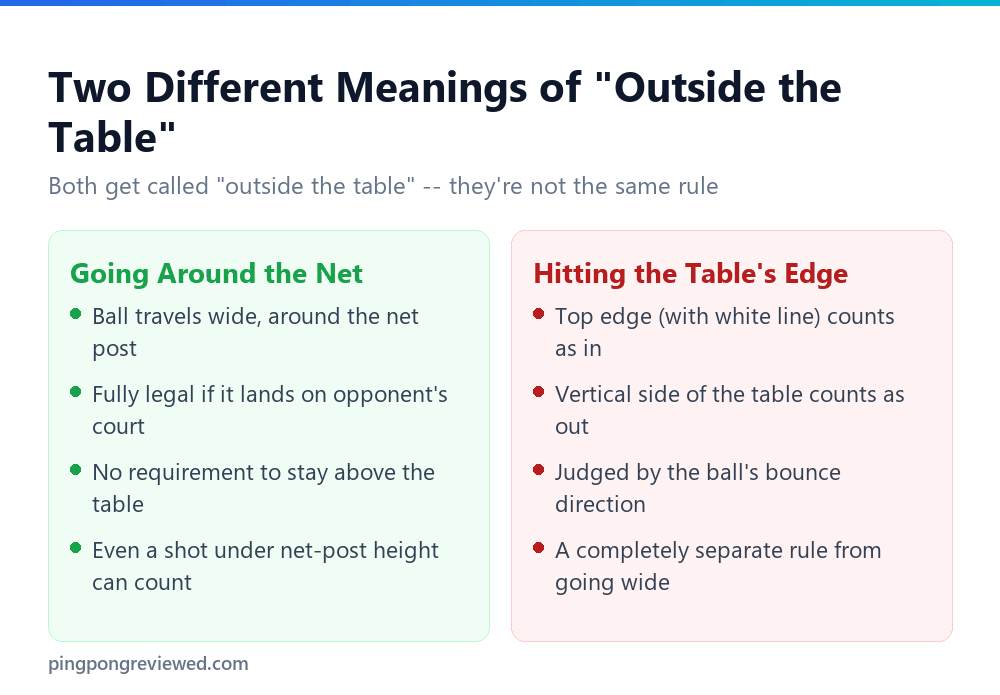
“Can the ball travel outside the table” gets asked by two different kinds of players for two different reasons. One group is asking whether a shot has to stay directly above the table’s footprint on its way over the net. The other is asking about a ball that clips the corner or edge of the table itself and wants to know if that counts as in or out. Both are legitimate readings of the same phrase, and both deserve a real answer.
Going Wide of the Net: Fully Legal
A legal return only requires the ball to touch the opponent’s court, either directly or after touching the net assembly, once it leaves the striker’s side. Nothing in that requirement says the ball has to travel in the vertical space directly above the table’s surface on its way there. A shot that curves wide, passes outside the line of the net post entirely, and still comes back down onto the opponent’s court is a completely legal return.
This is most visible on extreme sidespin shots or a ball played from well off the side of the table, where a skilled player can send the ball around the net post rather than over the net itself. It looks unusual, and it’s rare outside of high-level play or trick-shot demonstrations, but there’s no rule against it, the ball simply has to end up bouncing on the opponent’s side, however it gets there.
💡 Pro tip: This is sometimes called an “around the net” shot. It’s legal at every level of play, including sanctioned tournaments, not just casual games, there’s no separate competition-level restriction on it.
Hitting the Table’s Own Edge: A Different Rule
The other version of this question is about the ball striking the physical table itself, at the boundary of the playing surface, rather than about the vertical space above it. Here the rule is specific: the playing surface includes the top of the table and the 2 cm white line painted along the sides and ends. A ball that clips that top edge and continues in play is legal, what’s known as an edge ball.
The vertical sides of the table, the part running straight down from the edge, not the top surface itself, are explicitly not part of the playing surface. A ball that strikes the vertical side rather than the top edge is out, not a legal return, regardless of how close the contact point was to the corner.
Telling the Two Apart in Real Time
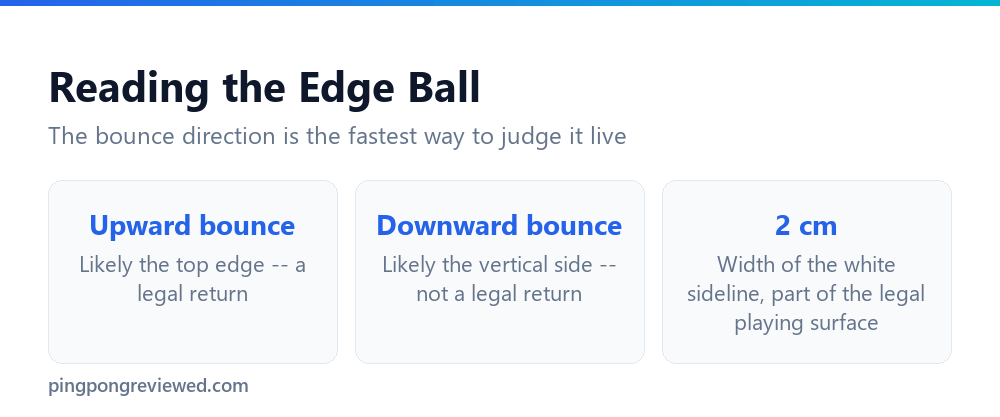
Umpires and players use the ball’s bounce direction as the practical way to judge which of the two actually happened, since the contact itself often happens too fast to see clearly. A ball that continues on an upward-ish trajectory after the contact almost certainly clipped the top edge, which is legal. A ball that deflects sharply downward instead almost certainly struck the vertical side, which is not.
That’s a practical heuristic rather than a rule written into the laws themselves, but it’s the standard way this gets called at every level of play, from club matches with no umpire up through officiated tournaments, because it maps reliably onto the physical geometry of where the ball actually made contact.
⚠️ Watch out: An edge ball ruling is often disputed in casual play precisely because the contact happens so fast. If there’s genuine doubt and no umpire available, the standard etiquette is to replay the point rather than contest it.
Why the Around-the-Net Rule Exists
It would be simple to write the rules so that every legal shot had to pass directly over the net, in the space between the two posts. The sport doesn’t do that, and the reason comes down to what the net is actually for: a barrier the ball has to clear or route around on its way to the opponent’s court, not a strict channel the shot has to travel through.
Defining a legal return by where it lands, rather than by the exact path it takes to get there, keeps the rule simple and avoids a whole category of disputes about whether a shot that curved slightly wide of the post still “counts” as going over the net. It either lands in, or it doesn’t, the path in between isn’t regulated.
Why the Edge Rule Is Stricter
The edge-ball rule works differently because it’s not about the ball’s flight path at all, it’s about defining exactly which physical surface counts as the table for scoring purposes. That has to be precise, because the table is a fixed object with a hard physical boundary, unlike the open space above and around the net. Drawing the line at the top surface, including the painted sideline, while excluding the vertical sides, gives officials and players a single, consistent physical feature to judge rather than an approximate zone.
That precision is also exactly why edge balls generate more disputes in casual play than around-the-net shots do, the ruling depends on a specific millimeter of contact that’s often too fast to see clearly, where the around-the-net question is usually obvious just from where the ball ultimately bounces.
Does This Rule Apply the Same Way on a Serve?
Both rules apply the same way regardless of whether the shot in question is a serve or a rally return, with one added requirement specific to serves: the ball must first bounce on the server’s own side of the table before crossing over. Once it has, everything covered above applies identically, a serve that travels wide around the net post is just as legal as a rally shot doing the same, and a serve that clips the top edge on either bounce is judged by the same edge-ball standard.
The one place this gets slightly more attention on a serve is the first bounce, on the server’s own side, since that’s an additional required contact that doesn’t exist on a rally return. If that first bounce clips the server’s own edge rather than landing cleanly on the surface, the same top-edge-versus-vertical-side distinction applies there too, before the ball has even reached the net.
Common Situations Where This Comes Up
The around-the-net shot shows up most often in two situations: a defensive player forced well off the side of the table by a wide attacking shot, returning the ball from an angle where going around the post is actually easier than lifting it back over the net, and an aggressive sidespin serve or attacking shot deliberately aimed to curve around the post as a trick or surprise tactic. Both are legal, and both are more common at higher levels of play where players have the racket control to place a shot that precisely.
Edge balls, by contrast, are almost entirely a matter of luck rather than intent. Nobody aims for the edge of the table on purpose with any reliability, when it happens, it’s typically a shot that was already headed close to the boundary and caught the table’s edge rather than clearing it cleanly or missing entirely. That’s part of why edge balls carry a reputation as a frustrating, lucky point for whoever benefits from one.
📊 Note: Neither rule changes in doubles. The around-the-net allowance and the top-edge/vertical-side distinction both apply exactly the same way regardless of how many players are on court.
That’s the full picture: a rule about flight path that’s permissive, and a rule about a physical boundary that’s strict, sitting side by side under a question that sounds like it should have one simple answer but actually needs both.
The Short Version, Restated
The ball is allowed to travel outside the vertical space directly above the table on its way to a legal return, going wide around the net post costs nothing as long as the shot lands in. What isn’t flexible is the table’s own physical boundary: the top edge and white sideline count as in, the vertical side does not, and that’s judged by the bounce, not by intent or how close the contact was to the corner.
Two rules, two different kinds of “outside,” and once they’re kept separate, neither one is actually complicated on its own.
None of this needs to be memorized as a long list of exceptions either. Ask which of the two questions actually applies: is this about the ball’s path around the net, or about which part of the physical table it landed on. Each has exactly one rule attached to it, and neither rule bends based on how the shot was played or how much it was intended.
Table Boundary Questions, Answered
Can the ball go around the net post and still be legal?
Yes. A return only needs to land on the opponent’s court. There’s no requirement for the ball to travel directly above the table or between the net posts to get there.
What is an edge ball in table tennis?
A ball that clips the top edge of the table, including the 2 cm white sideline, and continues in play. It’s a legal return, identified by the ball deflecting in an upward-ish direction.
Is hitting the side of the table a legal return?
No. The vertical side of the table is not part of the playing surface. A ball that strikes it, rather than the top edge, is out.
How do you tell an edge ball from a side hit?
By the bounce direction. An upward deflection usually means the top edge (legal). A sharp downward deflection usually means the vertical side (not legal).
Does the around-the-net rule apply in tournaments too?
Yes. It’s a standard rule at every level of play, not a casual-play exception, a legal return around the net post is fully valid in sanctioned competition.
The Short Version
- →Going around the net post is a legal return if the ball lands in.
- →There’s no rule requiring the ball to stay above the table’s footprint.
- →The top edge and white sideline count as part of the playing surface.
- →The vertical side of the table does not count as in.
- →Bounce direction is the practical way to judge an edge ball live.

Ping Pong Reviewed is an equipment review site covering table tennis and baseball gear. Specifications are checked against manufacturer listings, and prices against live retail pages, before publication.